

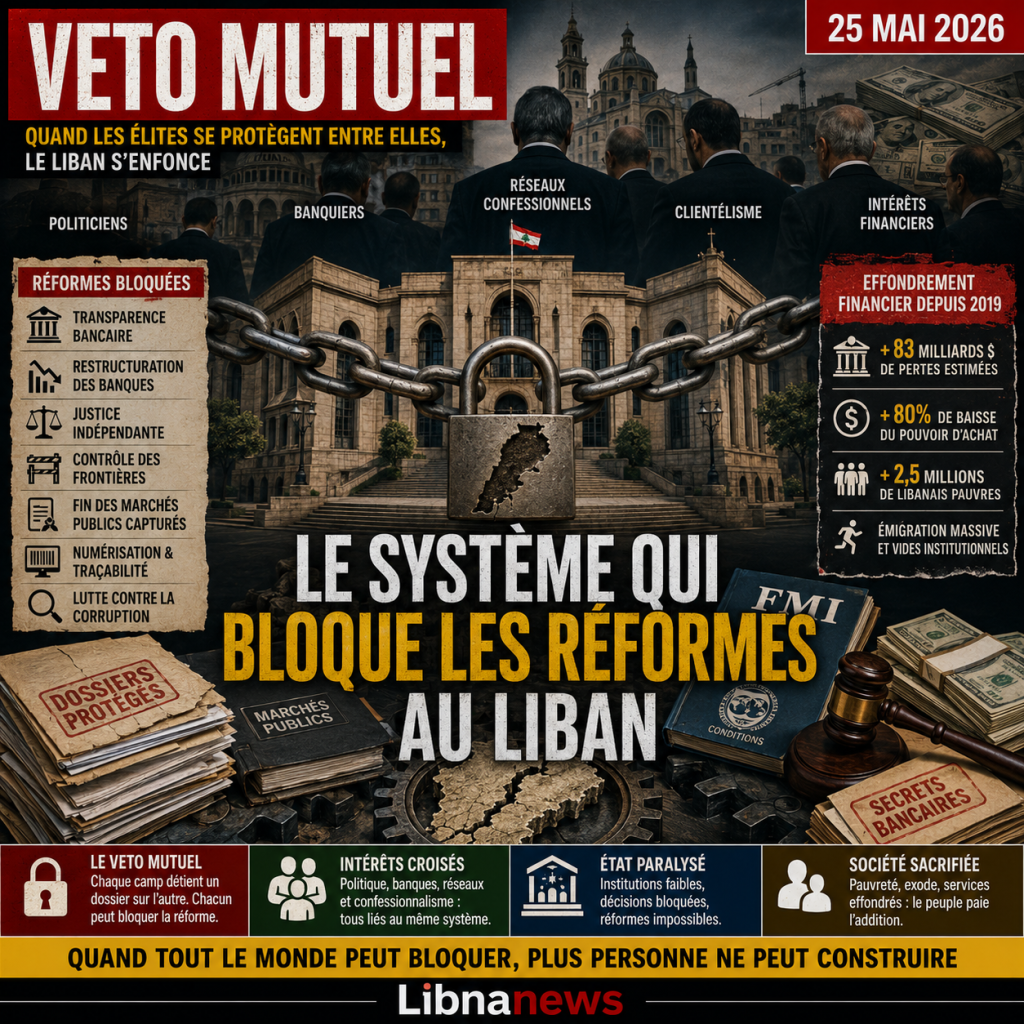
Political, institutional and financial analysis of reform paralysis in Lebanon
Since the financial collapse of 2019, an idea is constantly returning to the Lebanese debate: « Who blocks the reforms? For some, the person in charge is obvious. For others, it has a specific name, party or confession. Yet, the more the years pass, the more a reality arises: Lebanon’s problem far exceeds a man, a movement or a political camp.
The real Lebanese lock is systemic.
Lebanon does not function as a classical state where a majority governs and an opposition contests. It functions as a system of denominational balances, networks of interests and cross-protections where each component has an implicit veto power over others. And it is precisely this mechanism that ultimately prevents any profound reform.
Since the end of the civil war and the Taif agreements, the country has gradually evolved into a power-sharing architecture where each community, party and economic network has built its own sphere of influence within the state. Ministries have become areas of influence. The administrations of the bastions. Public procurement in political financing territories. Administrative appointments of instruments of religious balance.
In this system, no one really wants to destroy the other, because everyone owns a part of the system to be protected.
This is where Lebanon’s singularity lies: political adversaries publicly confront each other while depending on the survival of the same mechanism. Behind violent discourse and media tensions, there is often implicit solidarity between elites when it comes to avoiding reform that could threaten the entire structure.
The financial collapse of 2019 revealed this reality brutally.
When the banking system collapsed, the fundamental question immediately became explosive: who will pay the losses? State? Banks? The depositors? The Bank of Lebanon? Behind this technical question was in reality an existential war between the various components of the system. For any transparency could reveal decades of collusion between political power, commercial banks, clientelism and massive debt.
Very quickly, each camp began to defend its own survival:
– banks seeking to limit their losses;
– politicians who refuse to assume their responsibilities;
– some large depositors trying to protect their capital;
– denominational networks fearing a loss of control over their resources;
– and part of the state apparatus refusing full opening of financial files.
It is in this context that the reforms requested by the IMF have become almost impossible to implement fully.
Reforms are not simply economic. They directly affect the core of the Lebanese system of power:
– really lift bank secrecy;
– restructuring banks;
– make justice independent;
– modernise customs;
– control the borders;
– to impose transparency in public procurement;
– digitize financial flows;
– limit conflicts of interest between politics and finance.
In other words, rebuilding a modern state.
But rebuilding a modern state means reducing the informal space on which power balances have been based for decades.
The Lebanese tragedy is, therefore, that those who should vote for the reforms are often those that these reforms threaten directly.
The system then becomes a gigantic mechanism of mutual veto. Each group has files on the other. Each actor knows the fragility of his opponent. Everyone can block a reform today for fear that another reform will hit him tomorrow.
The result is organized paralysis.
Even geopolitical tensions are part of this logic. The issue of Hezbollah’s weapons illustrates this complexity perfectly. For part of the Lebanese and the international community, the existence of an autonomous armed force prevents the full sovereignty of the State. But for others, this force is on the contrary a strategic guarantee against regional threats. Again, any attempt at change threatens an overall balance that goes far beyond the simple Lebanese framework.
This mechanism explains why the crises in Lebanon extend far beyond economic rationality. In a traditional state, the collapse of the currency, the disappearance of bank deposits and the explosion of poverty would have led to a rapid overhaul of the system. In Lebanon, the system often prefers to survive in collapse rather than risk an unpredictable redistribution of power.
The paradox is terrible: the Lebanese political elite is sometimes too divided to govern, but united enough to prevent reforms that could threaten its collective survival.
And yet, despite this dark reality, Lebanon retains a rare singularity in the region: a still alive civil society, a pluralistic press, a powerful diaspora, institutions that, although weakened, have not completely disappeared, as well as a political culture where debate remains possible.
The real challenge in the coming years will therefore be less to replace a few political figures than to know whether Lebanon can finally emerge from this logic of reciprocal protection of elites in order to enter into a logic of state.
For as long as every reform is perceived as an existential threat by a component of the system, the country will remain a prisoner of its crossover vetos.
And in a country where everyone can block, no one can actually build.
Yet history shows that no system based solely on rent, clientelism and fear balances can survive indefinitely. Sooner or later, either the state is re-established or society is further fragmented until it loses national coherence.
Lebanon is now at this historic crossroads.
The real question is no longer only: « Who destroyed the country? The real question becomes: « How can we rebuild a state without causing the explosion of the entire system? »
Lebanon will probably not be able to emerge from the crisis through a sudden revolution or a providential man. The religious structure, regional influences and economic interests are too intertwined. The exit will necessarily be gradual, imperfect and negotiated.
But certain conditions now seem indispensable.
The first is the gradual reconstruction of the state idea.
For decades, a large part of Lebanese people have not really lived through the state, but through their community networks: political party, local zaïm, bank, NGO, family diaspora, foreign aid, religious structures or sometimes armed groups.
When the state disappears, the community becomes the natural refuge. But when each community becomes a mini-state, the country gradually ceases to exist as a coherent nation.
Lebanon will therefore have to re-create a minimum of collective trust around common institutions: justice, army, administration, taxation, banking regulation, social security and infrastructure.
Without this, no lasting recovery is possible.
The second condition is the gradual separation between politics and finance.
One of the major Lebanese tragedies was the incest between political power, banking system, central bank, public debt and rent economy.
For years, the state borrowed to artificially maintain monetary stability, banks bought public debt at high rates, politicians protected the system, and everyone enjoyed illusion as long as foreign capital continued to enter.
This model looked less like a productive economy than a gigantic permanent refinancing machine.
Reconstruction will therefore require:
– real banking transparency;
– strict rules on conflicts of interest;
– effective independence of the supervisory authorities;
– and a reduction of oligarchic power over the economy.
The third condition concerns sovereignty.
No State can operate sustainably with several competing strategic decision centres. The issue is far beyond Hezbollah alone. It affects Lebanese history itself more deeply.
For decades, almost all Lebanese communities have maintained forms of external support: some towards the West, others towards the Arab world, others towards Iran, sometimes towards several powers simultaneously.
Lebanon has become a geopolitical intersection space more than a fully autonomous state.
The country’s survival will probably require a pragmatic, difficult but indispensable form of neutrality: a balance where no component seeks to transform Lebanon into a regional platform serving an external axis.
This implies a new national pact.
No longer a pact based solely on the religious division of power, but on a few simple principles:
– progressive state monopoly on regal functions;
– independence of justice;
– protection of freedoms;
– relative external neutrality;
– serious administrative decentralization;
– and progressive equality before the institutions.
The fourth condition is psychological and cultural.
Lebanon also suffers from a profound collective trauma: civil war, occupation, assassinations, financial collapse, explosion of the port, massive emigration and loss of the economies of an entire generation.
In a traumatized society, everyone instinctively seeks the immediate protection of their group. It’s human. But a country cannot rebuild itself only on fear.
Reconstruction will therefore require a new elite:
– less based on clientelism;
– more about competence;
– able to think the state before the community;
– and above all able to tell a long avoided truth: no confession can save Lebanon alone.
For perhaps the ultimate paradox of Lebanon is this: all communities fear being dominated by others. But by neutralizing each other, they eventually weakened the state that protected everyone.
Lebanon will probably not be reborn by the total victory of a camp, by the elimination of a community, or by external domination.
He may be reborn on the day his elites finally realize that preserving their areas of influence forever means destroying the country itself.
And on that day, reform will no longer be seen as a threat. It will become a matter of national survival.




