

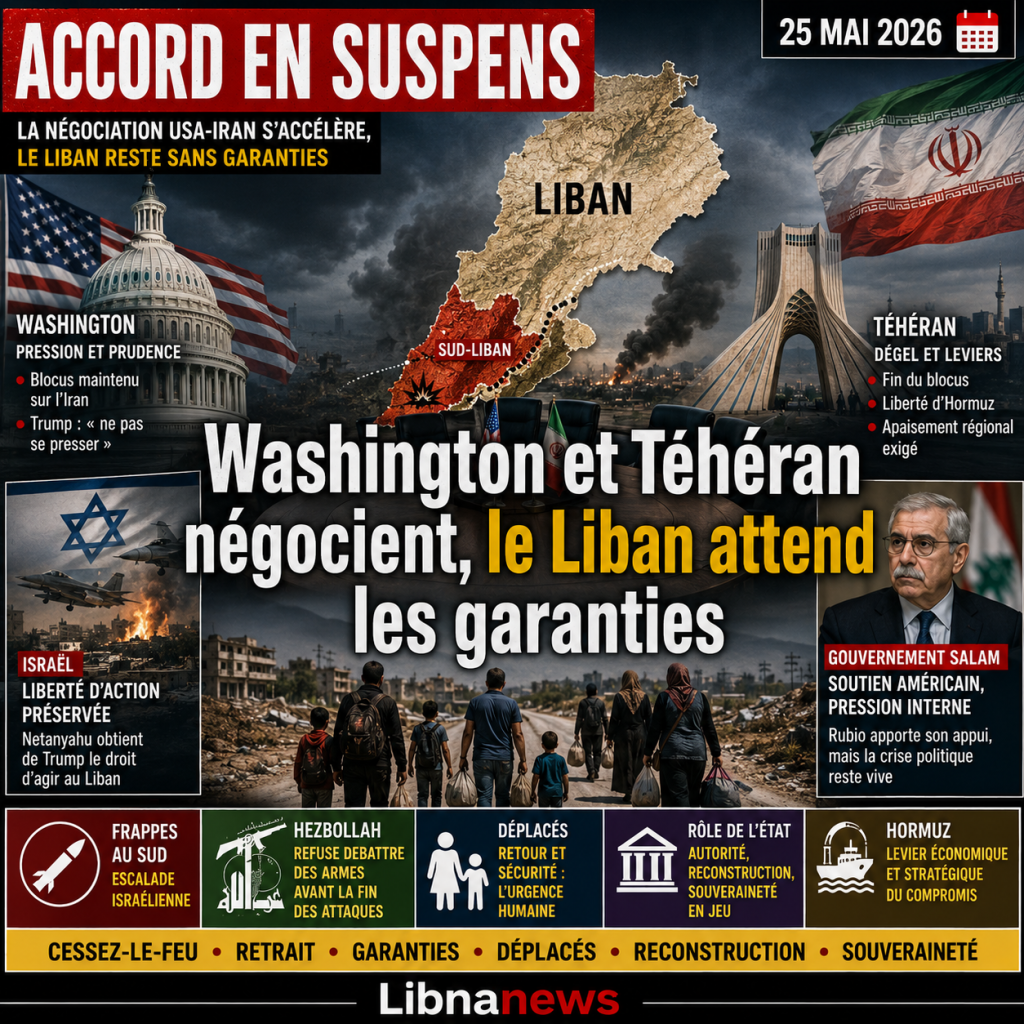
Lebanon follows the Washington-Tehran agreement as a matter of direct concern, without any clear guarantees yet. Discussions between the United States and Iran are advancing in a context of Israeli strikes in the South, internal political threats and US pressure on the Lebanese government. In Beirut, the stakes go beyond the only ceasefire. It affects the role of the State, Hezbollah’s weapons, the return of internally displaced persons and the country’s ability not to become an adjustment variable in regional negotiations.
Washington-Tehran agreement: a Lebanese wait under tension
The day of May 25 has set up a climate of change. The leaks of an American-Iranian compromise referred to a cessation of hostilities on several fronts, a gradual reopening of the Darmuz Strait and a postponement of the most sensitive issues, including Iranian nuclear power. But this architecture remains uncertain. Washington is moving cautiously. Tehran wants an end to the blockade and a regional appeasement. Israel, for its part, refuses to lose its freedom of action in Lebanon. This divergence places Beirut in a dangerous area: the country can be included in the texts, but remain exposed to strikes.
US President Donald Trump set the tone by asking his representatives not to rush. It maintained the US blockade on Iranian ports and ships until an agreement was signed and formally adopted. This choice reflects a method of pressure. The US wants to keep a lever on Iran until the last moment. The Darmuz Strait thus becomes the economic and strategic key to a still fragile compromise. Iranians want the return to freedom of movement and the resumption of their oil sales. The Americans are looking for guarantees, but without displaying a concession that is too visible.
This American prudence feeds a first uncertainty for Lebanon. While the agreement is limited to regional de-escalation, it does not necessarily address the southern front issue. Several available information indicates that Tehran wishes to include the cessation of hostilities in Lebanon in any compromise. This demand meets a clear political objective: to show that Iran does not dissociate its regional allies from its negotiations with Washington. But Israel is trying to block this link. For Tel Aviv, the agreement with Iran should not become an automatic constraint on its operations against Hezbollah.
Israel seeks to preserve its freedom of action
Israeli Prime Minister Benjamin Netanyahu sought to reassure his opinion and his internal allies. He claimed that Donald Trump had recognized Israel’s right to defend itself on all fronts, including in Lebanon. This sentence weighs heavily. It means that even a regional agreement would not be sufficient to ensure that strikes in the South are stopped. It also allows Israel to present any military action as a response to a threat, even if a broader ceasefire is in place. The risk for Beirut would be a regional truce with a Lebanese exception.
The ground confirms this concern. Israeli strikes intensified in the South and in the West Bekaa, as diplomatic discussions seemed to be advancing. This calendar is not neutral. He intervened prior to the security meeting scheduled for 29 May in Washington, D.C., between Lebanese, American and Israeli representatives. Israel thus seeks to impose facts before the technical table. The bombings create a balance of power, move the lines, weigh on the villages and increase pressure on the Lebanese state. In this type of sequence, the fire is used as much to strike as to negotiate.
In Beirut, the meeting of the Pentagon is seen as a necessary passage, but also as a possible trap. The Lebanese Government wants a real halt to Israeli violations, a withdrawal from occupied positions, the release of prisoners and the return of the inhabitants. But Washington also wants to address the restoration of state authority and the issue of weapons. This joint makes the folder explosive. For the Lebanese executive, it is necessary to speak of security without accepting that sovereignty be reduced to a list of American or Israeli demands. For Hezbollah, any discussion of his weapons is equivalent to an attempt to change the results of the war.
Salam government facing US support
Nawaf Salam is therefore in a narrow position. The Prime Minister enjoys public support, but this support also exposes him to accusations of alignment. Washington insists on the need to restore state authority, prepare for reconstruction and obtain international assistance. These objectives correspond to real needs. Lebanon must rebuild villages, secure the return of internally displaced persons and reopen a diplomatic path. But the more American support becomes visible, the more politically expensive it becomes inside. The government must prove that it is acting for Lebanon, not as a relay of a regional order decided elsewhere.
Marco Rubio’s reaction illustrates this hardening. The US Secretary of State condemned Hezbollah’s call to bring down the government and assured that Washington supported the Lebanese executive. The message targets two audiences. He talks first to Lebanese institutions, telling them that they are not alone. He then speaks to Hezbollah, presenting any threat to the government as an attempt to plunge the country back into chaos. This response reinforces Nawaf Salam on the international stage. But it also worsens the verbal confrontation with the party, which refuses to see the case of arms under foreign guardianship.
Naim Kassem fixed the Hezbollah line with great sharpness. The party’s secretary-general said that any debate on weapons should come after the Israeli attacks had stopped, the complete withdrawal, the release of prisoners and the return of the inhabitants. He also felt that the people had the right to go down the street against a project aimed at the party’s institutions. This statement moves the debate. This is no longer just a security negotiation in the South. This is a confrontation around legitimacy: who decides the timetable, who defines sovereignty, who speaks in the name of national defence?
Hezbollah’s weapons at the heart of the blockade
The Hezbollah formula contains a political logic. The party wants to link its weapons to a threat still present. As long as Israel strikes, occupies positions and maintains a military margin, it presents its arsenal as protection. This argument is echoed in the war-affected areas, where the people are waiting for the end of the attacks and the return to the villages. But there is another demand, made by a part of the State and the international community: no lasting reconstruction can be built if the monopoly of military decision remains contested. The country therefore moves between two incompatible emergencies.
President Joseph Aoun must deal with this contradiction. The Presidency wants to preserve a line of state, avoid Lebanon being treated as an Iranian map, and obtain concrete guarantees against Israeli violations. This position requires fine diplomacy. It can only succeed if the state achieves visible results. An Israeli withdrawal, a measurable reduction in strikes, a clear path for the return of internally displaced persons and reconstruction assistance would give weight to public authority. Conversely, a blurred agreement, with no effect in the South, would weaken the State’s discourse and strengthen those who say that only force imposes limits on Israel.
Nabih Berri sums up this prudence with a simple idea: the essential is in execution. This formula reflects a repeated Lebanese experience. The texts are not enough. The ads don’t protect the villages. Commitments are only valid if they result in withdrawals, controls, monitoring mechanisms and sanctions for violations. The Speaker of the Chamber thus retains a watchful role. He does not reject the idea of compromise, but refuses to judge it before its effects. This attitude also allows it to maintain a space between the government, Hezbollah and mediation channels.
Reconstruction, displacement and economic effects
The question of reconstruction adds a layer of tension. If the American-Iranian agreement opens a détente, Lebanon will soon have to move from the ceasefire to the construction sites. The destruction in the villages of the South, the cut roads, the damaged houses and the displaced families impose concrete decisions. But reconstruction is still political. Who finances? Who controls? Who distributes? Who sets priorities? Iran may want to show its support for areas close to Hezbollah. Western donors can condition their support for reforms and state authority. The government will have to avoid reconstruction becoming a new battle of guardianship.
The economic front also weighs on the diplomatic decision. Hormuz is not an abstraction for the Lebanese. The country imports most of its fuel, medicines, part of its food and many basic goods. A prolonged crisis on maritime routes increases freight, insurance, energy and internal prices. Even if the U.S.-Iranian agreement did not speak directly about Lebanon, its effects would be found in gas stations, pharmacies and ports. A partial return to freedom of navigation would reduce some tensions. It would not be enough to resolve the Lebanese economic crisis, but would limit an additional shock.
The human dimension makes this equation more pressing. In southern villages, displaced families do not live the crisis as a strategic discussion. They live it as a daily expectation. Homes remain inaccessible, fields cannot always be cultivated, schools and local services operate unevenly. The inhabitants heard about a regional agreement, but most of all asked whether the roads would reopen, whether the drones would stop flying over their neighbourhoods and whether the rescue teams could travel without being targeted. This distance between the language of diplomacy and real life fuels distrust towards all actors.
It also weighs on the Lebanese army. An increased military presence in the South can only produce stability if military conditions permit. Deploying soldiers in an area that has yet to be hit is not enough to restore state authority. There is a need for well-known rules, verifiable coordination, logistics, a strong political chain and international support that goes beyond declarations. The debate on Hezbollah’s weapons cannot therefore be separated from the concrete capacity of the State to protect civilians and enforce its borders.
Test of the silence of weapons
The major risk remains that of a multi-reading agreement. The United States could see this as a useful de-escalation before its political deadlines. Iran could present it as a resistance victory after maintaining its regional maps. Israel could accept it while retaining a right of intervention in Lebanon. Hezbollah could welcome the inclusion of the southern front while refusing any restraint on its weapons. The Lebanese government could look for space to restore its role. Everyone could therefore claim the same text, while preparing opposite interpretations. This ambiguity feeds crises more than it closes them.
For Lebanon, the Washington-Tehran agreement will only be useful if it produces verifiable effects. The people of the South do not expect a diplomatic formula, but a return without threat. The Lebanese army cannot deploy effectively if the strikes continue and the rules of engagement remain opaque. The government cannot defend state authority if the state seems unable to protect its citizens. Hezbollah will not give up its defence logic as long as Israel retains positions and an ability to act. The node is therefore practical before being theoretical: we must create conditions that make politics possible.
The sequence of the next few days will tell if diplomacy can come out of ambiguity. The Washington meeting should clarify the status of the ceasefire, the guarantees of withdrawal, the role of the Lebanese army, the monitoring mechanisms and the response to violations. It must also avoid appearing as a negotiation on Lebanon without the Lebanese. The country has already paid the price for poorly implemented external arrangements. This time again, he is on the verge of a compromise that can calm the region, but also leave the South in a slow war. The first test will not be the signature of a text, but the real silence of weapons.




