

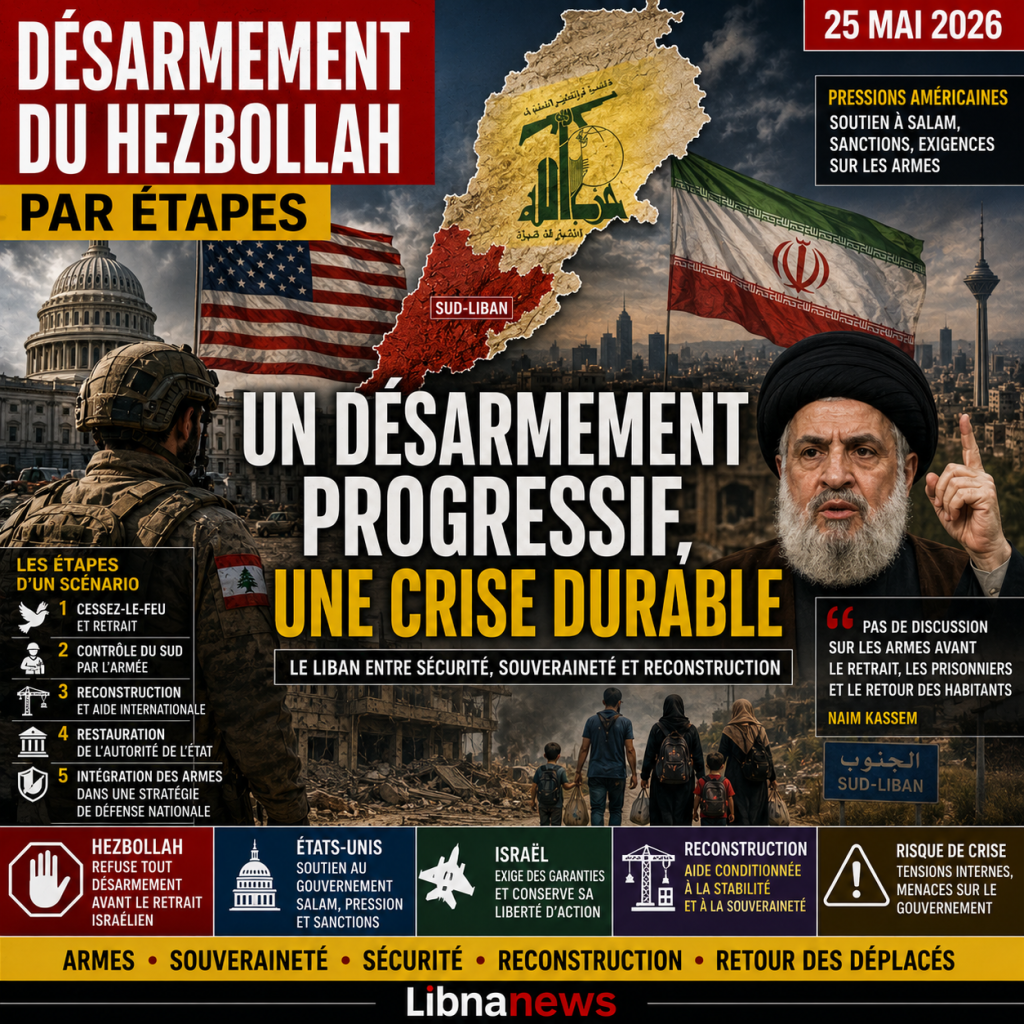
The disarmament of Hezbollah returns to the centre of the Lebanese crisis, not as an immediate decision, but as a progressive scenario. American pressure, Israeli demands and regional discussions with Iran are developing a tiered approach. It would go through the ceasefire, the control of the South, the reconstruction and restoration of State authority. For Hezbollah, this sequence resembles an attempt to reduce its military role without direct confrontation.
Hezbollah’s disarmament progresses in stages
The debate on Hezbollah’s weapons does not advance by brutal announcement. It settles in fragments, in the words of diplomacy and in technical mechanisms. American officials speak of state authority. Israel is talking about guarantees against rearmament. The Lebanese government speaks of the sovereignty, withdrawal and return of the inhabitants. Hezbollah speaks of defence, threat and resistance. Each camp uses a different vocabulary, but all discuss the same issue: who will control the military decision in Lebanon after the war.
This step-by-step approach can be more effective than a frontal injunction. It does not first ask Hezbollah to lay down its arms. It creates an environment where its weapons become the main obstacle to reconstruction, international aid, stabilization of the South and the return of a normal life. The risk for the party is therefore to find itself gradually locked in a binary choice: to accept controlled integration within a state framework or to appear as the force that prevents the country from leaving the war.
The current sequence gives this debate a particular intensity. Discussions between Washington and Tehran can lead to regional de-escalation. But they do not automatically resolve the Lebanese case. Israel seeks to maintain freedom of action against Hezbollah. The United States supports the government of Nawaf Salam in its efforts to restore public authority. President Joseph Aoun must preserve a state line without causing an internal fracture. In this game, Hezbollah disarmament becomes less an isolated issue than a node between security, reconstruction and political balance.
Naim Kassem sets a red line
Hezbollah Secretary General Naim Kassem has set a clear line. According to several Arabic-speaking headlines, he refuses to discuss weapons before the Israeli attacks stop, the complete withdrawal, the release of prisoners and the return of residents. This calendar is not a detail. It puts the Israeli threat at the beginning of the chain and internal debate at the end. The party wants to prevent disarmament from being placed as a precondition for calm.
This hierarchy serves a political strategy. As long as Israel strikes, Hezbollah can argue that its weapons are in real danger. As long as positions remain occupied, it may present resistance as a necessity. Until the displaced inhabitants return, they can link their arsenal to their protection. By placing the discussion on weapons after all these stages, the party seeks to shift the burden of proof. It is not up to him to disarm first, he says in substance. It is up to its opponents to stop the causes that justify its weapons.
Naim Kassem’s speech goes further. It presents disarmament as a threat to Lebanon’s defensive capacity. He talks not only about Hezbollah’s interest, but about the country. This rhetorical choice aims to turn a partisan question into a national one. The party refuses to be treated as a militia to dissolve. He wants to be seen as an actor of defense, even though this position is contested by a large part of the political class and by the Western partners of Beirut.
The street reference reinforces this red line. Naim Kassem spoke of the people’s right to go down the street and to drop any route that would aim at resistance. This sentence gives an inner reach to the arm. It means that Hezbollah will not limit its response to closed communiqués or negotiations. It reserves the possibility of mobilizing its social environment. In a country where the street bears a memory of crises and confrontations, this signal was received as a major political threat.
Washington supports Salam, but increases suspicion
Washington responded with a different vocabulary. US Secretary of State Marco Rubio supported the Lebanese government and condemned the idea of overthrowing the executive through pressure. This response aims to protect Nawaf Salam, but also to define the conflict. For the United States, the problem is not only the existence of an arsenal outside state control. The problem is also the ability of an armed actor to threaten the government when negotiations affect its interests.
This American scoping gives the Lebanese government international coverage. It allows it to present the restoration of State authority as a legitimate demand, not as a concession to Israel. But this coverage can also become a burden. The more Washington publicly supports the government, the more Hezbollah can denounce a foreign agenda. The Nawaf Salam line must therefore be precise. He must defend the state without appearing as executing an American plan.
Phased disarmament begins with the South. This is where security mechanisms can transform the balance of power. Strengthening the Lebanese army, increased surveillance, withdrawal zones, safeguards against infiltration and control procedures can reduce Hezbollah’s operational space without requiring immediate arms surrender. This type of device can be presented as a stabilization measure. But its political effects would be profound. It would move military authority from the ground to institutions.
Hezbollah fears this method because it can advance under cover of technique. A monitoring mechanism is not, in appearance, a disarmament decision. An area controlled by the army is not, in appearance, a declaration of political war. A condition imposed by a lessor to finance reconstruction is not, in appearance, a military sanction. However, the whole can produce a cumulative result: reducing party autonomy, limiting movements, regulating networks and depriving it of part of its strategic function.
Israel and reconstruction complicate the equation
Israel plays a central role in this dynamic. Its officials demand guarantees against Hezbollah and want to maintain a capability to strike. This position complicates any exit from crisis. If Israel maintains freedom of action, Hezbollah can claim that disarmament would be dangerous. If Israel accepts a strict ceasefire, it will ask for stricter controls in the South. The Lebanese government finds itself between two conflicting demands. It must stop Israeli violations and, at the same time, respond to the international demand for arms control.
Reconstruction is the second level of the scenario. The affected villages need money, roads, schools, water, repaired housing and local services. Displaced families want to get home quickly. But international donors can link their support to political and security guarantees. This logic puts Hezbollah in the face of indirect pressure. He can hardly refuse reconstruction. But it also refuses that aid becomes an instrument to reduce its role in its areas of influence.
This tension can create competition around aid. The State will want to centralize funding to restore its credibility. Western partners will want to avoid money strengthening Hezbollah-related networks. The party, for its part, will seek to preserve its ability to provide social assistance, as it forms an important part of its anchor. The disarmament of Hezbollah is therefore not confined to missiles or depots. It affects aid circuits, associations, municipalities, families of combatants and the daily relationship between the party and its base.
Penalties, banks and financial pressure
The third level concerns sanctions. Financial pressures may target individuals, institutions or suspected financing channels. They may also affect sectors close to the social environment of Hezbollah. For Washington, this tool makes it possible to force a choice without opening a military confrontation. For the party, it is an economic war that aims to weaken both its society and its military apparatus. This reading nourishes a feeling of encirclement and reinforces distrust of any compromise.
The Bank of Lebanon, commercial banks and public institutions are then in a sensitive position. They must apply international rules, preserve access to the global financial system and avoid secondary sanctions. But they are evolving in a country where the banking crisis has already destroyed the confidence of citizens. Any new financial pressure can be seen as an additional burden on an exhausted society. This climate favours the politicization of each measure.
The fourth level is institutional. The State monopoly speech can open a debate on a national defence strategy. In theory, this framework would enable Hezbollah’s weapons to be dealt with through Lebanese discussion. In practice, it remains blocked by the issue of timing. Hezbollah wants to discuss after the Israeli withdrawal. His opponents want to talk about making this withdrawal sustainable. Both sides therefore refer to the precondition. No one wants to enter the debate in a position of weakness.
The Lebanese State seeks a practical margin
Joseph Aoun’s role will be decisive in this phase. The president must avoid two traps. The first would be to give the image of a presidency that accepts an externally imposed roadmap. The second would be to suggest that the State renounces its authority. Between these two risks, the margin is narrow. A credible line should achieve results in the South before opening a wider internal yard. Without a real reduction in strikes, any discussion of weapons will remain explosive.
Nawaf Salam faces a similar difficulty. The Head of Government must maintain international support, prepare for reconstruction and reassure the Lebanese. It must also avoid the government becoming the target of street mobilisation. Its interest is to bring back the debate on the facts: where Israel withdraws, where the army deploys, how the inhabitants return, what aid comes in, what institutions control the funds. The more concrete the debate remains, the less it is reduced to an ideological confrontation between resistance and sovereignty.
Parliament can also become a conflict management area again. Nabih Berri, by his prudence, recalls that the agreements are valid in their execution. Its role could be to maintain a channel between the government and Hezbollah, while preventing a street crisis from escaping institutions. But Parliament cannot solve an issue that depends on Israeli, American, Iranian and Lebanese decisions alone. He can frame, slow down or legitimize. It cannot replace field guarantees.
A slow, contested and reversible method
Finally, the scenario of step-by-step disarmament involves a risk of overbidding. If Hezbollah feels overwhelmed, it can harden its discourse, mobilize the street or link its fate more closely to the regional balance of power. If Washington believes that the government is falling back, it can strengthen sanctions or condition aid. If Israel deems the guarantees inadequate, it can continue the strikes. Each actor therefore has a means of pressure, but none fully controls the effects of its use.
This logic explains why the file is moving slowly. Frontal disarmament would cause an immediate crisis. An extended status quo would prevent reconstruction and maintain the South under threat. The step-by-step approach therefore seems tempting for outside actors. It allows us to talk about sovereignty, security and help without requiring an instant break. But it assumes minimal confidence. But this trust does not yet exist. Hezbollah suspects a manoeuvre. Israel suspects a military reconstitution. Washington suspects a double game. The Lebanese State suspects all others to decide in its place.
For the people of the South, this institutional battle remains first and foremost a question of return. They will judge speeches at the opening of roads, the silence of drones, the repair of houses and the resumption of schools. If the step-by-step strategy brings these results, it can gain ground. If it only generates new pressures without real security, it will strengthen Hezbollah’s discourse. The next sequence will not only be played in chanceries. It will be played in villages, army posts, donor offices and government meetings.
The disarmament of Hezbollah no longer appears to be a unique event. It presents itself as a possible, disputed, fragmented and reversible process. His first step would not necessarily be the handing over of a weapon. It could be a deployment card, a funding condition, a targeted sanction, a meeting in the Pentagon or a monitoring mechanism. It is precisely this diffuse character that worries the party. The battle opens up less to the arsenal itself than to the political environment which can gradually make it more difficult to maintain.




