

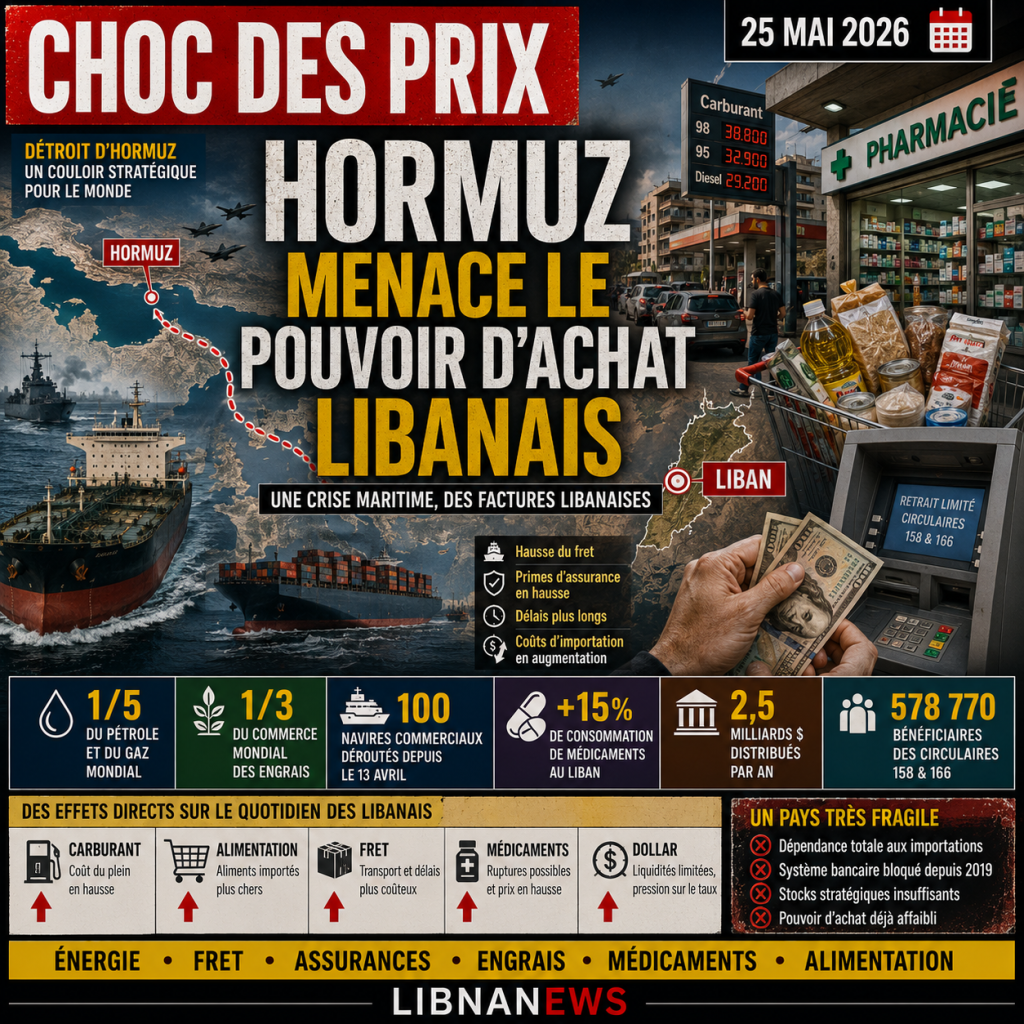
The Darmuz Strait acts as a vulnerability accelerator for Lebanon. The regional crisis is already affecting energy, freight, insurance, fertilizers, medicines and liquidity. In a country that imports most of its needs and whose banking system has remained blocked since 2019, the external shock quickly turns into pressure on Lebanese prices. The question is no longer only geopolitical. It includes the cost of filling, the price of food, the availability of treatments and the ability of households to pay.
Lebanese prices exposed to the shock of Hormuz
Lebanon does not need a complete and lasting closure of the strait to be affected by the crisis. A decrease in traffic, an increase in transport premiums or an anticipation by importers may be sufficient to increase the price of cargo. Markets operate on both risk and fait accompli. When shipping becomes uncertain, insurers increase their prices, shipowners change roads, delays increase and traders protect their margins. In a healthy economy, these increases can be partially absorbed. In Lebanon, they arrive on an already weakened body.
Lebanon’s fragility is primarily due to its import model. The country buys its fuel, a high proportion of its food, imported medicines, equipment and many inputs for services. It does not have a productive base strong enough to quickly compensate for a cargo or energy shock. Nor does it have a state capable of smoothing prices through strategic solid stocks. The consumer therefore becomes the last receptacle of the crisis. What is decided in a distant maritime corridor then appears on a Lebanese invoice.
The information reported in the press of 25 May 2026 shows the magnitude of the risk. The Darmuz Strait was presented as a passage through which approximately one-fifth of the world’s oil and gas trade and nearly one-third of the international trade in fertilizers was channelled. Another source mentions the diversion of a hundred commercial vessels since the start of the US maritime blockade against Iran on 13 April. It also cites more than 15 000 US troops mobilized, four neutralized vessels, 26 authorized humanitarian aid vessels and more than 200 warplanes and warships engaged. These figures describe a logistical crisis, not just a military one.
| Indicator | Number reported | Economic reading |
|---|---|---|
| World trade through Hormuz | One fifth of oil and gas, one third of fertilizers | Direct risk on energy, agriculture and food prices |
| Commercial vessels diverted | One hundred since 13 April | Time limits, insurance costs and tension on maritime routes |
| United States assets engaged | More than 15 thousand military personnel and more than 200 aircraft or ships | Militarization of regional trade |
| Banking circulars in Lebanon | Over $2.5 billion distributed annually | Minimum social liquidity, without bank reform |
| Medicines in Lebanon | Consumption up 15% | Fear of ruptures and pressure on stocks |
Energy, food and freight: the same chain of increase
The energy channel is the most visible. Tension on Hormuz can increase oil, gas and marine fuel. Lebanon is then facing a double penalty. It pays more for energy than it imports, then it pays more for the transport of goods that it also imports. This mechanics affects gas stations, private generators, bakeries, transportation, supermarkets and pharmacies. It reaches low-income households with particular violence, as energy is part of almost all their spending. The cost of transport weighs on labour. The cost of private electricity weighs on housing. The cost of fuel weighs on all services.
The food channel follows quickly. Fertilizers play a major role in global agricultural prices. As their trade expands, production costs increase in several exporting countries. Lebanon then receives this increase in the form of flour, imported vegetables, processed food or raw materials. The country already has an agriculture that does not cover all domestic demand. It cannot respond to a global shock by rapid substitution. An international increase thus comes almost without a filter, especially when the pound remains fragile and traders fix part of their prices according to the dollar.
Economic criticism begins here. Lebanon is suffering Hormuz because it has long lived as a consumption platform financed by deposits, transfers and imports. The banking crisis destroyed this architecture, but it did not produce a new model. Households have lost normal access to their accounts. Banks have not sold their losses. The State did not impose a clear restructuring. The withdrawal circulars work like an infusion. They give cash, but they do not repair the financial body. The external crisis therefore reveals an older internal weakness.
Bank circulars, an infusion become system
Circulars 158 and 166 illustrate this survival management. The information available indicates an expected extension, without an increase in monthly amounts. The scheme would provide more than $2.5 billion in cash per year. By the end of March 2026, approximately 578,770 beneficiaries had access to the mechanisms. Applications filed amounted to 610,624. The cumulative payments since the inception of the schemes were $6.109 billion. The Bank of Lebanon provided $4.183 billion, or 68.46 per cent, while commercial banks covered 1.926 billion, or 31.54 per cent.
| Banking indicator | Data reported | What it reveals |
|---|---|---|
| Annual cash flow | Over $2.5 billion | The system maintains minimum consumption |
| Beneficiaries | About 578 770 | The banking crisis touches a massive social base |
| Applications filed | 610 624 | Households remain dependent on supervised withdrawals |
| Cumulative payments | $6.109 billion | Temporary solution becomes sustainable |
| Share of the Bank of Lebanon | $4.183 billion, or 68.46% | The cost depends first on centralized resources |
| Share of banks | $1,926 billion or 31.54 per cent | Banks contribute less than the central bank |
These figures deserve a strict reading. The system gives depositors a fraction of their money, but it preserves most of the banking architecture. Depositors receive capped monthly payments. Banks are saving time. The Bank of Lebanon is taking a decisive part in the effort. Political power avoids the shock of a real distribution of losses. In times of regional crisis, this choice becomes even more questionable. Households need liquidity to cope with rising prices. The official response, however, is to extend a mechanism that limits withdrawals instead of closing accounts.
This strategy has a direct effect on Lebanese prices. When imported costs increase, households have to pay more. But their incomes and withdrawals do not increase at the same rate. The banking system therefore blocks the capacity for social adjustment. Families who receive a fixed monthly payment are reduced in purchasing power if fuel, food and care go up. Nominal stability becomes a real decline. The speech on continuity of payments masks a silent loss. Applicants remain officially assisted, but economically tight.
Drugs, another mirror of addiction
The medicine sector shows another face to the problem. Imports continue by sea and air. The stocks of imported drugs are announced as sufficient for several months. However, occasional ruptures may affect certain chronic or heavy treatments, for reasons of transport, agents, production or delays. Consumption was reported to have increased by 15% over the period. This increase reflects social concern. Patients and families buy more from caution. They fear disruptions, postponements of delivery or an increase in prices if the war lasts.
The market for the medicine also depends on Hormuz, even when the cargo does not pass directly through the strait. Freight prices, insurance, air delays and currency availability influence the entire chain. Lebanon can say that its stocks last several months. But this statement is not enough if patients seek specific, often expensive and imported treatments. Limited rupture may be serious for a patient on chronic treatment. An increase in prices can cause a family to reduce another essential expense. Health then becomes a variable of purchasing power.
The dependence on ports and airports reveals the lack of strategic margin. Imports go through Beirut, Tripoli and Rafic Hariri Airport, under coordination with health authorities and importers. This circuit can work as long as the accesses remain open. But it remains vulnerable to war, flight cancellations, maritime delays and the availability of the dollar. Lebanon does not have pharmaceutical production capable of meeting all needs. Nor does it have a health insurance system that is strong enough to absorb prolonged increases.
An economic model without shock absorbers
The regional shock therefore strikes an economic model that has never been reformed. Essential sectors depend on costly external trade. The banking system no longer normally finances the economy. The State does not provide broad social protection. Households pay the adjustments. This situation turns every external crisis into an internal crisis. Hormuz is not just a strait. It is a mirror of the Lebanese flaws: lack of stocks, productive weakness, dependence on the dollar, protected banks, fragile purchasing power and too late public policies.
Current management advocates can respond that circulars avoid a social breakdown. That’s partly true. Without these payments, hundreds of thousands of depositors would have less liquidity. But the argument is no longer enough. An emergency measure can be justified for a few months. It becomes problematic when it replaces a reform for years. Lebanon cannot face repeated geopolitical shocks with tools designed to save time. The time saved since 2019 has not been used to restore a system. It has often been used to postpone difficult decisions.
The political cost of this forward flight grows with the regional war. Households are seeing prices rise, banks remain closed to their rights, imports become more expensive and officials postpone decisions later. Trust does not rebuild under these conditions. An externally dependent country needs institutions that can anticipate. It should publish clear data on stocks, prices, reserves, margins and aid mechanisms. He must also say who pays the bank losses. Without this transparency, each increase is experienced as an additional spoliation.
Another lever is competition. Cargo crises often create a grey area where the real global rise mixes with preventive margins. The authorities must distinguish between imported costs and local speculation. This requires controls, but also data. A price of fuel, medicine or flour cannot be seriously discussed if the public ignores the cost of purchase, the cost of transport, the exchange rate used and the margin applied. In an economy undermined by distrust, transparency becomes an anti-inflation measure.
This also applies to Lebanon’s donors and partners. External aid cannot only finance the emergency. It must support more resilient chains: public transport, local basic production, warehouses, less fuel-dependent energy and bundled purchases for certain medicines. Otherwise, each crisis in Hormuz, the Red Sea or the oil market will bring back the same scenario. The country will call for help, prices will rise, depositors will pay, and then reforms will be further delayed.
What Lebanon can still control
Lebanon does not control the Darmuz Strait. It does not control American strategy, Iranian decisions or Israeli demands. But he controls part of his inner response. It can strengthen price surveillance, organize essential stocks, publish monitoring tables, protect critical drugs and impose a fairer distribution of bank losses. It may also stop presenting the extension of circulars as an economic policy. It’s a relief measure. An economic policy should reduce the dependency that makes the Darmuz Strait a threat to Lebanese prices.
The next test will be concrete. If the maritime crisis continues, the effects will appear in energy bills, food baskets, importer estimates and bank withdrawal requests. If a regional agreement reopens navigation on a sustainable basis, some of the pressure will decrease. But the substance of the problem will remain Lebanese. A country that does not reform its banks, its state, or its import model will continue to suffer every external shock as a national crisis. Lebanese prices therefore do not depend solely on Hormuz. They also depend on a system that has learned to survive without ever correcting itself.




