

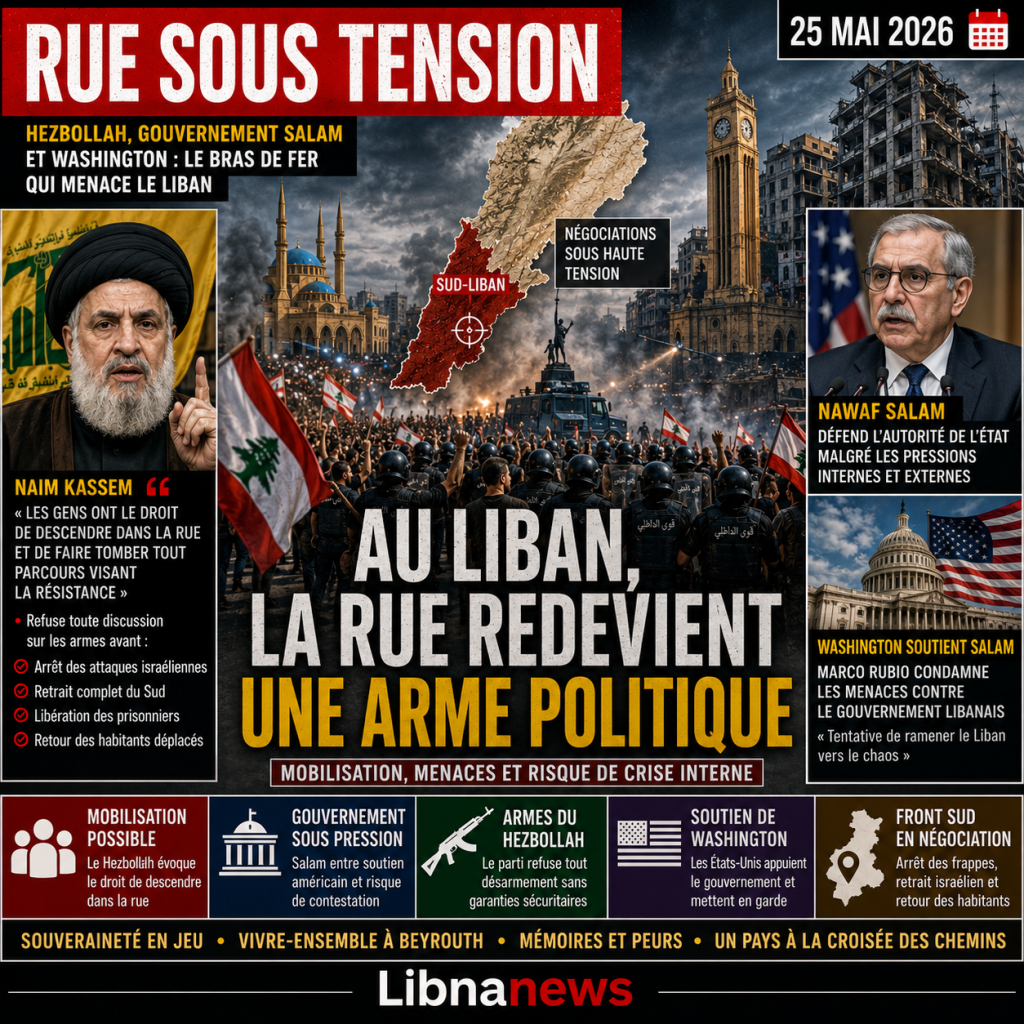
The return of the Lebanese street to the political debate marked a hardening of the crisis opened around the Salam government, Hezbollah weapons and negotiations on the southern front. By evoking the right to go down the street to bring down a route deemed hostile to resistance, Naim Kassem has placed popular mobilization at the centre of the balance of power. Washington responded with direct support to the government. Beirut now fears that a battle of guarantees will turn into an internal crisis.
The Lebanese street as a lever of pressure
The Lebanese street is never a mere political setting. It carries memories, fears, power relations and breaking thresholds. When a Hezbollah official talks about the possibility of going down the street, the message goes beyond the classic protest. He states that the party will not limit its response to institutional channels if its weapons file enters an imposed phase from outside. He also told the government that any decision taken under US or Israeli pressure could be combated by direct mobilization.
The formula attributed to Naim Kassem comes at a time when Lebanon is following an uncertain regional negotiation. The US and Iran are discussing a compromise to avoid a wider resumption of war. Israel wants to maintain its freedom of action in Lebanon. The government of Nawaf Salam is trying to defend the authority of the state, while seeking a real halt to the strikes in the South. In this context, the street becomes a political weapon because it can change the calculation of actors. It can raise the cost of a decision, weaken a firm, or block a safe schedule.
Hezbollah has already set its priorities. The party refuses to discuss its weapons before the Israeli attacks stop, the complete withdrawal, the release of prisoners and the return of displaced inhabitants. This sequence allows him to present his weapons as a response to a still active danger. It also allows it to reject any request for disarmament as a pressure from Washington and Tel Aviv. The possible call to the street completes this device. It shows that the party still has a means of social pressure, in addition to its military and political weight.
The Salam government targeted on behalf of sovereignty
Nawaf Salam finds himself at the heart of this tension. His Government received US support, but that support could become an internal risk. Washington presents the Lebanese executive as the legitimate interlocutor for the resumption, reconstruction and restoration of state authority. US Secretary of State Marco Rubio condemned the threats against the government and denounced Hezbollah’s attempt to bring Lebanon back to chaos. This position strengthens the firm on the international stage. She also exposes him to the accusation of being too close to the American agenda.
The difficulty lies in the very nature of the file. The government must stop Israeli violations and return the people of the South. It must also reassure international partners of its ability to restore the state monopoly. These two objectives are not theoretically incompatible. They become in the calendar. Hezbollah refuses to approach weapons as long as the Israeli threat continues. The United States and Israel want guarantees before considering the stabilized front. The government must therefore move forward between two opposing demands.
The street can be used here as a sign of prohibition. When Naim Kassem spoke of a mobilization capable of bringing down the government, he placed a limit in front of Nawaf Salam. He tells her, in essence, that institutional legitimacy is not enough if it leads to a decision lived as a surrender. The government can have international support. He may preside over meetings, receive delegations and speak on behalf of the State. But he must count with a force that can move the debate towards society and the capital.
Beirut, sensitive terrain of any mobilization
Beirut gives this threat a special resonance. The capital concentrates institutions, media, communities, universities, administrations, banks and neighbourhoods where each tension quickly takes on a national dimension. Any major mobilisation is read through the history of Lebanese crises. It can start as a political rally and become a test of coexistence. That is why the warnings around living together in Beirut are not just a matter of the moral register. They express a concrete fear of slipping.
Patriarch Béchara Boutros Rai recalled that Beirut was not built on exclusion, but on living together. This phrase comes in a climate of tension where the capital seems exposed to political upheavals from the South, Washington and Tehran. It refers to a simple idea: a national crisis cannot be solved by street pressure that would endanger urban balance. Beirut needs a present state, services, security, responsible words and clear boundaries between political mobilization and intimidation.
Fear of the capital does not mean that any manifestation is illegitimate. Lebanon has a long history of social, political and community mobilizations. Citizens have often used the streets to claim rights, denounce corruption or challenge decisions. But the current situation is different. It is not just about a social claim. It affects war, arms, the role of the State and the relationship with Israel. In such a context, the street becomes more flammable. It can affect negotiations, but it can also break the lack of confidence between institutions and political forces.
Hezbollah speaks at its base as well as at the state
Naim Kassem’s speech also targets the Hezbollah base. The party-related regions paid a high human, material and social price in the war. The people of the South are waiting for the return, the reconstruction and the end of the strikes. Many fear that external discussions will produce a text that imposes constraints on Hezbollah without really guaranteeing their security. By placing the street in the equation, the party reminds its supporters that it will not be isolated in institutions. He maintains a narrative of protection and resistance.
This story is based on a strong articulation between weapons, dignity and territory. Hezbollah presents its arsenal as a guarantee to prevent a return to vulnerability. It links the debate with the memory of the occupation, destroyed villages and displaced families. This approach allows him to challenge the American language of sovereignty. For Washington, sovereignty passes through a state that controls arms. For Hezbollah, it begins with the ability to defend the territory. The street then becomes the possible place where these two definitions clash.
But this strategy has a cost. Mobilization against the government may appear to be a defence of arms at the expense of national stability. She can worry about Lebanese who want to avoid an internal crisis first. She can also give Washington an argument to harden her speech against the party. Hezbollah must therefore measure the threat. He wants to show that he can block a trajectory he thinks dangerous. He must avoid appearing responsible for a disorder that would further weaken the inhabitants whom he claims to protect.
Washington turns the street into a test of legitimacy
The American reaction seeks to frame this debate. By supporting the Salam government, Washington says the street should not overthrow a recognized executive. The message is addressed to Hezbollah, but also to other Lebanese actors. The United States wants to make the government the focal point for reconstruction and security. They want to avoid the party imposing its veto through mobilization. This strategy places the crisis in the register of legitimacy. Who can decide? A government supported by institutions, or a force able to mobilize the street?
This American reading, however, simplifies a more complex reality. The Lebanese government cannot restore its authority only because Washington supports it. It must achieve tangible results. The people of the South must see the strikes stop. The displaced must go home. The army must deploy in real security conditions. Aid must arrive without being perceived as a guardian tool. If these elements are lacking, the discourse on state legitimacy will remain weak in the face of Hezbollah’s arguments.
The Lebanese street is often fed by this gap between institutional promises and concrete results. When a part of the population feels that the State does not protect, pay back, care and rebuild, it seeks other poles of loyalty. In this vacuum, parties, community networks and armed organizations are gaining ground. So the call to the street is not just a political threat. It reveals the weak capacity of the state to monopolize trust.
Memory of past crises weighs on the present
Lebanon knows that mobilizations can change in nature. A march, a sit-in, a rally or a call to strike can remain peaceful. They can also cause counter-mobilization, incidents, blockages and neighbourhood tensions. Memory of past crises acts as a filter. Each camp reads the other from its fears. In this climate, the slightest sentence can reach beyond its immediate meaning. The announcement of a mobilisation becomes a warning. The silence of the institutions becomes a weakness. The presence of supporters on the street becomes a balance of power.
This memorandum makes the role of politicians more important. Words must contain the crisis rather than broaden it. The government must avoid formulas that give the impression of a frontal confrontation with a part of the Shia population. Hezbollah must avoid threats that give the impression of an armed veto over institutions. Religious leaders must recall the common framework without replacing political decisions. Foreign partners must measure the internal impact of their statements. Lebanon is a country where words circulate quickly and where actors can test their opponents with language.
The current crisis adds another difficulty. It takes place during a regional negotiation whose contours remain unclear. An agreement between Washington and Tehran could calm certain fronts, but leave Lebanon in an ambiguous situation. Israel seeks to maintain a military margin. The United States wants guarantees. Iran wants to preserve its allies. The Lebanese government wants to speak for itself. This uncertainty makes the street more tempting for those who want to weigh before decisions are made.
A powerful but dangerous tool
The street can therefore be effective. It can remind a government that it cannot negotiate an existential subject without a national base. It can prevent an unbalanced agreement. It can also force mediators to integrate internal realities. But it remains dangerous in a country already weakened by war, the banking crisis, displacement and the collapse of public confidence. A street mobilized around weapons has not the same weight as a street mobilized around wages or services. It touches the heart of legitimate violence.
The real challenge is not to deny the right to demonstrate. The question is whether this right becomes a means of democratic pressure or an instrument of intimidation. The difference lies in objectives, methods and context. Mobilization that requires a transparent debate on the defence strategy can contribute to policy. Mobilization aimed at forcibly preventing any institutional decision can open a crisis. Lebanon is walking on that border. Actors know that. They play with her, sometimes willingly.
To avoid this slippage, the government must take the initiative again. He must make clear what he negotiates, what he refuses and what he demands of Israel. It must explain the role of the army, the timetable for the return of the inhabitants and the conditions for reconstruction. It must also open a Lebanese framework for discussion on defence, without giving the impression of a foreign injunction. Hezbollah, for its part, must specify what it would accept once its security conditions were met. Without this clarification, the street will remain a useful threat to block, but useless to build.
The upcoming sequence will tell whether the street remains a warning or becomes a real stage of the crisis. The first indicator will be the security meeting in Washington. If it produces clear guarantees for the South, the government can defend an institutional path. If it seems focused on Israeli and American demands without visible withdrawal, Hezbollah will find a more favourable ground to mobilize. Beirut will then remain the most sensitive space, for any battle over sovereignty ends up looking for a scene. In Lebanon, this scene is often the street.




