

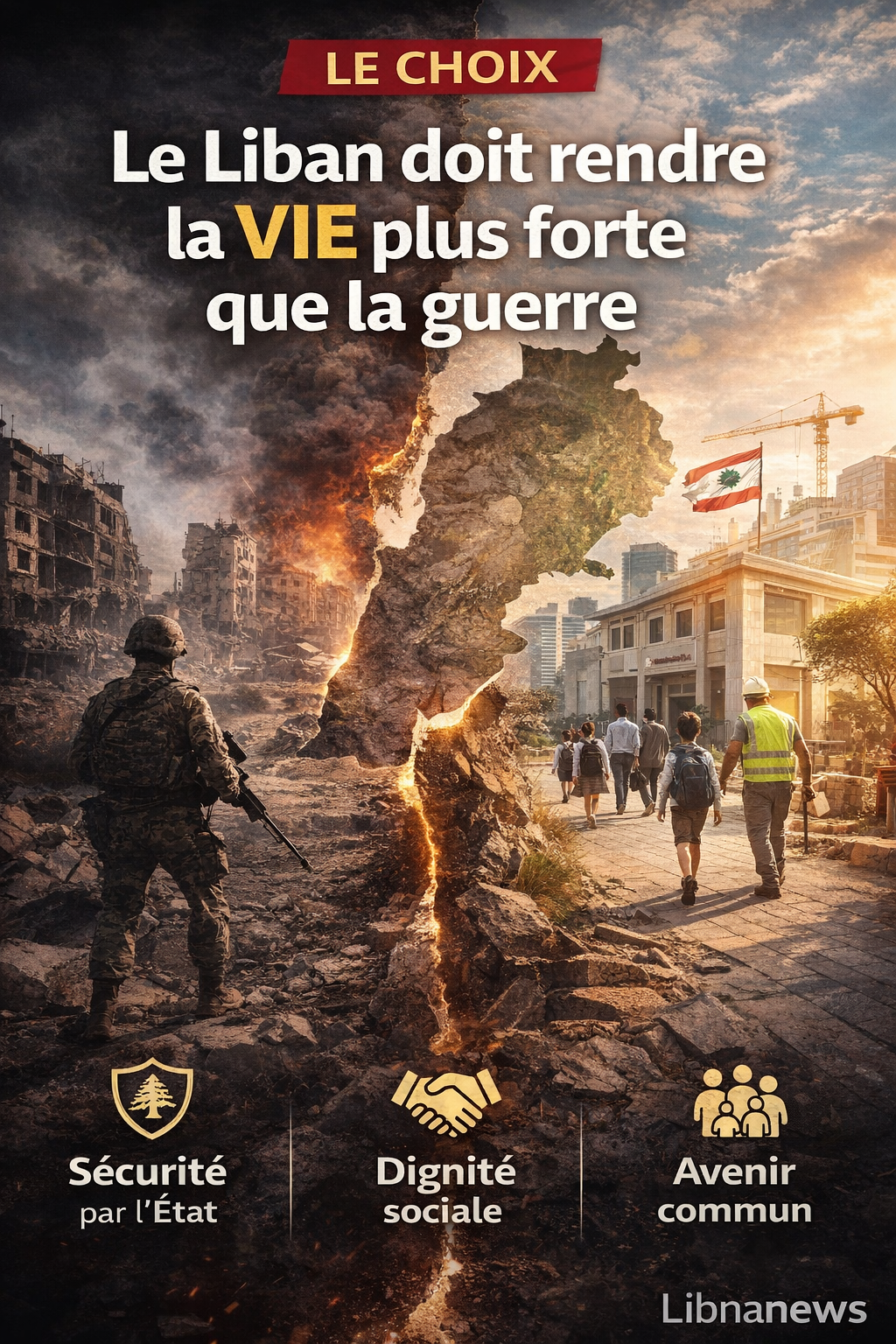
There are times when a country must stop lying.
Lebanon has reached this point.
For behind cautious discourses, fragile compromises and denominational balances, a crude reality is required: the country is caught between two incompatible visions of the world. Two logics that cannot coexist indefinitely.
On the one hand, the simple idea — almost obvious — that a state exists to protect life.
On the other hand, a system where death has become a political tool, a language, sometimes even a form of legitimacy.
You have to call things by name.
When an organization like Hezbollah structures part of its power around sacrifice, martyrdom and permanent confrontation, it does not just weigh on the political scene. It redefines the rules of the game. It imposes a hierarchy where life is no longer first.
And from there, everything turns.
For a country cannot function with two systems of opposite values. At the same time, we cannot build schools and glorify death. Stabilize an economy and maintain permanent tension. Promising a future and organizing the present around the conflict.
We have to choose.
This choice is not moral. He’s existential.
All societies facing this tension have had to decide. Revolutionary movements, radical nationalisms, totalitarian ideologies have all, at one point, made the same bet: destroy to be reborn, sacrifice to purify, suffer to exist. And all of them produced the same result: an exhausted society, unable to transform the intensity of the fight into stability of life.
Lebanon is currently replicating this pattern. Slowly. Silently. Dangerously.
The trap is terrible. Because this system is not a threat. He presents himself as a protection. It fills gaps. It organizes where the state fails. It offers structure, identity and solidarity.
But at what cost?
At the cost of a permanent dependence on tension. At the price of a country suspended between war and truce. At the price of an economy asphyxiated by uncertainty. At the price of a company that is no longer able to project itself other than in survival.
It’s a logic that feeds what she claims to fight.
And that is precisely why it is so difficult to undo.
Because you don’t fight an ideology of death with slogans about life. We do not disarm a culture of sacrifice with abstract calls to peace. We don’t replace intensity with emptiness.
We have to do better.
Much better.
The logic of death must be opposed to a logic of life that is credible, concrete, powerful. A life that protects. A life that builds. A life that gives more meaning than war promises.
This is where the Lebanese state is expected. And that’s where he so far failed.
For a State that does not protect leaves room for those who claim to do so.
A state that does not build leaves room for those who mobilize.
A state that does not offer a future leaves room for those who offer meaning — even destructive.
The responsibility is therefore twofold.
Yes, it must be made clear that Lebanon cannot live with a parallel army. That the decision of war can only belong to the state. That sovereignty is not negotiable.
But it must be equally clear that this will not be against a community.
The Shiite community is not a problem to solve. It is a part of the country to be fully integrated. To be respected. To secure. To be included in a national project that does not expose it to permanent war.
This is where everything is played.
If the state fails to offer this alternative, then the current system will continue.
If he succeeds, then he will gradually become useless.
It’s a battle of legitimacy.
And this battle is won neither by brute force, nor by complacency. It gains itself by restoring a simple evidence: life must become stronger again than death.
But we must go further, to the most sensitive point.
How can we get out of a culture of sacrifice without humiliating those who recognize it?
How can we tell a population that has suffered, resisted, lost, fought, that life must return to being superior — without denying what it has experienced?
We do not fight the love of sacrifice by denouncing it, we overcome it by making it useless.
What some call the love of death is in reality an attachment to meaning, dignity, protection.
When life does not guarantee anything, sacrifice becomes an alternative.
The only way to make the love of life triumph is to make it superior in practice.
Security superior.
Superior in dignity.
Higher in the future.
Making love of life a political project involves:
1. Real and visible State security
2. A tangible economic and social dignity
3. A new source of meaning outside the war
4. A national story about construction
5. Integration without humiliation of the Shiite community
6. A political transformation of existing structures without an autonomous military role
The truth is simple.
We will not emerge from this crisis through concepts.
We’ll get out when living protects better than fighting.
When building will give more dignity than resist.
When the future is more credible than sacrifice.
Lebanon must return to being a country where one no longer needs to die for a reason to exist.
There is no compromise possible with that.
Only one choice.




