

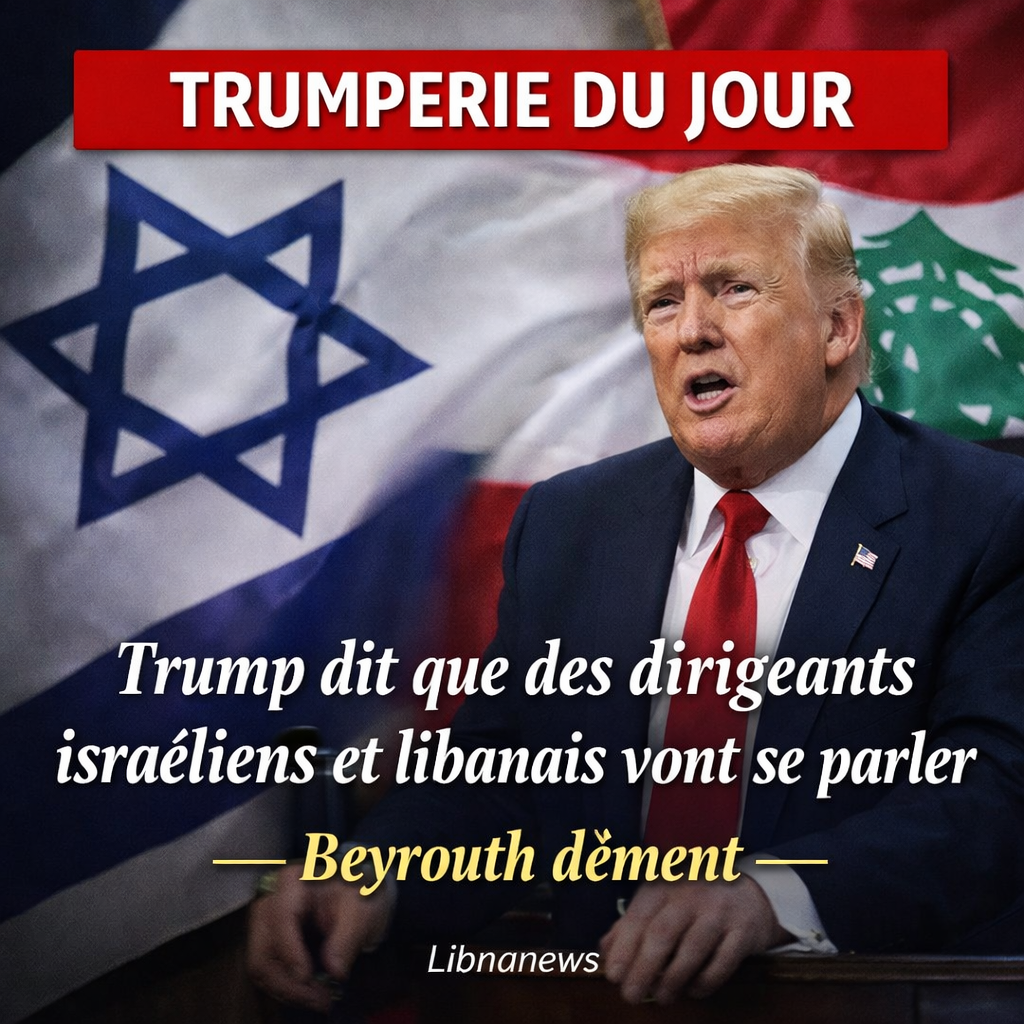
Lebanon learned of a possible new contact with Israel as a large part of the public discovered: by a message from Donald Trump. On Wednesday evening, the American president assured Truth Social that the « leaders » of the two countries would talk to each other on Thursday in order to create « a little respite » between Beirut and Israel. A few hours later, an official Lebanese source quoted by the AFP stated exactly the opposite: Beirut is not « not aware » of a planned contact with the Israeli side and has not been informed of this through official channels. The gap between the two versions is not a mere misunderstanding of communication. It reveals the extent to which the Lebanese-Israeli dossier is advancing in the opacity, under strong American pressure, even as it affects one of the most explosive subjects of Lebanese political life: war, sovereignty and the relationship to a State considered enemy by a large part of the country.
This contradiction is first of all institutional in scope. When a foreign head of state announces an imminent exchange between « leaders » even before Beirut confirms that it has been notified, the problem is not limited to diplomacy. It affects the chain of decision and the control of the calendar. Lebanon finds itself in a defensive position, forced to react to an announcement from Washington without immediate power to assume it, totally deny it or frame it politically. For a public opinion already worked out by the mistrust of negotiations with Israel, this gap has a simple feeling: what engages the country sometimes seems to be discussed elsewhere, and then discover itself in Lebanon afterwards.
American announcement without official relay in Beirut
The starting point is very clear. In his message, Trump did not give the names of the officials concerned, the exact format of the contact, or its precise purpose. Reuters noted that the publication did not specify which Lebanese and Israeli leaders were supposed to speak to each other, nor in what form, and that the offices of President Joseph Aoun and Prime Minister Nawaf Salam had not responded immediately to requests for comments. In other words, the American announcement preceded any identifiable institutional dress on the Lebanese side. It was precisely this vacuum that made it necessary to develop a Lebanese official source a few hours later.
The contrast is brutal. On the one hand, an American president who already speaks in the future, with the tone of certainty and even satisfaction. On the other hand, Beirut says it knows nothing by official means. Such a divergence can of course come under several assumptions: a Washington announcement too quickly, an exploratory discussion by intermediaries not yet formally notified to the Lebanese institutions, or a very extensive American reading of diplomatic contacts still embryonic. But whatever the final explanation, the political result is the same. Lebanese discover by surprise a supposed major initiative while their own state claims not to have official confirmation.
This sequence is all the more sensitive because the question is not about diplomatic banality. Lebanon and Israel have no formal diplomatic relations, and the issue of direct contacts remains one of the most inflammable markers of Lebanese policy. The Associated Press recalls that a Lebanese law of 1955 prohibits Lebanese citizens from contacting Israelis, even though this law has been applied selectively, while the history of state-to-state negotiations is rare, discontinuous and politically costly. In such a context, announcing a conversation between « leaders » without prior clarification almost mechanically amounted to an internal political shock.
Washington’s precedent is not enough to remove the blur
What further complicates the episode is that it does not arise out of nowhere. On Tuesday, 14 April, Lebanese and Israeli representatives met face to face in Washington with American mediation. According to the PA, the ambassadors of the two countries to the United States held a face-to-face preparatory meeting in the State Department, in the presence of Marco Rubio and other American officials. Both sides described the meeting as constructive, but it was completed without a ceasefire and without a date set for the continuation of the formal negotiations. Washington itself insisted that it was a process, not an isolated event.
In other words, a channel already exists. But this channel is not enough to validate Trump’s assertion on a contact between « leaders » the next day. The meeting on Tuesday had a specific format: ambassadors, American mediation, a session described as logistics more than substantial, and no immediate breakthrough on the truce. Moving from this stage to the announcement of an exchange at the summit, in less than 24 hours, required either a dramatic acceleration or a more ambitious political formulation than the reality of the moment. Beirut’s prudence therefore becomes understandable: to recognize an unconfirmed contact would be to publicly endorse an initiative that the Lebanese State has no control over terms or timetable.
The problem is therefore not the existence of discussions. These are established. The problem is the exact nature of what was announced on Thursday. Was it an exchange of heads of state, a contact via emissaries, a new meeting of ambassadors, an indirect call relayed by Washington, or a simple element of language intended to install the idea that the process was moving forward? Until this point is clarified, the dominant impression in Lebanon remains that of a diplomacy told from the outside before being explained from within. And in the Lebanese context, this reversal of sequence is enough to create a major political tension.
The formula of « 34 years » blurs more than it illuminates
Donald Trump’s phrase on « 34 years » also added confusion. Presented as a simple way to mark the historical character of the moment, it does not exactly fit the chronology available. The PA recalls that Lebanon and Israel had direct negotiations in 1982-1983, which led to the agreement of 17 May 1983 before its abandonment. The Agency also recalls that, in 1993, Lebanon had participated in direct peace negotiations with Israel in the wake of the Oslo process. On a more immediate scale, the ambassadors of both countries met on Tuesday in Washington, D.C., face to face, under American auspices. It was therefore difficult to present the sequence as a first conversation of this type in exactly thirty-four years.
This approximation is not anomaly. It gives the feeling that Washington is first seeking to produce a narrative of historical breakthrough, even if it greatly simplifies the diplomatic memory of the case. But this staging has concrete effects. It can make a political normalisation look much more advanced than it really is. It can also feed into the idea that the United States is trying to install a narrative fait accompli: if we are already talking about « leaders » and « 34 years », then the symbolic step already seems to be taken, even if the actual content of the exchanges remains unclear. It was precisely against this type of slip that the Lebanese reaction seemed to want to establish a minimum barrier.
It should also be recalled that the Israeli camp itself did not publicly confirm Trump’s announcement immediately. Reuters states that Benjamin Netanyahu’s office had not responded to the requests just after the presidential message. This lack of Israeli validation reinforces the suspended character of the sequence. If such a high level contact were actually locked, it would have been logical for a minimum of coordination to appear, at least in the background. Conversely, the silence of the offices concerned and the cautious denial from Beirut leave the idea of an announcement launched before all institutional floors had been aligned.
What Lebanon wants, what Israel wants
To understand the tension of the moment, we must go back to the bottom of the discussions that have been under way for several days. According to the PA, Beirut is first seeking a ceasefire, the withdrawal of Israeli forces from the South, the release of Lebanese prisoners, the return of displaced persons and reconstruction. Lebanon also wants more international support for its army so that it can deploy throughout the country and reaffirm a form of state sovereignty. Israel, for its part, presents these discussions from a very different angle: the disarmament of Hezbollah, the sustainable security of the border and the prospect of a peace built from its military power ratio. The two capitals are therefore not talking exactly about the same negotiation.
This discrepancy explains why premature announcements are particularly risky. When Lebanon hears « truct », Israel often hears « increased pressure until guarantees on Hezbollah ». Reuters reported on Wednesday that Israel continued to hit the Shiite movement and, according to a Lebanese assessment relayed by the agency, sought to secure a military gain in Bint Jbeil before any significant diplomatic progress. At the same time, the Israeli security cabinet was discussing a possible ceasefire, under strong US pressure. In other words, military ground and diplomatic ground move forward together, but not in the same logic and pace.
It is precisely in this in-between that communication becomes a tool of power. An overly optimistic American announcement can raise the idea of a close respite. An Israeli escape from a ceasefire can help to show an opening without immediately suspending operations. And a prudent denial from Beirut can be used to prevent a simple diplomatic signal from being interpreted in the Lebanese domestic debate as a shift towards unaccepted normalization. The battle therefore also concerns words, sequences, the order of announcements and the setting of the framework of what is happening.
Why Lebanese opinion gets so badly this type of announcement
The explosive nature of the case is also due to the Lebanese interior scene. The PA points out that many Lebanese fear that Beirut will approach these discussions with very little leverage, facing a militarily dominant Israel and American mediation perceived as far from neutral. The same agency recalls that Hezbollah and its supporters are already accusing the government of offering « free concessions » to an enemy state by negotiating while Lebanon remains under bombs. In this climate, learning from a Trump message that an exchange between leaders would be imminent can hardly be seen as mere diplomatic progress. For part of the country, this first looks like a decision that is being prepared over or without the Lebanese.
There lies the true heart of the subject. To say that « Lebanon is not aware » is not just to correct information. It is also a recognition that opinion has not been prepared and that the institutions do not want to be seen as blindly endorsing an external initiative. In a State as fragmented as Lebanon, the question of the report to Israel cannot be managed as a mere technical point of negotiation. It affects the political identity of the country, the balance between internal forces, the role of Hezbollah, the weight of the United States and the very perception of the ongoing war. To advertise before explaining, in such a case, almost always amounts to further fracture.
Nor should the symbolic force of the channel used be underestimated. Trump has not spoken since a joint press conference, nor after a tripartite communiqué, nor even through a classic diplomatic announcement. He spoke on his social network, with a personal, enthusiastic and relaxed tone. For Washington, this can be Trump-style. For Beirut, that changes everything. Such a sensitive negotiation discovered on Truth Social appears immediately less like a state procedure than an episode of American political communication. This shift in form reinforces the sense of disorder and improvisation, especially in a country where every word about Israel can have major internal political consequences.
Beirut is trying to avoid a crash
The Lebanese reaction can therefore be read as an attempt to slow down. By saying that no information has been received through official channels, the source cited by the AFP does not completely close the door to any future contact. Above all, it refuses to ratify an announcement whose parameters have not yet been controlled by the State. It is a way to save time, contain the media and remind that in Lebanon, especially on the Israeli issue, legitimacy still requires institutional validation. As long as it has not taken place, a word from Washington is not enough to make politics in Beirut.
This caution may seem minimal. It is actually revealing the Lebanese position in the current balance of forces. The country is looking for a halt to Israeli bombings and a diplomatic outcome, but it does not want to appear as drawn towards a logic imposed on it from outside. This is why the nuance between « discussion », « contact », « negotiations », « leaders » and « ceasefire » counts as much. Each of these words carries a different political burden. The United States should show that the process is expanding. Israel had better talk without giving up military pressure too quickly. Lebanon, for its part, should not be allowed to believe that an irreversible symbolic step had been taken without it being able to define its mandate.
Basically, the episode says something broader about the current phase. The Lebanese-Israeli file does not only advance through meetings and press releases. It also advances by floating ads, by test formulations, by signals sent to several audiences at the same time. Washington speaks to Israel, Lebanon, Iran, markets and its internal opinion. Beirut, for its part, must speak to its own political scene, to a population under pressure and to foreign partners on which it depends without abandoning the story altogether. It is in this space of friction that the most significant formula of the day was born: Lebanon does not know. More than a simple denial, it is the symptom of a negotiation whose form remains almost as sensitive as the substance.




