

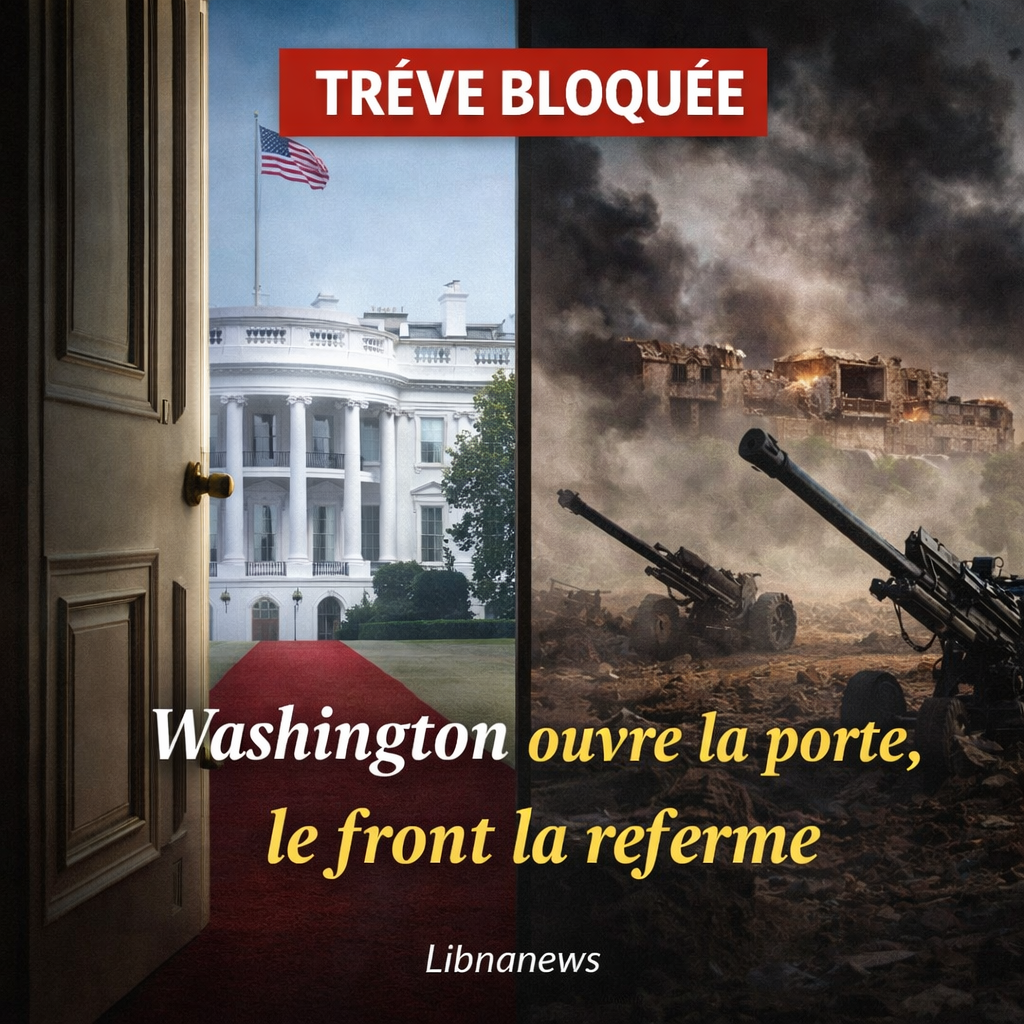
A diplomatic advance immediately caught up in the war
On 16 April there was a clear contradiction. On the one hand, a direct diplomatic channel was opened in Washington between Lebanese and Israeli representatives under American sponsorship. On the other hand, the terrain did not offer any sign of appeasement. On the contrary, fighting intensified in the South, as if the war had wanted to remind that it still keeps the last word.
This shift weighed all day. Diplomatic openness has created a threshold effect. It gave substance to a hypothesis long considered distant, that of a ceasefire negotiated before a broader discussion on the issues of dispute between Lebanon and Israel. But this hypothesis did not have time to settle. It was immediately contradicted by continued Israeli strikes, exchanges of fire and attempts to advance in several areas of the southern front.
The problem is not just the continuation of the war. It is the very logic of the sequence. Diplomacy seeks to freeze the ground to open a space for discussion. The ground, on the other hand, continues to produce military facts that alter the political meaning of any negotiation. As long as a battle remains active, none of the parties wants to enter a truce with the feeling of having given in. The front therefore does not follow the diplomatic timetable. He tests it, slows it down, sometimes even denies it.
It was this tension that dominated the day. Washington’s gesture was real. It has even been new at this level for a long time. But he immediately stopped at a simple truth: mediation progresses faster in the rooms than in the bombed localities. Between the table of discussions and the lines of fire, this decisive moment is still missing when an actor imposes a pause on weapons. But this moment did not take place.
The day of 16 April was therefore not that of a frank diplomatic breakthrough or a complete failure. Rather, it revealed an intermediate state. The war has recognized that it will sooner or later have to go through negotiation. But she refused to give him priority.
Bint Jbeil, point of blocking any truce
If a place sums up this contradiction, it’s Bint Jbeil. The city has become the nerve center of the moment. The confrontations remained so intense that they eventually conditioned any reading of the diplomatic sequence. As long as this battle remains open, the very idea of a ceasefire remains incomplete.
Bint Jbeil’s stake goes far beyond the local context. The city has a military, symbolic and political weight. For Israel, achieving a visible result in this sector would show that military pressure had produced an effect before any pause. For the Lebanese camp, the simple fact that this progress remains difficult prevents the construction of an Israeli victory story. The battle has thus become a battle of position, but also a battle of image.
This is where diplomacy comes at its most concrete limit. A truce, to exist, must be based on a minimum of stabilization of the ground. But Bint Jbeil remains precisely where this stabilization does not exist. The fighting remains hard enough to prevent rapid translation of American efforts. Every attempt to advance, every artillery exchange, every strike has the idea that none of the protagonists is ready to freeze the situation as it is.
This battle therefore acts as a lock. It suspends diplomacy on a local front. It also shows that, in this type of war, a city can decide the political pace of an entire issue. Washington can push to stop fighting. Beirut can make it its working condition. But if Bint Jbeil remains an open battle, none of these efforts is enough to create a credible pause.
The symbolic weight of the place further reinforces this effect. Bint Jbeil is not a simple line on a map. It refers to a memory of confrontation, resistance and territorial rivalry that goes beyond the tactics of the day. This explains why the battle is read as a test. Not only a military capability test, but a political will test. Under these conditions, diplomacy cannot simply bypass the front. She has to deal with him. And, for now, it is the front that imposes its tempo.
Washington wants to impose the order of events
The American logic is clear. The aim is to get a ceasefire first, and then to turn this lull into a starting point for a broader process. This method responds to a practical emergency. It is difficult to negotiate seriously as the strikes continue, the locations are targeted and the losses increase. The American bet is therefore to separate times: first the relative silence of weapons, then the processing of political and territorial issues.
On paper, this method seems rational. It would reduce immediate pressure, reduce the risk of escalation and give a chance to more structured discussions. It would also give Washington a central arbiter between Beirut and Tel Aviv. But this architecture is based on a demanding condition: the United States must convince Israel that a break is more useful than a new military thrust, and convince Lebanon that this break will not only serve to freeze an unfavourable balance of power.
This is where the difficulties begin. The American impulse exists. She produced a meeting, a framework, a channel and even the perspective of a sequel. But it has not yet demonstrated its ability to control the ground. In the present war, however, the credibility of mediation is measured less by the opening of a negotiating room than by its ability to obtain immediate military restraint.
So Washington is trying to impose an order of events. First the truce, then the negotiation. But this order comes up against another reasoning, especially on the Israeli side: first improve its military position, then discuss. The conflict is not just about substance. It also deals with chronology. And in war diplomacy, chronology is already a battle.
This tension explains the climate of April 16. Signals from Washington fueled the idea of a possible de-escalation. But the signals from the front said exactly the opposite. As long as these two messages contradict each other, mediation remains real but fragile. It exists, but it does not yet command.
Beirut seeks to negotiate without appearing in a position of weakness
For the Lebanese authorities, the stake is twofold. A truce is needed to open a viable diplomatic space. But we must also prevent this truce from being interpreted as the result of a weakness imposed by war. All the trouble is there. Lebanon wants to make the ceasefire the starting point of the process, not its final reward.
This distinction is decisive. If the truce comes before any detailed negotiations, Beirut can argue that it has obtained the recognition of a principle: we do not discuss under the continuation of the bombings and targeted assassinations. If, on the other hand, negotiations progress while the ground continues to burn, the Lebanese domestic scene risks presenting the process as a duress, and thus politically weakened from the start.
The power has therefore tried to establish a clear line: cessation of hostilities and then further discussions. This line meets an obvious security need. But it also responds to an inner necessity. Any diplomatic opening to Israel provokes an immediate battle in Lebanon over the meaning of the gesture accomplished. Is this an attempt to protect the country and get a withdrawal? Or a sequence that could turn against internal balance, especially against Hezbollah and against the legitimacy of resistance?
This issue weighed heavily on the day. Because the fragility of mediation does not come only from fighting




