

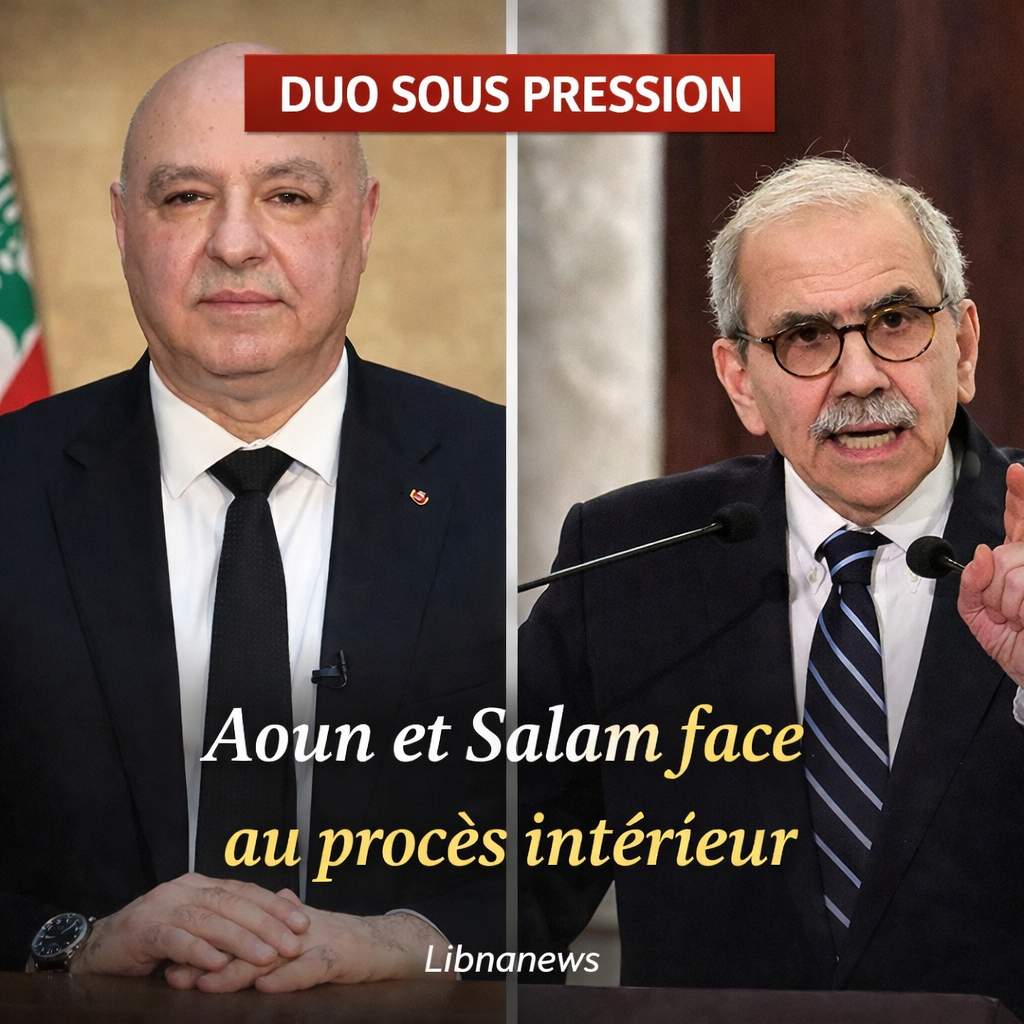
Negotiations moved war to the heart of power
April 16 showed a paradoxical scene. As the war with Israel continues to take place in the South, another battle has taken place in central Beirut, in institutions, parties and speeches. This battle is not about tanks, strikes or front lines. It focuses on the political significance of the US-sponsored negotiation. From the moment a direct channel was opened, even in a cautious and limited manner, the President of the Republic and the head of government were exposed to immediate internal proceedings.
The heart of this trial is simple. Joseph Aoun and Nawaf Salam claim that they are seeking a ceasefire, protecting the country from a wider escalation and placing the state at the centre of the decision. Their opponents, or at least their critics, suspect something else. For them, the current sequence is not limited to an attempt to stop fighting. It could be used to change the internal balance, put pressure on Hezbollah and open a new political phase in which sovereignty would be redefined against part of the country.
This divergence is not a mere analytical debate. It affects the very legitimacy of power. In a country like Lebanon, any discussion with Israel, even indirect, even if framed, even limited to security or border issues, immediately triggers a crisis of meaning. Who’s talking? In the name of what? With what margin? To get what? And especially at what domestic political cost? On April 16, Joseph Aoun and Nawaf Salam were exactly at this point of maximum tension.
The diplomatic opening therefore did not alleviate pressure on the executive. She reinforced it. The more power sought to impose the idea of a pre-ceasefire, the more its opponents tried to show that it was moving in a dangerous direction. The debate on war has thus been transformed into a debate on the state, its role, its limits and the real ability of its leaders to negotiate without opening a deeper internal crisis.
Joseph Aoun seeks to speak on behalf of the territory and state
Since the beginning of this sequence, Joseph Aoun has endeavoured to occupy a precise position. He does not present himself as an abstract compromise man or simply as a crisis manager. It seeks to appear as the guarantor of a clear institutional line, based on the defence of the territory, the demand for an Israeli withdrawal and the refusal of any political surrender imposed by the war. This posture has an immediate function: to prevent diplomatic openness from being read as a sign of weakening.
The difficulty is that this posture must stand on two planes at once. At the external level, it must convince the mediators that Lebanon is ready to move forward within a negotiated framework. At the domestic level, it must reassure those who fear that a truce or a broader discussion will conceal a strategic retreat. So the president cannot speak the pure language of de-escalation. It must add the vocabulary of territory, sovereignty and refusal to abandon.
This choice of vocabulary is not trivial. In the current crisis, every word weighs. To say that Lebanon will not give up any part of its territory is to try to establish a political boundary before negotiations produce its own ambiguities. It is also resuming the symbolic initiative against those who already accuse the power to embark on a path that is too flexible or too dependent on the American sponsor.
But this strategy has its limits. The more Joseph Aoun insists on sovereignty, the more his opponents can answer that the real test of sovereignty is not the discourse but the content of the discussions. The more he speaks in the name of the state, the more forcefully the question returns: does the state simply want to stop the war or does it also seek to restore inner balance to the detriment of Hezbollah? That’s where the political trial begins. He is not just challenging the President’s method. He contests the intention that is given to him.
Joseph Aoun is thus in a delicate position. It must appear firm enough not to be accused of weakness, but open enough for mediation to remain credible. He must speak to Washington without losing Beirut. He must speak on behalf of the State without giving the impression of using war to settle an internal account. This ridge line is narrow. On 16 April it became one of the centres of gravity of Lebanese policy.
Nawaf Salam carries the concrete weight of the decision
If Joseph Aoun embodies the institutional height of the sequence, Nawaf Salam bears the most immediate burden. The Head of Government finds himself at the point of contact between diplomacy, crisis management, continuity of public services and internal political confrontation. His position is even more exposed because he cannot be content with setting out principles. It must also manage the concrete consequences of war, displacement, international pressure and internal divisions.
This situation gives his word a special texture. When he defends the need for a ceasefire, he does not only speak as a responsible person engaged in a diplomatic process. He also speaks as the head of a government that must maintain the airport, ports, border crossings, vital networks, aid circuits and emergency devices. In other words, its political line cannot be separated from an administrative logic of national survival.
That is precisely what makes him a central target. His supporters describe his action as an expression of a concern for sovereignty and efficiency. His opponents look at him with greater distrust. They accuse him less of an isolated formula than a general orientation. In this critical reading, Nawaf Salam is not only a prime minister trying to stop the war. It would also be one of the faces of a political sequence designed to strengthen the role of the state against resistance.
This suspicion explains the strength of the trial against him. This is not just a disagreement on the diplomatic calendar. It is a suspicion of hidden purpose. The idea that the process could be used to move the confrontation from the south front to the centre of the inner game has an immediate distrust of the head of government. In this context, each gesture of Nawaf Salam becomes overinterpreted. Each position is read both as an act of management and as a political signal.
The paradox is that this exhibition can also strengthen its stature. By assuming the ceasefire line, by maintaining the functioning of institutions and by entering into a state logic, Nawaf Salam may appear to a part of the public as one of the few responsible for keeping a course in the midst of chaos. But this possible consolidation of his image is paid at the cost of growing hostility in the circles that see in the current sequence much more than just an exit from war.
Hezbollah and its allies fear displacement of conflict
The strongest criticism of Joseph Aoun and Nawaf Salam comes from the resistance camp and its allies. This criticism is based on a central idea: the negotiations undertaken would not only aim to end the war, but to reconfigure the Lebanese internal field. In this perspective, the cessation of fire, the resumption of state initiative and American centrality would not be neutral elements. They would form a set designed, sooner or later, to exert direct pressure on Hezbollah.
This reading weighs heavily because it transforms the diplomatic sequence into an existential confrontation. If the process is perceived as an attempt to politically circle resistance, then any formula of truce becomes suspicious. Any institutional progress becomes ambiguous. Any speech on sovereignty is subject to an immediate question: sovereignty against whom? Against Israel? Or against Hezbollah weapons?
On 16 April this concern was not a marginal reaction. It already forms an important part of the public debate. The thesis that some returned from Washington not to stop the war but to move the battle to Hezbollah crystallized this fear. It gave a simple formula to a broader feeling: behind the diplomatic discussion could prepare for a new internal confrontation on the definition of the State and on the status of resistance.
For Joseph Aoun and Nawaf Salam, the danger is considerable. Even if they seek only to impose a cease-fire, they must now act in a climate where part of the system suspects that they are pursuing a broader goal. Their political margin is narrowed. They can no longer only convince foreign mediators or institutional partners. They must also neutralize the idea of participating in a masked political offensive.
The most difficult thing at this time is that suspicion produces its own effects, even without new evidence. It is enough that it is credible for part of the political field to weigh everything else. Thus, the internal trial is not only dependent on the decisions taken. It depends on the fear they inspire, the narrative that accompanies them, and the power relations they awaken.
Nabih Berri, between alert and political lock
In this climate, Nabih Berri occupies a separate place. It is not part of an enthusiastic support for the Aoun-Salam line, nor is it part of a logic of total rupture with the institutions. His position is more complex. It expresses a clear mistrust of the current sequence, while seeking to prevent this mistrust from leading to implosion of the system or slipping into the streets.
This political lock function is essential. Berri knows that opening a direct channel with Israel reactive in Lebanon old, intense and dangerous fracture lines. He also knows that any perception of a slide against Hezbollah can cause deep tension in the interior scene. At the same time, he’s still a system man. It cannot allow the country to enter a total institutional crisis as war continues.
It is this dual logic that makes its role so central. When he alerts against the intentions of the current sequence, he speaks to his base and his allies. He basically told them that vigilance was necessary and that the battle was not only against Israel. But when it acts to avoid an internal confrontation, when it slows down the temptation of the street or maintains channels of contact with external partners, it plays a completely different score. It arises as a regulator of a system threatened with excess.
For Joseph Aoun and Nawaf Salam, this position is both an obstacle and a protection. An obstacle, because it prevents the formation of a simple political consensus around their line. Protection, because it prevents opposition to this line from immediately turning into an open crisis of regime. Berri does not really legitimize the process, but it helps prevent it from blowing up the whole building.
This centrality says a lot about the nature of Lebanese policy. Even when the country is engaged in a regional war, even when international mediation accelerates, the transition from one crisis to another remains filtered by a few figures able to slow down, contain or redirect tensions. On 16 April I showed forcefully: the trial against Joseph Aoun and Nawaf Salam did not take place in a vacuum. It passes through a system that still knows, by reflex, to produce shock absorbers.
The debate on arms returns to the centre
Behind the political trial against the President and the Prime Minister, this is an old question that comes back with new brutality: the monopoly of force. The war with Israel brought back the debate on arms, their place in Lebanese public space, their strategic function and the relationship between resistance and the state. Open negotiations under US pressure did not create this debate. She gave him a new intensity.
The more the power speaks of the state, the more the idea of refocusing on the army, on institutions and on a formal decision-making chain comes back. The more the resistance camp hears this logic, the more it sees the prelude to a political confrontation over its status. The question is therefore not simply military. It is deeply constitutional, symbolic and identity-based. Who embodies the protection of the country? Who decides war and peace? And can the Lebanese State really claim this role without causing a crisis with those who consider themselves to be the historical guarantors of confrontation with Israel?
Joseph Aoun and Nawaf Salam are exactly in the middle of this knot. Their discourse on sovereignty can be read as a legitimate attempt to restore the centrality of the state. But it can also be seen by others as a step towards questioning the military status of Hezbollah. That’s why the debate on weapons contaminates everything else. It turns a discussion on the ceasefire into a latent confrontation over the nature of the regime.
The ongoing war makes this issue even more explosive. In a country at relative peace, such a debate could be referred to conferences, compromises or electoral deadlines. In times of war, it takes on an immediate existential dimension. It is not about an abstract future. It touches the heart of the present. It concerns what protects, what decides, what represents and what compels.
A tandem under pressure, but already at the centre of the new Lebanese moment
On 16 April, a new political reality emerged. Whether supported or attacked, Joseph Aoun and Nawaf Salam are now at the centre of the Lebanese moment. They are no longer just the institutional heads of a power forced to manage the crisis. They have become the figures around which the main question crystallises itself: can Lebanon enter a way out of war by placing the state in the centre without causing a more serious internal fracture?
It is this question that explains the violence of the political trial against them. We’re not just judging their decisions today. The direction in which they could drive the country is judged. For their supporters, they are trying to protect Lebanon, contain escalation and build a framework where sovereignty is no longer just a slogan. For their critics, they open a sequence whose consequences could far exceed the mere stop of the fire.
Perhaps the most important thing is that this trial has already begun even before the negotiations produce a concrete result. This means that the inner battle does not depend on the success or failure of the ceasefire. She’s already here. It will accompany every step forward, every blockage, every diplomatic formula, every state initiative. Joseph Aoun and Nawaf Salam are therefore not only facing external war. They are now judged inside on how they claim to finish it.
In this sense, 16 April was not only a diplomatic day. It marked the opening of a new internal political trial, where the President of the Republic and the head of government must meet a double almost impossible requirement: to stop the war without appearing to yield, to strengthen the state without giving the impression of aiming at a part of the country. It is this equation, even more so than the meeting itself, which explains why their position has become so central, exposed and fragile.




