

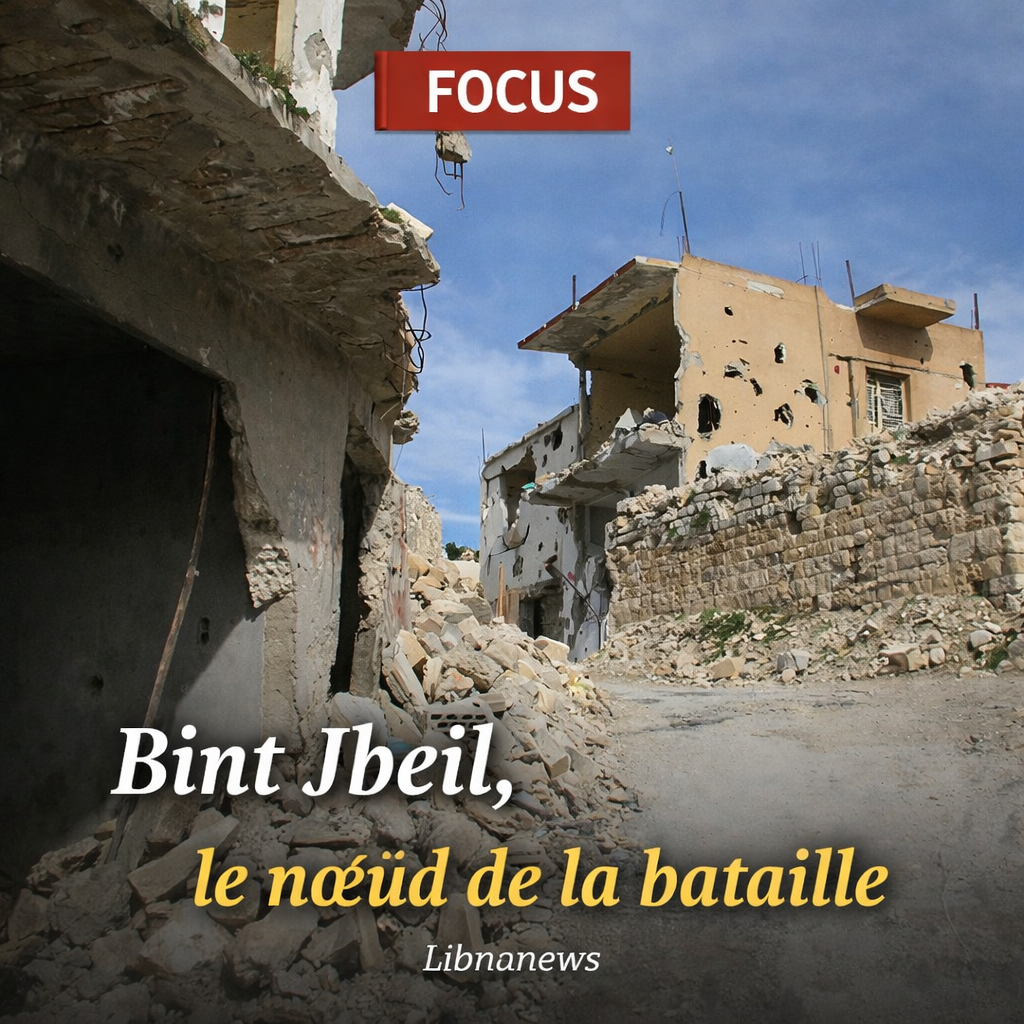
In Bint Jbeil, the battle ceased to be a mere episode of the southern front and became one of the centres of gravity of the war. This city, just a few kilometres from the Israeli border, focuses on both military issues, symbolic issues and diplomatic issues. For several days, the Israeli army has claimed to tighten its grip on the city and its surroundings, while Hezbollah continues to portray the area as an active area of resistance. Fighting now takes place on a much finer scale than the major air offensives at the beginning of the month. They spread in the urban fabric, around accesses, old quarters, buildings transformed into support points and roads that connect Bint Jbeil with other southern localities. At the same time, Washington is trying to advance direct discussions between Beirut and Israel. This superposition between city battle and diplomatic recovery gives Bint Jbeil a range that far exceeds its size.
What is being played out there is not just tactics. The city has become a test. For Israel, it must prove that a land offensive can permanently begin Hezbollah’s military architecture in the southern band and pave the way for a deeper security zone. For Hezbollah, it remains a place to hold, slow down, use and challenge the idea of a clear Israeli victory. For official Lebanon, Bint Jbeil sums up the impasse of the moment: the country is discussing a ceasefire and a return to state sovereignty while an intense urban battle is redrawing the ground. In this sequence, the city becomes less a point on the map than a revealing of the real power ratio.
Why Bint Jbeil focuses so much on issues
Bint Jbeil is not a locality in southern Lebanon. Its proximity to the border makes it an obvious geographical lock, but its scope is also political. The city has long been associated with the imagination of Hezbollah’s resistance and with the memory of the clashes with Israel. Its symbolic value was further enhanced after the Israeli withdrawal of 2000, and then in the 2006 war, when its name became a direct confrontation marker. It is this dual dimension, strategic and narrative, which explains the intensity of the discourses around the present battle. When Israel says it wants to neutralize Bint Jbeil, it does not only talk about a field objective. He speaks of a political bastion. And when Hezbollah resists in this city, it does not only defend positions. He also defends a story.
Militaryly, the interest of the city is even more concrete. Bint Jbeil commands axes to several surrounding villages and fits into a territorial depth that weighs on the security of the northern border of Israel. Israeli officials claim that the area served as a command, storage and launch hub for Hezbollah operations. This assertion is difficult to verify independently in detail, but it sheds light on the coherence of the ongoing offensive. For Israel, taking Bint Jbeil would mean reducing firing capabilities from this pocket, securing some of the border approaches and demonstrating that Hezbollah can be pushed out of its traditional strengths. That is why Israeli statements about the city have also been supported in recent days.
This centrality finally explains why Bint Jbeil weighs more on diplomacy than other sectors. The direct open discussions in Washington between Lebanese and Israeli representatives take place at a time when fighting is particularly intense. The implicit message on the Israeli side is clear: negotiations are undercover with a desired military advantage. The message on the Lebanese side is the opposite: priority must remain the ceasefire, the return of the displaced and the end of the bombings. Between these two approaches, Bint Jbeil acts as a scene of truth. If the Israeli army consolidates an advance, it strengthens its weight at the table. If Hezbollah slows down the offensive longer than expected, it shows that the force does not impose everything.
A slow and costly urban battle
Since 9 April, according to consistent reports, the Israeli army has entered Bint Jbeil after gradually encircling the city. Land units are advancing with the support of aviation, artillery and armoured personnel, in a logic now typical of Israeli operations in Lebanon: slow progression, high air cover, preventive destruction of structures deemed to be trapped or used for military purposes, and then tightening around areas where resistance remains. According to an Israeli military source relayed by a news agency, « full operational control » of the city could be reached within a few days. This formula deserves attention. It does not necessarily mean political or total control of the ground. Rather, it refers to the ability to circulate, strike, prevent organized fire and contain the remaining combatants in smaller areas.
The character of the fighting suggests a real street war, even if the information fog remains thick. Geo-localized dispatches reported direct clashes, artillery fire, strikes on the old town, and repeated raids on the nearby towns of Quinine, Tibnine, Jmeijmeh and Ghandouriyah. This density of incidents around Bint Jbeil indicates that the battle is not limited to its administrative center. It includes a set of villages, roads and support points that either strengthen defence or more closely surround the city. In this type of configuration, the slowest progression is not a sign of automatic failure. It also corresponds to the nature of urban combat, where every street, building and crossing can become a trap.
Hezbollah, for its part, seems to have chosen a defense attrition. The available information refers to the use of small groups, anti-tank fire, snipers, improvised explosives and hidden positions in the built environment. This procedure is not surprising. It corresponds to the doctrine of the movement when it comes to compensating for Israeli technological and air superiority. The goal is not necessarily to keep each parcel of land intact. It is often to slow down, inflict losses, complicate the narrative of a quick victory and turn each other’s advance into a political cost. Israel, for its part, claims to have killed more than 100 Hezbollah fighters in and around Bint Jbeil and claims that only a few dozen remain cut off. These figures, from a belligerent source, cannot be independently verified at this stage. However, they say one thing: the Israeli army wants to show that the battle is entering its final phase, even as the ground continues to produce fighting.
The city as a bastion and message
The importance of Bint Jbeil also comes from the surrounding language. Benjamin Netanyahu described it as the « hezbollah capital in southern Lebanon, » and the Israeli army associated it with the idea of a major bastion to be shot down. This rhetoric is not annoyed. It turns a military objective into a symbolic catch. The city becomes the place where Israel intends to demonstrate that war is not just punitive or defensive, but transformative. The idea of a security zone to the Litani, openly claimed by the Israeli staff, presupposes that cities such as Bint Jbeil cease to be active Hezbollah centres and, on the contrary, become neutralized, controlled or banned.
This neutralization logic has immediate consequences on the ground. It involves the destruction of infrastructure, the crushing of neighbourhoods suspected of sheltering combatants and the widening of the dangerous zone far beyond the immediate contact lines. It also aims to make it more difficult for people to return quickly. Even without a homogeneous and permanent occupation, a city subjected to street fighting, repeated strikes and the destruction of houses is entering a state of prolonged suspension. This is one of the major effects of the battle. It produces a vacuum. A human vacuum, because civilians are fleeing or unable to return. An urban vacuum, because living space is shrinking. And a political vacuum, because the Lebanese state has no effective control over the pace of this transformation.
For Hezbollah, on the other hand, Bint Jbeil remains a position that he cannot abandon without symbolic cost. The movement has built part of its legitimacy on the ability to stand up to Israel in the South, to charge for any incursion and to record its fighting in a historical continuity. This explains the particular burden of this battle, far beyond its tactical value. To lose Bint Jbeil, or even to allow Israel’s narrative of a decisive takeover to be imposed without dispute, would be to begin one of the pillars of Hezbollah’s discourse on himself. That is also why the battle is so observed throughout Lebanon. She speaks of memory, prestige and narrative as well as military topography.
A battle that already shapes the negotiations
Perhaps most striking in the current sequence is the overlap between the intensification of fighting and the resumption of direct discussions between Lebanon and Israel in Washington. On 14 April, under the aegis of US Secretary of State Marco Rubio, representatives of both countries held their first direct exchange of this level in decades. Washington’s framework is that of a process, not an immediate agreement. But the gap between the two delegations remains deep. Beirut emphasized the ceasefire, the return of internally displaced persons and the response to the humanitarian crisis. Israel insisted on the disarmament of Hezbollah and refused to make the truce the focus of the discussion.
In this context, the Battle of Bint Jbeil has a direct bearing on diplomatic dynamics. On the Israeli side, the idea is obviously to negotiate while consolidating a position of force on the ground. On the Lebanese side, on the contrary, it is a matter of preventing dialogue from being used for an imposed military advance. This contradiction explains the tone of the reactions in Beirut. Several political and religious leaders support the diplomatic path, but almost all of it depends on sovereignty, Israeli withdrawal and the cessation of attacks. In fact, Bint Jbeil shows that the attacks continue and that the South Lebanese space remains redesigned by Israeli army operations.
The battle also affects the Lebanese domestic debate. Hezbollah rejects direct talks and continues to denounce a path that, in its view, exacerbates national divisions. The government, on the other hand, seeks to defend a state line without appearing to legitimize forced normalization. In between, Bint Jbeil acts as a maximum voltage point. As long as the fighting is active, the idea of a peaceful negotiation seems almost theoretical. And yet, it is often at a time when the terrain is hardening the most as external mediations activate. The city thus becomes the mirror of a negotiation under fire, where each military advance seeks to change the terms of the dialogue before they are even stabilized.
Civilians caught in the vice
As often in the South Lebanon wars, the battle is also a matter of unseen civilians. In recent days, the Lebanese authorities have reported more than 2,000 deaths in the country since the outbreak of the large-scale conflict and more than 1.2 million internally displaced persons. These data cover the entire Lebanese theatre, but they say something about the pressure on the South. In Bint Jbeil, continued fighting not only prevents the return of the inhabitants, but also complicates access to relief, weakens health structures and exposes humanitarian workers. The International Committee of the Red Cross also expressed its deep concern at the impact of strikes on relief workers and medical facilities in the South, including in Tyre and Bint Jbeil.
Urban violence has a specific effect here. In a city battle, the damage is not just collateral. They become structural. Housing is destroyed or rendered uninhabitable. The schools are closing. Shops disappear. Water, electricity and traffic systems are collapsing or idling. To this is added a deeper phenomenon: the inability of families to join their villages, sometimes even to bury their dead. Testimonials from Nabatiyah, relayed by an international news agency, show that some residents are forced to temporarily bury their loved ones in Beirut because they cannot go down to the South. This detail tells a lot about the depth of the shock. War doesn’t just interrupt life. It also interrupts the rituals that organize death.
In Bint Jbeil, this human dimension already weighs on the next. Even if the fighting were to slow down quickly, the problem of return would remain. A very damaged city, mined by the strikes, crossed by suspicions of explosive devices or abandoned caches does not return to habitable in a few days. The experience of previous wars in Lebanon shows this. We need to clear, check, rebuild, restart services, and above all restore a minimum sense of security. But the current Israeli strategy is precisely aimed at establishing a deep and lasting insecurity in the south of the Litani. This means that the battle of Bint Jbeil will not necessarily stop with the last exchange of fire. It can extend into the long time of absences, ruins and prevented returns.
What the Battle of Bint Jbeil reveals
- First, South Lebanon is no longer just a front of harassment or point strikes. It becomes a theatre of heavy urban battles, where the conquest of a city serves a strategic and symbolic objective at the same time.
- Secondly, the current diplomacy did not suspend military logic. In Bint Jbeil, it is even the opposite: the terrain seems to be used to weigh on the terms of the discussions.
- Finally, the Lebanese state remains a spectator of a battle which, however, directly reshaped its future sovereignty, its social fabric in the South and its ability to bring the displaced back.
A changeover without a simple exit
The great battle of Bint Jbeil cannot therefore be read as an isolated local confrontation. It is part of a broader sequence in which Israel seeks to transform the security geography of southern Lebanon in a sustainable manner, while Hezbollah attempts to preserve its resilience and political legitimacy. Between the two, Lebanese society cashes destruction and the State tries to obtain by diplomacy what it does not control by force. This combination explains the particular density of the moment. Bint Jbeil is not just another battle. It is a condensation of the current conflict.
If the Israeli army succeeds in imposing lasting operational control over the city, it will be able to argue that its slow progress strategy, backed by massive firepower, produces visible results. If Hezbollah continues to impose costs and prolong confrontations, it can defend the idea that even an encircled bastion will not be absorbed without resistance. In both cases, the city will come out more destroyed, more empty and more difficult to re-register quickly in a normal life. This is perhaps the most important point of this battle: it is already changing Bint Jbeil before its military outcome is fully clarified.




