

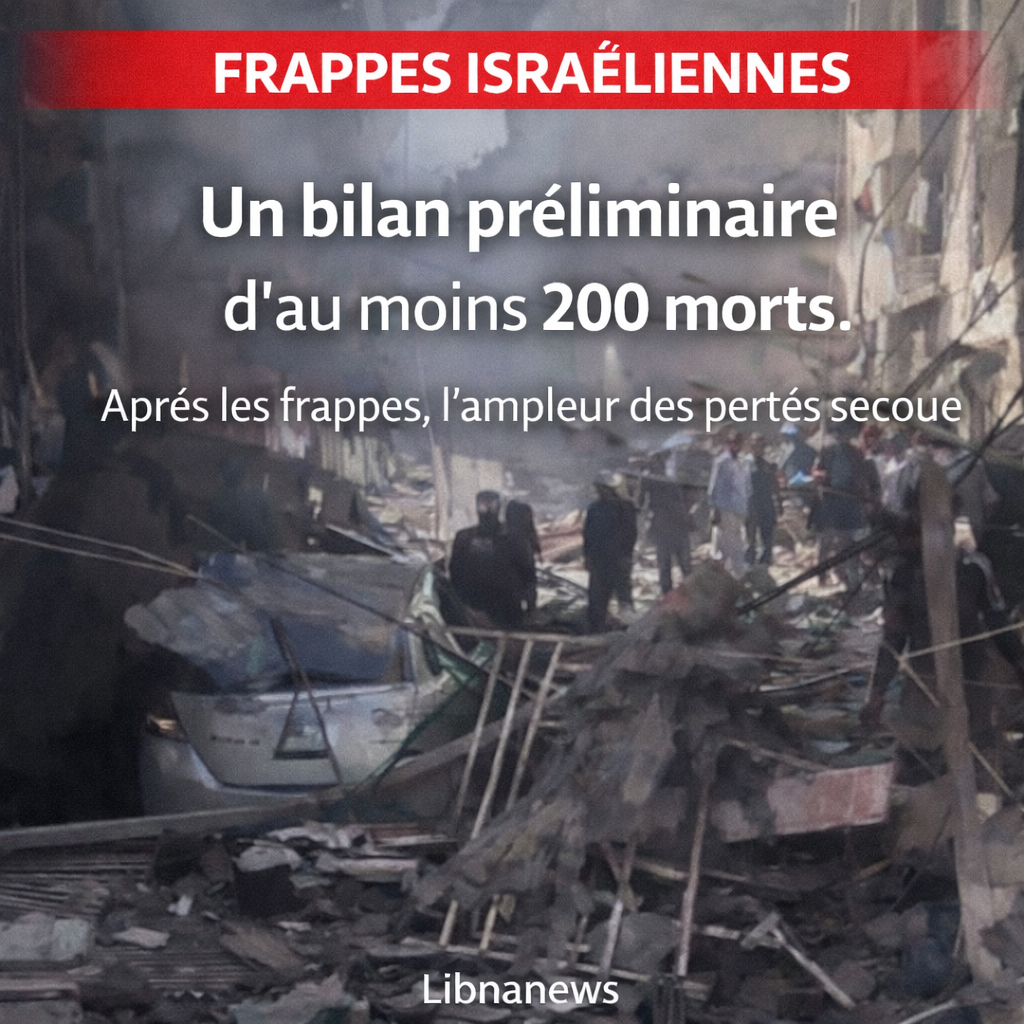
On Tuesday afternoon, Israel led a wave of strikes of exceptional magnitude on Beirut, its suburbs, Saida, Bekaa, Tyre and many localities in southern Lebanon. According to information provided by the Israeli army, approximately 100 Hezbollah sites and infrastructure were targeted in approximately 10 minutes in Beirut, Bekaa and the south of the country. At the same time, local reports indicate a preliminary assessment of at least 200 deaths, including many civilians in all of these strikes. This assessment has yet to be consolidated by the Lebanese health authorities, but the geographical extent of the raids and the increasing number of calls for blood donation already indicate a very high-intensity sequence.The strikes claimed by the Israeli army are confirmed by its public statements.
An Israeli operation of magnitude claimed as coordinated
The Arab-speaking spokesman for the Israeli army, Avichay Adraee, claimed that a large-scale operation had been carried out in Lebanon. According to the statement,Approximately 100 Hezbollah military sites and infrastructurewere beatenin about ten minutestoBeirut, inthe Bekaaand inSouthern Lebanon. The objectives announced include:Headquarters,command and control centres, infrastructure related toFire systemsandmaritime capacity, as well as positions attributed to the elite forceRadwanand air unit127. Israel also claims that the operation was based on accurate intelligence and several weeks of preparation. This claim is part of the continuation of the Israeli line of the day: the Lebanese front, according to Jerusalem, remains outside the ceasefire with Iran.
This Israeli communication aims to provide a unified framework for strikes perceived on the ground as being extremely dispersed. By presenting the whole as a single planned operation, IDF seeks to show that it is not isolated raids, but a coordinated campaign across Lebanon. It also reinforces the Israeli political message: despite the regional truce, the war against Hezbollah continues without any recognized pause.
Beirut, the southern suburbs and the peripheral areas affected
In the Beyrouthin agglomeration, the strikes and reports concernedBeirut,Ain al-Mreishh,Al Manara,Bir Hassan,Jnah,Kola,Corniche el-Mazraa,southern suburbsandHey el-Sellom. Dahiyah neighbourhoods had already been warned of evacuation earlier in the day, includingHaret Hreik,Ghobeiry,Lailaki,Hadath,Bourj el-Barajneh,Tahwitat al-GhadirandChiyah. A few days earlier, strikes onJnahhad already caused several deaths and dozens of injuries, showing that the urban areas of Beirut had become regular targets.
The strike on theNasereddine supermarkettoHay El Sellomhas given rise to many calls for blood donation, a sign of a large influx of injured people according to local accounts. At this stage, the reliable open sources consulted do not yet allow a consolidated balance sheet specific to this site. On the other hand, the urgent need for blood and the repeated calls for medical solidarity are in line with the situation of multiple victims in the southern suburbs. The Lebanese Ministry of Health also maintains emergency measures and publishes regular reports on the victims of the Israeli campaign.
Saida, Haret Saida, Khalde and coastal axis also struck
Further south and along the coastal axis, communities and neighbourhoods reported as affected includeSaida,Haret Saida,Khaldé,SarafandandBissaryeh. An agency report published on Wednesday already mentioned at leasteight dead and twenty-two wounded in Saidain a separate strike on the city. This figure does not cover the entire wave of daily bombardments in all the regions mentioned, but it illustrates the extent of the losses already recorded on a single coastal city.
The fact that Saida and its immediate environment are targeted at the same time as Beirut, Bekaa and South Lebanon shows that the sequence does not obey a narrow border logic. It is a simultaneous projection over several depths of the territory. For civilians, this means that the risk is no longer confined to a single combat band, but it affects both large urban centres, roads and coastal residential areas.
Aramoun, Bshamun, Kaifoun, Souk al-Gharb: the mountain also affected
Local information also reported strikes onAramoun,Bchamoun,KaifounandSouk al-Gharb. These localities mark an additional extension of the raids to the mountain overlooking Beirut and the southern axis. Again, this very broad geography suggests an operation to saturate several areas considered by Israel as part of Hezbollah infrastructure or its networks. The reliable open sources consulted do not yet give detailed results, locality by locality, for this part of the sequence, but the dispersion of the strikes is consistent with the Israeli framing of a large-scale operation against a wide territorial mesh.
This extension to the heights and intermediate areas between Beirut and the south increases the national perception of the crisis. It further reduces the possibility for residents to consider certain regions as areas of retreat. In a war where internal displacement is massive, this has a direct effect on families fleeing the targeted areas and seeking to reposition themselves in supposedly safer areas.
Bekaa and northeast: Shamshtar under a « fire belt »
In Bekaa, reports mentionShamshtarand its heights, targeted by an intense dam described locally as a« Fire belt ». Other areas in the eastern part of the country were also affected during the day. Strikes on the Bekaa are not new in this war, but their synchronization with raids on Beirut, Saida and the South accentuates the impression of a coordinated national operation.
The Bekaa occupies a strategic place in the logistics, territorial depth and geographical continuity of the Lebanese Shia space. An attack on this region, combined with simultaneous strikes on the capital and the South, has a scope that goes beyond military tactics. It means that the Israeli campaign intends to maintain pressure on all the axes considered structural for Hezbollah, not just on villages close to the border.
South Lebanon: Tyre, Jouaya, Ansar, Zefta, Deir ez-Zahrani and many affected localities
South Lebanon has been particularly targeted. The localities mentioned in the reports include:Sour (Tyr),Jouaya,Ansar,Charkiya,Zefta,Houmin al-Tahta,Deir ez-Zahrani,Deir Kanoun al-Nahrand other cities and villages in the South. In previous dispatches, strikes onDeir al-Zahraniand other localities in the area had already caused deaths, confirming that this area remains one of the most active cores of the ongoing war.
The South is also the region where the Israeli army justified its campaign by the desire to establish a security depth and to strike the positions of Hezbollah on a lasting basis. But today’s sequence shows that Israeli action has not been limited to border proximity strikes. It was conducted at the same time on Beirut, the coast, the mountain and the Bekaa, which gives the South the role of one link among others in a larger simultaneous offensive.
At least 200 deaths according to preliminary results: a figure still to be consolidated
The most serious element of this sequence is thePreliminary assessment of at least 200 deathsadvanced in the local information you transmit. At this time, this figure is not yet confirmed by a consolidated count published by the Lebanese health authorities or by the major news agencies for the entire wave of strikes. It must therefore be presented as aPreliminary local assessment, which may evolve. On the other hand, the general context makes a very heavy balance plausible: the strikes were simultaneous, very widespread geographically, and affected dense urban areas as well as residential areas.
What is already established more firmly is that the Israeli campaign in Lebanon had causedat least 1,461 deathsaccording to Reuters on April 5, thennearly 1,500 deadaccording to Reuters on April 6, andmore than 1,530 deathsAccording to figures transmitted on 8 April by the Lebanese press from the Ministry of Health. An episode of massive bombardments such as that on Tuesday can, therefore, cause an already extremely heavy national record to rise sharply.
Blood donation calls confirm a major health emergency
Another strong indicator is blood donation calls that multiply after strikes. In urban bombings, these calls usually occur when hospitals receive a significant number of serious injuries requiring transfusions, surgery and intensive care. The Lebanese Ministry of Health regularly recalls its emergency lines and the hospital circuits mobilized, proof that the medical system is already operating under constant pressure.
When these calls spread after strikes onHay El Sellom, the southern suburbs, Saida and other sectors, they report a situation beyond the simple local emergency. They reflect systemic stress on reserves, operating blocks and the capacity of several facilities at the same time. In a country already tested by weeks of bombing, each raid of this magnitude has a health chain effect far beyond the target location.
A regional truce that does not protect Lebanon
This day of strikes confirms above all a central political fact: in the Israeli reading, Lebanon remains outside the ceasefire with Iran. The dispatches published on 8 April report that Israel supports the break with Tehran while claiming that the battle continues against Hezbollah. The claim of a massive strike at about 100 sites gives this position an immediate military translation.
In other words, the de-escalation between Washington and Tehran did not freeze the Lebanese theatre. On the contrary, the bombings of Beirut, Saida, the mountain, Bekaa and the South show that Lebanon continues to absorb the shocks of regional escalation. If the preliminary record of at least 200 deaths is confirmed, this sequence will be one of the most deadly days of the recent campaign and will further reinforce the idea that Lebanon remains the main dead end of the truce.
Keyword:Israeli strikes
Keywords Secondary SEO:200 dead Lebanon, Beirut, Saida, Bekaa, Tyre, Hay El Sellom, blood donation
Description:Massive Israeli strikes targeted Beirut, Saida, Bekaa and South Lebanon, with at least 200 deaths at the local preliminary level.
Extract:
Israel carried out a wave of massive strikes on Beirut, its suburbs, Saida, Bekaa, Tyre and many localities in southern Lebanon. The Israeli army claims to have targeted about 100 Hezbollah sites in ten minutes. At the same time, local preliminary assessments show at least 200 deaths, a figure still awaiting official consolidation. Calls for blood donation are increasing, while the regional truce appears more than ever without protective effect for Lebanon.
Alternative securities suggestions:
- At least 200 dead in massive Israeli strikes
- Beirut, Saida, Bekaa: Lebanon hit on a large scale
- Israel claims 100 targets, Lebanon counts its dead
- Massive strikes in Lebanon, blood calls multiply
- Lebanon under bombs despite regional truce
Exact number of body words:2,351




