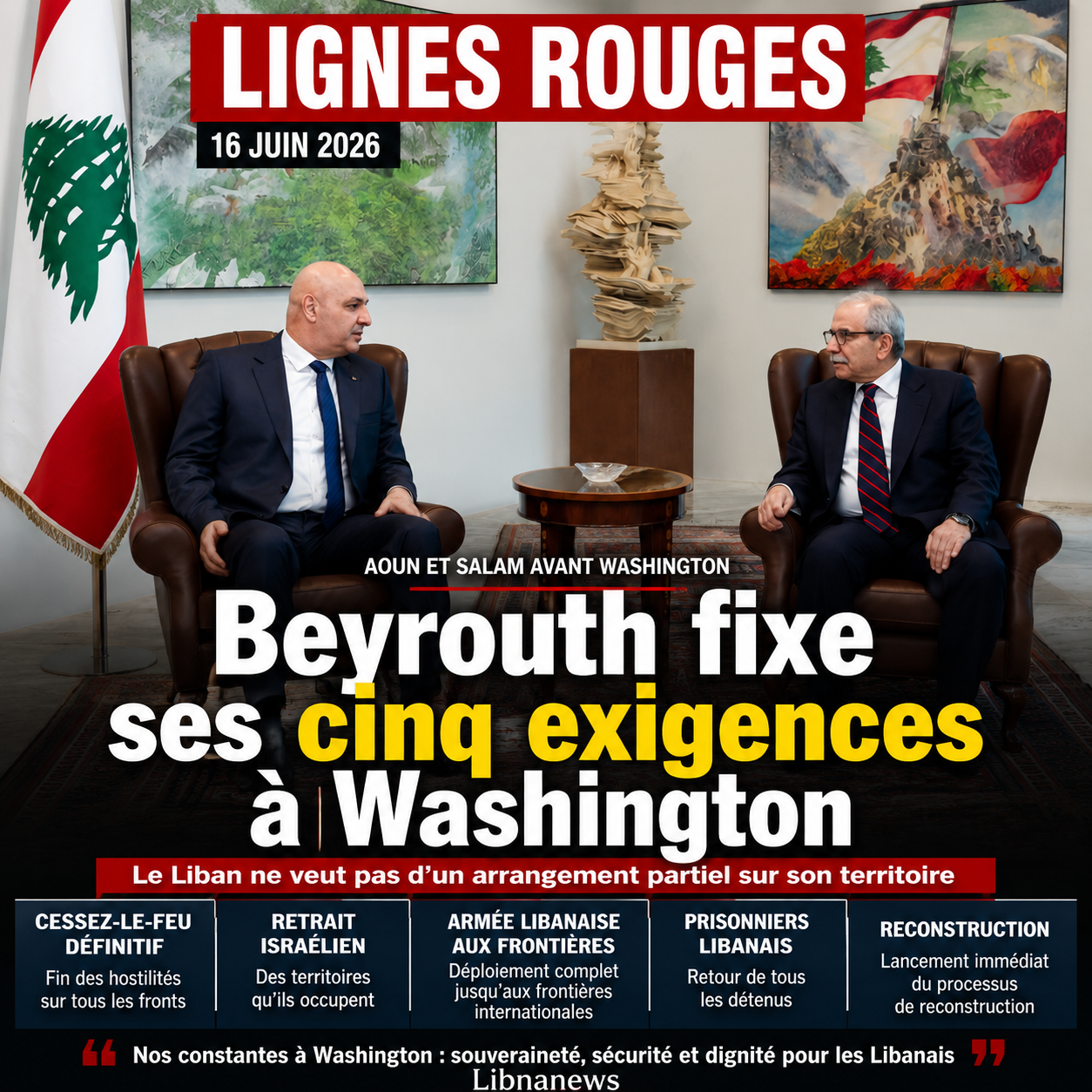
The President of the Republic, Joseph Aoun, and Prime Minister Nawaf Salam, set the constants of the Lebanese position before the next round of negotiations in Washington. Their statement, published after a meeting at the Baabda Palace, puts Lebanon’s case back in the sequence opened by the announcement of a memorandum of understanding between the United States and Iran. The official message is based on five requirements: a permanent cessation of fire, the withdrawal of Israeli forces from the territories they occupy, the deployment of the Lebanese army to international borders, the return of Lebanese prisoners and the launching of reconstruction. This formulation is not only diplomatic. It outlines the framework in which Beirut wants to avoid regional détente becoming a partial arrangement on its own territory.
The full press release, translated into French
The President of the Republic, General Joseph Aoun, discussed with the President of the Council of Ministers, Dr. Nawaf Salam, at a meeting held at the Baabda Palace in the morning, the current local and regional developments following yesterday’s announcement of the agreement on a memorandum of understanding between the United States and the Islamic Republic of Iran, as well as the assessment of the reactions to this agreement, in addition to the contacts with Lebanon in this context.
Discussions also focused on the ongoing preparations for the next round of the Lebanese-American-Israeli negotiations in Washington, D.C., scheduled for next week.
Presidents Aoun and Salam considered that the American-Iranian understanding was a positive factor in the reduction of tensions in the region, which it was pushing towards peaceful solutions and the end of the state of war.
The two Presidents confirmed the consistency of the Lebanese position in the Washington negotiations, namely the permanent cessation of fire, the withdrawal of Israeli forces from the territories they occupy, the deployment of the Lebanese army to international borders, the return of Lebanese prisoners and the initiation of the reconstruction process.
Lebanon wants to lock its diplomatic mandate
The press release is brief, but its construction is accurate. It begins with the institutional scene, with a meeting between the Head of State and the Head of Government. It continues with the regional reading, focusing on the American-Iranian memorandum. He then introduced the Washington Canal, where the Lebanese-American-Israeli negotiations were to take place. It ends with the Lebanese constants. This order has political significance. He indicated that Beirut did not want to approach negotiation as a mere appendix to the dialogue between Washington and Tehran. On the contrary, the Lebanese authorities seek to place their own mandates in a wider sequence, without allowing national priorities to dilute in a regional agreement.
The first data of the text is the unit displayed between Joseph Aoun and Nawaf Salam. In the Lebanese system, this unit weighs. Sovereignty and security issues often face differing readings between institutions, parties and community blocs. By presenting a common position, the Presidency and the government want to reduce the scope for interpretation. The press release does not suggest that Beirut arrives in Washington with open requests or an infinitely negotiable list. He claims constants. The word is important. It means that the five points are not tactical options, but the minimum bases of the Lebanese position.
This institutional unit also responds to an internal risk. Any negotiations with Israel, whether indirect or supervised by Washington, raised suspicions in Lebanon. Part of the opinion fears disguised normalization. Another feared an agreement that would keep Hezbollah at the centre of southern security. Still others fear that Lebanon will pay the compromise price between external powers. Recalling that negotiations are about a final cease-fire, withdrawal, army deployment, prisoners and reconstruction, the communiqué seeks to limit these suspicions. It gives the approach a defensive and sovereign tone.
A final stop to the fire, not a simple truce
The first axis concerns the final stop of the lamp. The formula goes beyond the simple call to calm. It presupposes the end of a state of instability where fighting can resume at any time. For the Lebanese authorities, an incomplete truce is not enough. It can reduce immediate losses, but it does not allow the return of the inhabitants or the resumption of economic activities in the South. It keeps the villages uncertain. It prevents schools, municipalities and public services from operating with minimal visibility. Lebanon therefore wants a cessation of hostilities that closes the military sequence, instead of suspending it.
This requirement meets a simple logic. Without a lasting stop to the fire, no other point can move forward. The Lebanese army cannot fully deploy under threat of strikes or incidents. Prisoners cannot be treated in a climate of constant tension. Reconstruction cannot start in areas that may be destroyed again. Lebanese diplomacy therefore places the final cessation of fire at the beginning of the chain. It makes it the practical condition for any return to state authority. The central issue will be the monitoring mechanism. A political commitment will have little effect if there is no procedure to establish violations and to draw consequences.
Israeli withdrawal as a condition of sovereignty
The second is the Israeli withdrawal from the occupied territories. This is the most sensitive point in the press release. It reflects a demand for sovereignty, but also a political calculation. As long as Israeli forces remain on Lebanese territory, the Lebanese State appears prevented. He can claim his authority, but he cannot exercise it completely. This situation gives an argument to armed actors who argue that resistance remains necessary. It also weakens the political forces that want to defend the state’s arms monopoly. For Beirut, therefore, Israeli withdrawal is not a secondary clause. It determines the credibility of any solution.
The release avoids long formulae, but it poses a clear equation. The Israeli withdrawal must precede or accompany the return of the Lebanese army to international borders. The two elements cannot be separated. A withdrawal without the presence of the State would open a dangerous vacuum. A military presence without complete withdrawal would place the military institution in an untenable position. It would be called upon to protect sovereignty that would remain incomplete. The Lebanese authorities therefore want to articulate the two movements. The departure of Israeli forces must pave the way for an effective deployment of the army, not competition between armed actors.
The Lebanese army as an institutional response
The third axis, the deployment of the army, meets the expectations of several actors at the same time. He reassures the partners who want the Lebanese state to regain control of the South. It responds to people who demand more stable security. It also offers a political response to those who fear that the Israeli withdrawal will only benefit Hezbollah. But this mission remains heavy. The army must act in a degraded environment. It will have to cover villages affected by the fighting, fragile axes and areas where mistrust remains strong. It will need means, coordination and a clear mandate. The communiqué indicates the objective, but the negotiation will have to specify the conditions for implementation.
This question of means cannot be ruled out. The Lebanese army has been going through a material crisis for years due to the country’s economic collapse. Its soldiers carry out numerous missions, from internal security to border surveillance. Increased deployment to international borders requires additional resources. It requires vehicles, equipment, fuel, communications, infrastructure and close coordination with international forces. By placing the army at the centre of its position, Beirut also sends a message to foreign partners: Lebanese sovereignty will not be restored by declaration. It must be financed, protected and organised.
Lebanese prisoners, a human component
The fourth axis concerns the return of Lebanese prisoners. This mention gives the communiqué a human dimension. It recalls that the end of a war is not limited to the silence of weapons or military cards. It also affects families, memories and personal injuries. The return of prisoners has a high symbolic value in a country where detention, disappearance and captivity records have often accompanied regional crises. By integrating this point into the Washington mandate, Aoun and Salam indicate that Lebanon does not want to leave this issue at an uncertain later stage. It must be part of the rules.
This human dimension can also facilitate political acceptance of an agreement. The people of the South and the families directly concerned are waiting for concrete signs. A negotiation that would bring only general formulations would soon be challenged. The return of prisoners, if it materializes, would give materiality to relaxation. It would show that the process affects people, not just chanceries. But it will require a precise method. Lists, identity checks, clarification of statutes and modalities of return will be required. This file can move forward in discretion, but it cannot be abandoned in the blur.
Reconstruction, concrete test of the agreement
The fifth axis is reconstruction. It arrives at the end of the press release, but it represents the social test of the whole process. A ceasefire without reconstruction would leave the inhabitants in ruins. A withdrawal without repair would not be enough to restore local life. The affected villages need roads, networks, housing, schools, clinics and economic activities. Reconstruction is not just a financial programme. It requires the return of families and the restoration of public authority. The slower the state is to rebuild, the more the partisan or community networks occupy the aid field.
Speaking of launching the reconstruction process, the two presidents did not announce an immediate project. They require a timetable. First, it will be necessary to secure areas, assess damage, mobilise funding and coordinate municipalities. But the inclusion of this point in the press release shows that Beirut wants to link diplomacy with visible results. The public will not judge the negotiation by the length of the texts or the number of meetings. She will judge it on the possibility of returning, repairing houses, reopening shops and retaking agricultural land. That is where the credibility of the process will be played.
The US-Iranian agreement changes the pace
The passage on the American-Iranian memorandum also deserves attention. Aoun and Salam describe it as a positive factor for the reduction of tensions, peaceful solutions and the end of the state of war. The formula remains measured. It recognises the possible effect of a relaxation between Washington and Tehran, without presenting this agreement as an automatic solution for Lebanon. This caution is logical. The Lebanese case depends in part on regional reports, but it has its own constraints. South Lebanon is not only a front linked to Iranian balances. It is also a inhabited territory, a disputed border, a fragile institutional space and an issue of national sovereignty.
The press release therefore shows a dual strategy. Beirut welcomes the decline in regional tension, as it can reduce the risk of escalation. But Beirut also recalls that any de-escalation must result in concrete measures on Lebanese territory. That’s the stakes of the next round of Washington. The discussions will not be limited to welcoming the new atmosphere created by the memorandum. They will have to test the mediators’ ability to convert this dynamic into a final stop to fire, a withdrawal, an army deployment, a return to prisoners and a reconstruction. Without this transition to concrete action, Lebanon would remain suspended from decisions taken elsewhere.
Washington against the five Lebanese constants
The Lebanese-American-Israeli format mentioned in the press release illustrates this tension. It gives the United States a central role in mediation and guarantee. It places Israel in the face of Lebanese demands made by the institutions. It also requires Beirut to present a clear mandate. But this format remains politically sensitive. Lebanon must avoid the impression of direct normalisation. It must maintain a negotiating margin. It must also take into account the internal actors who will monitor each word of the process. The strength of the communiqué comes precisely from its sobriety. He does not venture into details that could open up controversies. It sets goals that many Lebanese can recognize as legitimate.
Analysis of the text finally helps to understand what Beirut wants to avoid. The first danger would be a security agreement that would leave occupied areas and postpone withdrawal to a unclear date. The second would be a military calm without an effective military deployment. The third would be a promised but unfunded reconstruction. The fourth would be a record of prisoners referred to further discussions. The fifth would be a regional agreement that stabilizes relations between major Powers without settling Lebanese sovereignty. The five constants in the press release respond point by point to these risks. They form an evaluation grid for Washington negotiations.
The challenge will be to transform this grid into a mechanism. The Lebanese authorities will have to request a timetable, guarantees, verification procedures and funding commitments. They will also have to explain to the Lebanese what is being achieved, what remains under discussion and what cannot be accepted. Baabda’s statement opens this sequence by setting markers. It does not resolve contradictions. He exposes them. The next step will tell whether Washington can produce an arrangement that respects the constants announced, or whether Lebanon will again have to manage an incomplete truce, disputed territories, displaced families and suspended reconstruction.