

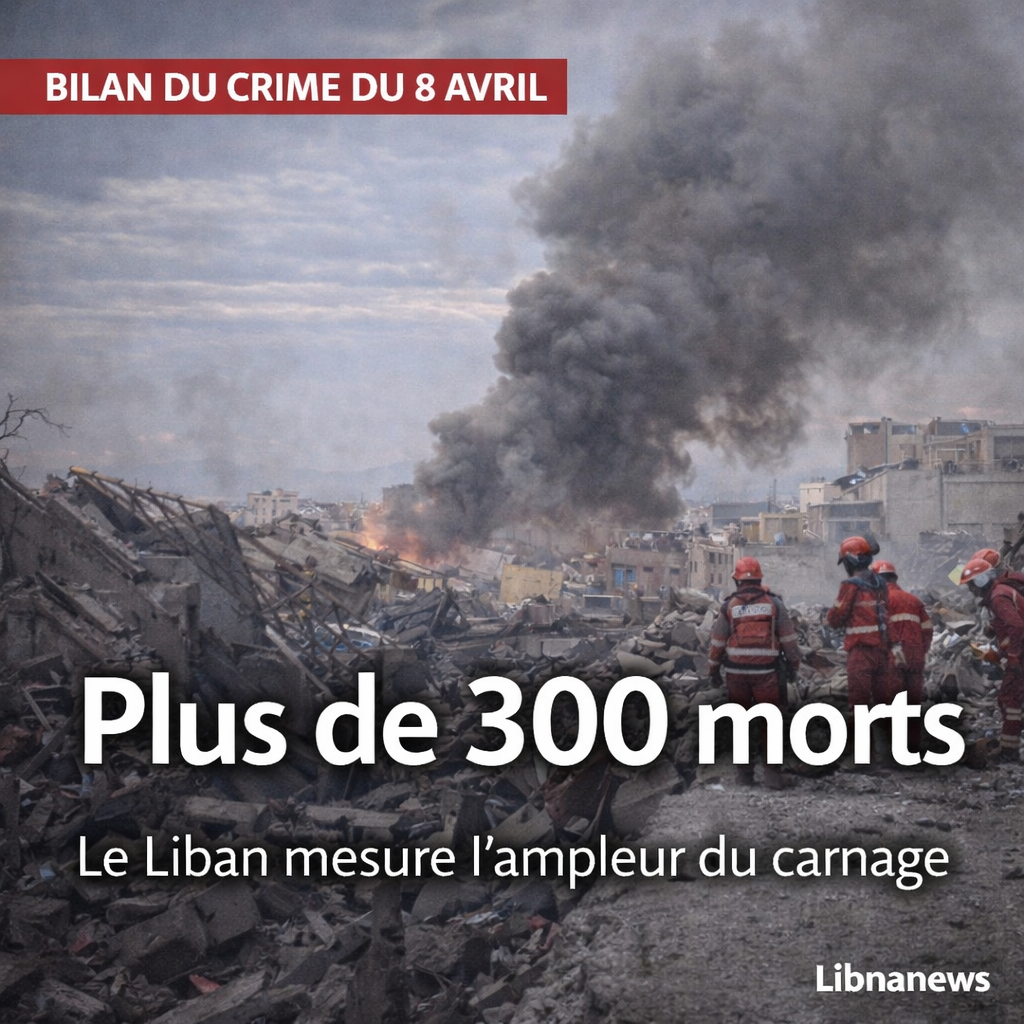
Israeli strikes in Lebanon on Wednesday, 8 Aprilmore than 300 deaths, according tofinal interim assessment of the Lebanese Ministry of Healthin your dispatch. If this figure is confirmed, it will mark a new threshold in the ongoing war. The whole day of Wednesday was marked by a brutal sequence: fleeting hope for a regional ceasefire, American and Israeli clarification excluding Lebanon, and then wave strikes of exceptional magnitude on Beirut, the Bekaa and the South. The results published earlier by Reuters, the PA and other media were lower, showing that the count continued to rise over the hours, as relief progressed and hospitals centralized the data.
Wednesday had begun as a possible regional de-escalation. After the announcement of a ceasefire between Washington and Tehran, part of Lebanon was able to believe, for a few hours, that the Lebanese front would also be drawn into a calming logic. This hope was quickly broken. The United States reported that Lebanon was not included in the truce, and Israel followed the same line, saying that its war against Hezbollah would continue. It was in this climate of diplomatic confusion that the day turned into mass violence.
The Israeli army then launched what it itself presented as the largest wave of strikes against Hezbollah since the beginning of this war phase. Reuters reported that Israel reported targeting more than 100 sites, including in Beirut, the Bekaa Valley and the south of the country. Witnesses, first aid workers and journalists described a rare sequence of intensity, focusing on an extremely short period of time. The Guardian spoke of « the most deadly ten minutes in decades, » while Reuters evoked the heaviest strikes since the outbreak of this war in early March.
The first few hours were marked by considerable uncertainty about the actual number of victims. Reuters first reported a report from the Ministry of Health stating that89 dead and 700 injured. Then the Associated Press reported a figure of182 dead and nearly 900 injured. At the same time, Reuters quoted the Lebanese Civil Defence, which advanced254 deaths. Even later, the PA reported an official balance sheet of203 dead. The fact that your dispatch now refers tomore than 300 deathsTherefore, it is part of a continuous progression of the count as the bodies are cleared, identified and recorded.
This increase in the balance sheet remains consistent with the very nature of the strikes. The attacks affected several areas at once, including dense areas of the capital. AP reported that commercial and residential areas in central Beirut had been hit, while Reuters and other media documented strikes in the South and the Bekaa. In such a context, the balance sheets often go up in steps: first the deaths immediately recorded, then those found under the rubble, and finally those who succumb to their wounds in the following hours. This is why the current figure should be presented asprovisionalEven though it already bears witness to a large-scale massacre.
Wednesday was not only a murderous day. It also disorganized the entire emergency chain. Reuters reported the situation at Rafic Hariri Hospital in Beirut, where families rushed to identify mutilated bodies, while ambulances and rescue teams tried to keep pace with the influx. The World Health Organization then warned that some Lebanese hospitals might lack vital supplies in the following days, after consuming in a single day the equivalent of three weeks of trauma kits. The human score on Wednesday is therefore not only in the number of deaths, but also in the immediate exhaustion of the hospital system.




