

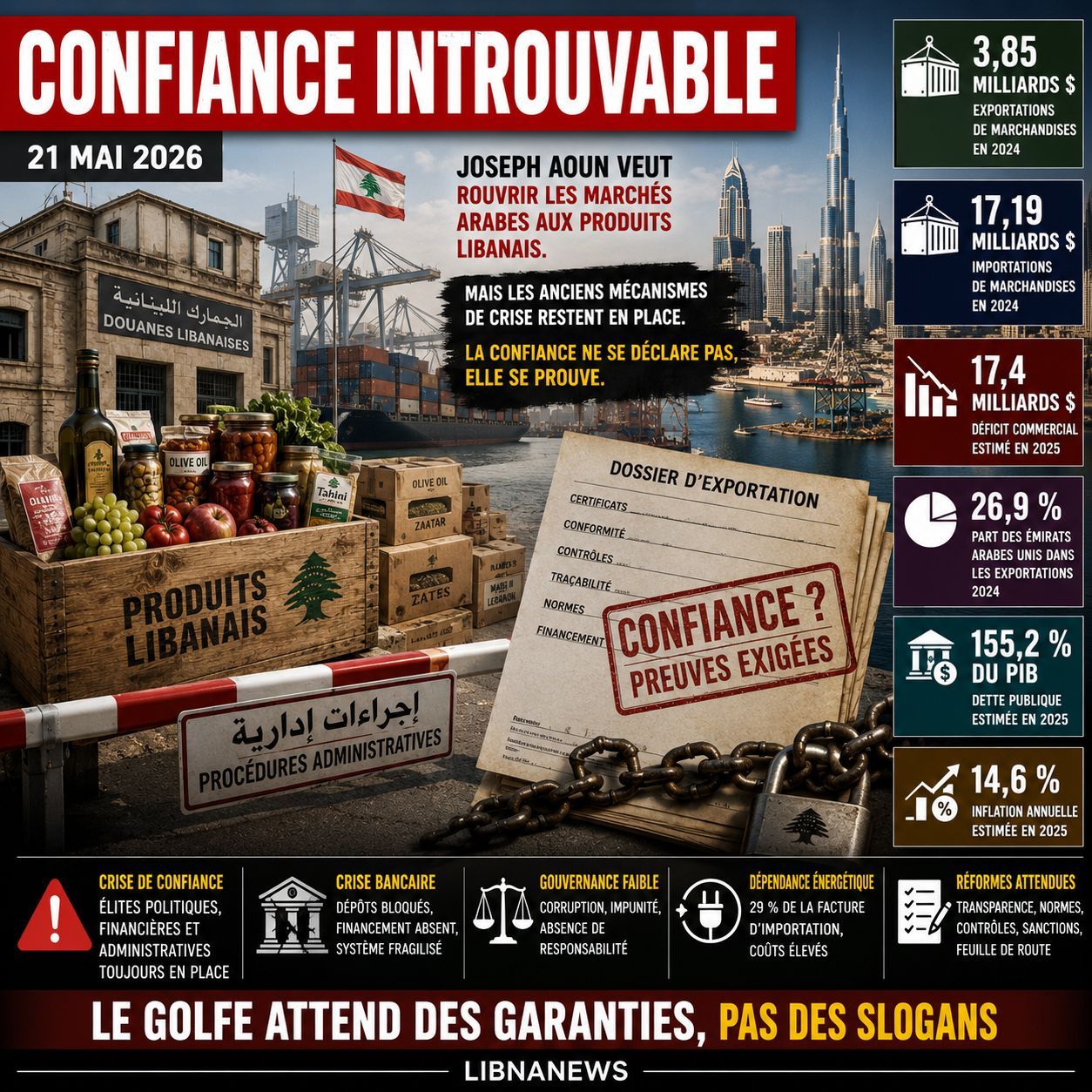
President Joseph Aoun wants to reopen the Arab markets to Lebanese products. The objective may seem natural for an economy whose external opportunities remain vital. But the central question is no longer just selling in the Gulf or regaining market share. It is tougher: how can we restore confidence when much of the political, financial and administrative actors associated with the Lebanese collapse remain in the landscape? Without public reporting, without clear responsibility, without verifiable reform and without accepted figures, the call for confidence may remain a slogan without economic strength.
Arab markets: a vital outlet, not a slogan
The reopening of Arab markets is a priority in the official discourse. President Joseph Aoun presented it as an economic and diplomatic objective, focusing on the Gulf markets. The message speaks to producers, industry, farmers and exporters. He also speaks to Arab capitals, who have been watching Lebanon with caution for years.
The stake is real. Available trade data show that Lebanon cannot treat Arab markets as a secondary issue. In 2024, Lebanese merchandise exports reached about $3.85 billion. The United Arab Emirates alone accounted for 26.9 per cent of these exports, or nearly $1.03 billion. Egypt accounted for 5.6%, Iraq 5.3%, Jordan 2.8% and Syria 2.6%. These figures do not tell the whole story, as some goods can be re-exported or re-routed. But they confirm that Arab space, and especially the Gulf, remains a decisive outlet.
The problem is that this market is not guaranteed. He deserves it. Gulf markets have become more competitive, more controlled and more diversified. Turkish, European, Asian and regional suppliers took advantage of Lebanese crises to occupy spaces. Lebanon maintains a reputation in some niches, but a reputation is not enough. Buyers want regular volumes, deadlines, reliable certificates, solid sanitary standards and an administration that can respond.
It is here that the presidential formula on trust becomes insufficient if it is not followed by acts. Trust is not rebuilt by statements. It is verified in an accepted cargo, in a recognized certificate, in a proper customs control, in a bank that processes a payment, in a border that does not allow questionable practices to pass and in a State that punishes breaches.
Figures recall the fragility of the model
Lebanon exports, but much more important. International trade data indicate that in 2024 goods imports reached about $17.19 billion, compared with $3.85 billion in exports. The gap is massive. It shows the country’s dependence on imported goods, energy, medicines, food, machinery and consumer goods often paid in foreign currency.
| Economic indicator | Available data |
|---|---|
| Exports of goods in 2024 | $3.85 billion |
| Imports of goods in 2024 | $17.19 billion |
| United Arab Emirates’ share of exports 2024 | 26.9 % |
| Exports to the United Arab Emirates in 2024 | $1.03 billion |
| Exports to Egypt in 2024 | $214.1 million |
| Exports to Iraq in 2024 | $204.7 million |
| Estimated public debt in 2025 | 155.2% of GDP |
| Estimated annual inflation in 2025 | 14.6% |
| Annual inflation in 2024 | 45.2% |
| Annual inflation in 2023 | 221.3 % |
| Commercial deficit of goods estimated in 2025 | $17.4 billion |
| Share of the merchandise trade deficit in GDP in 2025 | 56.8% |
| Share of energy imports in import invoice in 2025 | about 29% |
These data show that the reopening of Arab markets is necessary, but that it cannot, alone, repair the external imbalance. Even an increase in exports will not be enough if imports remain so high and the economy continues to rely heavily on imported energy. The World Bank estimates that energy imports accounted for about 29 per cent of the import bill in 2025. This exposes the country to every oil price shock, every regional crisis and every transport tension.
The situation is all the more delicate as the trade deficit in goods has remained very high. For 2025, it is estimated at $17.4 billion, or 56.8 per cent of GDP. Under these conditions, exports to Arab markets are not a luxury. They are a necessity. But they cannot be presented as a magic solution. Trade structure, productive weakness, energy dependence, logistics, standards and financing must be addressed.
Trust, but to whom?
Trust dominates the official discourse. He’s fair. But it imposes a question which the article must ask in front of it. Trust who? To the same parties, the same networks of influence, the same financial circles and the same administrations that accompanied the collapse? To a system that has allowed depositors to lose access to their money, the state loses its credit, the currency loses its value and public services deteriorate?
The question is not only moral. It’s economical. A foreign buyer may like Lebanese products, but he does not sign a contract with emotion. He’s assessing the risk. An investor does not only look at the creativity of entrepreneurs. It looks at justice, governance, banks, regulatory stability and the state’s ability to impose rules. A country may have competent producers and remain penalized by its political system.
The World Bank has used very harsh terms to describe the Lebanese crisis. She spoke of a deliberate depression and an elite who captured the state and its economic annuities. In another report, she questioned the logic of Lebanese public finances by referring to Ponzi-type finance rather than orderly public finances. The International Monetary Fund, for its part, has linked the return of trust to governance, the fight against corruption and the norms against money-laundering and illicit financing.
These findings create a political problem for the current discourse. Restoring confidence cannot mean asking the Lebanese and Arab partners to forget. We have to explain what has changed. Who’s accountable? Who controls the banks? Who guarantees deposits? Who’s pursuing abuse? Who prevents the return of the same pension mechanisms? Who protects serious exporters from the bad reputation created by failing actors?
Without answers, the word trust becomes almost a provocation for part of the population. Households that have lost their savings cannot hear the same vocabulary without asking for evidence. Entrepreneurs who have seen their credit lines disappear want to know whether the state really defends production or still protects the balances that have led to the impasse.
A State that wants to sell, but must first be held accountable
Lebanon needs to export. But the State cannot ask others to reopen their markets while avoiding the subject of liability. Arab markets are not just commercial spaces. They are political partners who observe Beirut’s ability to correct itself. The Gulf countries have the means to choose their suppliers. They can wait. They can turn to other sources. Lebanon needs to regain lost time.
The first condition is transparency. The authorities must publish a roadmap. What products are concerned? What lines are ready? What obstacles have been identified with each country? What health or customs requirements should be updated? Which laboratories are recognized? Which departments are responsible? What deadlines are set? The announcement of a presidential will will never replace a monitoring table.
The second condition is administrative responsibility. If a certificate is fragile, if a cargo is a problem, if a border post allows fraud, if a service blocks a file for opaque reasons, a chain of responsibility is required. Serious companies cannot be punished by the faults of other actors. The country must protect its signature. This requires sanctions, not just calls for unity.
The third condition is financial reform. Exporting companies need labour capital. They must buy raw materials, produce, package, transport, wait for payment and absorb variations in costs. In a country where the banking crisis has destroyed the normal relationship between companies and banks, this step remains critical. The reopening of Arab markets may create demand, but it will not automatically provide the necessary financing to meet it.
The fourth condition is political. Lebanon will not be convinced for a long time if the state gives the image of a divided power, unable to speak with one voice on security, diplomacy and the economy. Exporters do not need slogans. They need a predictable country.
The Gulf does not only judge products
The Gulf countries do not just buy a product. They’re evaluating an environment. They look at origin, traceability, reputation, transport channels, banking guarantees and political relations. This may seem harsh, but it is consistent with normal market practices.
Lebanon sometimes tends to believe that its products must be welcomed because of their historical quality or cultural attachment. This reasoning is insufficient. Competition did not stop during the Lebanese crises. Other countries have improved their standards, modernized their packaging, structured their agricultural sectors and strengthened their trade promotion agencies. Lebanon must now catch up.
The figures of 2024 show that the United Arab Emirates is the first destination for Lebanese exports of goods. This data is important. It may reflect varied trade flows, including re-exports or high-value goods. It should not be read as a mere industrial success. Rather, it requires a detailed analysis: which products actually go to the Emirates? What is the share of gold, jewellery, vehicles or other particular categories? What is the share of food or local production that creates jobs? Without this ventilation, the overall figure can give an image too flattering.
The issue of products is therefore central. If the objective is to support employment and regions, the productive sectors that generate local value must be identified. The country must not only increase the number of exports. It must increase exports that support farmers, workers, technicians, carriers and small businesses.
Exports that must create work, not just statistics
The reconquest of Arab markets will be useful if it supports a real economy. However, part of Lebanese exports may come from products with high value but with low direct social effects. International data rank vehicles, gold, jewellery, petroleum products, diamonds, metal waste or certain equipment among the first export outlets. This profile should lead to caution. A good export figure does not necessarily mean a broad productive recovery.
The priority should be to strengthen sectors that employ and anchor activity in the regions. Agri-food, certain agricultural products, processing industries, food brands, niche products, packaging, associated services and professional events can play this role. But these sectors need standards, certification, energy, transport and financing. They also need more coherent business promotion.
The Economic, Social and Environmental Council can be used to raise this issue. It must not only accompany the official speech. It may request detailed figures by sector, destination and employment effect. It can monitor legislation, administrative bottlenecks and departmental commitments. It may also publish regular reports. If it is limited to a protocol presence, it will become another institution in a country that is largely lacking execution.
An economy weakened by poverty and inflation
The debate on exports should not mask the social state of the country. The World Bank estimates that poverty among Lebanese remains very high, around 36 per cent in 2025, after a peak linked to the effects of conflict and economic contraction. Food insecurity was reported to have declined from the end of 2024, but remained around 13 per cent at the beginning of 2026. These figures indicate that the forecast recovery remains fragile for most households.
Inflation has fallen sharply from the extreme shock of previous years, but remains high. It rose from 221.3 per cent in 2023 to 45.2 per cent in 2024 and then to 14.6 per cent in 2025. This slowdown does not mean that prices have become affordable again. It means above all that the rate of increase has decreased. For families, the price level remains high. Expenditure on education, housing and food continues to weigh.
In this context, the argument of the Arab markets must be linked to everyday life. Reopening an outlet only makes sense if it creates work, stabilizes businesses and supports income. If openness benefits only a few already well connected actors, it will not restore social trust. The country needs a model in which exports also serve economic dignity.
Weight of energy imports
Lebanon remains a prisoner of its energy dependence. This data directly affects its competitiveness. Production is expensive when electricity is uncertain and private solutions are needed. Transporting is expensive when fuel weighs on every step of the chain. Refrigerate, pack, store and ship also cost more. The Lebanese exporter therefore leaves with a handicap.
The rise in energy prices due to regional tensions exacerbates this problem. The World Bank warns that oil prices, freight costs and reconstruction needs can rekindle inflationary pressures and affect the external deficit. This constraint is direct. A Lebanese product can be of good quality and lose a contract because its final price becomes too high.
Energy reform is therefore an export policy. It is not just a technical dossier or a legacy of crisis. If electricity remains expensive and unstable, Lebanese producers will find it difficult to compete with countries where energy is more predictable. Here again, the discourse of trust joins the issue of governance. The electricity sector has long symbolized public failure. As long as it remains without a durable solution, it will weaken any production strategy.
The actors in place and the cost of suspicion
One of the most sensitive points remains the continuity of political staff and decision-making networks. Lebanon has changed its president and government, but many forces that have participated in the old system remain present in institutions, parties, councils, banks, administrations and decision-making channels. This reality feeds suspicion.
This suspicion is not just a popular feeling. It influences the markets. External partners want to know whether new promises will be blocked by old interests. Donors want to know whether the reforms will be emptied of their content. Exporters want to know whether public services will work for everyone or only for those closest to power centres. Depositors want to know whether the banking crisis will be addressed or postponed.
Lebanon cannot rebuild confidence by avoiding this issue. It must show that rules change, even if actors remain. This requires effective parliamentary oversight, independent justice, credible audits, comprehensive banking reform, transparency in public procurement, combating smuggling and clearer access to economic information. Without this, confidence will remain blocked at the speech stage.
What a roadmap should contain
A serious strategy for Arab markets should start with public figures. The Government should publish exports by destination, sector, local value added and employment capacity. It should distinguish between re-export flows and productions that directly support the Lebanese economy. It should also identify countries where political, health, logistical or banking barriers exist.
The second stage should focus on standards. Each priority stream should know the requirements of the target market. Producers need to know which certificates to obtain, which laboratories to use, what documents to prepare and what controls to follow. Administrations must simplify procedures without weakening them.
The third stage concerns economic diplomacy. Lebanese embassies should be mobilized on specific targets. They should monitor files, organize contacts, report blockages and report. Economic diplomacy cannot be a general formula. It must become a service to productive sectors.
The fourth stage concerns funding. Export-ready companies must have guarantee tools, payment solutions and access to credit. Without this, only the richest companies can benefit from the demand. The reopening will then become a privilege, not a revival.
The fifth step is responsibility. Any incident that undermines the reputation of Lebanese products must be documented, treated and sanctioned. The country cannot afford to lose a market because of fraud, weak control or political intervention.
A promise to be measured
Joseph Aoun’s speech has the merit of placing Arab markets in economic strategy. But it opens up an obligation of results. In six months, we’ll have to be able to measure what’s changed. Have any contracts been reopened? Have any restrictions been lifted? Have any sectors obtained new certificates? Have any contracts been signed? Have productive exports increased? Were small businesses accompanied? Have the administrations reduced the deadlines?
This is essential, as Lebanon has for too long lived on unfollowed announcements. The country no longer has the luxury of the general formula. Producers are waiting for open doors, not promises. Arab partners are waiting for guarantees, not declarations. Citizens expect responsibility, not a new national narrative about resilience.
Trust can come back, but it won’t come back for free. It involves saying what has been lost, which has failed, which will be corrected and how the same errors will be prevented. Arab markets can be a stimulus. They can also become a political test. If the promise turns into a verifiable roadmap, it will give a strong signal. If it remains a sentence in an official sequence, it will join the long list of missed opportunities.




