

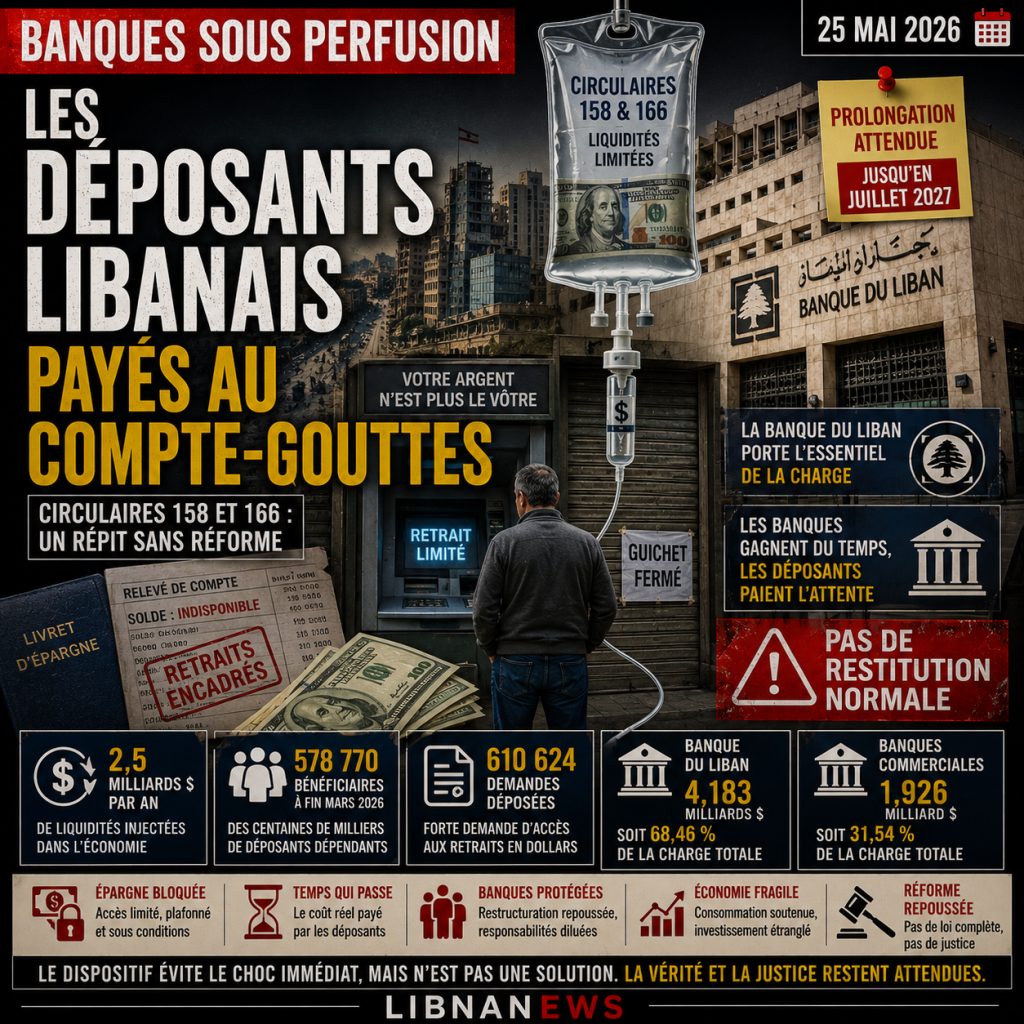
Lebanese depositors remain under bank infusion seven years after the start of the financial collapse. The expected extension of Circulars 158 and 166 maintains cash flow in dollars for hundreds of thousands of accounts. But this mechanism does not address the loss crisis, the liability of banks or the issue of deposit return. It stabilizes part of the consumption, while prolonging a situation where savers finance waiting.
Lebanese applicants facing framed survival
The scheme is based on a limited promise: to allow some depositors to withdraw a framed portion of their funds each month. Circular 158 and Circular 166 form the heart of a survival economy. They avoid a sharp break for private households with normal access to their accounts. They also inject dollars into the current economy. But their extension, without increasing amounts, shows that the Lebanese banking crisis is not entering a settlement phase. It moves into administrative management of the shortage.
Available data give the extent of this infusion. The two circulars would represent more than $2.5 billion in cash per year. At the end of March 2026, 578,770 beneficiaries were identified. The total number of applications filed was 610,624. Since the inception of the mechanism, cumulative payments amounted to $6.109 billion. Of this total, the Bank of Lebanon had assumed $4.183 billion, or 68.46 per cent, while commercial banks had covered 1.926 billion, or 31.54 per cent. These figures describe less an exit from crisis than an interim sharing of pain.
The first lesson is simple. The Bank of Lebanon has the largest share of the effort. Banks contribute, but to a much smaller extent. This distribution feeds a central political and economic question: who really pays for the collapse? The depositors lost the free disposal of their money. The central bank mobilizes its resources to maintain flows. Banking institutions are saving time. Political power rejects a comprehensive restructuring law. The chain therefore postpones the most difficult decision: to recognize the losses and distribute them clearly.
| Indicator | Available data | Economic reading |
|---|---|---|
| Annual cash flow | Over $2.5 billion | Maintenance of minimum consumption |
| Beneficiaries at the end of March 2026 | 578 770 | Very broad social base of dependent applicants |
| Applications filed | 610 624 | Strong request for access to framed withdrawals |
| Cumulative payments | $6.109 billion | Structured structure |
| Share of the Bank of Lebanon | $4.183 billion, or 68.46% | Main charge borne by the central bank |
| Share of banks | $1,926 billion or 31.54 per cent | More limited bank contribution |
Minimum stability, not restitution
The one-year extension, without increasing payments, confirms the choice of minimum stability. A recipient who receives a thousand dollars per month would continue to receive the same amount between July 2026 and July 2027. This continuity can reassure families who organize their budget around these withdrawals. It makes it possible to pay rent, care, education, debts or part of food expenses. But it does not protect against the erosion of purchasing power if prices increase. A fixed dollar amount may seem solid. It does not necessarily cover the needs of a household exposed to medical expenses, private electricity costs or rising import costs.
The paradox is there. The circulars give money to Lebanese depositors, but confirm that they do not recover their money as a normal right. They receive a withdrawal authorization, monthly, subject to conditions and ceilings. The depositor no longer fully owns an account. He becomes beneficiary of a device. This transformation has both moral and economic significance. It changes the relationship between citizen, bank and state. She said private savings remained suspended from monetary decisions and political negotiations.
The Lebanese banking system continues to operate in a grey area. Accounts exist. Surveys exist. Banks remain open. But the contractual relationship was broken. A bank deposit should be available according to account rules. In Lebanon, it becomes a difficult, split, circularized debt. This situation avoids an immediate shock on bank balance sheets. It also protects establishments against a massive demand for restitution. But it transfers part of the cost over time of depositors.
Time as an instrument for the allocation of losses
This time is not neutral. An older depositor may never recover all of his funds. A family that has to finance studies abroad cannot wait ten years. A small private company with its liquidity loses opportunities, suppliers or employees. A monthly withdrawal may help to live, but it does not replace capital. The Lebanese economy needs mobilizable savings to invest, import, produce and create jobs. Circulars maintain basic consumption. They don’t rebuild credit.
The criticism is not to deny the immediate usefulness of the device. The brutal cessation of circulars would cause a social shock. Hundreds of thousands of beneficiaries rely on these payments. The problem comes from their transformation into sustainable policy. An exceptional measure can be justified after a collapse. It becomes dangerous when it replaces a reform. Since 2019, Lebanese officials have often preferred temporary mechanisms to a truth decision. The banking crisis has therefore changed shape, but it has not been resolved.
The cost of this choice can be seen in confidence. Depositors still do not know what share of their funds will be returned, according to what timing, with what rule and under what guarantee. Not all banks present a clear picture of their real capacity. The State has not adopted a comprehensive restructuring framework. The Bank of Lebanon manages the flow, but cannot resolve a domestic solvency crisis alone. In these circumstances, trust does not return. It is limited to waiting for the next payment.
This expectation maintains a two-speed economy. Households receiving monthly dollars have a regular resource. Those who do not fall under the criteria remain more exposed. Those who have already recovered their entire funds according to the mechanisms concerned are outside the scheme. Those still holding large amounts remain prisoners of longer uncertainty. The crisis does not strike all applicants in the same way. It creates administrative categories, while it results from the same collapse.
| Category | Situation | Principal risk |
|---|---|---|
| Active beneficiaries | Boxed monthly withdrawals | Durable dependence on the system |
| Depositors who recovered the accounts concerned | Partial output of the mechanism | Possible loss on other accounts |
| Non-eligible applicants | More limited access to liquidity | Inequal treatment |
| Small enterprises | Funds blocked or split | Investment and employment held back |
| Commercial banks | Less than Bank of Lebanon contribution | Postponement of restructuring |
Banking reform still delayed
The presence of 266,166 depositors who have recovered all their assets in the accounts concerned, or 46% of the beneficiaries, can be described as progress. It shows that the mechanism produces concrete effects for a part of the public. But she can’t hide the rest. More than half of the beneficiaries did not complete their journey. Above all, the accounts covered by the circulars do not necessarily cover all bank losses. The system moves in pockets. It deals with deposit segments, without regulating the general architecture.
The extension also raises a question of justice. Banks have benefited for years from a model based on high rates, inflow of deposits and indirect state financing. When the model collapsed, depositors lost access to their money. The dominant response was to limit withdrawals and spread payments. A policy of resolution should have distinguished responsibilities, protected small depositors, recapitalized or restructured viable banks, liquidated insolvent institutions and established a clear rule for the allocation of losses. This architecture remains incomplete.
Lebanon is paying for the absence of a political decision. Banking reform is not only a technical matter. It affects the interests of shareholders, large depositors, banks, the state, the central bank and parties. Each option creates identifiable losers. The extension of circulars avoids naming these losers. It dilutes the cost over time. This method reduces the risk of an immediate explosion, but prevents the reconstruction of a normal financial system. No productive sector can finance itself sustainably in an economy where the bank inspires mistrust.
An infusion vulnerable to external shocks
The regional crisis further reinforces this weakness. Lebanon remains exposed to tensions over energy, freight, imports and medicines. Households need liquidity to absorb shocks. But withdrawals remain capped. If prices rise, the same monthly rate buys less goods and services. The bank infusion keeps the social body alive, but it does not give it the strength to resist new shocks. The Lebanese economic system therefore remains dependent on external stability which it does not control.
The authorities can defend the extension by invoking pragmatism. As a matter of urgency, payments should be avoided. A minimum of dollars must be maintained in households. Formal banking panic must be avoided, even if trust has already been broken. That argument exists. But it must be accompanied by an exit schedule. Without a calendar, pragmatism becomes inertia. Circulars cannot be the only response to a crisis that has destroyed one of the pillars of the Lebanese economy.
Extension can also weaken the demand for reform. As long as payments continue, some of the social anger remains contained. Officials can present the situation as manageable. Banks can avoid tougher confrontation with their customers. The applicants, on the other hand, are accustomed to a reduced fee. This normalization is the deepest danger. It turns an exceptional spoliation into an administrative routine. It makes the loss of capital, time and confidence less visible. The real cost does not appear only in the balance sheets. It appears in cancelled projects, forced departures, closed businesses and families who reorganize their lives around money that already belonged to them.
The conditions for a real exit from crisis
The exit first requires full transparency on losses. The country needs consolidated, recognized and public figures. He had to know what the bank balance sheets were really worth, what part of the commitments could be fulfilled and what part needed to be restructured. Then we need a hierarchy of protection. Small applicants must be given priority. Bank shareholders must absorb losses before ordinary depositors. Major players who have benefited from the system must be treated differently from households that have placed a life of saving in a bank. Without this hierarchy, reform will remain socially unacceptable.
Exit also implies a reform of banking governance. A system that has lost confidence cannot ask applicants to believe in a simple change of circular. It must accept stricter controls, enhanced supervision, credible audits and clarification of responsibilities. The Bank of Lebanon cannot continue to act alone as a social shock absorber. Banks must be restructured, recapitalised or exited according to known criteria. The sector must shrink if necessary. Priority cannot remain the nominal survival of all establishments.
The question of Lebanese applicants has thus become the heart of a broken social contract. It is not just about bank accounts. It affects trust in the law, in money, in institutions and in the promise of the state. As long as applicants are paid in fragments, without clear recognition of their rights, the crisis will remain open. An economy can survive for a long time under infusion. It cannot rebuild if the infusion becomes its only project.
The next deadline, with the expected extension of the circulars until July 2027, will give a respite. It will prevent an immediate break in flows. It will allow many families to continue to hold. But she won’t answer the central question. Lebanese depositors are not only asking for monthly payments. They demand a rule, a timetable, justice and a truth about their losses. The banking system can still save time. He can no longer claim that this time is a solution.




