

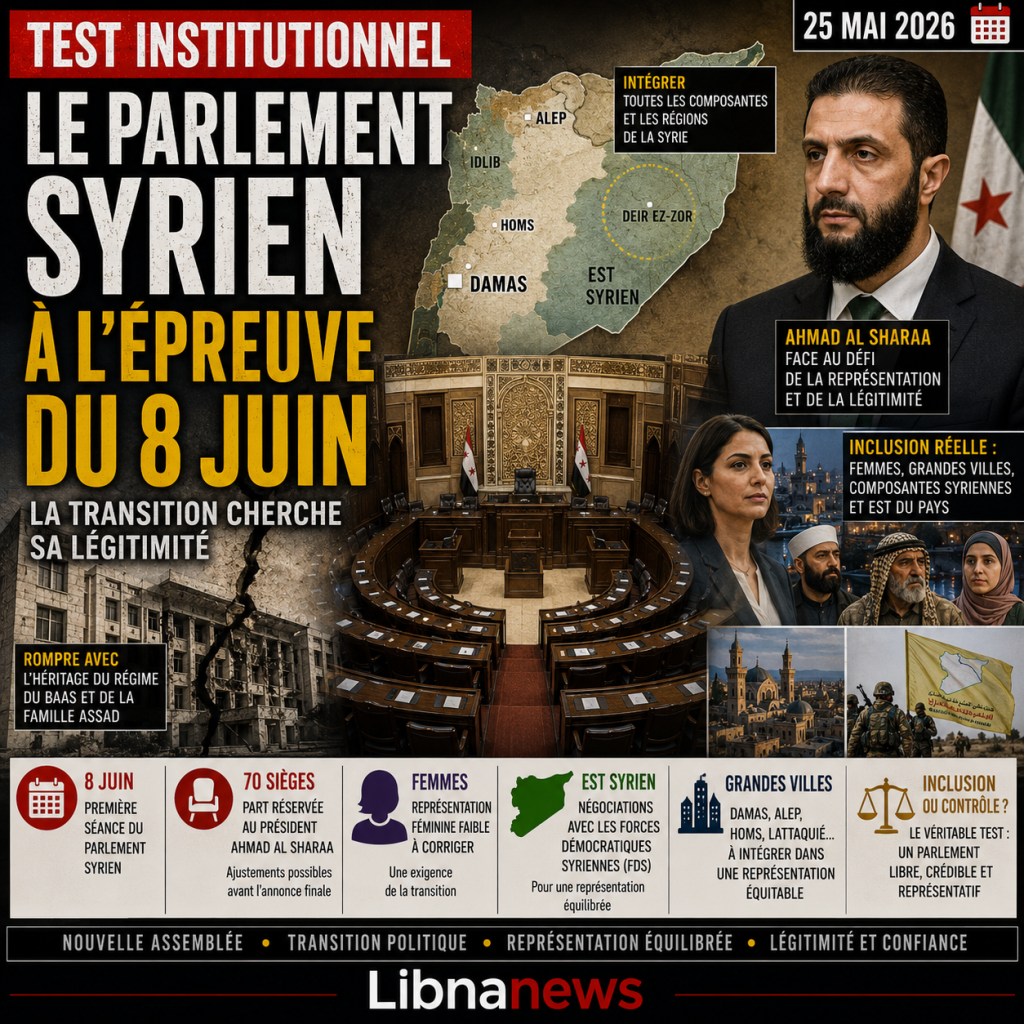
The Syrian Parliament expected on 8 June must open a new but still fragile political phase. The administration of Ahmad Al Sharaa is preparing for the first meeting of an assembly to give an institutional form to the transition, after the validation of local elected representatives and the appointment of a third president of seventy seats. The aim of the initiative is to show the inclusion of major cities, Syrian components and women. However, it remains a central question: can this institution produce real legitimacy, or can it only organise a balance controlled by power?
The Syrian Parliament scheduled for 8 June
The date of 8 June was chosen as the preliminary deadline for the first sitting of the Syrian Parliament. This choice comes after two decisive stages: the announcement of the President’s share and the validation of the members elected by the regional bodies. The calendar gives Damascus’ power a visible instrument to show that the transition is moving forward. It also allows the political debate to move to an institutional forum, after years of war, the collapse of the old apparatus and the recomposition of local forces.
The most important figure concerns the third president. The final list for President Ahmad Al Sharaa would have seventy seats, with the possibility of limited modifications before the final announcement. This reservation shows that the composition is not only administrative. It is an open political arbitration. The government seeks to correct imbalances resulting from local elections. He also wanted to give the assembly a more representative form, without losing control of the new building.
Available sources indicate that the list should include personalities from different Syrian components. It must fill gaps left by the election, strengthen the weight of large cities and localities with a strong popular presence, and respond to the weakness of women’s representation. This vocabulary speaks a lot of Syrian difficulty. The country is not just seeking to appoint deputies. It seeks to repair, at least in appearance, the fractures of representation arising from war, exile, partisan collapse and mistrust of the old institutions.
The presidential third as a tool for balance
The presidential third is the heart of the scheme. In a transition, a designated portion can be used to correct the blind spots of the vote. It can integrate absent regions, underrepresented minorities or useful technical profiles. But it can also become a control tool. It all depends on how the seventy seats are used. If they open the assembly to real voices, they can strengthen its credibility. If they are primarily used to produce a majority loyal to the administration, they will limit the scope of Parliament.
The Syrian administration seems to want to create a form of balance. It must give the big cities, often central to the Syrian political imagination. It must take into account the peripheral regions, some of which have lived outside the direct control of Damascus. It must also integrate religious, ethnic and social components without turning Parliament into a mere symbolic mosaic. The difficulty is to switch from a display representation to an active representation.
The weight of the Presidency therefore remains decisive. Ahmad Al Sharaa seeks, according to the evidence, to create a balance under the parliamentary dome while ensuring a bloc that will support his administration. This dual ambition has nothing unusual in a transition phase. Any power coming out of a war wants to avoid an ungovernable assembly. But the risk is clear. If institutional stability becomes the pretext for excessive control, the Syrian Parliament will be born with weak legitimacy.
This point will be closely observed by Syrians from within, by refugees, by regions still suspicious of Damascus and by foreign partners. A credible assembly must be able to debate, amend, question ministers and make disagreements visible. A too locked assembly can give the image of a return to ancient practices, even under a new name. The Syrian transition therefore plays an important part in the composition of this first session.
Women and cities as political tests
The weakness of female representation was explicitly mentioned as a point to be corrected. This data counts. The war has placed Syrian women in multiple roles: family leaders, displaced women, workers, activists, caregivers, educators and local leaders. Yet their place in political structures is often less than their real role in society. The Syrian Parliament will find it difficult to embody a transition if women remain marginal.
The question is not limited to the number of seats. It is important to know which women will be nominated or elected, which regions they will represent, which issues they will carry and what autonomy they will have. A power-controlled female presence does not have the same effect as a presence capable of defending rights, education, health, displaced persons, widows, prisoners and families of missing persons. The transition will not only be measured when women enter the Chamber. It will measure their ability to influence parliamentary work.
Large cities are another test. Damascus, Aleppo, Homs, Hama, Latakia, Deir ez-Zor, Raqqa or the cities of the eastern region do not bear the same memories or interests. Some have been destroyed, displaced or transformed by war. Others kept an administrative seat. Still others have experienced competing local governance. Strengthening their representation can give Parliament a stronger urban anchor. But it can also awaken territorial rivalries if choices seem unbalanced.
High-popular localities are also cited as a criterion. This suggestion suggests that power wants to avoid an assembly too far removed from demographic realities. It can be used to better represent the places where Syrians really live. It can also respond to accusations of artificial representation. To become credible, Parliament will have to show that its members are aware of the needs of the inhabitants: housing, water, electricity, schools, security, employment, the return of displaced persons and the fate of detainees.
The Eastern Region and the Syrian Democratic Forces
The most sensitive issue concerns the eastern region and the Syrian Democratic Forces. Sources close to the government referred to discussions around the presidential side and promises to raise the representation of the Syrian East. This is a crucial point. East focuses on issues of territory, resources, security, Kurdish presence, Arab components and relations with armed forces that are not all integrated into the Damascus authority.
Negotiations with the Syrian Democratic Forces show that the new institution is not born in a vacuum. It depends on political arrangements with actors on the ground. Parliament can become an instrument of integration if the eastern regions see it as a real place. It can also be rejected if this representation is experienced as a symbolic compensation without effect on local autonomy, security or resources. The Syrian East cannot be treated as a simple box to fill in a list of seats.
The issue of resources makes this issue even more sensitive. Eastern regions are of agricultural, energy and strategic importance. Their parliamentary representation therefore affects the sharing of power and means. An assembly that would discuss the budget, infrastructure or reconstruction without seriously integrating the East could prolong the fractures. Conversely, strong representation could open a way for compromise between Damascus and local forces.
This negotiation will also serve as a test for the relationship between centralisation and decentralization. The post-war Syria cannot simply return to an entirely vertical model. The regions have experienced forms of local management, sometimes constrained, sometimes autonomous. Parliament will have to deal with this reality. He will have to say how far the central State agrees to recognize local authorities, special needs and regional representation mechanisms.
Change name to break with old regime
Another debate concerns the name of the institution itself. Members of the future council would consider proposing the replacement of the name inherited from the old system, associated with the reign of the Baath and the Assad family, by the name of the Syrian Parliament. This change may seem symbolic. He’s not. The names of the institutions bear a political memory. In the Syrian case, the former parliamentary vocabulary remains linked to decades of partisan control, electoral façade and public locking.
Changing the name can therefore be used to mark a break. This can help distinguish the new assembly from the old People’s Council. It can also offer power a transitional image. But the name won’t be enough. An institution can change its label and maintain the same practices. The real test will be on procedures, debate, transparency, control capacity and freedom given to elected officials. The Syrian Parliament will have to prove that it is not just a new sign.
The change of name would require the approval of a majority of members. According to the evidence, this majority would be acquired on a preliminary basis. If the vote takes place, it will give a first signal on the internal discipline of the assembly. A real debate on the name could open a broader discussion on the memory of the previous regime, the nature of the transition and the expectations of Syrians. A rapid and unanimous vote, without real discussion, would, on the contrary, give the image of a rupture controlled by the top.
The memory of the Baas and the Assad family weighs on this moment. After decades of a system where Parliament played a limited role, the new institution must convince that it can represent something else. Institutional breakdown is never pure. Administrative frameworks, political habits and networks often survive regime changes. So the question is not whether everything will be new. She asked whether the assembly would allow new practices.
Election Commission and Process Control
The possible presence of members of the High Electoral Commission in designated seats also raises a question of governance. Sources report that their presence would not contradict the rules that prevented them from running for the local elections, as the seats for nominations were a presidential choice. This legal distinction can be defended. It does not erase the political question. A credible transition must avoid blurring the boundaries between those who organize the process and those who benefit from it.
In a fragile phase, perception counts almost as much as the rule. If officials to supervise elections then enter the assembly by appointment, some will see a confusion of roles. Others will see the choice of appropriate profiles to stabilize the transition. The power will therefore have to explain these choices. It must show that competence is not a pretext for capture and that appointment is not a reward for fidelity.
The transparency of the list will be an important moment. Names, regions, profiles, memberships and routes must be known. An opaque list would fuel mistrust. A balanced list with explanations could build confidence. The Syrians are not just asking for seats. They ask to understand why such an actor is chosen, what audience he represents and what role he will play. In a country of suspicion, detail becomes a condition of credibility.
The validation of members elected by regional bodies should also be considered. It shows that the new Parliament combines elements from local procedures with elements designated by the Presidency. This hybrid model can respond to the reality of a country that is still unstable. It can also reduce the elective reach of the whole. The challenge is to make this mixture a transition to more open representation, not a sustainable supervised appointment system.
An institution facing immense expectations
The future Syrian Parliament will inherit heavy issues. It will have to deal with reconstruction, the reintegration of regions, public services, displaced persons, refugees, detainees, missing persons, the economy, sanctions, justice and security. No Parliament can solve such wide-ranging problems alone. But he can make these files visible. It may require the government to respond. He can put institutional words on the suffering that war has often left without a framework.
The issue of refugees and internally displaced persons would be central. Millions of Syrians have left their homes or countries. Their return depends on security, housing, papers, employment and political confidence. A transitional assembly that ignores this reality would speak to an amputated country. It will have to incorporate, in one way or another, the voice of those who have not yet returned. This can be done through commissions, hearings, consultative mechanisms or seats linked to the most affected regions.
The record of detainees and missing persons remains even more sensitive. A credible parliamentary institution will have to be able to address the truth, families, court files and reparation claims. If it avoids these subjects, it will lose some of its value. If she treats them too quickly, without a frame, she can awaken tensions. The Syrian transition must find a path between justice and stability. Parliament could be a useful place to lay down the first rules, provided that it does not become a board of registration.
The economy will also measure the real. Syrians expect wages, electricity, roads, markets, schools and hospitals. Institutional debates will remain abstract unless living conditions improve. Parliament will therefore have to produce clear priorities. It will have to monitor the budget, foreign financing, the reconstruction of infrastructure and the distribution of resources between regions. In a country where war has widened the gap, fiscal policy will be a policy of reconciliation or division.
Institutional recovery still conditional
The Syrian institutional revival is therefore proceeding under conditions. The first is the composition of the assembly. The seventy presidential seats must really correct imbalances, not mask them. The second is the role of women, major cities and eastern regions. The third concerns the ability of the assembly to discuss with a real margin. The fourth is about breaking up with old practices. A new name will not be enough if the mechanisms remain closed.
Syria is entering a phase where the institution must gradually replace the logic of war. This passage is not decreed. It is built by trust. The Syrians will observe the first session of 8 June on the basis of simple questions: who sits, who speaks, who decides, who controls and who reports. The foreign partners will ask their own questions: can this assembly stabilize the country, represent its components and accompany a gradual return to political life?
Damascus’s power is trying to show that it is moving forward. It has a date, format, a list in the process of completion and a speech of inclusion. The test will begin when the seats are occupied and the first debates reveal the real nature of the Syrian Parliament. The transition will take place not only in the opening of the session, but in the place left to those who do not think like power, to the still distrustful regions and to the issues that the country can no longer push.




