

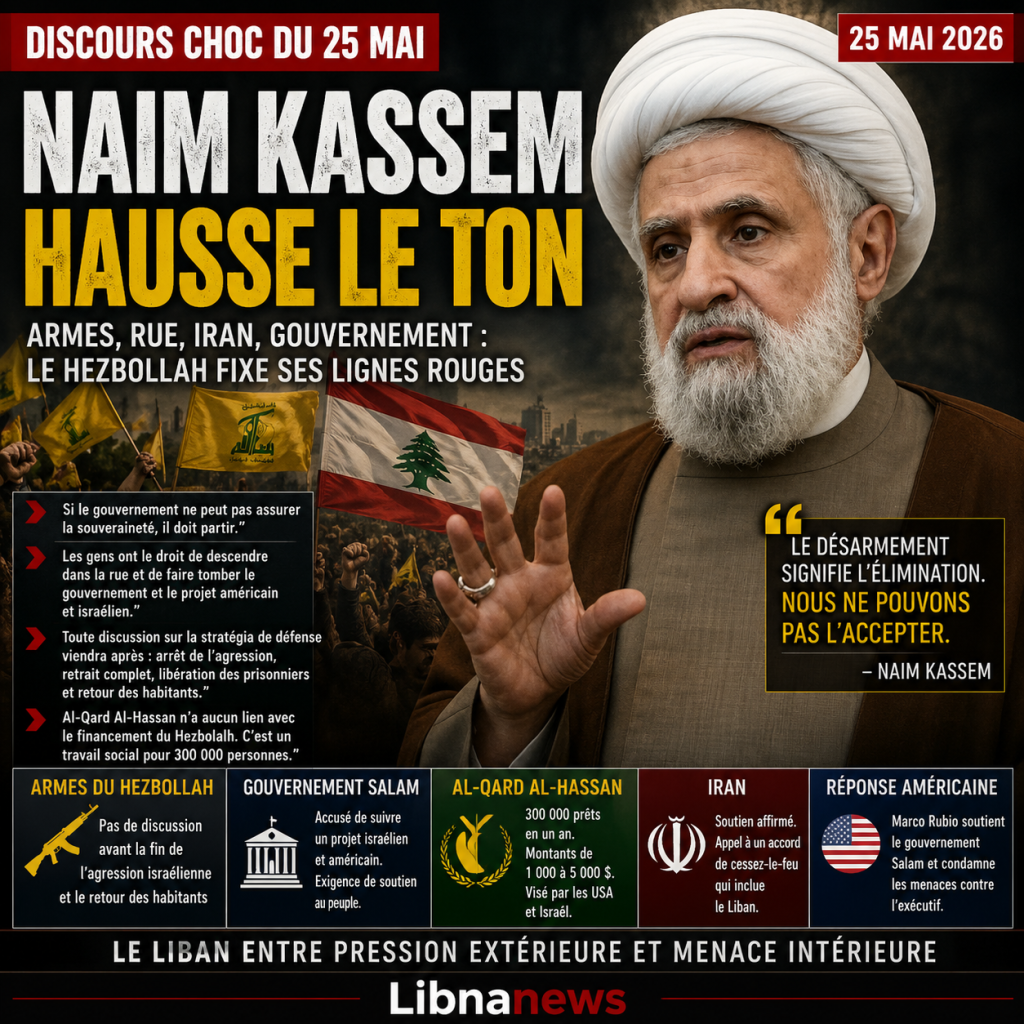
Naim Kassem raises the tone in a sequence where Lebanon awaits the effects of an uncertain regional compromise. His speech on the twenty-fifth anniversary of the Israeli withdrawal from the South set a hard line on the weapons of Hezbollah, the Salam government, the Al-Qard Al-Hassan association, Iran and the aftermath of the war. The statement immediately prompted an American response. It confirms that the Lebanese debate no longer focuses solely on the ceasefire, but on the power to decide on war, peace and reconstruction.
Naim Kassem raises tone on weapons
Naim Kassem’s speech comes at a time of great pressure. The United States and Iran are discussing a regional agreement that could include Lebanon. Israel wants to keep its freedom of action in the South. Nawaf Salam’s government is preparing a security negotiation in Washington. In this configuration, the Hizbullah leader chose to place the issue of weapons at the centre of his speech. He did not treat it as a technical file. He presented it as a line of existence.
He first put his speech back in the memory of May 25. According to him, the liberation of the South in 2000 was the result of the action of the resistors and cooperation between the army, the people and the resistance. He presented this moment as a first Arab liberation without agreement with Israel. This historical reference serves as the basis for the entire discourse. It allows Hezbollah to recall that the armed force has, according to its reading, produced a result that diplomacy alone would not have achieved.
The Secretary General of Hezbollah then linked this memory to the present. He claimed that Lebanon is undergoing a war that is not just a matter of border dispute. He described the Israeli project as a desire to eliminate resistance and gradually occupy Lebanon. This framing places confrontation in an existential logic. It is also preparing its rejection of any request for disarmament in the current period.
The strongest formula is for weapons. Naim Kassem stated that the withdrawal of Hezbollah’s arsenal would be tantamount to removing Lebanon’s defensive capacity and would pave the way for an elimination. He stressed that disarmament means elimination and that the party cannot accept it. This sentence summarized all of his comments. It set the threshold beyond which Hezbollah believes that negotiations are no longer a matter of compromise, but of surrender.
A sequence imposed on the Salam government
The charge directly targets the government of Nawaf Salam. Naim Kassem asked the executive to reconsider the decision to reserve arms to the state. He described this as an Israeli project, in the current context, and not merely a reform of sovereignty. He called on the government to stand alongside his people. The sentence is intended to challenge the legitimacy of a decision that would affect the military power ratio before the end of Israeli attacks.
The Hizbullah leader has set a very specific order of priorities. According to him, any discussion of the defence strategy must come after the cessation of the aggression, Israel’s complete withdrawal from Lebanese territory, the release of prisoners and the return of the inhabitants. This timetable is essential. It places security in the South before the reform of the arsenal. It means that Hezbollah refuses to treat its weapons as a precondition for a ceasefire. For the party, the threat must stop before the internal debate begins.
Naim Kassem also claimed that the weapons would remain in the hands of the resistance until the Lebanese State could fulfil its duty to protect sovereignty. This formulation leaves a theoretical door to a future debate. But it places it in a distant horizon, conditioned by the capacity of the state. The message is clear: Hezbollah today does not recognize to the state the ability to protect the country alone against Israel.
The sentence on the government has hardened the tone again. Naim Kassem claimed that if the government was unable to secure sovereignty, it had to leave. This passage turns the security debate into a political crisis. It no longer requires only a correction of trajectory. It calls into question the executive’s ability to govern if the executive cannot secure the cessation of attacks and the protection of the territory. In the Lebanese context, such a formula weighs heavily, as it awakens the possibility of a direct challenge from the cabinet.
The street as a political threat
The speech crossed another threshold with reference to the street. Naim Kassem believed that people had the right to go down the streets, to bring down the government and to bring down the American and Israeli project. This formula has shifted speech into an internal confrontational register. It is not only aimed at Israel. It aims at a political path that, according to Hezbollah, could be led by a part of the Lebanese state with the support of Washington.
This threat is part of a long Lebanese tradition where the street acts as a lever when institutions no longer break down. But it takes on a particular scope here. It intervenes at a time when American diplomacy pushes the issue of state authority, southern arrangements and guarantees for Israel. Hezbollah wants to show that it can oppose a social force to this calendar. He pointed out that decisions on weapons could not be taken in a negotiating room without taking into account its basis.
The American response confirmed the gravity of the moment. Marco Rubio condemned the call to overthrow the government and reaffirmed Washington’s support for the Lebanese government. The United States presents the Salam cabinet as the legitimate interlocutor for reconstruction, international aid and restoration of public authority. The face-to-face therefore becomes clearer. Hezbollah brandishes the street to block what it deems to be external pressure. Washington brandishes the legitimacy of the state to contain the party.
For Nawaf Salam, the trap is obvious. The more public American support, the more Hezbollah can denounce foreign guardianship. But without US support, the government will find it difficult to get pressure on Israel and finance reconstruction. The Prime Minister must therefore convince that his line remains Lebanese. He must obtain results in the South to prevent Naim Kassem’s rhetoric from finding a wider echo.
Al-Qard Al-Hassan at the centre of the social component
The speech was not limited to weapons. Naim Kassem devoted a significant part to Al-Qard Al-Hassan, a loan structure linked to the Hezbollah environment. He described it as self-employed social work, authorized by the Ministry of the Interior, unrelated to traditional banking activity or party financing. He claimed that the institution had granted approximately three hundred thousand loans to people with limited or poor incomes in the previous year, ranging from one thousand to five thousand dollars as needed.
This part of the speech is strategic. Hezbollah knows that pressure is not just about its weapons. They can also reach its social, financial and community networks. By defending Al-Qard Al-Hassan, Naim Kassem defends a support infrastructure that allows the party to maintain a direct link with its base. He describes any attack on this institution as an attack on hundreds of thousands of poor and modest households.
He accused Israel and the United States of wanting to close this structure. He challenged the idea that it would fund Hezbollah. He claimed that the party’s funds were circulating through other channels and that the association was not serving that purpose. This distinction is intended to respond to Western and Israeli suspicions. She also seeks to separate social assistance from the military file. Hezbollah wants to prevent international pressure on its armed apparatus from turning into an attack on its civilian environment.
The message to the government is very direct here. Naim Kassem criticized those who talked about closing Al-Qard Al-Hassan, then schools and hospitals. He presented this logic as an American and Israeli project. He promised to face him. The discourse thus links three levels: weapons, social services and political power. He claims that Hezbollah will defend itself on each of these lands.
Iran, Palestine and the regional axis
Naim Kassem also spoke about Iran. He asked what Iran had done to be fought by the United States and Israel. He presented Tehran as an actor capable of emerging from the war with his head high, after resisting a superior American and Israeli force. He affirmed that Iran would become an exceptional force, with an international place among free peoples. This passage enshrines Hezbollah in its regional axis and confirms that the reading of the conflict remains linked to Tehran.
He called for a cessation of hostilities agreement to be concluded and for Lebanon to be included. This is in line with reports of a compromise between Washington and Tehran, with a possible extension to the Lebanese front. But the speech refuses that this inclusion translates into pressure on weapons. Hezbollah wants to stop the fire. He did not want Lebanon to be used as a compensation for Israeli demands.
Palestine remains, in the discourse, the compass of Hezbollah. Naim Kassem reiterated that the Palestinian cause would remain central and that the party would continue to support it. This passage gives a regional scope to a very Lebanese speech. He recalled that Hezbollah did not separate the southern front from the wider conflict with Israel. It also places the current crisis in an ideological continuity: resistance to Israel, support for Palestine, alliance with Iran, rejection of the constraints imposed by Washington.
Hezbollah leader also referred to Bahrain, calling for the release of religious and political detainees. This part may seem peripheral. However, he said that the speech was addressed to several audiences in the region. Naim Kassem speaks in Lebanon, but he also speaks at the axis of his allies and to circles that recognize themselves in a vocabulary of resistance to the American order and its partners.
A speech that closes and opens at once
The political conclusion of the speech is twofold. On one side, Naim Kassem closes the door to immediate disarmament. He refuses the logic of the imposed timetable. He’s threatening to respond by the street. He defends Hezbollah’s social networks. It enshrines confrontation in a war of existence. On the other hand, it maintains some conditions for discussion: stop attacks, Israeli withdrawal, release of prisoners, return of inhabitants, state capacity to defend sovereignty. Blockage is therefore not presented as eternal. It is conditioned by facts that Hezbollah finds absent.
This nuance does not reduce the hardness of the message. It sets the Salam government a list of prerequisites difficult to satisfy. Stopping strikes depends on Israel and Washington. Withdrawal requires a field agreement. The release of prisoners requires negotiation. The return of the inhabitants requires verifiable security. The ability of the State to defend sovereignty requires military, financial and political means that Lebanon has not yet gathered. By placing these conditions before any debate on weapons, Naim Kassem rejects the discussion to an indefinite stage.
The speech also has an effect on the American negotiation. Washington can see confirmation that Hezbollah will refuse any arrangement on its weapons without strong pressure. Israel can find an argument to maintain its freedom of action in Lebanon. The Lebanese government, on the other hand, finds itself caught between two forces: an international demand for the restoration of the state and an internal threat of mobilization if this restoration affects Hezbollah too quickly.
The final sentence of this sequence is not in a press release. It will be played in fact. If the Israeli strikes cease, if the inhabitants return and if the state obtains visible guarantees, the Hezbollah discourse can be discussed in another context. If the attacks continue, Naim Kassem’s line will gain strength from its base. The speech of May 25 did not end the crisis. It sets the toughest terms, before a phase in which each actor will have to prove what he really can guarantee.




