

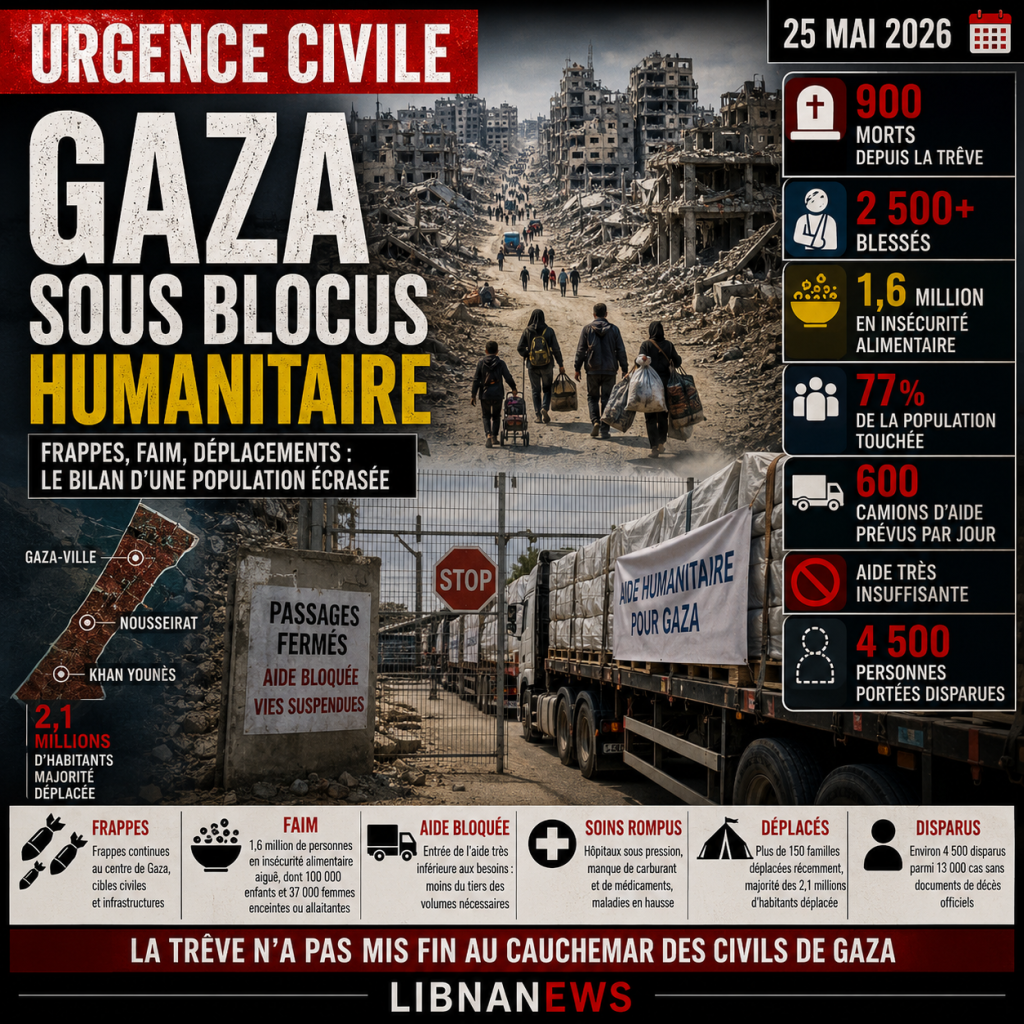
The war in Gaza continues to hit civilians despite the announcements of truce and repeated calls for the opening of crossings. The latest reports point to new victims in the centre of the territory, massive food insecurity, reduced access to aid and increasing health pressure. In Gaza, the record is no longer limited to the dead and wounded. It includes hunger, forced displacement, breakdown of care, sick prisoners and exhaustion of a population whose majority already live outside their home.
Gaza facing a war that continues after the truce
The word truce is no longer sufficient to describe the reality of Gaza. Available information indicates continued strikes, aid restrictions and forced displacement. The cease-fire which entered into force on 10 October of the previous year did not cease military operations. Since then, approximately 900 Palestinians have reportedly been killed and more than 2,500 injured in Israeli attacks, according to data reported by a Palestinian media source. This assessment gives the measure of a war that no longer presents itself as a total offensive, but as continuous pressure.
The latest reports in central Gaza reinforce this impression. A strike on a building in the camp of Nousseirat killed three members of the same family: Mohammad Abu Mallouh, 38 years old, his wife Alaa Zaqlaan, 36 years old, and their son Osama, one year old. The targeting of family housing illustrates the extreme vulnerability of civilians. In a territory where displaced families are buried in buildings, tents or makeshift shelters, the boundary between military target and living space often disappears.
Another attack on a police centre in the al-Tawam area north of Gaza City killed six people. The bodies were reportedly found in a state of advanced mutilation and burn, according to the reported evidence. These two events are not just a series of various events of war. They report a recovery in intensity in areas already exhausted. They also recall that local structures, even fragile ones, remain exposed to strikes. In a territory where civil order has collapsed, the destruction of local posts or services further exacerbates daily insecurity.
A human balance that exceeds the immediate figures
The human impact of Gaza is not limited to the number of deaths of the day. The immediate deaths, the wounded, the disappeared, the careless and the displaced form the same picture. War kills directly by strikes. It also kills because of the lack of food, the destruction of health structures, the lack of medicines and the inability to live in dignified conditions. Each new attack adds to a system already pushed beyond its limits.
The situation of the disappeared adds another layer of suffering. Some 4,500 persons reported missing in Gaza, in a larger group of approximately 13,000 without documents, are reported by a media source to officially establish their death. This administrative and human category produces very concrete effects. Families cannot carry out ordinary procedures. The wives of missing persons may be blocked for official recognition, assistance or decision related to their family status. War therefore creates legal suffering in addition to physical suffering.
Children pay a central price. The murder of a one-year-old child in the Noussiirat camp is just one example. Children in Gaza are exposed to shelling, displacement, hunger, disease and loss of loved ones. Many have not had regular schooling in months. Trauma accumulates in a context where families have no safe space, no continued access to psychological care, and no guarantee of stability. The war reduced childhood to a succession of warnings, leaks and losses.
The wounded form another record, less visible than the dead. More than 2,500 people have been injured since the cease-fire of October in an already broken health system, meaning amputations, infections, chronic pain, trauma and impossible care. Lack of fuel limits hospitals. Restrictions on medical equipment block operations. Movements make treatments irregular. In Gaza, surviving a strike does not mean being saved. This can mean entering a long chain of suffering without sufficient care.
Hunger as second front
The food crisis has become one of the centres of drama. A World Food Programme report, cited in available sources, indicates that 1.6 million people in Gaza, or 77 per cent of the population, face high levels of acute food insecurity. These include more than 100,000 children and 37,000 pregnant and nursing women. These figures place hunger at the heart of the balance sheet. They show that the war does not only affect the affected areas. It affects the ability of almost the entire population to feed themselves.
Even before the declared famine, acute food insecurity destroys society. Families reduce meals. Adults deprive themselves of children. Pregnant women lack adequate food. Infants depend on milk, clean water and care that are not always available. Older or sick people become more fragile. Hunger acts slowly, but it acts everywhere. It makes bodies more vulnerable to disease. It increases fatigue, anxiety and social tensions.
The demonstrations of internally displaced persons in central Gaza against the siege and the restrictions of aid reflect this anger. Participants denounced the famine policy and called for the opening of passages to allow the unhindered entry of food and medicine. These protests show that the population no longer lives solely under military threat. It also lives under the pressure of controlled access to means of survival. The right to eat becomes a public demand.
The humanitarian protocol provided for the entry of 600 aid trucks per day. However, the quantities actually admitted would have remained far below this target. A source indicates that less than one third of this volume has entered. Another mentioned a level not exceeding 38% of pre-war volumes. In both cases, the finding is the same: the aid available does not cover the needs. The difference between 600 trucks expected and actual volumes is translated into missing flour, medicines absent, fuel rationed and abandoned families.
Closed passages prolong collapse
Control of crossing points has become a central issue. The Palestinian Government alerted to the rapid deterioration of living conditions due to the voluntary reduction in the entry of food aid and restrictions on fuel and medical supplies. It asked the mediators, the United Nations and the guarantors of the agreement to exert pressure to open the passages in a complete and lasting manner. Vocabulary is important. This is not a call for one-off delivery. This is a request for regularity.
Regularity conditions any humanitarian response. An isolated cargo does not stabilize a territory of more than two million people. Hospitals need fuel every day. Bakeries need flour and energy. Families need food, water, medicine, diapers, blankets and shelter. Humanitarian organizations need security, accessible roads and repeated permissions. If aid comes in, it feeds competition, black market and fear.
Fuel plays a strategic role. Without fuel, generators stop, ambulances no longer move, water is no longer pumped, communications deteriorate and hospitals reduce their services. Fuel restrictions therefore do not only affect mobility. They affect health, water, food, medicine conservation, surgical operations and aid distribution. In a shelled territory, fuel is a vital element.
The reduction of aid also has a political effect. It weakens local structures, increases dependence on distributions and increases tensions between displaced families. When goods are lacking, access to aid becomes a source of power. The lines stretch. The weak ones come too late. Large families are most at risk. The food crisis then becomes a factor of disorder. It destroys cohesion as much as it destroys bodies.
Forced displacement exacerbates civil crisis
Displacement continues despite announcements of truce. The United Nations humanitarian office reported the displacement of more than 150 families from east Khan Yunes and east Gaza City due to tank movements or shelling. Of these, 40 families were identified as in need of emergency assistance after fleeing with only a few cases. This may seem limited compared to the previous massive movements. However, it remains significant. It shows that the forced movement has not stopped. It continues in waves, according to operations.
The majority of Gaza ‘ s 2.1 million inhabitants would remain in displacement. This sentence summarizes the civil collapse of the territory. A population that no longer lives at home cannot organize a normal life. Families sleep in temporary spaces. Children change their homes. Older people lose their bearings. Women and girls face additional risks in overcrowded areas. Patients struggle to follow their treatments. Displacement becomes a lasting social condition, not a temporary episode.
The term « return » then takes on political value. People are not just asking for food aid. They want to find a home, a neighborhood, a school, a market, a cemetery, a routine. War takes away this continuity. Even when a family survives, it can lose its living space, papers, resources and social network. The destruction of houses therefore results in a greater loss than material loss. It defeats the organization of society.
Forced displacement is also linked to fear. Families often flee before they even know where to go. They leave with what they can wear. They are found in already saturated areas. Each additional displacement increases the density of shelters, pressure on water, the risk of disease and tensions around aid. The numbers of 150 families and 40 families in emergency situations do not only describe one movement. They describe the mechanics of repeated exhaustion.
Public health in a breathless area
Public health collapses under several pressures. Injured people are accumulating, medicines are lacking, fuel is limited, travel is conducive to disease and inadequate food is weakening the body. The warnings from the World Health Organization and the human rights centres mentioned in the available sources highlight the risk of catastrophic worsening. In a territory where health infrastructure has been hit or disorganized, every new wave of injuries puts the system under extreme stress.
Skin diseases, infections and diseases associated with lack of clean water can spread rapidly in shelters. Children are particularly exposed. Pregnant women, the elderly and the chronically ill need regular access to care. But war is fragmenting this access. Hospitals cannot always treat heavy cases. Medical evacuations are limited. Specialized medicines remain rare. The health system works by tragic priorities, choosing the most immediate emergencies.
The situation of Palestinian prisoners adds an external dimension to the Gaza record. The Palestinian Prisoners’ Club warned about the rapid spread of scabies in Israeli prisons. According to reports, in some cells of eight prisoners, at least three would be affected. The organization accuses the prison administration of depriving prisoners of care and transforming diseases into a tool of pressure. This issue is not directly related to aid to Gaza, but it is part of the same framework: health becomes a field of vulnerability and domination.
This information requires a clear distinction. Charges against prisons must be verified by independent investigations. But the health alert is serious enough to require access from lawyers, doctors and competent organisations. The war does not suspend obligations to prisoners. Nor does it suspend the duty to treat civilians. In the case of Gaza, the combination of strikes, hunger and disease creates a crisis where each sector depends on the others.
Mediators face the failure of guarantees
Appeals to mediators are increasing. The Palestinian authorities, humanitarian organizations and political actors are calling on the guarantors of the ceasefire agreement to impose the opening of the passages and the cessation of violations. This request reveals a fundamental problem. An agreement without enforcement mechanism loses its value for civilians. If it does not guarantee aid, security or return, it becomes a formal framework without protective effect.
Ombudsmen have a specific responsibility. They cannot only encourage the parties to honour their commitments. They must measure truck entries, publish figures, monitor violations, protect convoys and guarantee fuel. Civilians judge agreements on the basis of these elements. They do not judge diplomatic communiqués. They judge flour, bread, water, medicine, open roads and silence of weapons.
The difficulty lies in the balance of power. Israel controls the main access, military movements and much of the ground conditions. Humanitarian organizations depend on authorizations. Local authorities have very limited resources. Mediators can push, but their pressure varies according to political interests. The result is visible in the figures: 600 trucks planned, but a much lower actual volume; hundreds of deaths since the ceasefire; a majority of the population still displaced.
This situation feeds distrust. The people of Gaza see the announcements succeeding without sufficient improvement. The words « truct », « help » and « guarantees » lose their meaning if daily life continues to deteriorate. War then becomes a permanent state, even when its intensity varies. She doesn’t really stop. She’s changing shape.
Balance sheet to be monitored
The Gaza record must be monitored on several fronts. The first remains the direct human balance: dead and injured. The figures reported since the ceasefire, about 900 dead and more than 2,500 injured, show continued violence. The second is hunger: 1.6 million people in acute food insecurity, or 77 per cent of the population, with more than 100,000 children and 37,000 among the most at risk pregnant or breastfeeding women. The third axis concerns aid: 600 daily trucks planned, but far lower entries, sometimes described as less than a third of the necessary volumes.
The fourth axis concerns displacement. More than 150 families have reportedly fled some areas under recent pressure, while the majority of the 2.1 million inhabitants would remain displaced. The fifth priority concerns health: hospitals under stress, restricted fuel, inadequate medical supplies and the spread of diseases in places of detention or displacement. The sixth focus is on missing persons, with approximately 4,500 persons reported missing and thousands of cases without full documentation. This grid allows us to understand why Gaza cannot be summed up with a single digit.
The immediate priority remains the sustainable opening of the crossing points. Without this measure, the remaining responses will remain partial. Food cannot enter in sufficient quantity. Hospitals can’t work. Shelters cannot be equipped. Displaced families cannot stabilize their situation. Aid must become predictable, massive and controlled by transparent mechanisms. Otherwise, each day will add an invisible balance sheet to the official balance sheet: weakened children, untreated patients, displaced families once again and civilians forced to wait for the next distribution to survive.




