

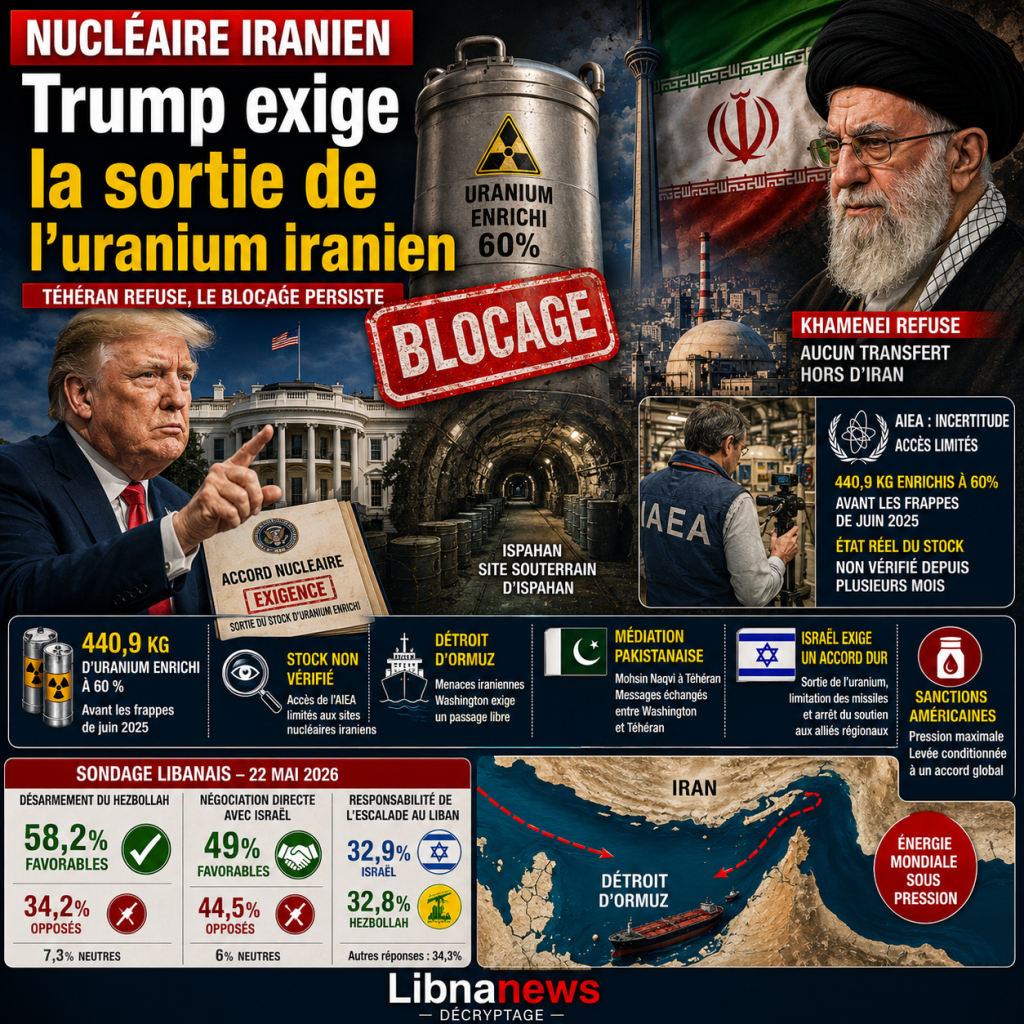
The Iranian nuclear issue has returned to the centre of the negotiations between Washington and Tehran. The latest available information indicates a persistent blockage of the fate of Iran’s highly enriched uranium, which Donald Trump wants out of the country, while Iranian guide Mojtaba Khamenei refuses this transfer. Pakistan’s mediation continues, but discussions remain exposed to tensions around the Strait of Ormuz, Israeli demands and the uncertainty of the International Atomic Energy Agency about the real state of stocks.
Iran’s uranium, the heart of the blockade
The heart of the arm lies in a clear American demand. Washington wants Iran’s high enriched uranium stock to leave Iranian territory. Donald Trump said the United States would get it, stating that his country did not want to keep it and that it could be destroyed. This formula gives the file a strong political significance. It is not just about reducing a nuclear risk. The aim is to obtain visible evidence that Iran agrees to step back under US pressure.
The American position follows a logic of control. The United States wants to avoid Iran retaining a quantity of nuclear material that, if further enriched, could shorten the time required for a military option. Washington is therefore looking for a verifiable measure, difficult to reverse and simple to publicly present. The release of the stock meets these three criteria. It shows a result. It offers an image. It allows us to say that Iran no longer possesses the most sensitive matter in it.
Tehran reads the request in an opposite way. For Iranian officials, transferring the stock out of the country would mean losing a strategic leverage and giving the image of surrender. This symbolic dimension counts as much as the technical dimension. The Iranian nuclear programme is presented by power as an element of sovereignty. A transfer imposed after American and Israeli strikes against nuclear sites would be difficult to justify in front of the Iranian political and military apparatus.
According to a press agency, Iranian officials claim that Mojtaba Khamenei ordered that enriched uranium not be sent abroad. This information reinforces a line already expressed by Iranian officials, although not all the internal modalities of this decision have been publicly confirmed. However, the political message is clear. Iran refuses to allow the stock to leave its territory under Washington conditions.
A hard-to-check stock
The press close to the file also reports that Tehran believes that it needs uranium for civilian purposes, including medical and research purposes. This justification does not exhaust the question, as 60% enrichment remains very close to the thresholds that the Western powers are concerned about. The International Atomic Energy Agency recalls that Iran is the only non-nuclear-weapon State, within the meaning of the Non-Proliferation Treaty, to have produced and accumulated enriched uranium up to 60%. This situation feeds international concerns.
The figure most often quoted by the nuclear agency dates back to the period before the strikes in mid-June 2025. Iran then accumulated 440.9 kilos of enriched uranium up to 60%. Since then, international verification capacity has deteriorated. The Agency states that it was unable to verify the exact status of previously reported stocks for several months. This lack of access is fuelling doubt about the surviving quantity, storage locations and the possibility for Tehran to move or protect part of the material.
A report by the Agency, published in February 2026, focused on the Ispahan site. He indicated that Iran had stored enriched uranium in an underground tunnel complex and that access by inspectors remained urgent. Subsequent information estimated that a significant portion of the stock, perhaps more than 200 kilos of 60% enriched uranium, could still be in this area or have been kept there before the last access breaks. This data remains to be verified, precisely because inspections are limited.
This technical uncertainty reinforces the political weight of American demand. The more localized the stock, the more Washington demands a radical solution. The more Washington demands an exit or destruction, the more Tehran refuses to deliver an asset that it considers vital. The blockage therefore feeds on mistrust. The United States believes that only an irreversible measure can guarantee the agreement. Iran believes that an irreversible measure would make it more vulnerable to further strikes.
Trump’s Pressure and Pakistani Mediation
Donald Trump’s statements maintain this pressure. The US president says he wants an agreement, but he suggests that Washington’s patience is not unlimited. He said he could wait for an Iranian response, while recalling that other options remained available. This posture combines diplomatic openness and military threat. It gives mediators little time to reconcile positions.
Pakistan’s mediation is now central. Pakistan’s Minister of Interior, Mohsin Naqvi, travelled to Tehran to meet with Iranian Foreign Minister Abbas Araghchi. Message exchanges between Iran and the United States continue through this channel. According to media sources citing regional sources, Islamabad is seeking a framework of agreement that can transform a fragile truce into a more lasting arrangement.
This mediation involves several cases at a time. The first is nuclear, with the issue of highly enriched uranium. The second concerns the Strait of Ormuz, which has been partially disturbed since the beginning of the war. The third concerns sanctions, security guarantees and Iranian claims for compensation. Pakistan can transmit, reformulate and bring together. He cannot impose a solution. Its role therefore depends on the real will of Washington and Tehran to reduce their demands.
The last signals remain ambiguous. Iranian media reported that the latest US proposal had narrowed some gaps, without resolving the substantive issues. US Secretary of State Marco Rubio spoke of good signs, while refusing excessive optimism. He also felt that Iran’s system appeared fragmented, making negotiation difficult. This remark aims at the existence of several decision-making centres in Tehran: government, security apparatus, religious institutions and military commands.
Ormuz, other red line
The Ormuz Strait is the other major block. Marco Rubio warned that a system of rights of way or taxes imposed by Iran in the Strait would make a diplomatic agreement impossible. Washington considers such a measure illegal and dangerous for the world economy. The message is simple. The US does not want a nuclear agreement that would allow Iran to have a direct lever on one of the most sensitive energy routes in the world.
The passage is strategic. Much of the oil and liquefied natural gas passed through Ormuz before the war. Restrictions, threats or charges imposed in this area therefore have immediate effects on markets. The rise in oil prices, frozen or delayed vessels and the risks for energy shipments give the issue a global dimension. The crisis no longer concerns Washington and Tehran alone. It affects Asian importers, Europeans, Gulf countries and financial markets.
A senior Emirati official recently found that the chances of an agreement were close to a perfect balance, around 50%. However, he cautioned against a simple truce that would not resolve the causes of the conflict. His warning reflects the concern of the Gulf monarchies. They want to avoid a resumption of strikes, but they also fear a de facto recognition of Iranian control over Ormuz. For Abu Dhabi, Riyadh or Doha, freedom of navigation is not a technical detail. It affects their economic security and exports.
Iranian demands also go beyond nuclear power. Tehran calls for a lasting halt to attacks, lifting sanctions, guarantees against further strikes and, according to some reports, reparations for war. The United States considers many of these requirements excessive. This difference in framing complicates the drafting of a text. Washington first wants to treat uranium and Ormuz. Tehran wants to discuss the war as a whole.
Israel, Russia and the Compromise Scenarios
Israel adds another level of pressure. The Israeli government calls for any agreement to provide for the release of highly enriched uranium, the limitation of Iranian ballistic capabilities and the cessation of Tehran’s support to its regional allies. This position reduces Donald Trump’s margin. An agreement perceived as too partial would be challenged in Tel Aviv. Too hard an agreement would be rejected by Tehran. So Washington must convince both an opponent and an ally.
Russia left another option open. Diplomatic information refers to the idea of Iranian stock storage in Russia, in a form that would allow Washington to say that uranium has left Iran, while offering Tehran a less humiliating solution than a surrender to the United States. This track seems rational on paper. However, it poses several problems. Would the United States accept Moscow keeping such sensitive material? Would Israel consider that transfer sufficient? Would Iran trust an external actor, even an ally, to retain what it considers a strategic asset?
Another formula would be dilution or conversion under international supervision. Diplomats sometimes refer to this hypothesis as it would reduce the level of enrichment without transferring all the matter to a third country. But it requires full access by inspectors, detailed technical agreement, long-term monitoring and cooperation that the nuclear agency says is not yet getting. This leads to a lack of minimum confidence.
The status of inspections remains one of the most worrying issues. The nuclear agency believes that the lack of continuity in stock knowledge is a matter of proliferation. It requests access to sites affected by the strikes and facilities reported after June 2025. Without this access, no agreement can be fully verifiable. Parties may sign a text, but doubts about surviving stocks would remain a major risk.
This explains why discussions cannot be limited to a political formula. A credible agreement will have to answer three concrete questions. Where is the stock located? How much remains usable? Who can verify it? As long as these answers are missing, each side can accuse the other of preparing a manoeuvre. Washington suspects Tehran to hide materials. Tehran suspects Washington to want to disarm Iran before another attack.
Negotiating under economic and political constraint
Time also plays against negotiators for economic reasons. Markets respond to each declaration on uranium and Ormuz. A Washington sentence on the possible resumption of strikes can raise the prices of crude oil. An Iranian indication of stock retention or strait control may affect shipping companies and insurers. Energy-importing countries therefore follow the negotiations with the same attention as chanceries.
The American domestic dimension also counts. Donald Trump wants to present a possible agreement as a personal and strategic success. This requires a simple result to explain. The release of Iranian uranium responds to this logic. It offers an image of victory and a promise of security. But this same image makes the deal more difficult for Iran, as it gives Tehran’s opponents a triumphal scene. A measure that seems politically useful in Washington can therefore become politically toxic in Tehran.
The Iranian power must also deal with its internal balances. The government may benefit from an economic break, partial lifting of sanctions and reopening of trade. Security forces can favour the preservation of military levers. Hardest currents can refuse any formula that looks like a capitulation. Iran’s negotiators must therefore obtain sufficient advantages to justify any concession, especially if it relates to the nuclear programme.
In this context, mediators often seek gradual formulae. A first step could be to freeze certain activities, restore targeted inspections and suspend the most dangerous decisions on Ormuz. A second step could be to process the stock by dilution, framed transfer or international storage. A third could address sanctions and security assurances. This type of sequence reduces the risk of rupture, but it requires confidence that the war months have destroyed.
The most immediate point remains verification. Even if a political agreement were announced, its implementation would depend on inspectors, lists of materials, cameras, seals, access to tunnels and Iranian statements at the affected sites. The current crisis reminds us that nuclear is trading in capitals, but is being tested in facilities. Without reliable access, promises would remain fragile.
The current sequence therefore remains suspended from the Iranian response to the last text transmitted by the mediators. If Tehran agrees to discuss a framed formula on uranium, negotiations can enter a more precise technical phase. If the refusal to transfer remains complete, Washington will have to choose between prolonging mediation, tightening sanctions or relaunching the military option. In the immediate future, diplomacy continues, but red lines have not disappeared.




