

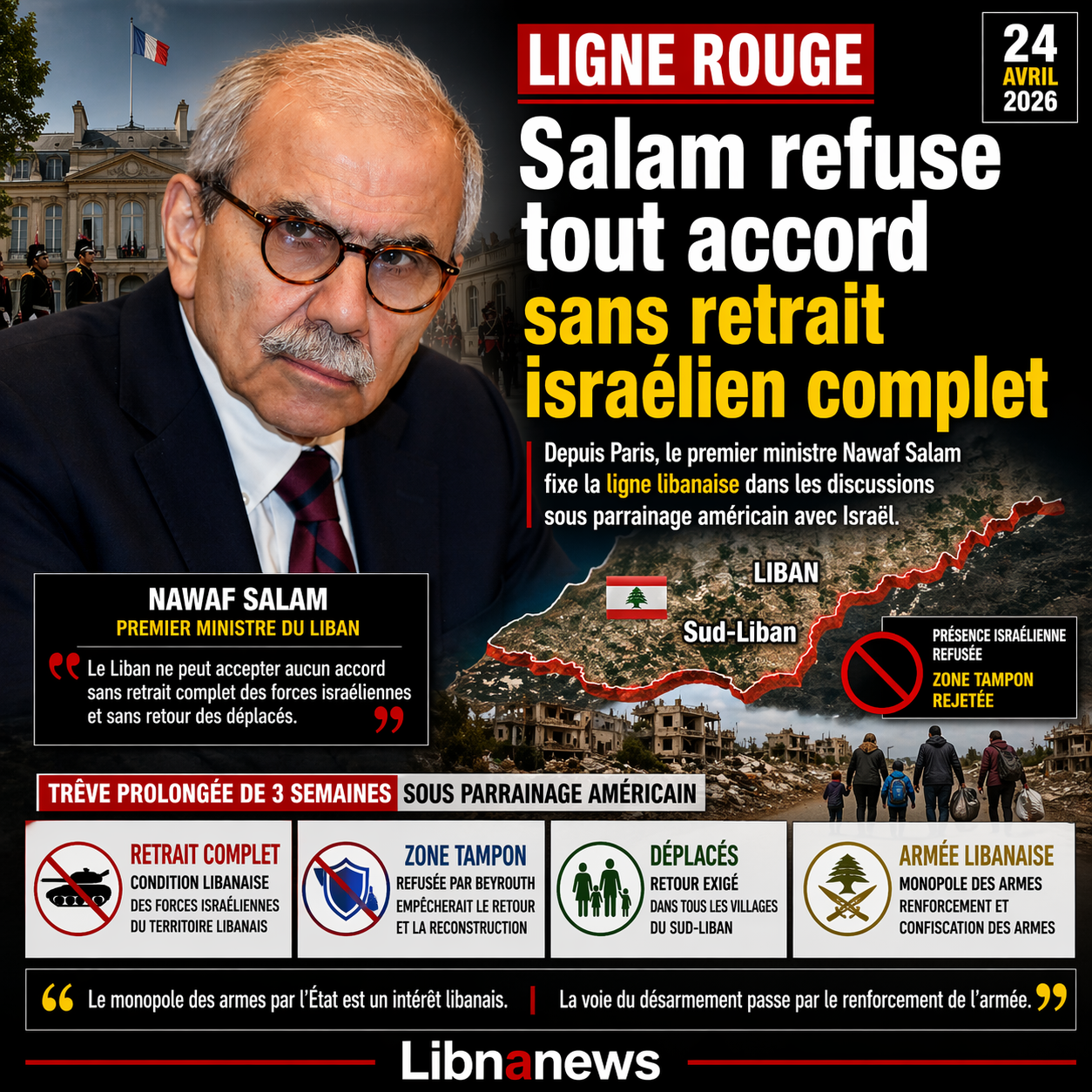
Lebanese Prime Minister Nawaf Salam set the main red line in Beirut from Paris in open discussions with Israel under American sponsorship. Lebanon cannot accept any agreement that does not provide for a complete withdrawal of Israeli forces from Lebanese territory. It also refuses any buffer zone that prevents internally displaced persons from returning and destroyed villages from being rebuilt.
This position was expressed after an interview with French President Emmanuel Macron, while Washington oversees the extension of the cessation of hostilities between Lebanon and Israel. For the Head of Government, negotiation is not presented as a concession. It is described as a necessary channel, as the United States remains, according to Beirut, the most able actor to exert direct influence on Israel.
So Nawaf Salam’s message is twofold. The first concerns the ground: Israeli withdrawal, refusal of a security zone, return of the displaced, reconstruction of the affected localities. The second concerns the Lebanese State: the arms monopoly, the strengthening of the army, the confiscation of weapons and the prohibition of military operations beyond public authority. These elements define the Lebanese official position at a time when the truce remains prolonged, but still incomplete.
A red line from Paris
The head of government expressed his position in an interview with the American press in Paris, after his meeting with Emmanuel Macron. The sequence comes at a time when Lebanon is seeking French and American support to consolidate the cessation of hostilities and avoid a wider resumption of fighting in the South. It also comes at a time when the extension of the three-week truce must open a more substantive phase of discussion.
Nawaf Salam stated that Lebanon could not sign any agreement that did not include a complete withdrawal of Israeli forces. He added that Beirut could not accept what he described as a buffer zone. In its reasoning, such a zone would have direct consequences: it would prevent the return of Lebanese displaced persons, block the reconstruction of villages and maintain an Israeli military presence on national territory.
The declaration refers to areas in southern Lebanon where Israel maintains de facto military presence or control. Israel justifies this presence by the need to protect the northern part of its territory from Hezbollah rockets, drones and anti-tank missiles. On the contrary, Lebanon considers that this situation undermines its sovereignty and prolongs the effects of the war on civilians.
The position of Salam provides a political basis for the Lebanese delegation engaged in the discussions. It states that the Lebanese objective is not limited to prolonging the truce. The aim is to achieve an exit from the crisis that will allow the inhabitants to return, the localities to rebuild and the Lebanese institutions to take over responsibility for security at recognized borders.
Israeli withdrawal and refusal of buffer zone
The rejection of a buffer zone is the core of the Lebanese message. Such a zone would, according to Beirut, create a lasting separation between the inhabitants and their villages. It would transform the truce into a frozen situation, with empty localities, closed roads, destroyed houses and inaccessible agricultural land. The Head of Government seeks to prevent this configuration from becoming permanent data.
Villages in the South have already paid a heavy price in recent hostilities. Houses were destroyed, infrastructure damaged and families displaced. Several border localities remain difficult to access. Residents sometimes return for a few hours to see the damage or to recover essential goods, then leave for lack of security.
In this context, the return of internally displaced persons is not only a humanitarian issue. It becomes a political criterion of the truce. If the inhabitants cannot return, the cessation of hostilities remains incomplete. If the villages cannot be rebuilt, the ceasefire does not yet produce an effective return from the State or civilian life.
Nawaf Salam’s statement therefore establishes a direct link between Israeli withdrawal and reconstruction. The Lebanese Government does not want to separate the military discussion from the civilian situation. For Beirut, an agreement that would leave a part of the South inaccessible would not meet the immediate needs of the inhabitants and would not resolve the crisis opened by the fighting.
The expected role of the United States
The Prime Minister also explained why Lebanon is participating in discussions sponsored by the United States. He said Beirut is entering this process because he sees Washington as the party capable of influencing Israel. This sentence summarizes the Lebanese government’s diplomatic reading: the negotiation goes through the actor who has the most direct leverage on the Israeli state.
Nawaf Salam recalled that the role of the United States had been essential to achieving the ceasefire. He hoped that the United States would continue to exercise that influence. This request is in keeping with the extension of the truce announced in Washington, after discussions between Lebanese and Israeli representatives under the aegis of the US administration.
The Head of Government did not present the outcome of the negotiations as an achievement. He said he did not know what Lebanon could get through this channel, but said he knew the objectives of his Government. This formula introduces an important distinction between diplomatic realism and the political line. The process remains uncertain, but Lebanese requests are identified.
To the question of whether to continue this path, Nawaf Salam answered clearly. It considered that Lebanon should use all available means to achieve its objectives. In this perspective, negotiations do not replace Lebanese claims. It is used to carry them in a setting where Washington can weigh on Israel.
The arms monopoly as a Lebanese interest
The Prime Minister also answered questions about weapons and the role of the State. He claimed that the government had taken courageous decisions and made progress through the confiscation of weapons and the prohibition of military operations. This part of his speech is intended to show that Beirut does not intend to limit its speech to reporting Israeli violations.
Nawaf Salam reiterated that the state monopoly of arms was a Lebanese interest. The formula is important, because it places the subject of disarmament within a national framework, and not only within a logic of responding to Israeli, American or Western demands. The government wants to see the reconstruction of public authority as an internal necessity.
This position directly affects Hezbollah, even if the head of government formulates the case in the terms of the state. The Shiite movement remains the main armed actor against Israel in the South. The United States and Israel are calling for neutralization or disarmament. The Lebanese government insists on an institutional process and the strengthening of the army.
Nawaf Salam said that the only way to disarm Hezbollah was to build the capacity of the Lebanese army. He added that disarmament was a process, not a decision that would apply overnight. This clarification is intended to meet two opposing requirements: to demonstrate a state will, without promising an immediate measure that the government could not impose without major internal risk.
The Lebanese Army at the centre of the system
The Lebanese army thus appears as the central instrument of the strategy defended by the Head of Government. According to this logic, it must receive more resources, training, equipment and external support. Its role is not limited to field deployment. It also concerns the State’s ability to gradually regain control of the security decision.
This approach responds to a practical constraint. The Government cannot demand the departure of the Israeli forces without explaining how security will then be provided in the border areas. By putting the army in the centre, Nawaf Salam seeks to answer this question. He described the strengthening of the military institution as the condition of an Israeli withdrawal, a return of civilians and a progressive treatment of the issue of arms.
The Head of Government also wanted to mark an internal political boundary. He said his government would not give in to intimidation. This sentence refers to the climate of pressure surrounding the issue of arms, negotiations and truce. It means that the executive intends to maintain its line, despite possible oppositions in the country.
This statement comes at a delicate moment. Hezbollah challenges direct contacts with Israel and refuses to see the issue of its weapons treated under foreign pressure. On the contrary, other Lebanese forces are calling for the State to resume the monopoly of force more quickly. The government of Nawaf Salam evolves between these two poles, with a stated objective: to avoid a new war while strengthening the authority of the state.
Paris and Washington in the same diplomatic sequence
The passage from Nawaf Salam to Paris is part of a broader diplomatic sequence. The Prime Minister seeks to mobilize Lebanon’s partners, including France and the United States. Paris remains an important political player for Beirut, due to its historical ties with Lebanon, its diplomatic role and its regular engagement on the issues of the army, humanitarian aid and reconstruction.
After his meeting with Emmanuel Macron, Nawaf Salam placed priority on three issues: truce, Israeli withdrawal and support for the army. France can weigh in European and international forums. The United States has a more direct leverage on Israel. The Lebanese government is therefore trying to associate the two channels without confusing them.
The Paris Declaration thus completes the Washington sequence. In Washington, the truce was extended. In Paris, the Prime Minister clarified the political conditions Beirut wants to put at the centre of the follow-up. Both times respond: prolong the cessation of hostilities and then seek concrete guarantees on the withdrawal and return of the displaced.
The prolonged truce remains fragile. Violence has decreased, but it has not disappeared. Strikes, fire and demolitions were reported again in southern Lebanon. Civilian casualties were reported, including a journalist. Each incident revives the charges of violation and complicates the diplomatic translation of the agreement into real security for the inhabitants.
Southern villages as a concrete test
It is in this context that Nawaf Salam’s refusal of a buffer zone takes on a concrete scope. It is not just a diplomatic formula. The area controlled by Israel determines who can return, who can move around, who can rebuild and what authority is exercised on the ground. It also determines the credibility of the Lebanese State among displaced populations.
For the inhabitants concerned, Israeli withdrawal is not an abstract claim. It affects access to homes, land, roads and basic services. It also affects the possibility of reopening schools, shops, places of worship and local governments. As long as these elements remain blocked, the truce remains a partial military break.
The Lebanese Government wants to prevent the three-week extension from becoming a mere delay in managing the conflict. It seeks to make it a step towards a more stable framework. This implies an effective cessation of attacks, access to villages, an increased presence of the Lebanese army and negotiations on border points. None of these cases are settled at this stage.
The Lebanese position is also based on a sequenced negotiating logic. Beirut is not just asking for a general formula on peace or security. It calls for verifiable measures: cessation of military operations, withdrawal of forces, access to localities, return of displaced persons, reconstruction and extension of State authority. For the government, these elements must be dealt with together, as each condition of the other. A safe withdrawal would remain fragile. Security without the return of the inhabitants would be incomplete. A truce without reconstruction would not respond to the concrete effects of the war.
Nawaf Salam’s position therefore sets the Lebanese road map before the next stage of the discussions. Lebanon agrees to enter the American channel because it considers this channel indispensable. However, he refused to accept an agreement that would devote a lasting Israeli presence to the South. This distinction is the core of the government line.
The file remains open on several points. Washington must show whether it can transform its role as mediator into effective pressure on Israel. Beirut must demonstrate that the army can occupy more security space. Israel must specify whether it accepts a complete withdrawal and under what guarantees. The three-week truce now places these issues at the centre of future diplomatic exchanges.




