

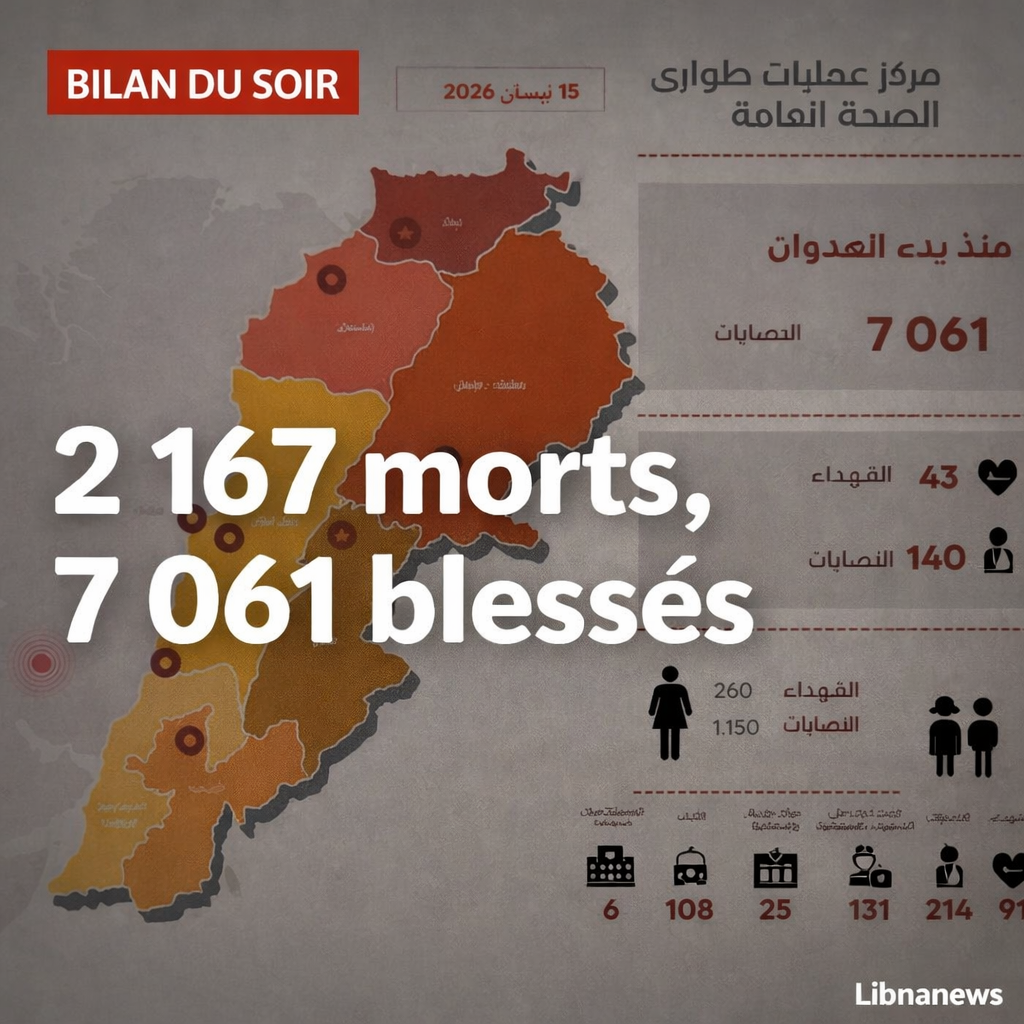
The official record of the Israeli aggression in Lebanon continues to grow. In a statement issued on Wednesday, 15 April, the Health Emergency Operations Centre of the Ministry of Public Health announced that the cumulative total of victims since 2 March now stood at 2,167 dead and 7,061 injured. This update is not merely a statistical variation. It confirms that Israeli bombardments continue at a rate that is sufficiently rapid to increase the human cost of war almost every day. At the same time, the dispatches of the National Information Agency, the NNA, have again reported several Israeli strikes, Israeli artillery fire and relief operations in the South, indicating that violence remains active in many locations despite diplomatic discussions about a possible appeasement.
An official balance sheet that increases daily
This new assessment places the sequence opened on 2 March in another dimension. The threshold of two thousand dead is now crossed, and the official figure of the wounded exceeds seven thousand. The Lebanese health authorities use the term « aggression » in their Arab communication to describe this military campaign. This vocabulary is not neutral. It reflects the official reading of a State that assigns direct responsibility to Israel for the resulting strikes, bombings and humanitarian degradation. At the international level, this qualification is also becoming increasingly critical. The United Nations High Commissioner for Human Rights considered the extent of the destruction and deaths on 8 April to be horrific, while UN experts denounced on 15 April an « illegal aggression » and indiscriminate bombing campaign.
The comparison with the previous day allows us to measure the rate of this deterioration. The Ministry of Health site still recorded 2,124 deaths and 6,921 injuries as at 14 April. In 24 hours, the cumulative balance increased by 43 deaths and 140 injuries. This is the only difference in the real situation. Even in the absence of a single bombardment comparable to 8 April, Israeli strikes, Israeli artillery fire and targeted attacks continue to cause very high losses over a single day. The increase in the balance sheet is no longer solely linked to exceptional peaks. It has become structural. This is precisely what feeds, on the Lebanese side, the idea that the country undergoes a prolonged military campaign and not a series of isolated incidents.
The figures published by the Ministry of Health provide a solid framework for what has been happening for six weeks. They first show continuity. Far from being interrupted after the largest waves of strikes, the Israeli offensive continues to cause deaths and injuries over the days. They then show an extension. War is no longer only perceived through a few spectacular days of massive raids on Beirut or the South. It settled in the form of a war of wear and tear made up of repeated strikes, artillery fire, drone attacks, localized destruction and successive tremors that eventually formed a national disaster. Finally, these figures require a clear allocation. These are not anonymous clashes, but, according to the Lebanese authorities and international agencies, Israeli bombings against Lebanese territory.
Latest NNA dispatches point to Israeli strikes
The latest NNA dispatches confirm this very concrete reality on the ground. On Wednesday afternoon, the official agency reported that a strike had targeted Harouf in the Nabatiyah district, killing and wounding one person. A few hours earlier, she reported the withdrawal of four bodies and the evacuation of three wounded after a strike on the Al-Khadra complex in Qadmous. In another dispatch, the NNA reported Israeli artillery fire at Shaqra and Kfardinin in Bint Jbeil District. Further strikes were reported between Qlaila and Haniyeh at the entrance to Qlaila, Aitit, Nafakhiyah, Abl al-Saqi and several localities in Bint Jbeil. Taken separately, each of these events may seem limited to a specific area. Taken together, they show that Israeli bombings continue to plough southern Lebanon daily.
This point deserves to be stressed, because it corrects too abstract a reading of the balance sheets. The figures of 2,167 dead and 7,061 injured do not fall from a block. They make locality after locality, strike after strike, ambulance after ambulance. A death in Harouf, four bodies removed from Qadmous, wounded in Shahabiyeh, shooting at Shaqra, a raid on Qlaila, an attack on a vehicle in Abl al-Saqi: it is by this addition of apparently dispersed Israeli violence that the national record is increasing. War acts by concentration and diffusion. There are days of massive bombings, like the one on 8 April. And there are days of continuous pressure, like this 15th April, when the Israeli strikes, less spectacular internationally, nevertheless maintain a high lethality and constant anguish in the South.
April 8 marked a change of direction
The day of 8 April remains a turning point. Reuters reported that the Israeli strikes of that day had been the most violent since the beginning of the campaign, with 254 deaths initially announced by the Lebanese civil defence, before Beirut then reported to the United Nations a record of 303 deaths, including 30 children and 71 women. On the same day, an Israeli strike damaged Hiram Hospital near Tyre and another hit an ambulance from the Islamic Health Authority in Qlaileh. These episodes count for two reasons. First, because they show that Israeli bombings are not limited to military installations clearly isolated from civilian fabric. Secondly, because they shifted the international debate towards the issue of violations of humanitarian law, with calls for independent investigations into attacks against civilians and medical infrastructure.
Since then, international criticism has become even stronger. UN-mandated experts on Wednesday claimed that recent Israeli strikes in Lebanon were the result of « illegal aggression » and an indiscriminate bombing campaign. They considered that these operations violated the Charter of the United Nations and attacked the international order itself. The vocabulary is exceptionally severe. It provides a solid basis for discussing Israeli violations in a journalistic article when reporting accusations from the United Nations, Lebanese authorities or humanitarian organizations. This does not exempt Israel from saying that it is targeting Hezbollah infrastructure. But this bans artificially neutralizing the attribution of strikes, even though official communiqués, NNA dispatches, UN statements and international agencies explicitly designate the Israeli army as the perpetrator of these bombings.
Civilians and caregivers pay high price
The human cost is also reflected in the nature of the victims. The United Nations assessment of 30 children and 71 women among the dead after the 8 April bombings, which is a reminder that the war is far beyond civilians. This applies beyond that day alone. When inhabited neighbourhoods, roads, vehicles, ambulances and hospital approaches are affected, the distinction between military and civilian space becomes much more fragile. This is one of the reasons why the Lebanese authorities and several international bodies speak not only of Israeli bombings, but also of attacks that could constitute violations of international humanitarian law.
Pressure on the health care system is another proof. The World Health Organization (WHO) warned last week that Lebanon’s hospitals are likely to lack vital traumatic supplies in a few days. According to Reuters, three weeks of trauma kits were consumed in a single day after the escalation of the Israeli bombings on 8 April. WHO also points out that the stocks of antibiotics, dressings, anaesthetic drugs and medicines for chronic diseases are under high pressure. In a country where hospitals were already operating in a fragile economic environment, the massive influx of war wounded creates an additional risk: that of preventable deaths being added to the direct victims of Israeli strikes due to lack of adequate care, equipment or response time.
This vulnerability of the health sector has been exacerbated by the attacks themselves. The Lebanese Ministry of Health and international agencies have repeatedly reported damage to hospitals, ambulances and relief teams. Reuters reported on 8 April that an Israeli strike had hit the area in front of Hiram Hospital and another struck an ambulance in Qlaileh. A few days later, images relayed by Reuters showed further damage to a Tebnine hospital after reports of Israeli strikes in the area. In these circumstances, talking about a health crisis caused by the war is no longer enough. It must be said more precisely that part of this crisis is also the result of Israeli bombings that directly or indirectly affect the country’s care capacity.
War of wear and tear despite diplomatic discussions
At the political level, the official assessment of 15 April comes at a time when Israel continues to reject the idea of a ceasefire in Lebanon, even if there are unprecedented discussions in Washington with Lebanese representatives. Reuters again on Wednesday indicated that Israel did not intend to discuss a truce before the achievement of its war objectives, the first of which was the disarmament of Hezbollah. At the same time, the Israeli army claimed to have hit more than 200 Hezbollah infrastructure sites in southern Lebanon in 24 hours and renewed its orders to move north of the Zahrani River. This sequence illuminates the current paradox. While diplomacy seeks to loosen the tide, the reality on the ground remains that of a continuation of Israeli bombings, with their procession of dead, wounded and displaced.
The displacement of the population is also the other side of the balance sheet in Lebanon. Reuters and WHO estimate that more than one million people have already been displaced since 2 March, and Reuters even mentions 1.2 million internally displaced persons according to the Lebanese authorities. Again, statistics do not just add one figure to another. It indicates the extent of the disruption caused by the Israeli strikes. Families are fleeing bombed areas, evacuation roads are saturating, schools and housing are filling up, the continuity of medical treatment is breaking, and areas considered to be relatively safe are in turn seeing pressure on infrastructure. When the Ministry of Health announces 2,167 deaths and 7,061 injuries, it gives the hard core of the disaster. Around this core is a much wider social, health and territorial crisis.
Name Israel, name the facts
Finally, what this assessment means in terms of public language must be measured. When articles speak only of « fighting » or « violence » without naming the striker, they erase an essential part of reality. The facts documented by the NNA, the Ministry of Health, Reuters, the WHO and the United Nations allow for a much more precise formulation. Israeli bombings have hit many Lebanese localities since 2 March. Israeli artillery fire and Israeli airstrikes continue to target southern Lebanon on 15 April. UN forums speak of violations of international law and illegal aggression. And the cumulative record of these attacks now stands at 2,167 dead and 7,061 wounded according to the Lebanese health authorities. Nominating Israel in this context is not a position. It is a requirement of journalistic precision.
The balance sheet of 15 April, however, does not exhaust the reality of the war. It does not include the totality of invisible traumas, the exhaustion of first aid workers, the interruption of treatment, delays in care, or families dispersed by displacement. But he sets a line. He said that on the evening of 15 April, after six weeks of Israeli bombing, Lebanon officially had 2,167 dead and 7,061 wounded. He also states that these losses continue to increase at the rate reported by the official agency in Harouf, Qadmous, Qlaila, Bint Jbeil, Tyre and other southern localities. And he recalls, with an increasingly difficult force to circumvent, that the question is no longer just one of regional military escalation. It is an Israeli campaign whose human, territorial and health costs are now at the very heart of Lebanese life.




