

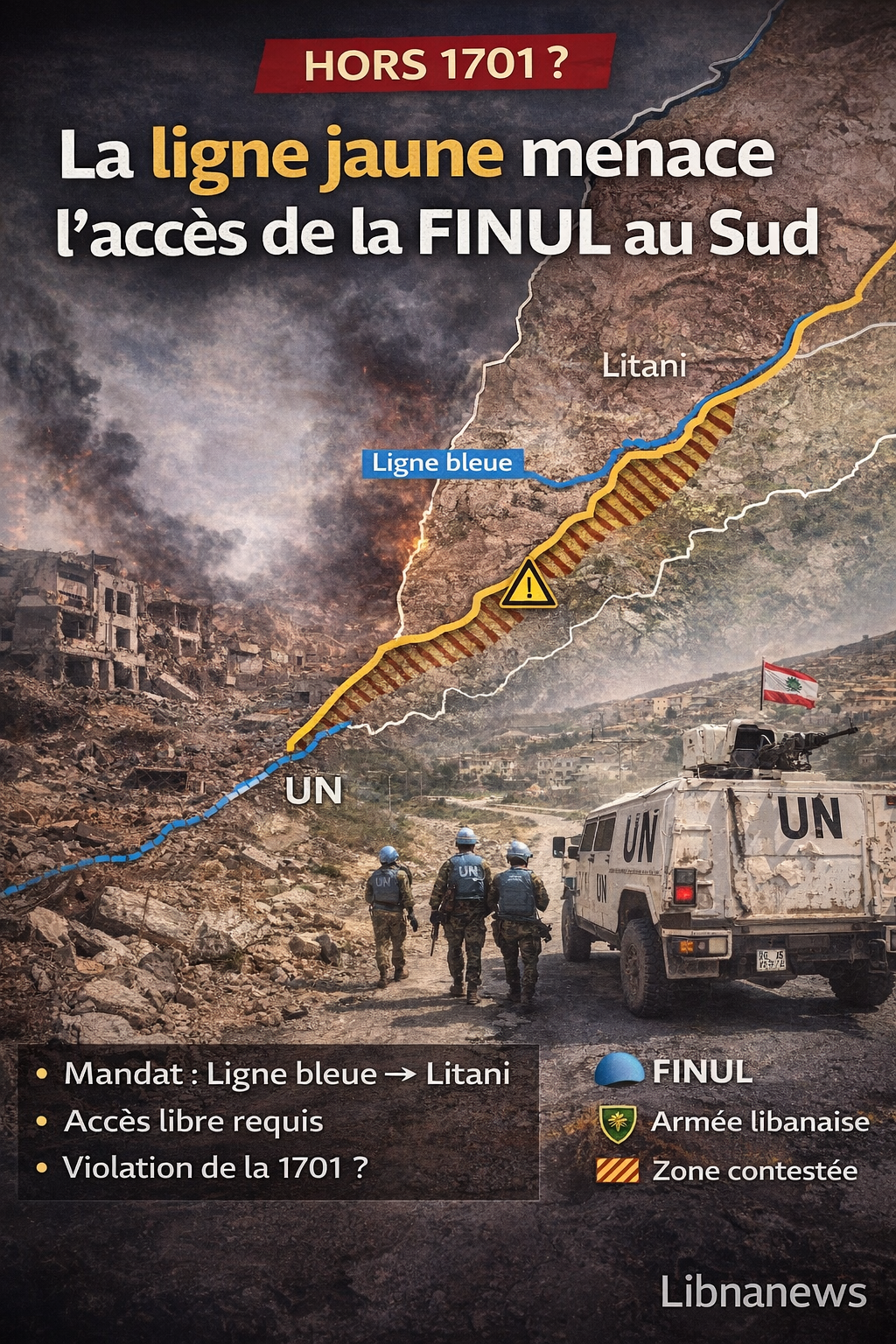
In terms of mandate, the answer is yes. If the yellow line is located, as the maps show, between the Blue Line and the Litani River, it enters the normal UNIFIL operations area. The UN mission is not supposed to be kept away from part of this area on the grounds that Israel has redesigned its military use. Its mandate is precisely to monitor the cessation of hostilities, support the Lebanese army in the South, report violations and contribute to the safe return of internally displaced persons.
This is important because it corrects a misconception that often circulates in Lebanon and abroad. UNIFIL is not limited to the axes that the belligerents wish to leave to it. Under UN law, his freedom of movement is part of his mandate. It must have access to all parts of its area of operations to observe, patrol, verify and report. This freedom is in principle valid even when security conditions are poor, subject to tactical decisions taken for the immediate protection of peacekeepers.
In practice, the situation is much more complicated. Since the beginning of the escalation, UNIFIL has repeatedly reported that its freedom of movement has been hampered. UN communiqués issued in April denounced roadblocks, restrictions on access to certain positions and obstacles to logistical transport to isolated bases. In other words, the mission has a theoretical right to go to these areas, but it can be physically prevented either by Israeli military decisions, by the dangers of the terrain or by the very state of the roads and towns.
That is where the yellow line becomes a direct problem for UNIFIL. If Israel treats this band as a unilateral military action zone, with movement control, fire clearance and return restrictions, the United Nations mission may only gain access to the dropper, under forced coordination or with very limited margins. However, a UNIFIL which can no longer freely access its area of operations ceases to be a fully credible observer. It does not disappear, but its capacity for verification, dissuasive presence and political liaison is seriously deteriorating.
Another often forgotten point must be added. UNIFIL can, according to UN texts, patrol with or without the Lebanese army. This has been the subject of ongoing political debate in Lebanon, but the framework of its mandate allows it to operate independently. If an area in southern Lebanon were to become accessible only under conditions established by the Israeli army, it would indeed be tantamount to subjecting a United Nations mission to a regime of access decided by a foreign army on Lebanese territory. This would be a very heavy change, not only on the ground, but in the very economy of the UN presence in the South.
Does the yellow line contravene Resolution 1701?
On a strict reading, yes, the yellow line as presented by Israel is very difficult to enter within the framework of resolution 1701.
The first reason is simple. Resolution 1701 is based on respect for the Blue Line and the cessation of offensive operations. The establishment of an Israeli military line within Lebanese territory presupposes, by definition, an armed presence beyond the Blue Line. For the United Nations, any crossing of this line by either party constitutes a violation of the resolution. A security band created unilaterally in Lebanese territory cannot therefore be considered compatible with the spirit or letter of 1701.
The second reason is sovereignty. The resolution provides for the absence of foreign forces in Lebanon without the consent of the Lebanese Government. Lebanon did not recognize such a line, nor did it agree to a lasting Israeli presence in the villages and heights concerned. The continuation of Israeli troops in this band, even justified by a security argument, is therefore in front of the principle laid down by the resolution.
The third reason is related to the planned security architecture south of Litani. The purpose of 1701 is to establish, between the Blue Line and the Litani River, an area free of armed personnel, weapons and military infrastructure other than those of the Lebanese State and UNIFIL. Israel often invokes this provision to say that Hezbollah should not be present. But this same provision does not give him the right to substitute for it. The resolution does not create an Israeli permit to redraw the ground. It organizes a space where only the Lebanese army and UNIFIL are legitimate.
It’s a central point. Yes, 1701 also contains very heavy obligations for Hezbollah and, more broadly, for any armed group south of Litani. Israel uses this aspect to argue that the threat has not disappeared, so it must maintain a depth of security. But this interpretation remains political, not legal. Nothing in the resolution authorizes the establishment of a new line of control alone, the prohibition of the return of civilians to dozens of villages or the restriction of access by a UN mission to its own area of operations.
However, a nuance must be kept. In such crises, Israel can argue that its measures constitute immediate self-defence against a threat it considers to be persistent. This argument may have a political impact in some capitals. But even in this reading, self-defence does not automatically erase the obligations arising from 1701 or the principle of Lebanese sovereignty. Nor does it nullify the role of UNIFIL. Clearly, Israel can invoke a security necessity; However, this does not transform the yellow line into a mechanism recognized by the law resulting from the resolution.
What it changes for UNIFIL in the field
If the yellow line continues, UNIFIL may find itself in a paradoxical position. It would remain officially responsible for monitoring an area where it would no longer have real freedom of movement. It should continue to document violations, even though access to the most sensitive points may depend on the authorization of those who are specifically accused of unilaterally changing the terrain.
This would weaken its buffer function. Since 2006, UNIFIL has not replaced a political solution, but serves as a breathing mechanism between the parties. It patrols, conveys messages, reduces the risk of misunderstandings and helps to contain certain incidents before they become wider clashes. If kept at a distance from the red areas of the moment, this damper function is reduced.
It would also complicate the return of the inhabitants. Because an area where UNIFIL does not enter freely becomes much more difficult to certify as practical for civilians. The Mission can help assess, coordinate, report risks and support the minimum safe environment for a return. If it no longer has access, this capacity declines sharply. The inhabitants are then faced with a double vacuum: the Lebanese State does not yet fully control the area, and the United Nations cannot normally exercise its presence there.
Is this an additional element of war recovery?
Yes, clearly. Not necessarily in the form of an immediate total war, but as a very clear factor in the erosion of the ceasefire.
First, because an Israeli unilateral line inside Lebanon creates permanent litigation. Secondly, because it puts Hezbollah before a dilemma: to tolerate a presence which it will call occupation, or to repeat a logic of harassment in the name of resistance. Finally, because it undermines the role of UNIFIL, even though this mission remains one of the few concrete stabilization mechanisms in the South.
The longer this line lasts, the closer it brings to the ground of an already known pattern in Lebanon: empty villages, foreign military presence, amputated sovereignty, obstructed UN mission, suspended civilian return and tactical incidents likely to turn into escalation. So the question is not just whether the yellow line violates 1701 on paper. It is also concerned with whether a truce can survive for a long time a system that removes from UNIFIL part of its ability to act and part of its effective authority from the Lebanese State




