

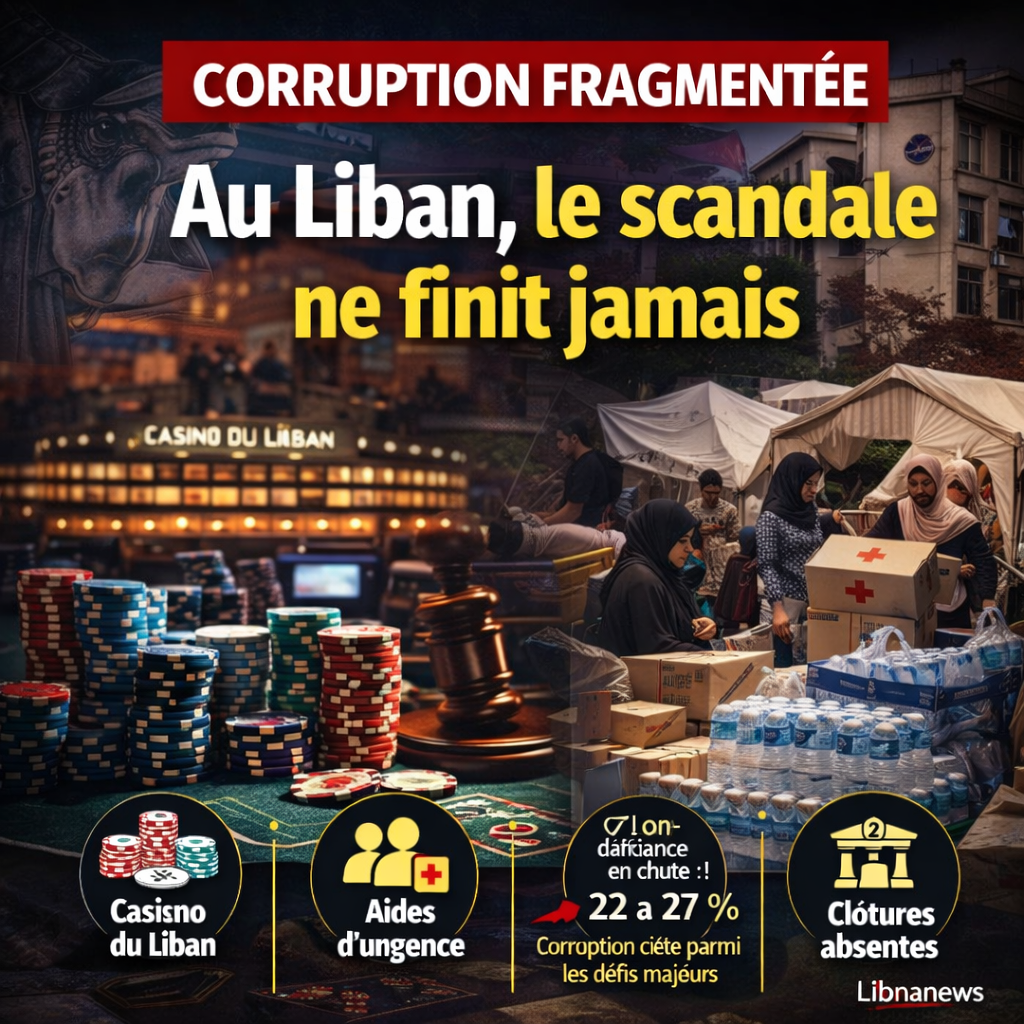
Corruption did not leave the Lebanese landscape. It simply changed shape in public space. It no longer appears, or more only, as a major national campaign with a single slogan, a clearly identified political front and a clear hierarchy of issues. Rather, it goes up by fragments, by touches, by partial affairs, by successive reminders in the press and in political conversations. One day, it is a complex financial issue that reappears around the Casino of Lebanon. Another is a survey that recalls the collapse of trust in institutions. Elsewhere, these are criticisms of the management of internally displaced persons, the circulation of public money, the opacity of emergency circuits or the impotence of control bodies. Nothing is yet a great unified judicial moment. But the overall picture is much heavier: that of a country where corruption is not an isolated scandal. It’s a permanent climate.
The most disturbing thing is that this permanence coexists with war, humanitarian emergency, diplomatic pressure and social fatigue. In another context, Lebanon would probably be talking much louder about misappropriation, waste, money laundering, tax fraud, wrongful omissions and public responsibility. But war moves the focal point. It does not remove these questions. She pushes them to the margin, then they come back in pieces. The result is paradoxical. The country is not immersed in a major national debate on corruption. He lives in a permanent recall regime, where each case seems to confirm what everyone is already thinking: the Lebanese crisis is not just a political, economic or military crisis. It is also a crisis of public probity and responsibility.
The Casino file says much more than the Casino file
The best example of this fragment return is the case related to Bet Arabia and the Casino of Lebanon. The file is not new, but its return to the foreground has produced a revealing effect. It is not just a trade dispute or a management dispute. We are talking about a former president of the Casino, Roland Khoury, and the head of OSS, Rassam Gharios, both detained for several months before being released on bail in autumn 2025. We are also talking about a particularly heavy set of grievances: suspicions of money laundering through tax evasion, illegal gambling, wrongful omission in the performance of duties, waste of public funds.
The seriousness of the case lies not only in the possible criminal qualifications. It concerns the institution concerned. The Casino of Lebanon is not any establishment. It is located at the junction of public and private, regulatory control, revenue, image of the country and networks of influence. When a court case seeks a space of this nature, it immediately reacts to a broader question: how does the state really monitor institutions that generate income, delegate activities or maintain complex relations with private operators?
The judicial response is not yet closed, but the mere fact that the case was expanded instead of being shipped says a lot. The indictment chamber of Mount Lebanon did not choose the path of rapid decision. She preferred to deepen, complete, cross-check, and multiply the checks. Some see it as another slow pace. On the contrary, others read evidence that a case involving money, gambling, taxation, institutional responsibility and public interest cannot be treated as an ordinary case. Both readings coexist. And that’s exactly what makes the file a symbol. In Lebanon, even when a case progresses, it advances in a climate of distrust such that no one really knows whether time is working for justice or for the wear and tear of the scandal.
This file therefore concentrates several typical Lebanese features. First, a grey area where public interest and private circuits mix. Secondly, a structural difficulty in establishing clear responsibilities in complex installations. Finally, there is a well-convinced view that large business can always simmer at the useful delays of the system. The problem is not just whether or not offences will be retained. The problem is that everyone sees this procedure as a test of credibility of economic justice itself.
The suspicion of corruption now also lives in opinion, not only in the files
The other strong signal comes from the level of distrust towards the institutions. A recently commented survey showed that, in the hierarchy of challenges identified by the Lebanese, the economic situation comes first, followed by security stability, followed by financial and administrative corruption, cited by almost a quarter of respondents. This result is important. It shows that corruption is not seen as a secondary issue for lawyers, judges or professional opponents. It remains, in the minds of the public, one of the central problems of the country.
The same survey sheds even more light on the climate when measuring confidence in institutions. Government, Parliament and justice all have very low levels of confidence, around 22-27%. These figures do not only say that the Lebanese are unhappy. They say that corruption is no longer experienced as a gap. It is integrated into the general perception of the State. When institutions fall to this level of credit, every case, every suspicion of waste and every financial matter is immediately re-read through a prior conviction: the public apparatus no longer controls properly what is being done on its behalf.
This data profoundly changes the nature of the problem. In a system where confidence remains high, a corruption case arises as an accident that must be corrected. In a system where trust is already collapsed, each case becomes the confirmation of a normal state. You don’t even feel the same way. We add up. We’re archiving. We’re waiting for the next file. Maybe it’s the most serious symptom. The scandal loses its exceptional strength and becomes an ordinary language.
Corruption no longer appears only in markets, but in emergency management
War and mass displacement have added another dimension to the problem. Corruption is no longer only sought in large contracts, concessions or financial arrangements. She is also suspected in emergency management. As soon as the State starts distributing aid, financing accommodation centres, delivering fuel, paying hospitals and supporting municipalities, the same question arises: who really controls flows, according to what criteria, with what transparency and with what guarantees?
It is here that criticisms of the management of displacement take on particular relief. After several weeks of crisis, voices denounced a public response that was considered to be very inadequate, pointing out that, in relation to the number of displaced persons and the duration of the crisis, meals distributed, drinking water and hygiene kits remained far below the needs. This type of criticism is not yet evidence of corruption in the criminal sense. But it produces a very strong climate of political suspicion. For in a country like Lebanon, chronic insufficiency of the public response feeds almost mechanically the idea that means exist somewhere, but is lost in intermediate circuits, clientele, opacities or organized inertia.
The problem is reinforced by the very structure of the survival economy which has settled. The State acts through municipalities, the Southern Council, social security, local centres, partisan networks, associations and hybrid administrative relays. This mesh can save situations. It can also dilute responsibilities. The more multiple the circuits, the more difficult it becomes to know where a simple inefficiency begins, where the objective shortage ends, and where a favouritism, hijacking or abusive retention could take place.
This is an unpleasant truth. Lebanese corruption does not always need to appear in the form of suitcases, offshore accounts or spectacular commissions. It can also take the much greyer form of chronic poor distribution, unequal access to aid, lack of traceability, local authority that chooses its beneficiaries, or an organisation that does not clearly explain what it receives, what it spends and what it leaves on hold. In an exhausted country, this opacity corruption can be almost more destructive than conventional big business.
The question of public waste comes back everywhere, even when it is not named
What is striking in the current period is that the notion of public waste comes back in very different contexts. It explicitly appears in legal files like the Casino. It is implicit in the discussions on the reserves available at the Bank of Lebanon, on the promises of external aid still awaited, on how emergency social spending is arbitrated, or on the delay with which certain sectors receive the funds necessary for their survival.
When hundreds of billions of pounds are released for hospitalization, the decision is politically defensible, of course. But it also recalls a structural truth: the country no longer has the means to finance its essential services smoothly. It is done by extension, by point injections, by successive infusions. This situation feeds a tenacious question in the opinion: how did one manage to depend on exceptional envelopes to finance what should be part of the ordinary operation? Again, corruption is not always at the end of the sentence. But she’s in the background of the question.
The same logic applies to emergency aid, fuel sent to municipalities, housing expenditure or support for the hospital sector. Every time the state acts in an emergency, it revives the memory of all that it has not been able to build in the long term. And this memory, in Lebanon, very quickly takes the form of a request for years of mismanagement, misappropriation, clientelism and confusion between public resources and particular interests.
Fragments form a system
This may be the most accurate reading key. Taken separately, the elements appear heterogeneous. On one side, a heavy case of alleged money laundering, tax fraud and illegal gambling. On the other hand, a survey on corruption and institutional confidence. Elsewhere, severe criticism of the management of displaced persons and the weakness of the State response. Further on, discussions on reserves, the money expected from donors and the pace of public spending. None of this constitutes a single major national trial of corruption. And yet, the ensemble draws a system.
This system has three features. First, the blurred border between public and private. It appears in the Casino file, but it crosses many other sectors. Second, weak control and accountability. Even when decisions are taken, the chains of responsibility remain opaque. Finally, an opinion which has become so suspicious that it no longer spontaneously grants the institutions the benefit of the doubt. This combination is formidable. It means that corruption no longer needs to be spectacular to be credible. She no longer needs to be demonstrated in every conversation. She became a general prism.
That’s also why she comes back in fragments. The Lebanese system no longer offers the conditions for a great single clarification. Rather, it produces a series of files, clues, reminders, weak signals and moments of partial truth. Each of these fragments seems limited. Together, they make up a much more overwhelming image: that of a country where the collapse of confidence preceded the collapse of total evidence, and where justice, when acting, must do so in an atmosphere already saturated with suspicions.
Perhaps the most serious is not the existence of the business, but the habit of their incompleteness
The deepest danger is not only that corruption cases continue to exist. The danger is that the country will get used to their incompleteness. A case opens. We’re talking about it. Names come out. Detentions are taking place. Heavy suspicions are made. Then the procedure slows down, becomes complex, stretches, changes the chamber or rhythm, until the opinion no longer really waits for a way out. This pattern is one of the most corrosive for a judicial system.
The Bet Arabia case is observed through this prism. Criticism about emergency management is also critical. Even very weak confidence polls are part of this collective experience: the problem is not only that the public thinks there is corruption. He doubted whether the institutions could complete the demonstration, sanction and correction.
A country can survive scandals. It survives much less well to the diffuse conviction that scandals never completely end. For then corruption ceases to be a risk. It becomes a horizon.
Lebanon does not lack business, lacks closures
It is therefore possible to summarize the situation of a simple formula: Lebanon does not lack corruption cases, there is a lack of judicial, administrative and political closures capable of closing these cases with legible conclusions. The Casino file is an emblematic example. The measured defiance of the state is another. Controversies about emergency management, aid flows, survival expenses and public waste continue to hold the same impression.
As long as this logic dominates, corruption will continue to return in fragments. Not because it would have become secondary, but because it became too structural to hold in a single story. It will arise where public money crosses the private. Where emergency permits opacity. Where the institutions still ask for confidence without providing sufficiently clear accounts. And where justice moves forward, but too slowly to restore suddenly what was destroyed for years.
The real question is no longer whether corruption is still a Lebanese subject. She obviously is. The real question is more difficult: is the country still able to turn these fragments into decisions, suspicions into established responsibilities, and this collective fatigue into accountability? As long as the answer remains uncertain, each new case will only confirm the previous one, and each fragment of scandal will continue to fuel the idea that, in today’s Lebanon, corruption is not an accident of the system. It is one of the forms in which the system continues to function.




