





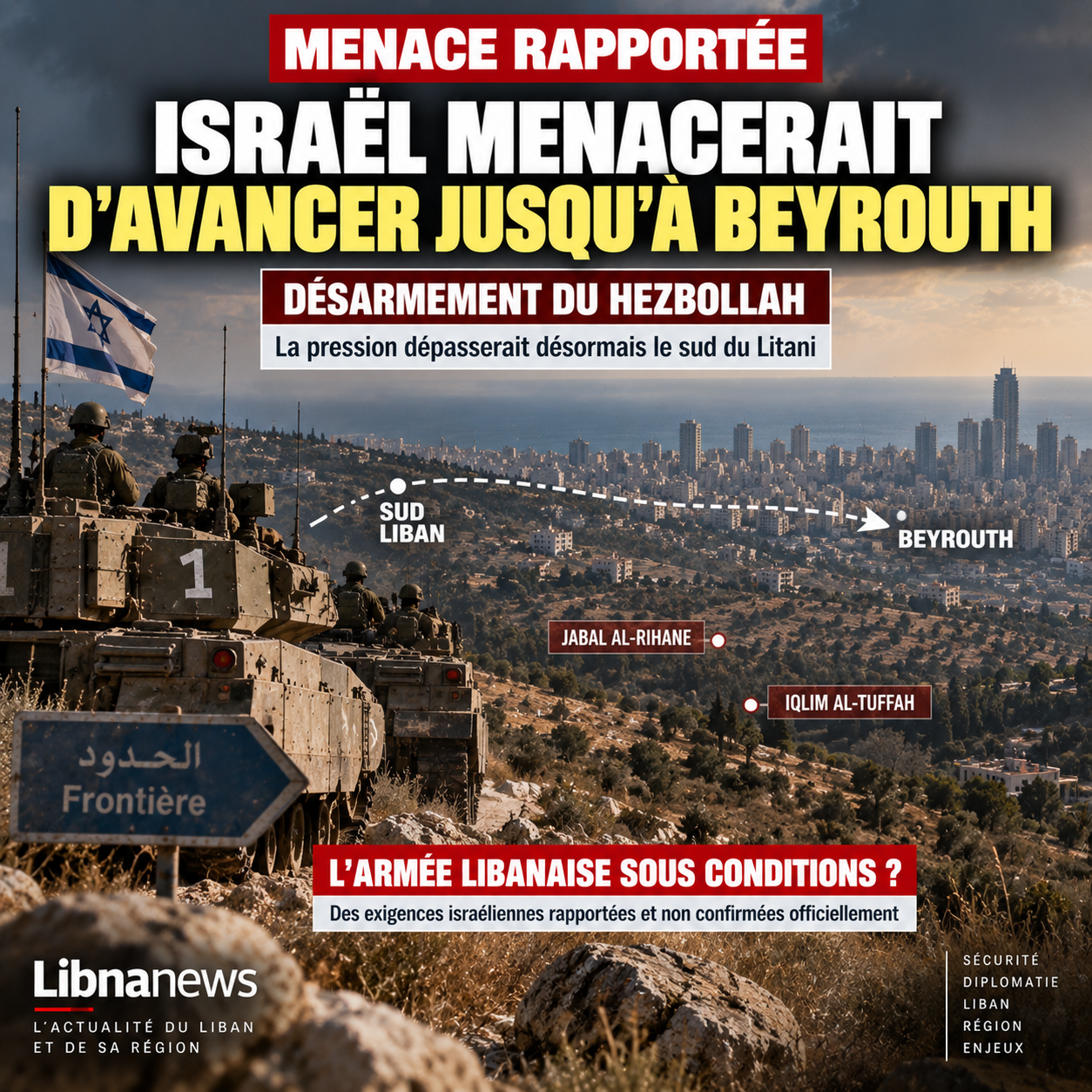
Israel would have threatened to launch a large-scale ground offensive that could reach Beirut if Hezbollah did not surrender its weapons, according to reports published by the Lebanese press on Thursday, 1 October 2026. The warning was reportedly transmitted to Lebanon by the US Ambassador to Beirut, Michel Issa, at a meeting held in September with Shiite Islamic High Council Vice-President Sheikh Ali al-Khatib. No official American or Israeli announcements at this stage publicly confirm the precise terms of this threat.
Reports also indicate Israeli requirements for the disarmament of Hezbollah beyond border areas. Israel would request, inter alia, a Lebanese army intervention in Jabal al-Rihan and Iqlim al-Tuffah, two areas north of the Litani and historically associated with a Hezbollah presence.
More sensitive, Israel would have requested information on the Lebanese troops involved in certain deployments and would like direct military coordination with the Lebanese army. According to the same information, a requirement to exclude any Hezbollah-related military from pilot areas, but also any Shiite-owned military, has been formulated. The Lebanese army would have categorically rejected this latter condition.
Israeli threat to Beirut reported to Ali al-Khatib
Central information relates to a meeting that allegedly took place in September between Michel Issa and Sheikh Ali al-Khatib. According to the Lebanese electronic daily Al-Modon, the American ambassador then issued a particularly serious warning about Israeli intentions.
In the absence of Hezbollah disarmament, Israel would be prepared to launch a land-based operation on a scale greater than current operations. According to the message, progress could reach Beirut. This formulation would constitute a sharp escalation in relation to the Israeli demands relating mainly to the dismantling of Hezbollah’s military capabilities in certain areas.
However, the information must remain attributed to Al-Modon. Neither the Embassy of the United States nor the Israeli authorities had publicly confirmed, at the time of publication, that Michel Issa had actually made this threat in those terms before Ali al-Khatib.
The context nevertheless makes the message particularly sensitive. The disarmament discussions no longer concern only Hezbollah’s positions near the Israeli border. They now cover areas deeper inside Lebanese territory.
The disarmament of Hezbollah north of Litani
According to reports from the Lebanese press, Israel transmitted several direct and indirect messages calling for complete disarmament of Hezbollah. Israeli demands would include Jabal al-Rihan and Iqlim al-Tuffah.
These two areas are of particular geographical importance. They are located north of the Litani and constitute mountainous areas where the presence of Hezbollah has long been considered important. Extending disarmament operations to these areas would therefore significantly alter the geographical scope of the mission entrusted to the Lebanese Armed Forces.
Israel would specifically demand that the army deploy to these areas to dismantle Hezbollah’s military infrastructure. According to Al-Modon, Israeli messages would warn against a repetition of the « Ali al-Taher scenario ».
This reference refers to tensions and operations in this area of Nabatiyah Governorate. In particular, it reflects Israel’s commitment to preventing the maintenance or reconstruction of military infrastructure in areas where the Lebanese army is called upon to strengthen its control.
The issue of disarmament is gradually changing. After the debate on the control of the territory south of the Litani River, pressure is being exerted on areas further away from the border.
Israel would like to know the military deployed
However, the most unusual information relates to the conditions Israel would seek to impose on the deployment of the Lebanese army.
Diplomatic sources cited by Al-Modon claim that Israel requested a list of officers and military personnel to be deployed in certain pilot areas. Tel Aviv would also like to establish a form of direct military coordination with the Lebanese army.
If confirmed, such a request would go far beyond the geographical positioning of the units. It would give Israel a right of control over the very composition of the Lebanese forces deployed on its territory.
However, there is no official Lebanese or Israeli confirmation publicly that these lists were actually claimed. This claim is based, at this stage, on the diplomatic sources cited by the Lebanese media.
The issue also has an obvious security dimension. Communicating the precise identity of officers and soldiers assigned to certain operations to a foreign power would be a particularly sensitive decision for a military institution.
A request to exclude Shia soldiers
Another condition attributed to Israel appears to be even more problematic. According to reports, Israel would require that no military deployed in the pilot areas be linked to Hezbollah. But this demand would go further: the military members of the Shiite community should also be excluded.
The Lebanese army would have strongly rejected this condition.
The exclusion of soldiers on the basis of their religious affiliation would directly affect the composition of the Lebanese military institution. The army brings together personnel from the different communities of the country and its command cannot treat membership of a confession as equivalent to political or military affiliation to Hezbollah.
Again, this requirement has not been publicly confirmed by Israel. It should therefore be regarded as a request attributed to Israel by the sources cited in the Lebanese press.
Its formulation nevertheless shows the depth of the disagreement which would arise around the modalities for possible deployment in the sectors concerned. For the army, accepting a religious criterion would mean allowing an outside actor to intervene in the composition of its units.
Army at the centre of disarmament machinery
The new demands reported place the Lebanese army in a particularly delicate position. It must strengthen its authority in the territory while avoiding the transformation of a deployment to restore the State monopoly on weapons into a mechanism controlled by Israel.
This distinction is essential for the Lebanese authorities. The deployment of the army is a sovereign decision of the State and its chain of command. International coordination may accompany certain operations, particularly under existing mechanisms, but individual selection of military personnel would be another step.
The problem becomes even more sensitive when it concerns areas such as Iqlim al-Tuffah or Jabal al-Rihan. Military intervention in these areas would require significant resources and may require the prior identification of military infrastructure, depots or Hezbollah positions.
The effectiveness of such an operation would also depend on political and security cooperation on the ground. A direct confrontation between the army and Hezbollah would be a scenario that the Lebanese authorities have long sought to avoid.
The pressure now goes beyond the southern border
The information published on Thursday indicates above all that Israel’s requests would no longer stop at the disarmament of Hezbollah in areas directly adjacent to the border.
Jabal al-Rihan and Iqlim al-Tuffah are further north. Their inclusion in the Israeli demands would reinforce the objective of a broader dismantling of the movement’s military capabilities, not a mere distance from its border forces.
This development also explains the scope of the threat attributed to Michel Issa. An offensive that could reach Beirut would no longer be seen as a consequence of a particular border incident, but as the ultimate means of pressure in the event of a failure of disarmament.
Such an operation would have considerable military and human consequences. It would imply a deep Israeli advance within Lebanese territory and would open a new phase of the conflict.
At this stage, however, it is a threat reported by media sources, not a public announcement of an Israeli operational plan.
Several statements still to be confirmed
The information published must therefore be distinguished according to their level of confirmation. Israeli pressure for the disarmament of Hezbollah is an established element of the political and military context. The extension of this pressure to areas north of Litani is also part of the current discussions on arms control.
On the other hand, several specific elements remain reported by Al-Modon and its sources: the threat of an invasion to Beirut transmitted by Michel Issa, the demand to obtain the names of the Lebanese soldiers deployed, the desire to establish direct coordination with the army and, above all, the requirement to exclude Shia soldiers from certain areas.
These claims require answers from Washington, the Lebanese Army and the Israeli authorities to be definitively established.
However, they are taking place at a time when the issue of Hezbollah weapons is gradually spreading to more remote areas of the border. The next point of tension could therefore focus less on the principle of the deployment of the Lebanese army than on a question of sovereignty: who decides the areas in which it intervenes, the soldiers it sends there and the information it agrees to communicate to Israel?