

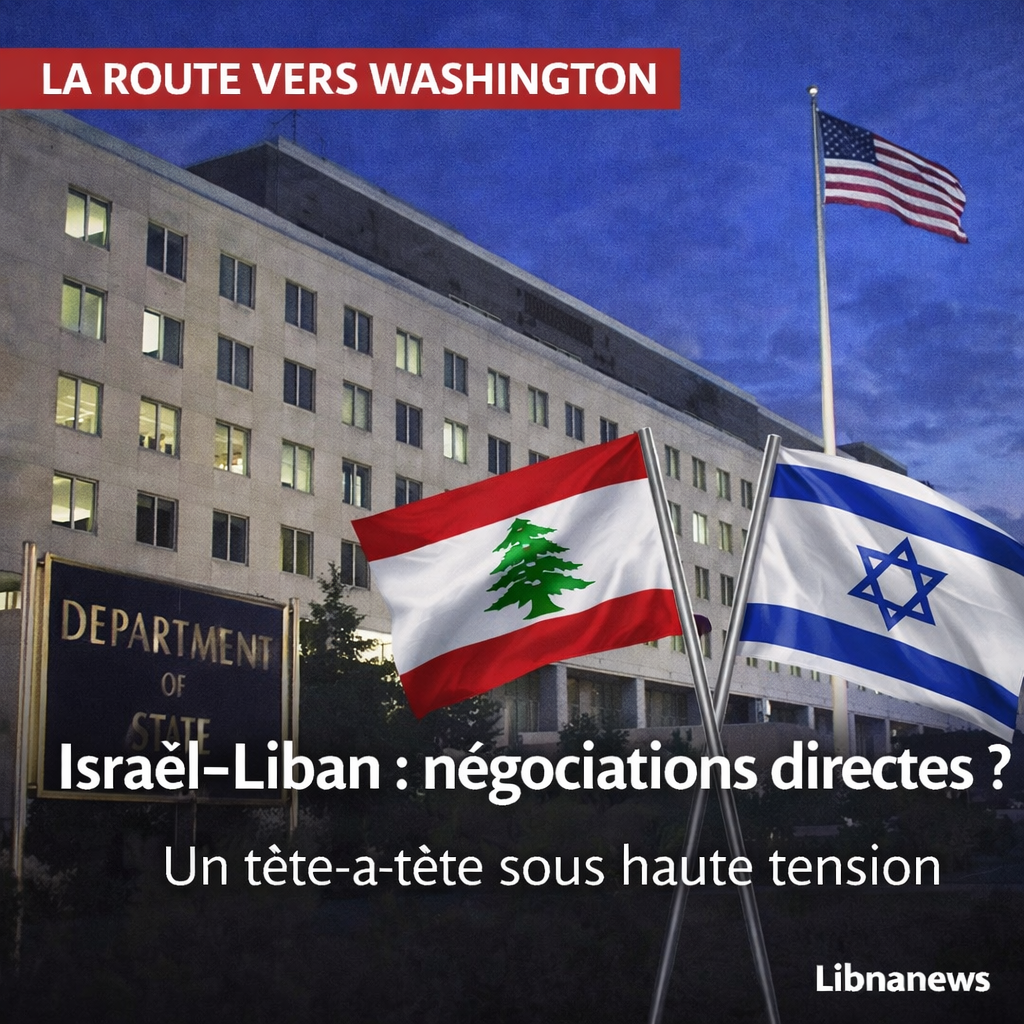
Direct negotiations between Israel and Lebanon could begin next week in Washington, D.C., according to information reported by Reuters from a message published on X by the journalist of Axios Barak Ravid. The first meeting would be held at the U.S. State Department, with delegations led by the two countries’ ambassadors in Washington and by the U.S. Ambassador to Lebanon, Michel Issa. If this sequence is confirmed, it will mark a major diplomatic turning point. But it would open up in a deeply unbalanced framework: Israel wants to discuss without a prior ceasefire on the Lebanese front, while Beirut defends the opposite logic. Above all, this initiative comes after a truce with Iran which paradoxically gave Hezbollah a political centrality that Tel Aviv is now seeking to neutralize.
First, the information must be precisely laid down. Reuters reports that Barak Ravid, a journalist from Axios, claimed that a senior Israeli official told him that direct negotiations between Israel and Lebanon would begin next week. According to the same message, the first meeting would take place at the State Department in Washington. The US delegation would be led by Ambassador Michel Issa to Lebanon. Israel would be represented by its ambassador to Washington, Yechiel Leiter. Lebanon is reportedly represented by its ambassador in Washington, D.C., Nada Hamadeh-Moawad. At this point, it is therefore an information relayed by Reuters, but based on a high-ranking Israeli source quoted by a journalist from Axios, not on a joint announcement already formalized by the three parties.
The calendar is not neutral. This possible diplomatic opening comes after a day of Israeli strikes of exceptional magnitude in Lebanon, then after statements by Benyamin Netanyahu claiming to have ordered the opening of direct negotiations as soon as possible. Axios adds that this Israeli decision followed calls with Donald Trump and Steve Witkoff, and that the US envoy asked Netanyahu to calm down the strikes in Lebanon and launch discussions. But the same article also quotes an Israeli official unequivocally stating that there would be no ceasefire in Lebanon. It is this point which gives the whole sequence its true meaning: Israel wants to speak, but without stopping the war.
A first meeting in Washington under American sponsorship
If the meeting next week continues, it would be a major diplomatic moment in the recent history of Israeli-Lebanese relations. The simple fact that the first contact is held in the US State Department says a lot about the power balance. It would not be Beirut, Tel Aviv, or a neutral capital that would serve as a framework. That would be Washington, that is, the diplomatic space where the Israeli advantage is traditionally the most structured. This data does not in itself prejudge the content of the discussions, but it immediately sets the tone: the channel would be American, the rhythm would be American, and the initial framing would be largely so. The latter sentence is based on an analysis based on the announced venue of the meeting and on the central role played by the US administration in the exchanges reported by Axios.
The choice of representatives confirms this. Michel Issa for the United States, Yechiel Leiter for Israel, Nada Hamadeh-Moawad for Lebanon: we are talking about diplomats based in Washington, no technical delegations gathered on a border or indirect discussions under multilateral mediation. This means that the first floor of this sequence will be played on the political ground, not just security or tactical arrangements. It also shows that the United States is trying to frame the scene from the outset, reducing the risk that another mediator or format might impose itself. Again, this is an analytical reading from the institutional architecture described by Reuters.
It should also be noted that the idea of a direct channel is not new. As early as last month, Axios reported that Lebanon had asked the United States to help open direct talks with Israel to end the war. At that time, according to the media, Beirut wanted a high-level framework to stop hostilities and lay the foundations for a post-war order. Israel did not respond favourably to this proposal and then favoured continued military pressure on Hezbollah. If we compare this sequence with today’s, the overthrow is obvious: yesterday Beirut wanted to speak and Israel refused; Today, Israel wants to speak, but in a much more favourable setting.
Why Israel is now pushing for direct negotiations
The first reason is the ceasefire between Washington and Tehran. This truce did not produce the political effect that Israel could expect on the Lebanese front. Instead of crushing the Hezbollah issue, it turned Lebanon into a central point of friction. According to Reuters and the international press reports, the question of whether or not Lebanon was included in the logic of the ceasefire has become one of the main subjects of dispute between mediators, Iran, Europeans, the United States and Israel. The mere fact that Lebanon had become a major diplomatic issue has given Hezbollah a political centrality that Israel was seeking to reduce.
This is the essential paradox of the sequence. Militaryly, Hezbollah remains under pressure. Politically, he did not disappear from the game; He even found a central place there. If Lebanon had to be explicitly excluded from the truce, it was good that the Lebanese front remained decisive. The movement can therefore argue that it remains the element that neither Washington nor Tel Aviv managed to neutralize diplomatically, since it was necessary to redraw the perimeter of the ceasefire to continue to strike it. This conclusion is an analysis, but it stems directly from the documented dispute over Lebanon’s inclusion in the truce.
So Netanyahu has better take over the initiative. Speaking of direct negotiations, he tried to move the focus of the debate. We should no longer talk about a Lebanon whose fate determines the credibility of the regional truce. We should talk again about an isolated Lebanon, reduced to one question: the disarmament of Hezbollah and a future arrangement with Israel. The opening of direct talks serves this purpose. It aims to narrow the Lebanese file, detach it from the regional framework, and reformulate it as a strictly bilateral issue, which is therefore more manageable by Israel.
There is also an American reason. Axios explains that Steve Witkoff asked Netanyahu to calm down the strikes and launch negotiations. This means that Washington does not want to let the Lebanese front derail the truce with Iran. But the concrete result remains favourable to Israel as long as no Lebanese ceasefire is imposed. For in this configuration, the American administration pushes to diplomacy without taking away from Tel Aviv its main lever: the ongoing war. Israel therefore obtains the benefit of a political initiative without abandoning its capacity to climb.
Lebanon faces negotiations without real leverage
For Beirut, the situation is much more difficult. If the meeting next week takes place, Lebanon will do so without having obtained the point it considers essential: a pre-ceasefire. All the diplomatic doctrine defended in recent days by the Lebanese State is that we cannot negotiate seriously while the strikes continue. This is the line that several Lebanese observers summarized in a clear formula: first silence the weapons, then only open the discussion. The current perspective completely reverses this order. Lebanon would be invited to speak while Israel retains the freedom to bomb.
In such a framework, Israel has almost everything for it. He keeps military pressure. It comes with an already public agenda: Hezbollah disarmament, security, then possible peace relations. He enjoys an American setting. And he can then present any Lebanese prudence as a hesitation before a historic chance. Lebanon, for its part, has neither military superiority, nor firm diplomatic coverage of its inclusion in the regional ceasefire, nor American guarantee capable of rebalancing the initial conditions. Its scope for manoeuvre therefore remains very narrow. This conclusion is based on an analysis of the terms reported by Reuters and Axios.
The paradox is that Beirut cannot completely ignore this channel, if it is confirmed. Because the Lebanese State just wants to remind us that he is the only one to negotiate on behalf of the country. Refusing to enter the game could allow others to say that Lebanon still leaves the vacuum to decide in its place. But getting into the game without a prior ceasefire amounts to accepting a discussion under duress. All the diplomatic difficulty of the coming days will be there: how to preserve the legitimacy of the negotiating state without validating an unbalanced negotiating framework in advance. This last sentence is a logical inference from the Lebanese official line and the announced modalities of the meeting.
A tight Lebanese delegation sign of strict political control
The dispatch you provided adds one important element: the Lebanese delegation would not be enlarged and would be limited to one figure, assisted by another, according to a formula approved by Joseph Aoun, Nabih Berri and Nawaf Salam. I have not found in the open sources consulted any public and detailed confirmation of this exact formula. On the other hand, it is consistent with a logic now visible: the Lebanese power wants to lock the country’s representation to the maximum in any direct negotiations, in order to avoid ambiguities, leaks and competing readings. This is therefore plausible information, but at this stage should be presented as reported and not fully publicly confirmed.
If this formula is confirmed, it will show several things. First, that there is at least a minimum agreement between Joseph Aoun, Nabih Berri and Nawaf Salam to keep his hand on the canal. Secondly, that Beirut wants to avoid an overly broad delegation that would immediately expose internal fractures. Finally, let Lebanon understand that it is potentially entering into a high-risk diplomatic sequence, where each word, gesture and composition of delegation will have considerable internal political significance. Again, this is an analytical reading consistent with the current Lebanese institutional prudence.
Risk of fractures in the Lebanese government
This possible diplomatic opening is not only between Israel and Lebanon. It is also played inside Lebanon. The government has just adopted a sensitive decision on Beirut, calling on the army and security forces to immediately strengthen full state control over the capital and to limit weapons to legitimate forces alone. This decision was made, but not without tension. This means that the issue of weapons, and more importantly that of Hezbollah, is already touching a fracture line within power.
If the direct negotiations open next week with an explicit Israeli agenda focusing on the disarmament of Hezbollah, the pressure on the Lebanese government will be immediate. Part of the cabinet and its supporters can say that we must take the moment to finally reaffirm the state monopoly. Another might consider that moving forward on this ground while the strikes continue would be to endorse an agenda imposed under Israeli compulsion. The risk is not only that of a debate. This is the result of a deeper government divide on the very legitimacy of the process. This conclusion is based on an analysis based on the simultaneousity of Beirut decisions and Israeli diplomatic pressure.
This danger is reinforced by the timetable. The more Israel insists on the disarmament of Hezbollah when there is no truce in Lebanon, the more hardline supporters can be accused, by their internal adversaries, of politically translating what the war has not yet completely imposed militarily. Conversely, the more the temporal government, the more it will be accused of impotence. So the process announced in Washington is not just a diplomatic test. It is also a cohesion test for the Lebanese executive.
The spectrum of internal deflagration
The word remains heavy, but it becomes difficult not to see the risk: such a sequence can revive fears of internal confrontation in Lebanon. Not because a civil war is already going on or inevitable. But because the combination is particularly dangerous: Israel’s still active war, negotiations without a ceasefire, pressure on the issue of Hezbollah’s weapons, and long-standing Lebanese divides over the sovereignty, resistance and role of the State.
The mechanism of danger is clear. If one part of the country believes that the State is finally acting to regain the monopoly of force, while another believes that it is acting under the dictates of Israel and the United States, then the institutional issue is quickly transformed into an existential question. In a country like Lebanon, where memories of war remain alive and where political territories are still heavily marked, this drift cannot be considered theoretical. This conclusion is a general analysis, not a fact already found.
That is precisely why the demand for a ceasefire before any negotiations remains so important for Beirut. It is not just about stopping the bombings. It also aims to prevent the most explosive issue in Lebanese political life — that of Hezbollah’s weapons — from being dealt with in an environment where any decision may be read either as a capitulation or as a betrayal. In this sense, the Lebanese demand for a break before the talks is also a demand for domestic survival.
Washington, theatre of a possible turning but not a rebalancing
If next week’s meeting really takes place in the State Department, it will probably open a new phase. But there is nothing to say that this phase will be favourable to Lebanon. The place, the actors, the timetable and the absence of a pre-ceasefire are instead a framework in which Israel has more to gain. For Netanyahu, these discussions allow us to resume the initiative after a sequence where Hezbollah regained political weight. For Washington, they can be used to prevent the Lebanese front from detonating the truce with Iran. For Beirut, they risk starting in a situation of strategic weakness and acute internal tension.
That is why the information reported by Reuters on a possible first meeting starting next week must be read with all its seriousness. If it is confirmed, it will not simply be diplomatic progress. This will be an open negotiation in an extremely asymmetrical balance of power, at a time when Lebanon is trying to save its remaining political margin, institutional cohesion and internal stability. This is what makes this perspective a possible turning point, but also a heavy risk bet for the whole country.




