





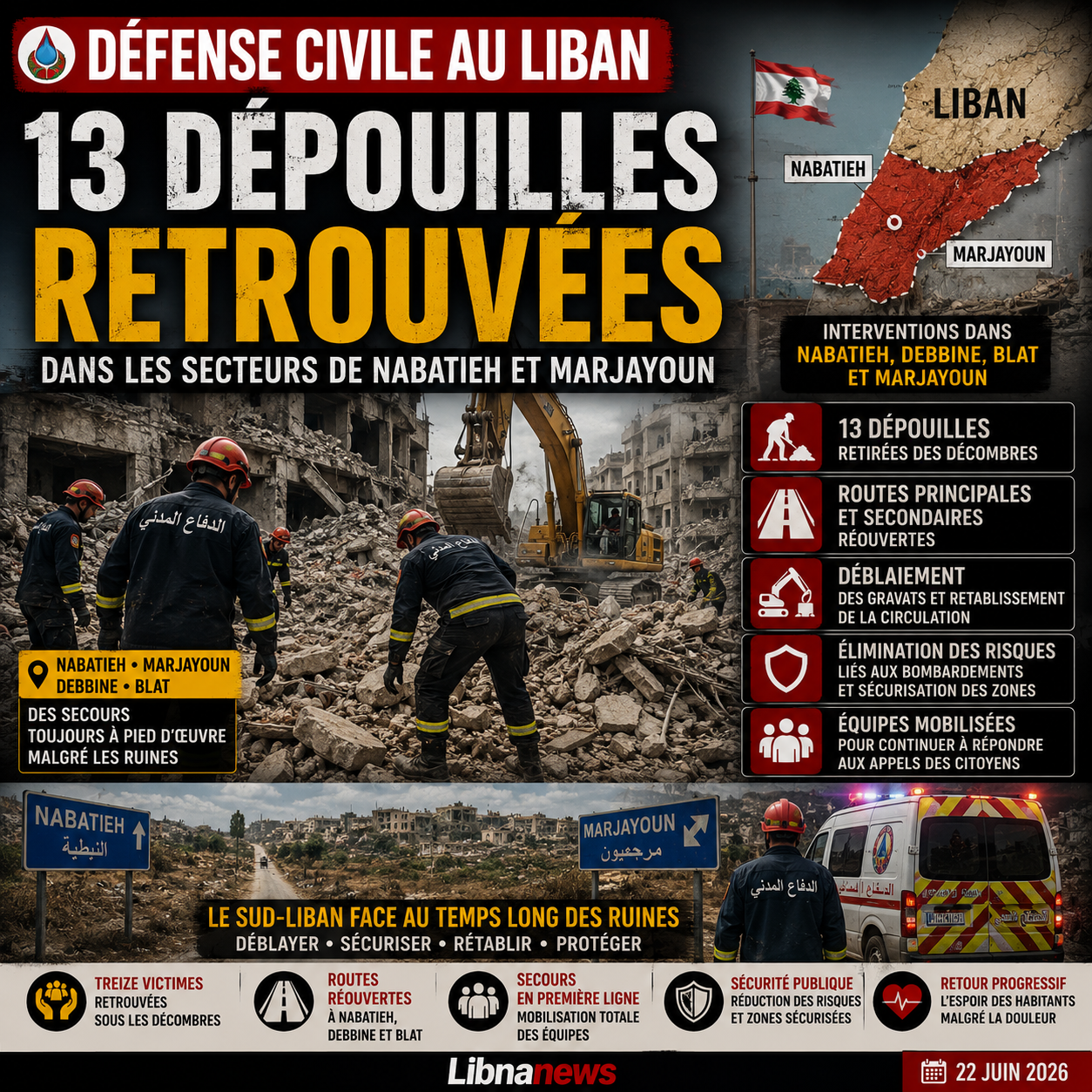
On Monday, 22 June, the Lebanese Civil Defence announced that it had removed thirteen remains from the rubble in the Nabatiyah and Marjayoun areas of southern Lebanon. Its teams also reopened main and secondary roads in the Nabatiyah region, as well as in the localities of Debbine and Blat in Marjayoun. The operation aimed to clear the rubble, restore traffic and reduce the risks left by the bombings.
This announcement gives the measure of an emergency that does not stop with the retreat of the fighting. In southern Lebanon, relief workers are still working under pressure from ruins, cut roads and fragile buildings. The communiqué of the Directorate-General for Civil Defence does not detail the identity of the victims or the exact locations where the bodies were found. However, it confirms the continuation of a phase of research, security and re-mobilisation of the affected areas.
Operation between Nabatieh and Marjayoun
Nabatieh’s teams worked all Sunday on several axes. They cleared the main roads, followed by secondary roads for the inhabitants, ambulances, municipal vehicles and emergency equipment. The official statement also cites Debbine and Blat, two localities in the Marjayoun area. Their mention shows that operations are not limited to a point of impact. They cover a wider territory, where access remains essential for assessing damage and responding to local calls.
In this type of intervention, the opening of a road is not an ordinary task. It conditions everything else. A street crowded with concrete blocks, collapsed walls, cables or car carcasses prevents the arrival of rescue. It delays the transport of the wounded. It also complicates the passage of families who want to check the state of a house, recover property or join relatives. The task of the teams is therefore to restore a minimum of access before even considering a more normal resumption of traffic.
Regional and civilian defence centres were mobilized together. This coordination allows for the division of tasks between clearance equipment, research teams and public safety officers. The communiqué stresses the continuity of missions despite the difficulties on the ground. This precision is not secondary. Rescue workers intervene in places where structures can still yield and where traces of the bombing can create new risks after the initial impact.
Thirteen bodies removed from rubble
The heaviest part of the announcement concerns the thirteen remains removed from the rubble. The search and rescue teams conducted this operation in parallel with the clearance of the roads. The communiqué does not specify whether the bodies were found in a single site or in several buildings. Nor does it give a nominal balance sheet. At this stage, the confirmed information therefore relates to the number of remains removed, the areas concerned and the nature of the missions carried out.
Body removal after bombing requires slow work. Teams must advance in unstable clusters. They must avoid causing another collapse. They must also preserve the elements for the identification of victims. This stage counts for families, local authorities and medical services. It makes it possible to establish a more reliable balance sheet and to make the bodies to the relatives when identification can be completed.
In its communiqué, the Civil Defence uses the term martyrs, in accordance with official Lebanese usage in this context. In journalistic treatment, the central fact remains the same: thirteen people were found dead under the rubble. The advertisement does not allow to say whether all were killed at the same time. Nor is it possible to indicate their age, sex or civil status. These elements will have to come from subsequent announcements, if the authorities make them public.
Civil defence in Lebanon: relief under pressure
Civil Defence in Lebanon operates in an environment already marked by the exhaustion of emergency services. The Southern teams were solicited without interruption by strikes, displacements, evacuations, fires, victim searches and security operations. The work announced on 22 June adds to this burden. It shows that the human emergency continues after the immediate end of a bombardment, sometimes for several days.
Nabatieh occupies a particular place in this sequence. The city and its region have suffered significant damage in recent weeks. The first aid workers also paid a direct price. The regional civilian defence centre in Nabatiyah was destroyed in May by an Israeli strike, according to international media reports. Rescue workers had already been killed or injured in the conflict. This environment makes each intervention more complex, as teams must continue to act even when their own means have been reached.
This point explains the scope of the communiqué. It is not just a matter of reporting a routine operation. The aim is to show that relief remains active in the most affected sectors. The message also targets residents who call for help. The Directorate-General points out that its officers continue to respond to citizens’ requests despite difficult conditions. This sentence recalls the fragility of the public service in an area where safety, energy, communications and roads can be interrupted at the same time.
Road clearance as a civil emergency
In bombed areas, the road often becomes the first public service to be restored. Without access, ambulances move slowly. Water or fuel trucks do not pass. Municipal teams cannot inspect the networks. Families remain isolated or take more dangerous routes. In Nabatieh, Debbine and Blat, the clearance of the roads is therefore a civil emergency as well as a logistical necessity.
Secondary roads are particularly important in southern Lebanon. They connect villages, hamlets, agricultural lands and peripheral areas. When a main axis is damaged or exposed, these pathways become alternatives. Their blocking can isolate an entire pocket of inhabitants. Re-opening allows first aid workers to increase access points and to better distribute interventions. It also helps the authorities to draw up a first map of the damage.
However, the work remains provisional. Opening a road does not mean that the area is safe. Buildings can remain unstable. Debris can fall after the gear passes. Damaged electrical installations or tanks can create additional hazards. The specialized teams have therefore worked to eliminate the risks associated with the bombing. This public security mission is essential before any massive return of the inhabitants to the affected areas.
From bombardments to residual risks
The press release is not limited to roads and remains. He also mentioned the work of the specialized teams to ensure public safety and remove the dangers caused by the bombings. This formula covers several types of threats. It may involve fragile structures, threatening materials, dangerous obstacles, possible fire pits or areas where traffic exposes residents to an accident.
These residual risks often affect civilians after strikes. A cracked house can collapse when moving rubble. A stairwell can yield. A wall can stand a few hours before falling. Damaged vehicles may block a passage or present a fire risk. Rescue workers must therefore intervene with caution. They can’t just remove the debris. They must determine what can be moved without aggravating the situation.
The security phase also conditions the work of other actors. Municipalities, technical services, doctors, local associations and families cannot enter an area for a long time if the risks of falling or explosion are not ruled out. Civil Defence acts as a first filter. It opens the ground, signals dangers and facilitates the next step. In the affected villages, this stage can decide how quickly people return.
Information still incomplete
Several points remain outstanding. The communiqué does not provide a list of victims. It does not specify whether the thirteen remains were discovered in Nabatieh, Marjayoun or both sectors. Nor does it indicate the exact number of roads reopened, the duration of each intervention, the resources committed or the state of public infrastructure. These absences do not call into question the announcement. They only show that the balance sheet remains technical and provisional.
This caution is necessary. In the first few hours after a rescue operation, the numbers can change. Bodies can be identified later. New calls can take teams to other sites. Clear roads can be closed again for safety reasons. Local authorities must therefore move forward in successive updates, especially in areas where research operations are not necessarily completed.
However, the choice of communicating on thirteen remains removed from rubble provides a benchmark. He reports that the relief efforts have taken an important step in the search for victims. It also warns about the depth of the damage. When bodies remain under the ruins for several days, this often means that access was difficult, buildings were unstable or operations had to wait for a minimum of security. The statement does not conflict between these explanations, but makes them plausible.
South Lebanon facing the time long ruins
The work of the Civil Defence reveals another reality: the war does not stop when the fire decreases. The rubble imposes its own calendar. We need to clear, inspect, secure, identify, prevent and start over. Every open street can lead to a new discovery. Every building hit can hide a risk. Every return home can create new needs. This long time weighs on the southern municipalities, already weakened by displacement and destruction.
In Nabatieh, relief operations are part of a series of bombings that have profoundly disrupted local life. The city is an urban, commercial and administrative centre of the South. When its axes are cut, the effect exceeds the affected neighborhoods. It affects neighbouring villages, markets, medical services and displaced families. The reopening of roads therefore does not only meet a need for traffic. It helps to restore a minimum of territorial continuity.
In Marjayoun, Debbine and Blat, access to border areas or near areas of tension is also at stake. Teams must deal with fragmented terrain, sometimes narrow roads and dispersed needs. People need accurate information before they come back. They want to know which roads are practicable, which areas remain dangerous and where relief can be provided. This request for information becomes part of the humanitarian response.
An intervention at the heart of a fragile truce
The announcement of 22 June comes as Lebanon seeks to stabilize a still fragile ceasefire. In this context, each relief operation has an indirect political dimension. The Lebanese authorities are calling for a halt to the strikes, respect for sovereignty and protection of civilians. In the field, the Civil Defence teams respond to the immediate emergency: removing the bodies, opening the roads and reducing the dangers.
This separation between diplomatic and humanitarian time is essential. Negotiations can announce a truce. They don’t clear the streets. They can’t find the victims. They don’t secure affected homes. This work is done by local teams, often with limited resources. Their action gives a concrete measure of the gap between a political communiqué and the reality of the inhabitants.
The next few days will say whether this operation remains an isolated episode or whether it is part of a long series of similar missions. Emergency services should continue to respond to calls, check buildings and report hazards. The authorities, for their part, must specify the human and material needs. In Nabatieh, Debbine, Blat and Marjayoun, the return to a minimum life will depend first of all on these concrete actions, the safety of the roads and the ability of the teams to reach the still crowded areas.