

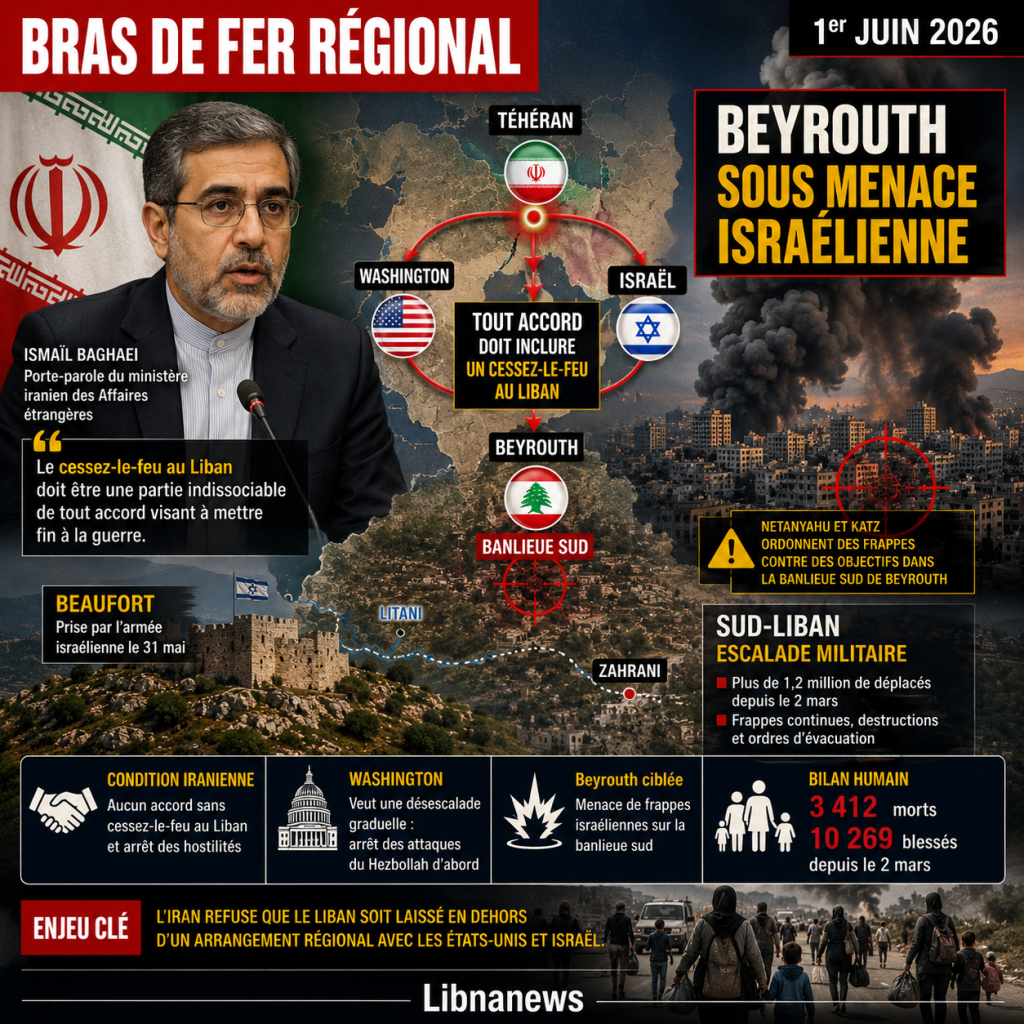
The spokesman for the Iranian Foreign Ministry, Ismail Baghaei, said on Monday that the ceasefire in Lebanon must be part of any agreement to end the war. This statement comes at a time when fighting is intensifying in southern Lebanon, when the Israeli army has advanced to the Beaufort area and Benjamin Netanyahu and Israel Katz have announced that they have ordered strikes against targets in the southern suburbs of Beirut. Tehran thus intends to recall that the Lebanese front cannot be isolated from the ongoing regional discussions.
This Iranian position gives the Lebanese case a wider scope than the one face-to-face between Israel and Hezbollah. It links the cessation of hostilities in the South, the security of Beirut, discussions with Washington and maritime tensions around Iranian navigation. For Lebanon, this link is heavy. The country is directly affected by strikes, destruction, displacement and loss of life. But part of the settlement is in negotiations where Beirut does not control all military parameters or diplomatic levers.
Tehran puts Lebanon at the heart of the discussions
Ismail Baghaei said this at his weekly press briefing. He stated that the ceasefire in Lebanon was an inseparable part of any agreement to end the war. The sentence refers first to the United States and Israel. It means that Tehran does not want an arrangement limited to Iranian interests alone, or a text that would leave Hezbollah under military pressure in Lebanon. Iran regards the Lebanese front as one of the components of the same regional confrontation.
The Iranian spokesman also accused the United States of supporting, in his words, a permanent war against the countries of the region for eighty years. The formulation follows the usual Tehran line, which presents Washington as Israel’s political and military guarantor. It also provides an ideological framework for the ongoing negotiations. Iran says it is discussing, but it does not present these discussions as a trust-based process. Rather, he describes them as a necessity imposed by the balance of power and by the risk of war widening.
Baghaei insisted on this point. According to him, negotiations are taking place in an atmosphere of deep doubt. The parties would still be at the point of exchanging messages. He added that the negotiation was not the result of trust between the interlocutors. This formula aims to prepare Iranian opinion for a long, fragile and reversible process. It also allows Tehran to attribute the slowness of the dialogue to the other side, accused of constantly changing its positions. The message is twofold: Iran remains in the discussion, but it refuses to give the image of a quick rapprochement.
A doctrine already affirmed since April
This mistrust explains the place given to Lebanon. Since April, Tehran has claimed that the Lebanese ceasefire is part of a broader regional framework. The Iranian Foreign Ministry had already welcomed the announced truce in Lebanon as a component of a broader arrangement negotiated with the support of mediators. He then called for Israel’s complete withdrawal from occupied areas in southern Lebanon, the release of prisoners, the return of displaced persons and the reconstruction of destroyed areas. Monday’s statement extends this doctrine.
The stakes are now more urgent. The latest consolidated official assessment of the Lebanese Ministry of Health, published on Sunday evening, reported 3,412 deaths and 10,269 injuries since 2 March. This figure shows an increase of 41 deaths and 140 injuries in 24 hours. It does not necessarily cover all the partial reports reported on Monday, especially after the attack by Deir el-Zahrani, who killed eight people and injured another 19 according to the ministry. The magnitude of the losses gives concrete weight to the call for a ceasefire in Lebanon.
In recent days, Israeli strikes have affected Tyre, Nabatiyah, Deir al-Zahrani, Qlaylé, Majdel Zun, Al-Mansuri and several southern localities. A strike near Hiram Hospital in Tyre injured 13 health personnel. International organizations also alerted children killed or injured and attacks on medical facilities since the beginning of the theoretical truce of April. In this context, Iranian demand does not remain abstract. It deals with a war that results every day in deaths, injuries, evacuations and overcrowded public services.
Beaufort, Beirut and the weight of the land
The military situation further reinforces this reading. On Sunday, the Israeli army announced the capture of Beaufort Castle, also known as Qalaat al-Shaqif, as well as the nearby ridge. The site dominates the Litani and several axes of southern Lebanon. Israel had occupied it from 1982 to 2000. Its resumption therefore has military and symbolic value. It also states that the Israeli operation is no longer limited to point strikes or incursions near the border. It settles in a battle of deep positions.
Israel affirms its desire to neutralize Hezbollah’s infrastructure and protect the northern part of its territory from rockets, missiles and drones. According to a news agency, more than 1.2 million Lebanese have been displaced by Israeli strikes and evacuation orders since 2 March. Israel refers to soldiers and civilians killed by the Hezbollah attacks. These losses feed the Israeli justification for an expanded operation. Lebanon accused Israel of carrying out a policy of destruction and forced displacement in civilian areas.
The announcement made on Monday by Benjamin Netanyahu and Israel Katz adds an additional degree to this crisis. Both Israeli officials said they ordered the army to strike targets in the southern suburbs of Beirut. The Israeli communiqué invokes repeated violations of the ceasefire by Hezbollah and attacks on Israeli cities and citizens. The dense and popular southern suburbs are concentrated in residential areas, shops, roads and Hezbollah-related structures. Any strike in this area can have major human and political consequences.
Washington wants to sequence, Tehran wants to bind
For Tehran, this threat against Beirut confirms that the ceasefire in Lebanon must remain at the centre of the negotiations. Iran does not want Washington to get a regional agreement while allowing Israel to continue operations in the South or hit the Lebanese capital. This position also serves Hezbollah. The movement can lean on it to refuse a unilateral halt to its fire. His allies claim that Hezbollah cannot stop its attacks if Israel retains troops on Lebanese territory and continues to bombard.
The American proposal follows a different logic. Washington is looking for a gradual de-escalation. The plan discussed in recent days foresees that Hezbollah will cease its attacks on Israel first. In return, Israel would refrain from climbing against Beirut. President Joseph Aoun supports the search for an agreement that can reduce military pressure. The Speaker of Parliament, Nabih Berri, believes that Hezbollah could respect a ceasefire if Israel stopped firing. The disagreement therefore concerns the first gesture.
Baghaei’s statement is precisely part of this dispute. She refuses the American sequence as presented. By linking any agreement to the ceasefire in Lebanon, Tehran calls for a simultaneous approach. Hostilities must cease on all the fronts concerned, or no settlement can be solid. This line joins Iran’s vision of a single regional conflict, where Lebanon, the Red Sea, the Gulf, Iran and Israel are in the same balance of power. It contradicts the American method, which tries to cut down files to obtain successive gestures.
Iranian navigation enters the equation
The maritime section cited by Baghaei follows the same logic. The Iranian spokesman denounced the continuation of what he described as maritime piracy and an attack on Iranian navigation. He described these acts as a violation of the ceasefire. He added that the Iranian diplomatic apparatus was closely following developments and that Tehran would take all measures deemed necessary to defend its sovereignty. The message refers to restrictions, interceptions or pressures against Iranian maritime interests.
The sea thus becomes another negotiating ground. Iran wants to link the safety of its navigation with regional stability. The United States and its allies defend freedom of movement and the safety of energy roads. Both positions may seem to converge on principle, but they differ on responsibilities. Tehran believes that its ships and interests are targeted. Washington accuses Iran and its allies of threatening maritime routes. In this climate, Lebanon becomes a case among others, but a matter whose evolution can block or accelerate discussions.
For Beirut, this regionalisation involves a major risk. Lebanon needs a rapid halt to strikes, the return of internally displaced persons and guarantees on its southern border. But if the ceasefire becomes a piece of a comprehensive agreement between Tehran, Washington and Israel, the Lebanese calendar can be slowed down by external issues. Frozen Iranian assets, United States sanctions, navigation, guarantees of non-aggression and regional balances can affect the end of fighting in the South. The price of this joint is measured on the Lebanese ground.
The Lebanese debate on the negotiation
This explains the internal debate on direct negotiations. Joseph Aoun seeks to give the Lebanese state a margin of action. On Monday, the Lebanese Forces announced their support for its choice of direct negotiations to stop the escalation and end the suffering of the Lebanese. This position aims to put Baabda back at the center of the game. It affirms that Lebanon cannot remain dependent on military or diplomatic decisions taken elsewhere. But it encounters the reality of Hezbollah, a major armed actor and ally of Iran.
Hezbollah has no interest in letting the Lebanese State negotiate alone the terms of an agreement that could touch its weapons, its positions in the South or its regional role. The movement presents its attacks as a response to Israeli aggression. It claims to target Israeli forces, armoured personnel and military positions. Israel, for its part, asserts that it is targeting its infrastructure and firing capabilities. Between these two accounts, the Lebanese government is trying to manage the humanitarian emergency and preserve weakened institutional sovereignty.
The Iranian position therefore gives Hezbollah a diplomatic depth. It states that Tehran will not let the Lebanese front be treated as a secondary variable. But it also feeds the critics of those who believe that Lebanon remains a prisoner of a regional agenda. For these actors, priority should be the sovereign decision of the State, the protection of civilians and the deployment of the Lebanese army to the South. For Hezbollah’s allies, sovereignty cannot be restored as long as Israel occupies positions or threatens Beirut.
International pressure still limited
France, the United Kingdom and Germany expressed concern about the deepening of the Israeli operation in Lebanon. Paris called for an urgent meeting of the Security Council after the Beaufort takeover. These European reactions reinforce diplomatic pressure on Israel, but they have not yet imposed a military pause. Above all, they show that Lebanon is once again becoming a central international issue, while regional fronts are multiplying and the April truce seems to be emptied of its substance on the ground.
The timetable for the next few hours remains decisive. If Israel strikes the southern suburbs of Beirut, the American proposal for de-escalation will be subject to a major shock. If Hezbollah intensifyes its fire, Israel can justify further progress in the South. If mediators succeed in obtaining a simultaneous or progressive stop, Baghaei’s statement will become one of the parameters to be incorporated into a broader text. But for now, no announcement confirms a final agreement, or even a sequence accepted by all actors.
Iran has therefore established its position at a time when Lebanon is sinking into an acute military and humanitarian crisis. The ceasefire in Lebanon is no longer presented by Tehran as an annex, but as a central element of any settlement. This line reinforces the regional weight of the Lebanese front, while complicating Beirut’s margin of manoeuvre. Between American discussions, Iranian warnings, Israeli threats on the southern suburbs and fighting around the Litani, the next signal will come from both chancelleries and the ground.




