

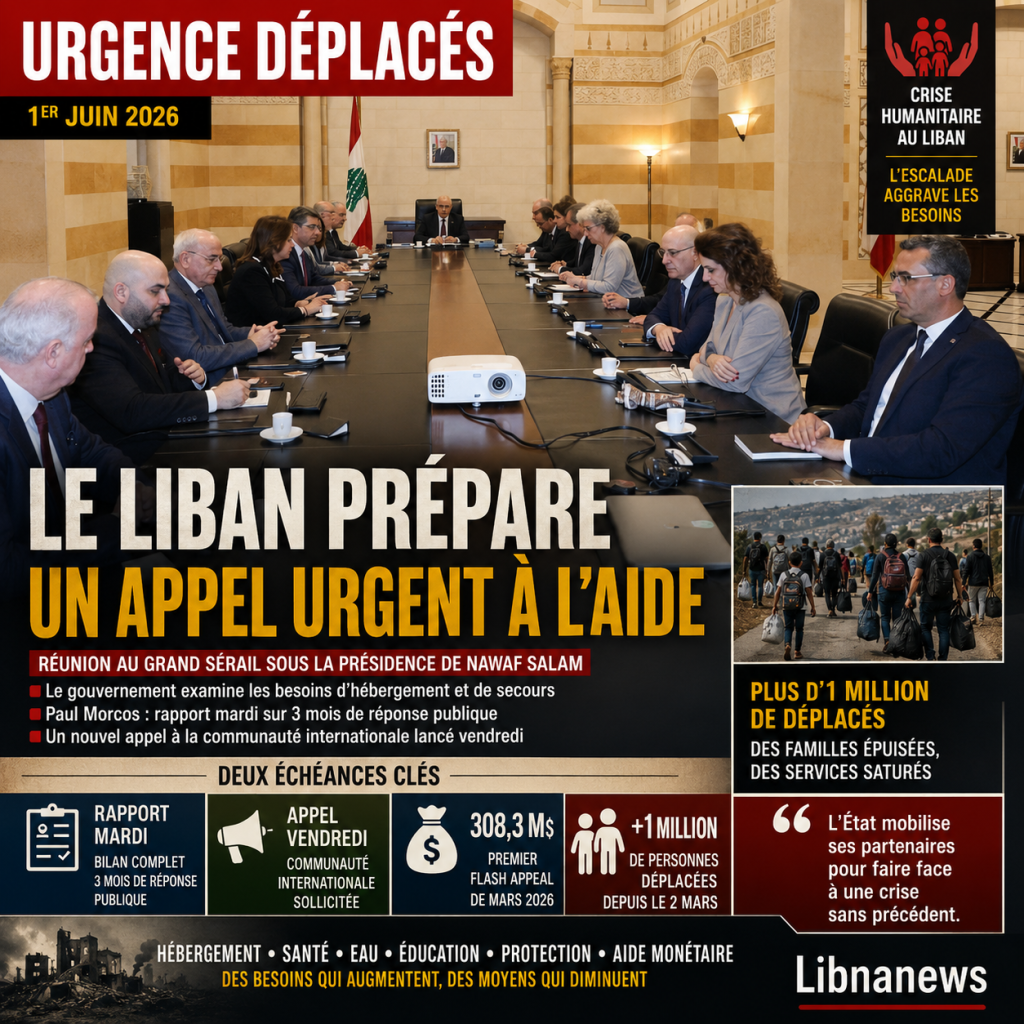
The Lebanese government is trying to regain control of two emergencies that are advancing at the same time: the military escalation and the crisis of the displaced in Lebanon. Meeting on Monday in the Grand Sérail under the chairmanship of Prime Minister Nawaf Salam, a ministerial committee discussed accommodation and relief needs, in a context marked by the worsening of the southern front and the increasing pressure on reception centres. At the end of the meeting, the Minister of Information, Paul Morcos, announced the publication on Tuesday of a comprehensive report on three months of public response to shelter and travel needs.
The same Minister also indicated that an urgent appeal to the international community would be launched on Friday. This new call, presented as a complement to the first Flash Appeal, is intended to cover increasing needs, while available resources are decreasing. The Government’s formulation reflects a concern that Lebanon can no longer absorb the human and logistical cost of a war that has already displaced more than a million people and weakened all its public services.
Serail at the centre of humanitarian response
The ministerial meeting was not an ordinary meeting. It was held at a time when Lebanon was seeking to resettle an effective ceasefire after several days of escalation in the South. Nawaf Salam opened the discussions with a presentation on the launch of negotiations at the military level in Washington. He also presented efforts with friendly and brotherly countries to try to consolidate the cessation of fighting. The message is twofold: the government is working on the humanitarian ground, but it knows that the response to the displaced depends first on military evolution.
The choice of the Grand Sérail as a steering centre confirms the desire to give an institutional form to crisis management. Since the beginning of the March offensive, ministries, municipalities, relief agencies and international organizations have often responded to the emergency. The proliferation of evacuation orders, the saturation of schools turned into shelters and the pressure on hospitals now require a consolidated vision. The report due on Tuesday must therefore be used to measure what has been done, but also what is still missing.
Moved to Lebanon: emergency accommodation
Paul Morcos’ statement insists on the last three months. This period corresponds to the sequence opened by the resumption of the war on 2 March. Since then, the country has seen the expansion of the areas of displacement: first the border villages, then the localities close to the Litani, then the areas further north, to the Zahrani. Families who had found refuge in intermediate towns sometimes had to leave for a second time. This forced mobility complicates censuses, the delivery of assistance and the schooling of children.
The report will therefore have to answer a simple question: where are the displaced, what do they need and what capacity remain? Requirements are not limited to mattresses, blankets or meals. They also concern water, hygiene, medicines, fuel, psychological care, access to education and the protection of vulnerable people. Pregnant women, the elderly, chronically ill and unaccompanied children require specific devices. These arrangements are costly and require sustainable coordination.
Accommodation is the most visible emergency. In several regions, public schools, municipal buildings, sports centres, religious premises and private housing accommodate families from the South. These solutions prevent a large-scale street crisis, but they are not designed to last. The classrooms should normally reopen to students. Collective buildings lack privacy. Sanitary is getting used to it quickly. Families received with relatives weigh on households already impoverished by the economic crisis.
The government therefore faces a dilemma. It must maintain reception capacity, while preventing temporary shelters from paralyzing other services. Schools used as shelters delay courses. Municipalities must finance water, waste and electricity with limited budgets. Hospitals receive the injured and continue to treat ordinary emergencies. In this context, Friday’s call is as much for funding as for avoiding the exhaustion of local structures.
A new call after a first mobilization
The first Flash Appeal had already set a framework for several months. It covered vital aid, water, health, protection, education, shelter and essential goods. But the military aggravation changed the scale of the response. Initial needs were exceeded by the expansion of displacement and the duration of the crisis. The new appeal should therefore not be read as a mere administrative formality. He pointed out that the assistance provided was no longer sufficient and that promises must turn into real funding.
The first appeal launched in March set a target of $308.3 million to provide vital assistance and protection to one million people for three months. Within this framework, the Office of the United Nations High Commissioner for Refugees had indicated that it needed $61 million to reach 600,000 people with basic necessities, shelter, protection and monetary assistance. These amounts give an order of magnitude, but they do not prejudge the new call announced for Friday. The Government has not yet communicated its envelope or the breakdown by sector.
This clarification is important, as needs have evolved since March. Travel has continued, families have exhausted their economies and new sectors have been affected. The collective centres use more fuel, water and sanitation equipment. The host homes bear additional charges. NGOs must renew the stocks of blankets, mattresses, hygiene kits and medicines. The next appeal must therefore include the duration of the crisis, not just the number of displaced persons.
The international dimension is decisive. Lebanon is emerging from several years of financial collapse. Its administrations operate with reduced resources. Municipalities do not have the resources to support tens of thousands of families over time. Humanitarian organizations, too, must choose between several regional emergencies. By launching a call on Friday, the government wants to put the Lebanese crisis back on the donors’ agenda, while global attention is scattered across several fronts.
A response that Beirut wants to make readable
This approach is also politically relevant. Nawaf Salam wants to show that the state is not content to denounce the bombings. It seeks to organize, encrypt and present needs. Tuesday’s report must provide a technical basis. Friday’s call must translate this base into an international application. This sequence gives the government a structured voice at a time when it must convince foreign partners that aid will be used in a transparent and targeted manner.
Transparency is becoming a central issue. Donors want to know how many people are registered, which sectors are priority, which ministries are responsible and which organizations are implementing the programs. The internally displaced want to know where to go, what rights they have and how long they can stay in the reception centres. The municipalities ask for compensation. Schools want to know their schedule. The expected report should therefore be more than a balance sheet: it should serve as a coordination tool.
Washington in the background of the crisis
The ministerial meeting also addressed military negotiations in Washington. This dimension should not be separated from the humanitarian issue. The aid can relieve the displaced, but it does not replace a ceasefire. If fighting continues, each new area evacuated will add needs beyond those already identified. If the strikes near Beirut or Saida, the existing reception capacity could be quickly exceeded. Diplomacy and humanitarianism are now linked in the same emergency.
The Prime Minister described contacts with friendly and fraternal countries as intensive efforts to restore the ceasefire. This expression shows that the government does not see the truce as acquired. It must be rebuilt. The discussions in Washington, open at the military level, aim to create a security framework. But the situation remains fragile. Israel accuses Hezbollah of violating the cessation of fighting. Hezbollah and its allies denounce the continuation of Israeli strikes and the advance of the Israeli army to the south.
Defence Minister Michel Menassa presented military developments during the meeting. Its presence underlines the importance of the link between security and displacement. A land advance, a highway bombardment or a threat to an urban area can change the needs map within hours. The reception centres must then anticipate new arrivals. Rescue must secure the routes. Hospitals have to prepare beds. Humanitarian management depends on military reading.
Priorities beyond reception centres
The other constraint is time. The government announces a report Tuesday and a call Friday. This short calendar shows urgency, but it leaves little room for improvisation. Figures need to be consolidated, ministries aligned, associated humanitarian partners and prioritized financial requests. A poorly prepared international appeal could dilute priorities. A specific appeal can, on the contrary, speed up commitments and direct funds to the most immediate needs.
Priorities should focus on shelters, essential goods, water, health and emergency education. Displaced families need safe places, but also income or monetary support to avoid complete dependence on collective centres. Children must remain in school or benefit from temporary programmes. Chronic patients should be treated. Women and minors must be protected from the risks of exploitation, violence and extreme insecurity. These needs increase with the length of the trip.
The government will also have to manage the issue of host communities. Many displaced families live with relatives or rent apartments. This form of reception remains less visible than collective centres, but it weighs heavily on households. Rent goes up, bills go up, jobs go down. A response focused only on official shelters would leave an important part of the crisis behind. The report announced on Tuesday should therefore cover the internally displaced persons registered in the centres, but also those dispersed in the urban and rural fabric.
Military escalation weighs on needs
The military context makes this task more difficult. The last few days have seen an intensification in southern Lebanon, with strikes around Tyre, Nabatiyah, Deir al-Zahrani and other localities. The Israeli army’s capture of the Beaufort Castle also reinforced the fear of a lasting installation of Israeli positions between the Litani and the Zahrani. This trend is pushing new families northward. It complicates the return of those who had hoped to return quickly to their villages.
The human assessment adds to the urgency. The last official consolidated total published on Sunday evening reported 3,412 deaths and 10,269 injuries since 2 March. New partial reviews were announced on Monday after strikes in the South. These figures are not just health data. They explain the fear, exodus and saturation of services. Each strike results in injured people, as well as families leaving, children leaving school and communes that have to organise new receptions.
Friday’s call will have to convince beyond the usual partners. Arab countries, European states, UN agencies and large NGOs will be asked. But aid will also depend on the credibility of the Lebanese response. The government will have to show that distribution channels are being followed, duplication is being reduced and the most vulnerable are being prioritized. In a long crisis, trust becomes as important a resource as funds.
Two deadlines for the Lebanese State
The meeting of the Serail thus places the State before a double obligation. It must continue diplomatic efforts to establish a ceasefire. At the same time, it must organize the daily survival of the displaced in Lebanon. These two tasks are not moving at the same pace. Military discussions can last. Humanitarian needs cannot wait. Families need water, medicine, shelter and security right now.
The publication of the report on Tuesday will be the first test. She will say whether the government has a clear mapping of the crisis and a precise reading of the gaps. Friday’s call will be the second. It will show whether international partners are meeting the needs or whether Lebanon will have to continue to manage a massive crisis with reduced resources. Between the Washington negotiations, military developments and reception centres already under pressure, the issue of internally displaced persons becomes one of the main indicators of the state’s ability to maintain.




