

In the Akkar, preparing the mink is to organize a part of the food year. Kishk, olives, makdous and jams do not fulfil the same function as a simple purchase of provisions: their preparation turns the products of a season into reserves for the following months. It mobilizes time, learned gestures and accurate knowledge of ingredients.
This activity belongs to domestic life, but it can also support small production for sale. The two uses are not confused. A jar prepared for the family is not automatically a profitable commercial product, and the know-how does not exempt from a manufacturing organisation or from work on the market.
Keep crops, diversify meals
Rural Preparation Specialist Ihab Taleb describes a mound that exceeds storage alone. In the villages, these reserves conserve the fruits of agricultural work and provide several foods when the cold complicates movement. His experience illuminates a family practice; It does not provide a statistical measure of all Akkar productions.
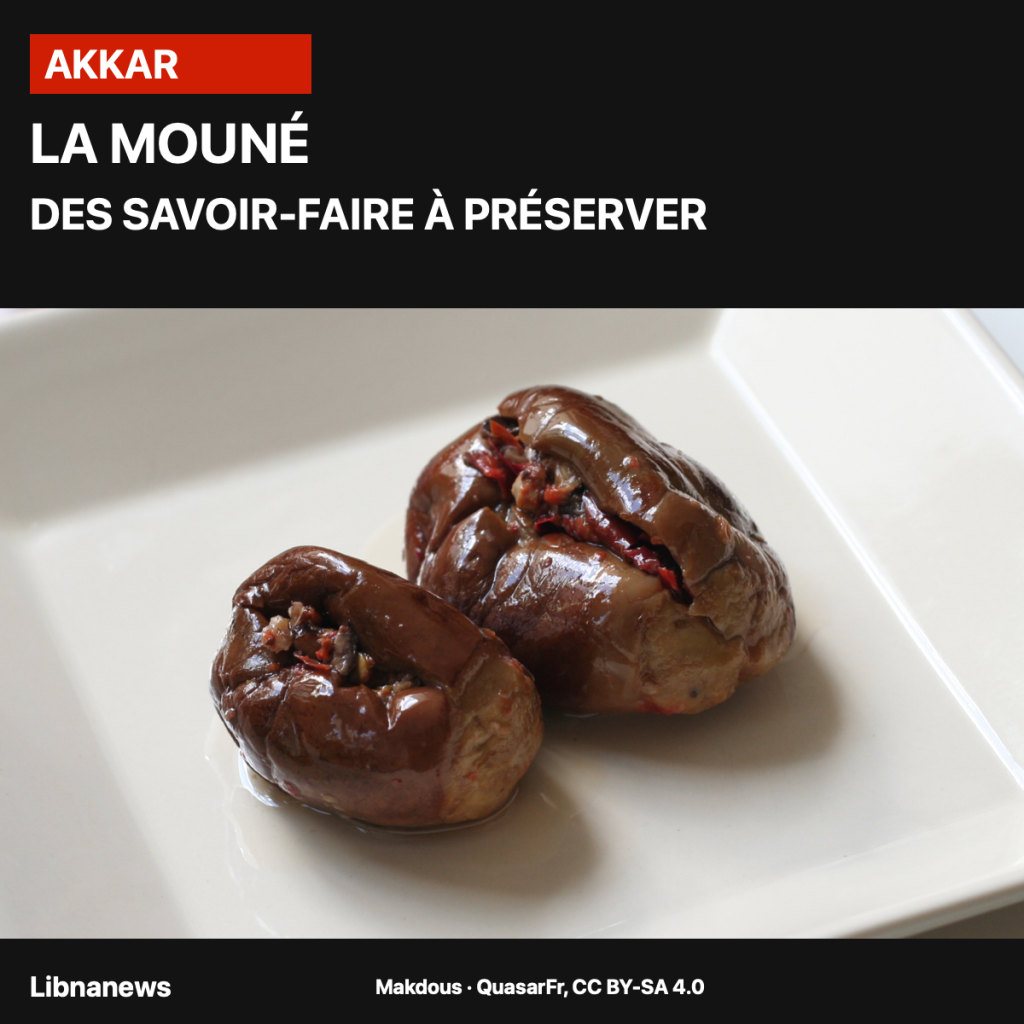
Dry kishk, used mainly for soups, close to dairy and cheese preparations, canklich to labne preserved in oil. The makdous combine eggplants with a stuffing including nuts, garlic and red pepper. The jars also welcome cucumbers, turnips, cauliflower or vegetable mixtures.
On the fruit side, figs, apricots and squash are found in jams. The pomegranate molasses belongs to another transformation register, by concentration of juice. This diversity explains why minnow is not a unique product: it consists of several raw materials, preparations and table uses.
Taleb stresses the importance of precision in preparation and preservation. A family recipe and a souvenir of taste are not enough to define all the conditions of manufacture. This article describes practices and products, without constituting a food conservation protocol to be reproduced.
Olive shows a changing tradition
Olives occupy a special place in this repertoire. They can be broken, seasoned with garlic and lemon, prepared with salt or stuffed. In addition to the forms transmitted within the families, there are variations: roasted olives of nuts or peppers, stuffed preparations and olive pasta.
These adaptations show that know-how is not only identical. A simpler preparation to serve or a new presentation can meet other consumption habits. However, this does not prove an increase in sales: the change of recipe and economic success are two different things.
The work of women, between family reserve and activity
Much of this transmission is based on women who prepare reserves and transmit actions to subsequent generations. The value of their work is not limited to the possible price of a jar. For a family, it is also a matter of using the products available and organizing meals to come.
Ihab Taleb sees these skills as an opportunity to develop rural activities. It cites improvements in manufacturing, packaging and marketing, while maintaining product quality. These paths have economic potential, not an insured income. No current profit amount or representative result of all Akkar producers is established here.
The switch to sales changes the nature of the work. It is necessary to be able to present a product, provide suitable quantities and find buyers beyond the circle of relatives. The preservation of one family tradition and the organisation of one business activity can be strengthened, but one does not automatically guarantee the other.
A documented example of meeting with buyers
In April 2023, rural cooperatives presented their products for four days at HORECA in Beirut. FAO documented this participation in a project with the Department of Agriculture and the Co-operatives Branch, funded by Canada.
Marie Nehme, of the development and processing cooperative of Andaket, in Akkar, presented pots of peanut butter. She explained that she had applied the training received. The exhibitors also proposed jams, syrups, kishk and makdous. This experience illustrates access to professional contacts; it does not demonstrate current sales or the same continuation of the program in 2026.
Between the family shelf and a stand for buyers, the challenge remains concrete: allowing skills to circulate without erasing the work needed to maintain them. Akkar’s minnow lies in this link between harvest, processing and transmission, rather than the promise of an automatic commercial outlet.





Comments