

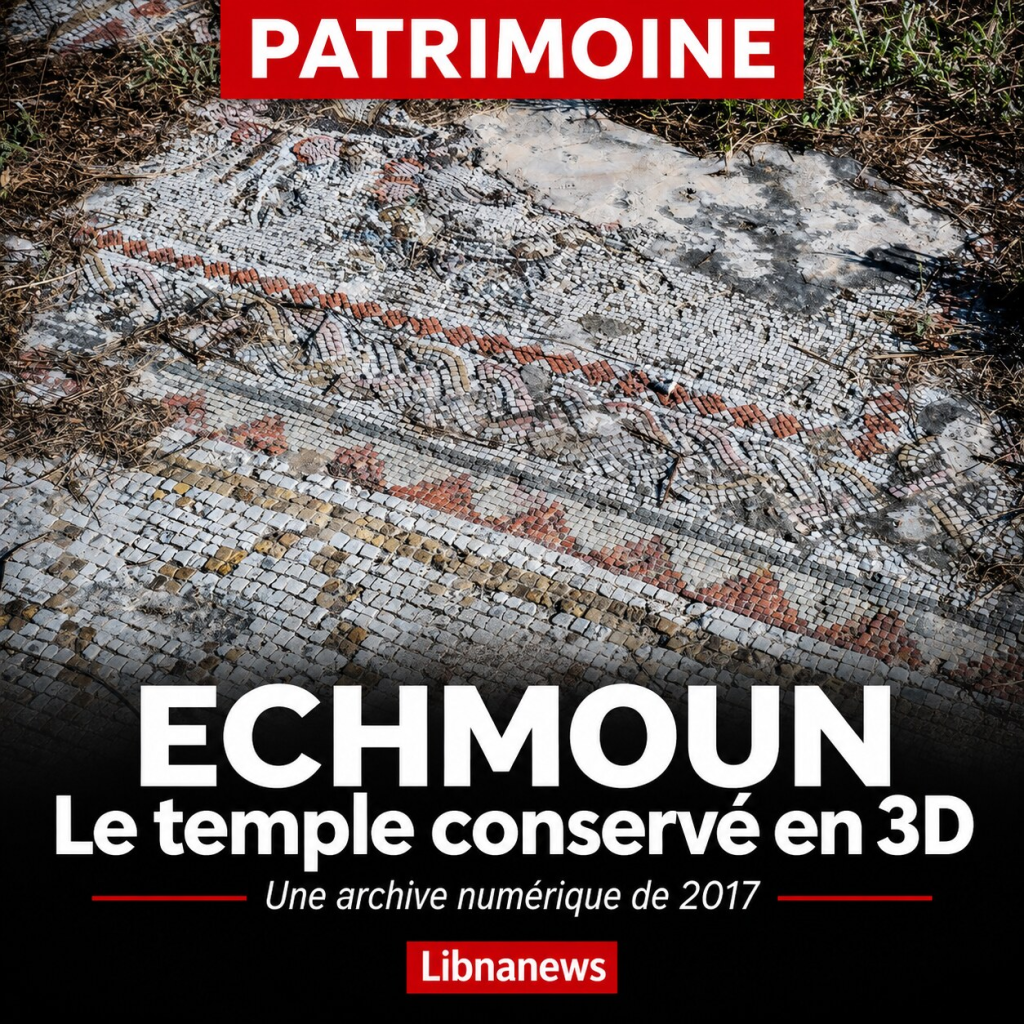
The Shrine of Echmoun, near Saida, has a three-dimensional archive from a campaign conducted in January 2017. These surveys document a condition of the site. They do not replace his stones or the work of archaeologists, but give another way to study this Phoenician heritage.
In Echmoun, history is read in support walls, basins and successive constructions. It is also kept in the form of data. The sanctuary near Saida was surveyed digitally from 16 to 18 January 2017. Published in April 2018 on the Open Heritage 3D platform, they remain identified by a stable documentary reference. It is therefore not a recent discovery, but a fund dedicated to a major Lebanese site.
This campaign has associated terrestrial photography, aerial shooting and laser scanner. Two sets are listed: 27.7 gigabytes for laser surveys and 149.53 gigabytes for photogrammetry. These volumes alone do not measure the accuracy of the survey. However, they give an idea of the material behind the views accessible to the public.
Echmoun, a sanctuary built around water
The temple was dedicated to the healing god Echmoun, close to Asclepios in Greek tradition. The choice of location is due in particular to the presence of water. Basins, pipes and areas of worship allow to approach together architecture and religious practices.
The dossier submitted by Lebanon to the indicative list of world heritage describes a set of 3.6 hectares, in Bqosta, on the south shore of Awwali. Two podiums, Hellenistic temples, Roman facilities and a Byzantine church testify to a long succession of occupations. The royal inscriptions also provide information on the constructions and enlargements of the sanctuary.
This superimposition explains the value of precise documentation: a general photograph is not enough to make relations between all levels and volumes. The indicative list, on which the dossier was submitted on 11 July 2019, should not be confused with an inscription on the World Heritage List.
Training in Lebanon
The digital documentation of Echmoun is part of the Anqa project. CyArk, ICOMOS and the Yale Institute for the Preservation of Cultural Heritage participated in this process, together with the antiquities administrations concerned. A workshop held in January 2017 at UNESCO headquarters in Beirut trained Lebanese and Syrian heritage professionals.
The ambition exceeded the production of remotely searchable models. The program also aimed to transfer skills and tools to local teams. In a region where access for foreign researchers can become difficult, the ability to document on-site is a concrete issue. The Anqa project later documented several monuments in Damascus.
This human dimension is included in the scientific work on the programme. Researchers point out that the digitization of a building is not enough to restore its history. The uses, transformations and values attached to the place must accompany the geometric data. Without this interpretation, the visitor sees a volume, but does not necessarily understand what it represents.
An archive dated, not a permanent status
Lasers and photographs record accessible surfaces at the time of survey. Therefore, an archive of 2017 alone cannot establish the current state of the sanctuary. It does not prove the presence or absence of any degradation since then. A comparison requires new surveys and an appropriate analysis.
Similarly, a digital model does not automatically reconstitution missing parts. Representing what remains and proposing the appearance of an old building are two different operations. The second requires archaeological arguments, the degree of certainty of which must remain visible.
The public consultation is finally accompanied by conditions of use. The Echmoun data set is proposed under a licence with a restriction on commercial use. Accessing an image or model therefore does not give all reproduction rights. Documentary photography of the site, the scientific survey and its dissemination follow separate rules.
For both researchers and the curious, these archives offer an additional entry point to Echmoun. Their value lies precisely in what they are: a documentation located in time, to bring together inscriptions, vestiges and research dedicated to the sanctuary.





Comments