

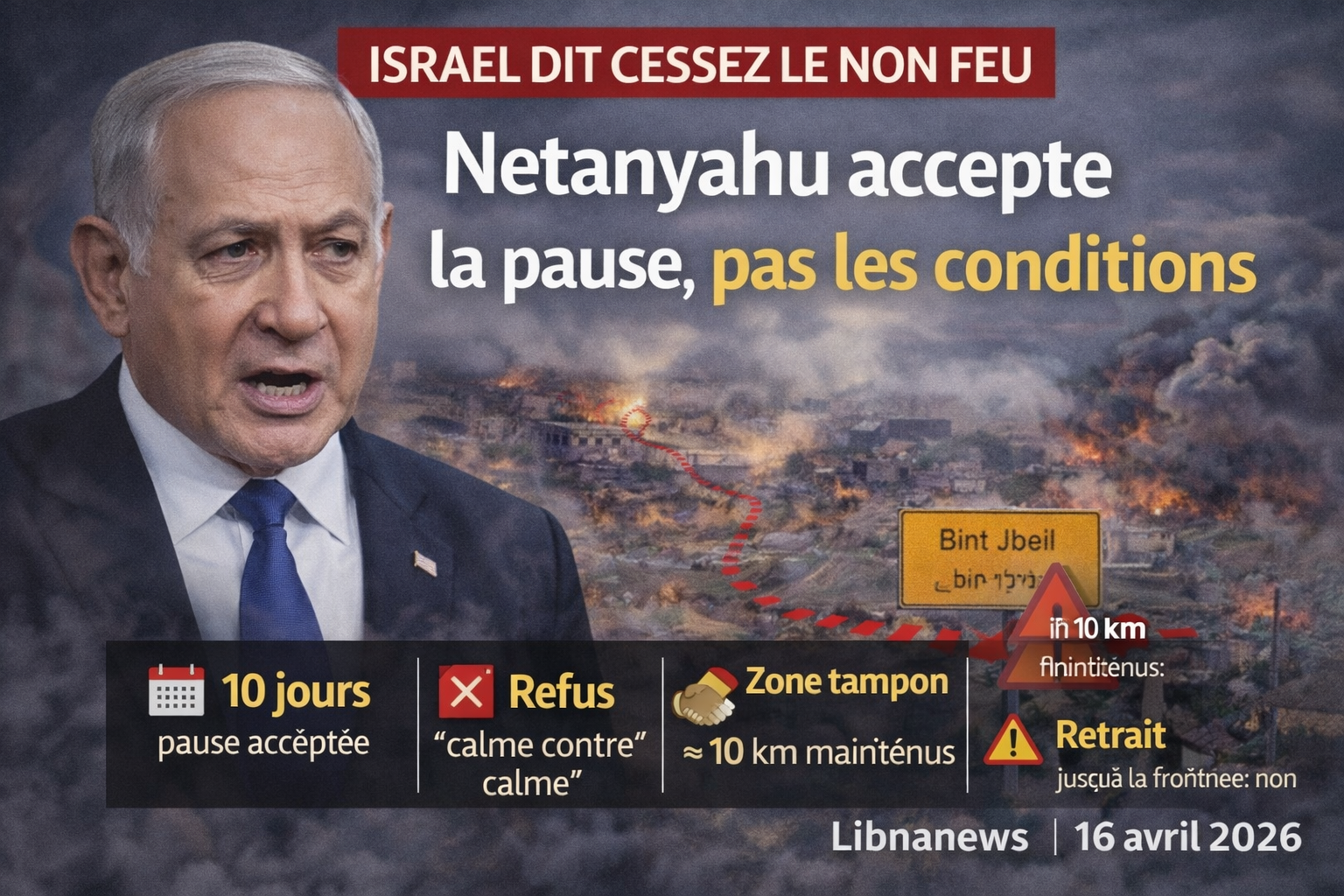
Benjamin Netanyahu set Thursday night the harshest Israeli reading of the ceasefire in Lebanon announced by Donald Trump. While the US President claimed that the truce « will include Hezbollah », the Israeli Prime Minister insisted on one other point: he said that there was no question of accepting the conditions imposed by the Shiite movement. In statements made public after the American announcement, he assured that Israel had rejected two Hezbollah demands: an Israeli withdrawal to international borders and a ceasefire based on the principle of « quiet against calm ». In his view, therefore, the truce did not obliterate the Israeli occupation of areas in southern Lebanon, nor did it remove the declared objective of dismantling Hezbollah.
This development immediately changes the political meaning of the ceasefire in Lebanon. The White House talks about a suspension of fighting to open a peace sequence. Donald Trump claims to have spoken to Joseph Aoun and Benjamin Netanyahu, and to have obtained a ten-day truce beginning at 5 p.m. in Washington, D.C., or 11 p.m. in Lebanon. He then clarified that this cease-fire « will include Hezbollah ». But Netanyahu’s words show that the Israeli government does not intend to read this inclusion as an acknowledgement of the movement’s demands. For Jerusalem, the truce does not mean abandoning military pressure, no complete withdrawal, no renunciation of the buffer zone, nor does it mean accepting a simple formula of reciprocal cessation without changing the balance of power on the ground.
This position is all the more important as Hezbollah and Iran have been calling for the inclusion of the Lebanese front in any ceasefire for several days. Hezbollah claimed that it would respect the truce in Lebanon provided that Israel stopped all its hostilities, including targeted assassinations against its members. The movement also added that no ceasefire should allow Israel freedom of movement on Lebanese territory. Iran, for its part, reiterated that a ceasefire in Lebanon was as important as on other regional fronts and that it should be an integral part of any wider de-escalation. In the face of this, Netanyahu therefore responds with a firm line: yes to a ten-day break, but not to the conditions of Hezbollah.
Netanyahu reframes the ceasefire in Lebanon
The heart of the Israeli message lies in two refusals. Benjamin Netanyahu says first that Israel will not withdraw to international borders. He then rejected a ceasefire based on the idea of « quiet against calm ». This expression, in Israeli reading, refers to a truce where each camp would simply cease fire without structural change on the ground. This is precisely what the Israeli Prime Minister refuses. He does not want a purely symmetrical suspension, which would leave Hezbollah’s capabilities intact and cancel, in Israel’s eyes, the military gains achieved in recent weeks in southern Lebanon.
Instead, Netanyahu describes another logic. He claims that Israel will remain in a « safety belt » in southern Lebanon. According to him, this area extends over a depth of about 10 kilometres and must go as far as the Syrian border. Other formulations reported by the Anglo-Saxon press evoke a band from the Mediterranean to the eastern sector of the front. In any case, the idea is the same: the truce does not imply a return to the previous line, but the consolidation of an Israeli presence in Lebanese territory.
This clarification was expected. For several days, Netanyahu and Israeli military officials have explained that the war against Hezbollah aims to create a durable buffer zone to protect northern Israel. They therefore do not present the ceasefire in Lebanon as a return to the status quo. They present it as a possible useful break, but within a framework already redesigned by ground operations and bombardments. The refusal of « quiet against calm » is consistent with this doctrine. It means that Jerusalem does not want a truce that would freeze the front without endorsing a new security reality.
We must read in this sequence an obvious tension with Donald Trump’s formulation. When the US President says that the cease-fire « will include Hezbollah », he suggests that the movement is part of the concrete framework of the truce. But Netanyahu immediately responds that this inclusion does not mean that Hezbollah’s demands become the basis of the agreement. This is a fundamental distinction. Washington wants an operational ceasefire. Netanyahu wants it to remain compatible with Israel’s long-term strategy in southern Lebanon.
A buffer zone at the heart of Israeli doctrine
The « belt » described by Netanyahu is not a secondary element of the debate. On the contrary, it is the key to the Israeli position. Speaking of a depth of 10 kilometers, the Prime Minister gives a precise materiality to the objective pursued by his army for several weeks. It is not just about preventing rocket fire. The Israeli account also seeks to prevent any risk of infiltration or ground attack on northern communities. That’s why Netanyahu is talking about a device designed to eliminate the danger of « invasion » and reduce the threat to the people of northern Israel.
This vocabulary is very meaningful. It lists the Israeli presence in southern Lebanon not as a mere transitional measure, but as a structural element of Israeli national security. This means that, even within the framework of the ceasefire in Lebanon, the Israeli army does not intend to consider itself bound by an automatic disengagement logic. The reverse movement is even presented as excluded at this stage.
This reading is confirmed by several international dispatches published during the day. Reuters reported that Netanyahu, in a video statement, said that he had accepted the ten-day break while saying that he was not withdrawing Israeli forces deployed in southern Lebanon to the international border. The Associated Press also indicated that it intended to maintain a military presence in a « stronger, wider and more continuous security zone than before ». These formulations converge on the same idea: the truce is compatible, from the Israeli point of view, with a sustainable presence on the ground.
For Lebanon, this is an immediate problem. The Government and the Presidency support the ceasefire in Lebanon as a prerequisite for any progress. But they also formally defend territorial sovereignty and Israeli withdrawal. If Netanyahu announces from the outset that there will be no withdrawal to the border, nor a simple formula of reciprocity, the ceasefire in Lebanon appears less as an agreement to normalize the front than as a truce under Israeli power.
Hezbollah had set exactly the opposite conditions.
Hezbollah’s response measures the distance between the two readings. The movement claimed that it would respect the ceasefire in Lebanon, but under conditions. Ibrahim Moussaoui said that it would be a « conservative » respect linked to the global cessation of Israeli hostilities and, above all, to the end of targeted assassinations against its members. In another message, Hezbollah added that any truce should be « complete throughout Lebanese territory » and should not offer Israel freedom of movement within the country.
In other words, where Netanyahu says no to « quiet against calm », Hezbollah in practice calls for a real and reciprocal cessation of hostilities. Where Netanyahu announces the maintenance of a safety belt in Lebanese territory, Hezbollah claims that the Israeli presence on Lebanese soil gives Lebanon and its inhabitants « the right to resist ». Where Netanyahu refuses withdrawal to international borders, the movement considers that the absence of withdrawal makes the ceasefire in Lebanon immediately more fragile.
This frontal opposition gives the measure of the challenge posed to the agreement announced by Donald Trump. The US President can say that the ceasefire « will include Hezbollah ». But on the political front, the starting positions remain very distant. Hezbollah does not accept that Israel retains a freedom of military action or a presence on the ground. Netanyahu refuses precisely to yield on these points. The ceasefire in Lebanon is therefore born in a context where each party already sets its red lines in a way almost incompatible with those of the other.
It should also be recalled that this mistrust of Hezbollah is rooted in the November 2024 experience. The previous ceasefire had been presented as the end of the war, but it was then experienced in Lebanon as a largely unilateral truce. Israeli strikes continued for months. According to the Lebanese authorities, relayed in March 2026, some 850 people were killed between the truce of November 2024 and the open resumption of the war on 2 March 2026. Hezbollah relies on this precedent to explain that it no longer wants a ceasefire in Lebanon that would reduce its own fire while allowing Israel to continue targeted strikes.
Iran also wanted Lebanon to be included
Netanyahu’s statement comes as Iran was already pushing in a direction similar to that of Hezbollah on a specific point: the inclusion of the Lebanese front in any de-escalation dynamics. The President of the Iranian Parliament, Mohammad Bagher Ghalibaf, had said in recent days that a ceasefire in Lebanon was « as important » as in Iran. That message had a double recipient. He addressed the Americans, telling them that partial stabilization would not be enough if Lebanon continued to burn. He also spoke to Hezbollah to show that Tehran did not want to leave him out of regional arrangements.
This Iranian line has fuelled a strong distrust in part of the Israeli press. Several comments expressed the view that the ceasefire in Lebanon was actually being pushed by Washington to facilitate further discussions with Tehran. In this reading, the truce would not first be dictated by the situation on the northern front, but by a broader US diplomatic need. It is precisely this suspicion that explains Netanyahu’s additional firmness: to accept a break, but to show that it will not result in strategic relaxation on Hezbollah, nor in a political gift to Iran.
The Prime Minister’s sentence on the Iranian maritime blockade and nuclear capabilities follows this logic. By stating that Donald Trump confirmed his willingness to maintain the maritime blockade against Iran and dismantle its nuclear capabilities, Netanyahu seeks to reassure his opinion and political camp. He wants to show that, although the ceasefire in Lebanon coincides with the continuation of an indirect dialogue with Tehran, Washington does not give up the maximum line of pressure against Iran.
This part of his message is far from anecdotal. It places the ceasefire in Lebanon in a broader regional architecture. Netanyahu is not just talking about southern Lebanon. He speaks of a dual horizon: on one side, the consolidation of Israeli security in the north; on the other, the continuation of strategic confrontation with Iran. This is probably what he means when he says that Israel is facing « two trajectories » that could transform its security and political situation for the years to come.
The land was not quiet before the truce
The firmness of the Israeli statement must also be read in the light of the events of the last few hours. The ceasefire in Lebanon was announced as Israeli strikes continued. On Thursday, the Lebanese National Information Agency reported shelling of Bint Jbeil and Yarun, damage to the Tebnine government hospital, and destruction of the Qasmiyeh bridge. Reuters and the Associated Press also mentioned the continuation of fighting and strikes around several sectors of the South.
Bint Jbeil remains at the centre of this reality. The area has for several days concentrated the heaviest land clashes. For Netanyahu, it embodies a bastion of Hezbollah that Israel wants to reduce and neutralize. For Hezbollah, on the contrary, it represents a front where resistance continues to play. In this context, the ceasefire in Lebanon has not been proclaimed on an already soothing ground. It was announced in full military intensity.
This makes the Israeli position even more meaningful. By saying that there will be no complete withdrawal or « quiet against calm », Netanyahu speaks from a position of strength that he still considers active. He does not consider that the war has already produced all its effects, but he wants the truce to be reflected in the effects already achieved. The ceasefire in Lebanon is therefore presented, on the Israeli side, not as a reset, but as a pause on a reconfigured front.
This reality also explains the tension with American reading. Donald Trump wants to talk about future peace. Netanyahu talks about safety belts, Hezbollah missiles, blockades against Iran and maintaining profits. The vocabulary is sufficient to show that the truce is not based on a common vision of the future. It is based first on a temporary overlap of interests, in which Washington wants a break and Israel wants to translate it to its advantage.
A announced truce, contradictions already visible
Perhaps the most striking, in the open sequence on Thursday evening, is the speed at which the contradictions were displayed. Donald Trump says the ceasefire in Lebanon will include Hezbollah. Hezbollah replied that it would respect it only if Israel stopped all its hostilities and renounced targeted assassinations. Netanyahu replied that he precisely refused the two main conditions of the movement and that Israel would remain in a safe area inside Lebanon.
There is therefore, from the beginning, a structural tension. The White House wants a ceasefire broad enough to be sold as a regional breakthrough. Hezbollah wants a truce that effectively blocks Israeli strikes. Netanyahu wants a pause that does not hinder the Israeli military presence or the strategy of pressure against Hezbollah. These three definitions are not identical. They temporarily intertwine, but they do not confuse.
For official Lebanon, the difficulty is obvious. Joseph Aoun and the government support the ceasefire in Lebanon as an immediate necessity. They want to stop the bombing, ease pressure on the South, protect civilians and open diplomatic space. But if Netanyahu claims from the outset that the truce does not imply withdrawal to the borders or mere reciprocity of calm, then Beirut will soon have to clarify what he considers acceptable application of a ceasefire.
The first night will therefore be decisive. If the strikes actually stop, the truce can begin to acquire a form of reality, even in ambiguity. If targeted attacks continue, Hezbollah may say that its conditions have not been respected. And if Israel maintains its active presence in the safety belt while continuing its operations on an ad hoc basis, the Lebanese reading of the ceasefire in Lebanon could very quickly join that of 2024: that of an officially proclaimed agreement, but politically and militarily very unbalanced.
Netanyahu already poses post-threat
In essence, Benjamin Netanyahu is not just talking about the ceasefire in Lebanon. He’s already talking about what to follow. When he states that Hezbollah missiles must be « taken up » as part of a move towards a peace agreement, he shows that, for him, the truce only makes sense if it opens up a phase of additional political pressure on the Shiite movement. The subject is therefore not only the temporary cessation of fighting. The subject is the future balance of power on the Hezbollah arsenal and on the configuration of South Lebanon.
This perspective explains the hardness of his refusal to « quiet against calm ». A simple military symmetry would leave Hezbollah intact as an armed actor. Netanyahu wants the truce to be the starting point for structural change. He says, in essence, that Israel accepted ten days of break, but not ten days forgotten its goals.
With this in mind, Trump’s phrase on the inclusion of Hezbollah and Netanyahu’s phrase on the rejection of the conditions of the movement do not cancel. They describe two different levels of the same problem. Trump recognizes that Hezbollah is part of the reality of the ceasefire in Lebanon. Netanyahu replied that this inclusion would not give him the right to define the political and territorial terms of the truce. It is precisely in this gap that the solidity, or fragility, of the announced ceasefire will be played out.




