






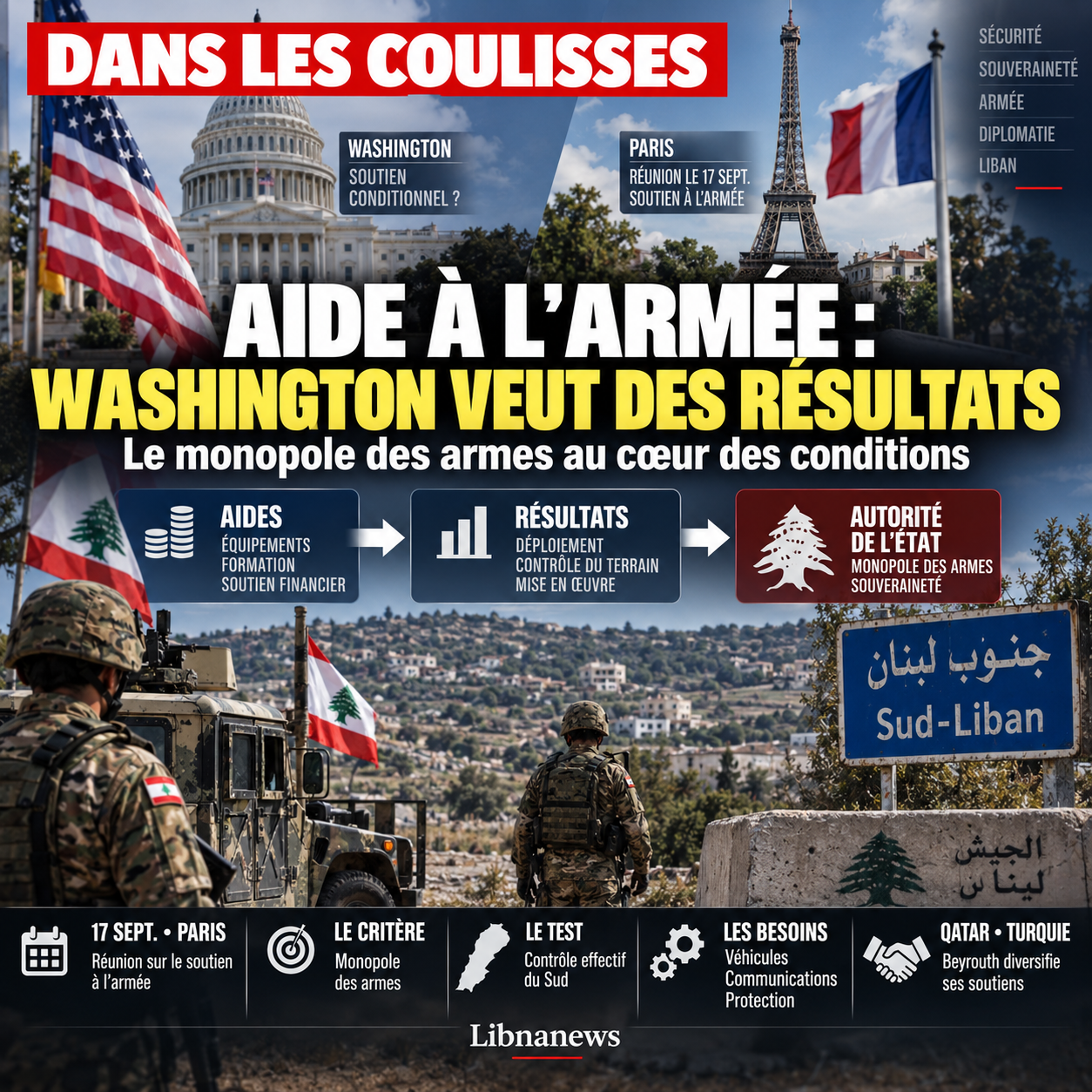
The preparation of the Paris meeting on support for the Lebanese army conceals a more political issue than the official speech suggests. Al Joumhouria of 15 September 2026 reports, citing diplomatic sources, that an American orientation would be to linkthe volume and nature of the aidthe results achieved by the State and the military in the implementation of their commitments. The first is the issue of state monopoly of arms.
Washington would like to move from a logic of support to a logic of results
According to Al Jumhouria, the needs of the Lebanese delegation to present in Paris are important. The Army is looking for vehicles, modern communication systems, protective equipment and means for operations and field control. The financial crisis also remains a major problem. International support must ensure the availability and ability of military personnel to carry out their missions.
However, the newspaper reports a decisive American reservation. Washington would like to establish a link between this aid and Lebanon’s ability to apply the principle of exclusive State authority in practice. The diplomatic source cited includes the withdrawal of weapons and the prohibition of armed demonstrations outside the official framework.
The shade is important. It would no longer be merely a matter of helping an institution considered essential to the stability of Lebanon. The partners would also seek to measure what this institution is capable of doing with the means it is given.
Al Joumhouria added that some of the army’s supporters would maintain a cautious attitude pending clearer reforms and political guarantees. The Government should demonstrate its willingness to enforce the State’s decisions, particularly on the issue of arms.
However, the exact status of this information must be maintained.The corpus does not contain an official United States statement publicly announcing a formal condition that such a quantity of weapons or a sum would be refused if Lebanon failed to achieve a specific objective.This is an American orientation reported by diplomatic sources of Al Joumhouria.
Paris could therefore become a political test as much as a military conference
This confidence changes the reading of the Paris meeting. Annahar of 15 September 2026 explains that the meeting on 17 September is part of the Aqaba process and is a preparatory step for a wider mobilization for the Lebanese armed forces. Joseph Aoun, Emmanuel Macron and King Abdullah II must participate in this sequence, with military officials and international representatives.
Officially, the file is that of military capabilities. But while Al Joumhouria’s information is accurate, the discussions will indirectly focus on a much more sensitive issue:are foreign partners willing to strengthen the army massively before they have proof that they can exercise the exclusive military authority of the state?
This question places Beirut in a difficult situation. Lebanon explains that a better equipped army is needed to extend State authority. Some partners might respond that they want to first observe concrete progress before significantly increasing their support.
The two reasonings can then form a difficult circle to break. The army can argue that it needs additional resources to carry out more missions. Donors can demand more results to justify new means.
Ad Diyar of 15 September 2026 adds to this point. The newspaper reports that the military command would like to get out of the model of point aids. It would seek sustainable partnerships, including training, equipment, maintenance and technical assistance. This approach would build capacity over several years rather than depend on occasional deliveries.
The South would be the main land on which the partners would judge the army
The conditionality referred to has its full meaning in the South. Al Jumhouria directly links international support to the deployment of the army and the negotiation process with Israel. Discussions include areas where Israeli withdrawal, army presence and verification arrangements could be tested.
In this sense, each successful deployment would have a value that goes beyond the ground. It would become a diplomatic argument allowing Lebanon to seek further support.
The army should demonstrate that it can permanently occupy the sectors concerned, prevent the return of a non-State armed presence and become the single security interlocutor. If this demonstration is found to be convincing, the partners could consider that investment in the institution produces the desired results.
The events of Ali al-Taher give an immediate dimension to this issue. Several newspapers on 15 September presented the control of the heights and the deployment of the army as essential elements of the new balance of forces. Former President Michel Sleiman calls on Hezbollah to hand over the positions concerned to the army. Joseph Aoun’s visit to Nabatiyah is also interpreted as an affirmation of state authority.
The issue of arms therefore becomes inseparable from that of foreign military support. What is presented within Lebanon as a constitutional and political debate can be treated by donors as a criterion for assessing the effectiveness of their aid.
The planned disappearance of the current system in the South increases the urgency
Al Joumhouria also reports discussions between Paris, Rome and Washington on the future of the international presence in the South after the end of the current arrangements of the United Nations Interim Force. The information published does not yet make it possible to identify precisely the formula which might succeed it. However, they show that the partners are already thinking about the next security architecture.
This mechanically reinforces the expected role of the Lebanese army. If the international presence is reduced or transformed, some responsibility will have to be assumed by national institutions. International support would therefore not be limited to maintaining the current military capabilities. It would be used to prepare for an increase in its responsibilities.
This also explains why donors can request guarantees. They don’t just want to finance salaries or provide equipment. They are looking at whether the army can actually perform the functions transferred to it.
The Paris rendezvous thus became the meeting point for three dossiers: military capabilities, the arms monopoly and the future of the security system in the South.
Previous conferences make Beirut suspicious of promises
However, caution does not come only from donors. Lebanese officials also have reasons to be wary of international announcements.
Ad Diyar of 15 September 2026 recalls that several support conferences have already produced commitments whose implementation has remained below expectations. Changes in donor priorities, administrative procedures and the absence of permanent mechanisms have sometimes slowed or reduced aid.
Ibrahim Kanaan reiterated this concern when he referred to international financing. His message is to ask for measurable results rather than new announcements. This comment does not concern exclusively the army, but it reflects a concern in external cooperation cases.
The military command would therefore like the army to participate directly in the definition of programmes. In this way, it could identify its operational priorities rather than receive equipment selected primarily by donors.
This is important in the face of the American conditionality reported by Al Joumhouria. If Washington wants to judge the army on its results, Beirut can in turn ask that the means provided correspond to the missions that it is asked to perform.
Qatar and Turkey offer complementary channels
Lebanon is also seeking to diversify sources of support for its army. Al Binaa and Al Sharq of 15 September 2026 report the meeting between Army Commander Rodolphe Haykal and Qatar Ambassador Saud bin Abdelrahman Al Thani. Haykal thanked Doha for its continued support and stressed the importance of cooperation between the two armies.
The Finance and Budget Committee also approves a military cooperation agreement with Turkey. Al Sharq indicates that its value reaches 100 million Turkish pounds, or about three million dollars according to the newspaper. The scheme should allow exchanges of skills, equipment and other forms of cooperation over five years.
These initiatives remain modest in relation to the overall needs of the army. However, they are of diplomatic importance. They allow Lebanon not to make its military institution dependent on one partner.
They can also give Beirut a small margin in the face of conditions imposed by some Western donors. However, this margin remains limited. The financial, logistical and technical needs of the army are such that the United States, France and other major partners will retain a decisive weight.
Behind the aid is therefore the definition of the future role of the army
The confidence of Al Joumhouria makes it possible to read the discussions in Paris differently. The question is not just:how much will the army receive?It becomes:what missions will it actually have to perform in order to continue to receive more?
According to the newspaper’s diplomatic sources, Washington would seek to measure Lebanon’s ability to translate the principle of arms monopoly into reality. Paris seeks to build the capacity of the institution. Beirut requires sufficient resources to enable the army to expand its deployment. At the same time, negotiations with Israel make the control of the ground by the regular forces a central element of any withdrawal.
The potential conditionality of aid therefore creates a very concrete relationship between domestic policy and international assistance. A Lebanese decision on weapons could have an impact on the army’s equipment level. Conversely, the strengthening of the army could be presented by the State as the material condition for the gradual implementation of this decision.
In order to follow this confidence, it will be necessary above all to observethe formulation of commitments that will emerge from Paris. A simple support announcement will not confirm the information. On the other hand, step-by-step aid, coupled with specific objectives of deployment, territorial control or arms monopoly, would be a much stronger indication of the American conditionality described by Al Joumhouria.