






The postponement of the eighth round of negotiations between Lebanon and Israel, originally expected in Rome in September 2026, gives rise to two significantly different stories in the 15 September press. The first, relayed notably by Al Joumhouria, presents the shift towards October as a calendar adjustment that does not call the process into question. The second, developed by Al Liwaa, considers that these explanations mask a much more serious difficulty: negotiators would not have been able to agree on the criteria for verifying the application of the arrangements discussed on the ground.
Official version focuses on calendar issue
Al Joumhouria of 15 September 2026 reports the explanations of a diplomatic source that the postponement does not « in any way » mean that the negotiations have entered a phase of paralysis. Contacts continue under American sponsorship. In particular, Washington would prepare a meeting between Lebanese and Israeli diplomatic representatives, while discussions continued to set a new date in Rome.
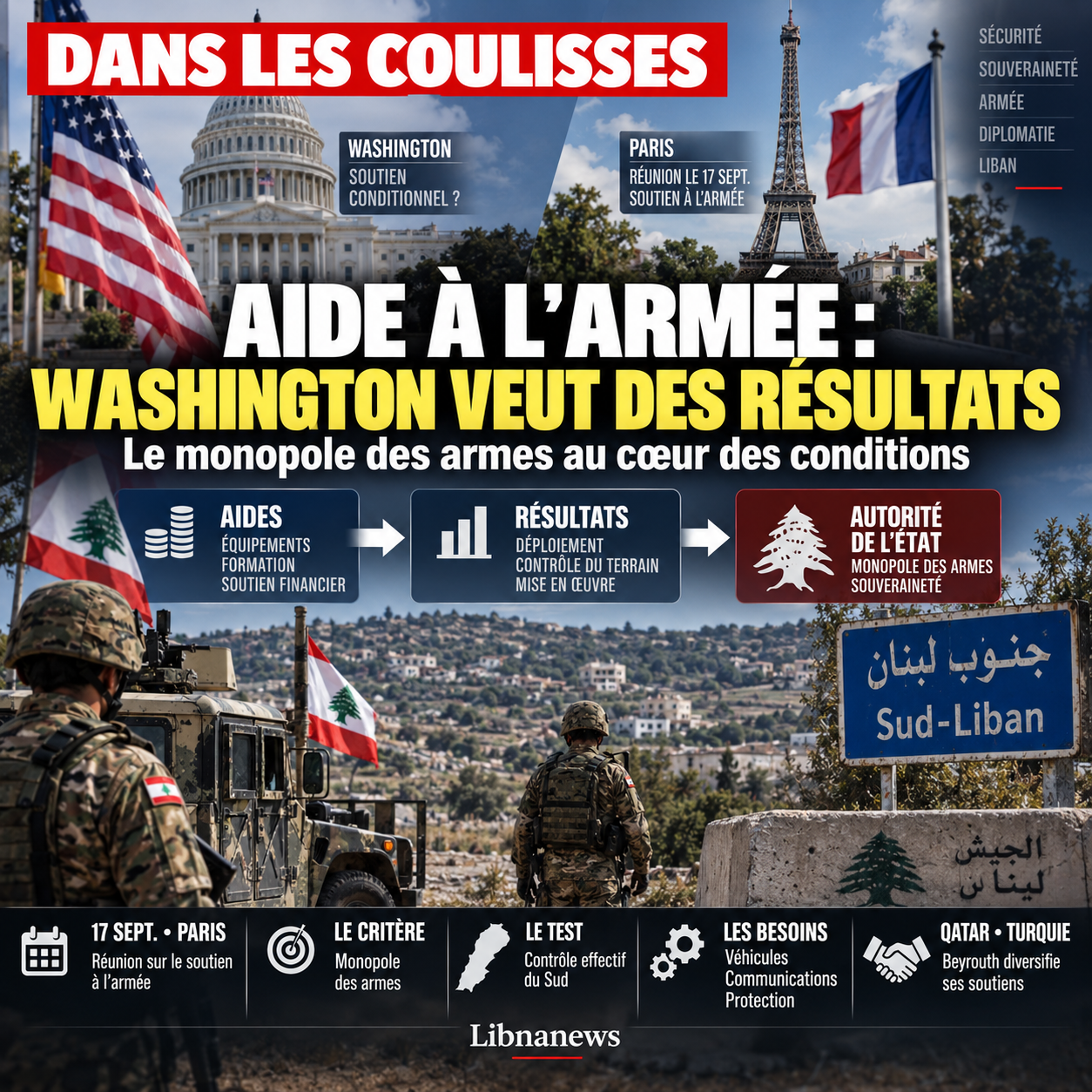
According to this source, several scheduling elements explain the postponement. Jewish holidays complicate the availability of the Israeli side. The General Assembly of the United Nations also mobilises the diplomacy concerned. Finally, Lebanon must participate in the Paris meeting devoted to supporting its army. The accumulation of these deadlines would have made it preferable to shift to October.
The same source insists on one important point: the negotiations would now have gone beyond the point of simply obtaining acceptance of the dialogue. The framework would exist and contacts would have become regular. The problem would now be to turn this process into concrete measures.
This presentation therefore gives the deferral a relatively limited scope. Discussions continue. Washington remains engaged. Rome is delayed, but not abandoned.
Al Liwaa contests this explanation and refers to the failure of the previous meeting
Al Liwaa of 15 September 2026 proposes a much more critical reading. The newspaper considers that the reasons for the postponement lack strength. Jewish holidays, the UN General Assembly and the Paris meeting were known long in advance. They would therefore not, according to his reading, constitute unforeseen events which alone could explain the postponement of such a sensitive negotiation.
The daily refers instead to the previous meeting in Rome, held on 6 August. This would have revealed the impossibility of reaching a common understanding of thecriteria for verification of application in experimental areas.
This confidence is much more important than the issue of timing. It means that disagreement would no longer focus on the opportunity to negotiate, but on how each party actually respects what has been agreed.
Al Liwaa therefore interprets the deferral as a consequence of an unresolved operational problem. Negotiators would be able to discuss a general framework, but not yet agree on mechanisms to translate it into the field.
Nevertheless, the distinction between information and interpretation must be maintained. The newspaper develops this reading from its sources and analysis. The corpus does not contain any official statement from the United States or Lebanon publicly acknowledging that the Rome meeting was postponed due to the failure of the verification discussions.
The real problem would be who certifies that the commitments have been fulfilled
Al Joumhouria paradoxically brings several elements that give weight to the hypothesis of Al Liwaa. His diplomatic source explains that the most sensitive issues remain precisely the Israeli withdrawal, verification mechanisms, security arrangements and Hezbollah weapons.
Negotiations would have progressed on certain technical aspects and on the principle of experimental sectors. But they have not yet produced a final settlement on these issues.
The difficulty is easy to understand. A political agreement may provide that Israel withdraws from an area and that the Lebanese Armed Forces take a position. But then we have to answer several very concrete questions.
How can we determine that the Israeli withdrawal is complete? How can we verify that the Lebanese army really controls the area? How can we establish that no other armed organization is resettling there? Who does this check? What happens if the two sides present contradictory versions?
These questions may seem technical. They are in fact at the heart of the whole agreement.
A verification mechanism deemed insufficient by Israel could allow it to refuse a withdrawal. A mechanism deemed too intrusive by Lebanon could be seen as a limitation of its sovereignty. The composition of the body responsible for monitoring implementation is therefore itself becoming a negotiating issue.
« Experimental zones » would have become the real test
Al Jumhouria of 15 September 2026 provides on this point one of the most interesting diplomatic confidences of the corpus. According to his source, « experimental zones » would now be the real way to measure the seriousness of the process.
The idea is to avoid immediately seeking a comprehensive settlement applicable to the whole South. The parties would start with a limited number of sectors. A model could be tested: Israeli withdrawal, Lebanese army deployment and verification of the new situation.
If this mechanism works, it could be replicated gradually elsewhere.
This approach has a clear diplomatic advantage. It makes it possible to verify the feasibility of an agreement without obliging both parties to resolve all their disagreements immediately. A local success would set a precedent. It could then serve as a model for larger areas.
But the same logic can produce the opposite effect. Failure in the first experimental zone could block the entire process. If Israel considers that the guarantees are insufficient or if Lebanon considers that the withdrawal is not actually carried out, each party could use this failure to reject the next step.
Al Joumhouria summarises the problem around an essential question:who makes the first move?
Lebanon wants Israel to withdraw. Israel wants guarantees before withdrawing. U.S. mediation must therefore build a sufficiently precise chain for each party to agree to act without considering that it takes the risk alone.
The role of the Lebanese army becomes decisive
This mechanism explains why the army has become central in the negotiations. Its deployment must provide Lebanon with a concrete translation of the return of sovereignty. At the same time, it must provide Israel with a guarantee that an evacuated area will not become a Hezbollah military space.
Al Joumhouria believes that the army’s entry into the areas under agreement has a scope that goes beyond security. It must prove that the State is capable of transforming the principle of sovereignty into a real presence.
This logic directly joins the Paris meeting dedicated to support for the army. The two files are therefore not separated. The resources requested in Paris must help the army to fulfil the tasks entrusted to it in the negotiations.
This also explains the possible US conditionality of aid. Washington can hardly ask the army to take more responsibility without building its capacity. But it may also want to verify that the means granted do lead to increased State control.
The success of an experimental zone would thus have three simultaneous consequences: facilitating an Israeli withdrawal, strengthening Lebanon’s diplomatic position and justifying further aid to the army.
The postponement could also give Israel time to change the ground
This is where the main danger of the shift appears around October. Al Jumhouria of 15 September 2026 devotes an entire article to the hypothesis of an extension of the Israeli apparatus around Nabatiyeh and the surrounding heights. The newspaper is concerned that the time separating the two meetings is not neutral.
Each additional week may lead to new developments.
In particular, the daily newspaper refers to Ali al-Taher and the possibility of the pressure moving towards Nabatiyah, then towards the heights of Iqlim al-Tuffah, Jabal al-Rayhan, Kfarhunah and Machghara. He does not present this evolution as certain. This is a scenario based on observed movements and analyses by military experts.
However, the issue is directly related to the negotiations. If the territorial situation changes between two meetings, the parameters of the discussion also change.
An area that was not at the centre of the file in August can become one in October. A new control point may create a new withdrawal requirement. Further destruction can make the return of the inhabitants more difficult.
Diplomatic time thus becomes a military variable.
Washington would nevertheless regard the deadline as a preparation period
The diplomatic source of Al Joumhouria presents an opposite reading. According to her, Washington does not consider the postponement a vacuum. The United States would seek to use this period to reorganize the elements of the negotiations.
The meeting between diplomatic representatives in Washington then took on particular importance. It would maintain direct contact while continuing discussions on the experimental areas, deployment and verification.
The U.S. administration would focus on preventing disagreements from falling outside the diplomatic framework.
This Washington function is important. The United States is not just trying to produce a final agreement. They also try to maintain a process to contain successive crises.
Diplomacy therefore becomes a mechanism for managing the conflict as much as a means of resolving it.
But Al Joumhouria himself recognizes the limit of this strategy. Accumulation of military operations can make the resumption of negotiations more difficult. The more the facts change on the ground, the stronger the political positions.
The Israeli elections are another explanation for the slowdown
Al Sharq of 15 September 2026 reports the statements of David Schenker, former American official in charge of the Middle East. He believes that the framework between Lebanon and Israel is unlikely to be finalized before the Israeli elections scheduled for October.
According to him, the current meetings are primarily used to keep the process alive.
This analysis offers another key to reading. Even if technical problems were resolved, the Israeli government might hesitate to make important decisions before an election deadline.
A territorial withdrawal or concession in negotiations with Lebanon may become an issue of Israeli domestic policy. The officials concerned may therefore prefer to postpone the most sensitive decisions.
However, Schenker believes that further developments are possible. He mentioned inter alia the exchange of prisoners and an Israeli withdrawal from certain sectors. He stressed the role of the Lebanese army and the need for an American mechanism to monitor execution.
His remarks therefore come precisely to the heart of the problem identified by Al Liwaa:verification.
The disagreement would therefore no longer be about dialogue, but about transforming dialogue into action
The confrontation between the two narratives finally makes it possible to clarify what is being played behind the postponement.
The most reassuring version affirms that the diplomatic calendar simply imposes a delay. Negotiations remain active and Washington continues its work.
The version of Al Liwaa states that the postponement reveals the failure of the previous meeting to define a common verification mechanism.
These two explanations are not completely incompatible. A busy schedule can provide an opportunity to postpone a meeting while a major technical disagreement remains to be resolved.
Al Joumhouria’s information shows that verification is one of the outstanding issues. They also confirm that the experimental areas have become central. What the corpus does not allow to establish with certainty is thatthis disagreement alone is the cause of the postponement.
The strongest confidence is therefore more precise:the process is not officially interrupted, but negotiators are still struggling with how to execute and verify commitments in experimental areas.
The next indicator to be monitored will be less the simple announcement of a new date in Rome thanthe content of the next meeting. If it produces a detailed mechanism specifying the order of Israeli withdrawal, the deployment of the army and the authority responsible for verifying commitments, the main obstacle described by the newspapers will have been overcome. If these questions remain open, the return to Rome could maintain the dialogue without really bringing the parties to an agreement.