

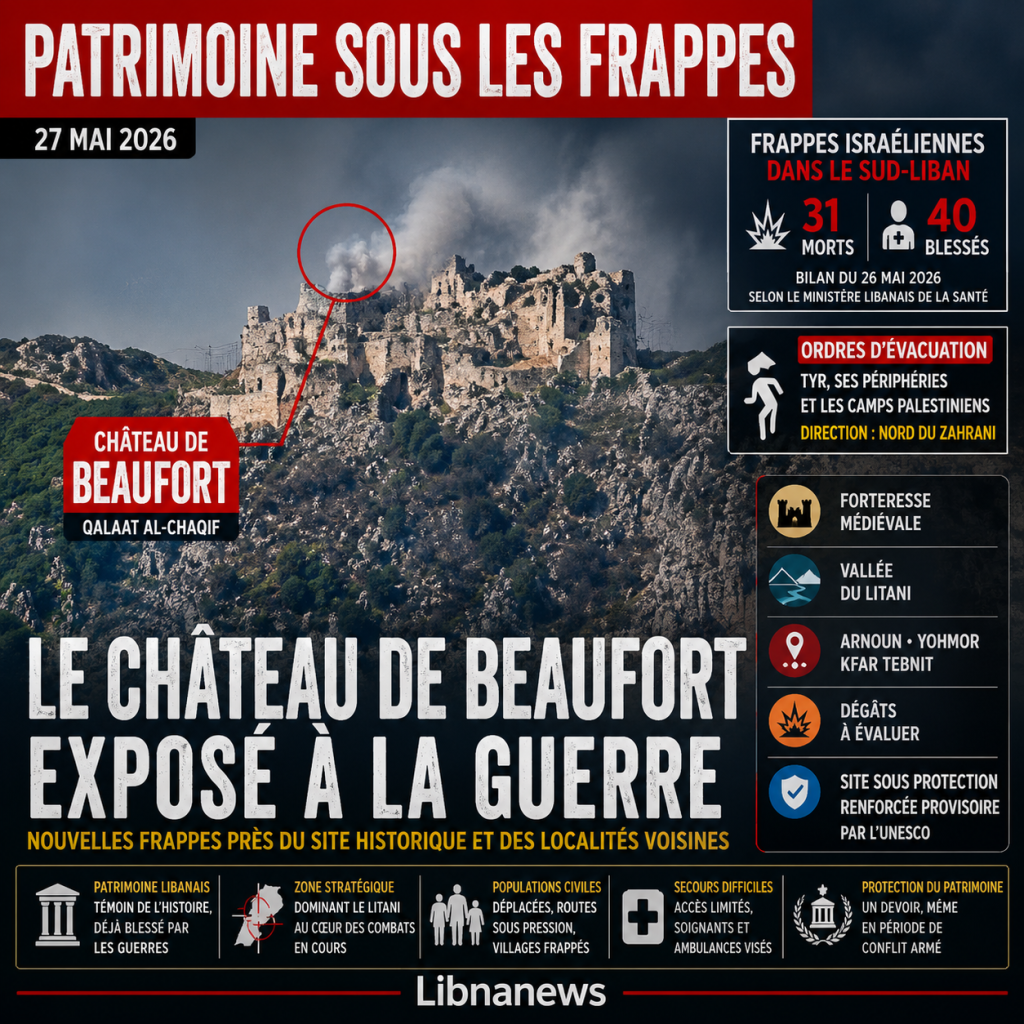
The Beaufort Castle area, one of the most sensitive heritage sites in southern Lebanon, was hit on Tuesday by a new series of Israeli strikes as part of the military escalation around Nabatiyah and Litani. The bombings targeted the outskirts of this medieval fortress, known locally as Qalaat al-Shaqif or Chaqif Castle, as well as the localities of Arnoun, Yohmor al-Shaqif and Kfar Tebnit. No full official assessment of the damage to the monument had yet been made public. However, the information confirms the increasing exposure of Lebanese heritage to a war that no longer affects only villages, roads and infrastructure, but also the country’s historical landmarks.
Beaufort Castle in the area of strikes
Beaufort Castle has dominated the Litani Valley from a rocky promontory that has made it a major strategic point for centuries. Its location explains both its historical value and its current vulnerability. In peacetime, it offers one of the most spectacular views of South Lebanon. During wartime, it becomes a coveted, observed, bombed or bypassed height. The latest raids are part of a wider sequence of strikes on the south and east of Lebanon, with heavy human casualties and evacuation orders targeting several cities and localities, including Tyre and Nabatiyah.
The fortress is not only a war setting. It belongs to the memory of southern Lebanon. Its history traverses the Crusaders, the Muslim dynasties, the local feudalities, the Israeli occupation, the civil war and the restoration works started after 2000. Recent bombardments therefore reactivate an old concern: that of seeing a site already damaged by successive conflicts be subjected to further damage. In a country where cultural institutions lack resources, every strike near a monument requires rapid verification, difficult to carry out when roads remain dangerous and military operations are under way.
The Beaufort site was never an ordinary monument. His position above the Litani gives him immediate military visibility. The heights near Arnoun and Yohmor al-Shaqif dominate routes leading to Nabatiyah and several villages in the South. This geography explains the concentration of strikes reported in recent hours. It also explains the Lebanese fear of the area being turned into a military lock, as Israel extends its ground operations beyond the line it presents as an advanced defence zone. For the inhabitants, this change means, above all, new departures, less secure roads and even more isolated villages.
A bombardment in a murderous day
Bombardments around the castle occur after one of the most intense qualified days in several weeks. Lebanese security sources reported more than 120 Israeli strikes on Tuesday, while the Lebanese Ministry of Health reported at least 31 deaths and 40 injuries in raids in southern Lebanon and the east. The strikes also hit Burj al-Shamali, the outskirts of Tyre, the Nabatiyah region, the Western Bekaa and the vicinity of the Qaraoun Dam. The cumulative record since the resumption of the offensive in early March now exceeds 3,200 dead and 9,700 wounded, according to the Lebanese authorities.
In this context, Beaufort Castle becomes a symbol among others of a deeper war. Fighting is no longer limited to directly border villages. They go up to the Litani, the Nabatiyah heights, the interior axes and the essential infrastructure. Hezbollah announced clashes with Israeli forces in Zawtar al-Sharqiyah, north of the Litani River, following the expansion of Israeli ground operations. The Israeli army claims to act against direct threats and Hezbollah positions. Lebanon, for its part, denounces the effects of the strikes on civilians, inhabited localities, roads, relief and now heritage sites.
The Beaufort area concentrates all these tensions. Arnoun, a village in the immediate vicinity of the fortress, is located in one of the most exposed areas of the South. Yohmor al-Shaqif and Kfar Tebnit are under pressure from bombardments and military movements. Nabatiyah, a large city of the southern interior, was also affected by warnings and strikes. The inhabitants live in a tight geography, where heritage, houses, agricultural roads, mosques, schools and relief posts are side by side. When a raid strikes a height, its effects exceed the point of impact. It alters movement, blocks access and creates lasting fear.
A Lebanese heritage under enhanced protection
Beaufort Castle is one of the most important heritage properties in southern Lebanon. UNESCO presents it as one of the best preserved examples of medieval fortresses in the region. Lebanon has included, along with other castles of Jabal Amel, in its indicative list of world heritage. In November 2024, several of these sites, including Beaufort, benefited from temporary enhanced protection for cultural property during armed conflict. This protection does not physically prevent a strike. However, it establishes a clear legal and policy framework: a heritage site must be preserved, except in circumstances strictly regulated by international law.
The importance of this protection lies in the recent history of the castle. During the civil war, the site was occupied by the Palestine Liberation Organization and bombed several times. In 1982, the Israeli army seized it at the beginning of its invasion of Lebanon. It maintained a presence there for 18 years, until the withdrawal of May 2000, with major military developments and destruction upon departure. The walls of the Beaufort still bear the traces of a prolonged militarization. The restorations carried out then sought to return to the site its historical reading, without completely removing the scars of the twentieth century.
It is this past that makes the current strikes particularly sensitive. The monument is not only ancient. It has already been transformed by contemporary wars. For the inhabitants of the South, it refers to the Israeli occupation, the fighting of 1982, the years of the occupied area and the withdrawal of 2000. Seeing it again at the heart of the bombings gives the feeling of a return to a ground never really pacified. The smoke images around the heights of Nabatiyah and the Chaqif revive a local memory where the fortress appears in turn as a military post, wounded ruin, tourist destination and identity marker.
Damage still to be established
The immediate question remains the state of the site. The available information mentions strikes near the castle and in its surroundings. At this stage, they do not permit an accurate inventory of damage to walls, accesses, restored areas or archaeological approaches. Such an assessment requires the presence of specialized teams, secure access to the site, photographic surveys and comparison with previous states. Military conditions complicate this mission. Repeated bombardments around Arnoun and Yohmor can prevent the competent services from travelling quickly to the site.
The Directorate General of Antiquities should be on the front line to document any damage to the monument. Its role is to establish facts, distinguish old and recent damage, alert the authorities and seize international protection mechanisms if necessary. Municipalities, security forces, civil defence and residents can provide initial guidance, but only a technical assessment can measure the real impact. In the case of Beaufort, this step will be all the more important as the site has undergone several conservation campaigns. Restaurateurs have worked for years on stones already weakened by previous fighting.
Potential damage is not limited to visible walls. A nearby explosion can affect embankments, slopes, vaults, archaeological soils, stairs, trimmings and consolidated areas. It can also open cracks or move already unstable blocks. Repeated vibrations create an additional risk on old structures. This danger is not always measured with the naked eye in the first few hours. Anchors, joints, consolidation zones and overhanging parts must be checked. In a castle built on a steep relief, the stability of the land counts as much as the condition of the stones.
A possible loss for the memory of the South
Heritage protection cannot be separated from that of civilians. The villages around the castle live under the threat of the same strikes. The inhabitants of Arnoun, Kfar Tebnit and Yohmor al-Shaqif are aware of rushed departures, road cuts, waiting for ambulances and uncertainty about returns. Heritage is not intended to hide human victims. It adds another level of loss. When a monument is touched or threatened, it is part of the collective memory that is exposed, in the same way as houses, fields and places of worship.
This dimension explains the concerned reaction of cultural and local communities. South Lebanon has a dense heritage, often less known than coastal sites in Byblos, Tyre or Baalbeck. Castles, sanctuaries, ancient villages, terrace landscapes and medieval remains make up a cultural fabric rarely protected to the height of the risks involved. Beaufort occupies a separate place in this set. It dominates the landscape and tells a history of borders, empires, passages and resistance. Its danger reminds us that the war does not only erase the present. It can degrade the traces that allow us to understand the past.
International law provides rules for cultural property in armed conflict. The 1954 Hague Convention and its Protocols require the parties to respect and protect the heritage. The enhanced protection afforded to certain sites is intended precisely to signal their exceptional importance and to limit their exposure. Lebanon can use this framework to hold accountable, demand investigation and alert relevant agencies. The difficulty lies in the practical application of these rules when fighting takes place around heights considered strategic by the military.
A historic site taken from the front
The Israeli army claims to target Hezbollah’s infrastructure and fighters. This justification goes back in most of his communications on the strikes in southern Lebanon. The Lebanese authorities and the inhabitants, for their part, stress the breadth of the affected areas, the civilian deaths, the forced displacements and possible attacks on protected property. The Beaufort case illustrates this discrepancy. For Israel, the surrounding heights can be linked to operational imperatives. For Lebanon, the fortress and its surroundings form a major historic site, located in the heart of an already fragile civil and heritage fabric.
The military situation makes the immediate future uncertain. Evacuation warnings were issued for several areas of the South. Tyre, its suburbs and neighbouring Palestinian camps have been called upon to empty themselves north of the Zahrani. Nabatiyé remains under heavy pressure. Fighting around Zawtar al-Sharqiyah indicates an active land front near the Litani River. In this environment, an ordinary heritage mission seems difficult. The priorities of the local authorities are first relief, evacuation, hospitals and roads. The examination of the castle will have to take place as soon as security permits, in order to avoid loss of evidence and aggravation of damage.
Tourism, already weakened in the South, is being further broken. Before the climb, Beaufort Castle was one of the emblematic destinations for Lebanese and foreign visitors who wanted to discover the Nabatiyah region and the Litani Valley. The guides presented views, military history and occupation strata. The restaurants, small shops and inhabitants of the nearby villages benefited from this, even modest presence. The war has suspended these traffics. The roads empty visitors and fill with ambulances, cars loaded with families and military vehicles.
The value of Beaufort, however, exceeds tourism. The castle tells of territorial continuity in a country often fragmented by crises. It connects the South with the rest of Lebanon through history, architecture and landscape. It also recalls that war zones are not empty spaces. They contain schools, olive groves, shrines, cemeteries, houses and monuments. The strikes around the Chaqif thus refer to a broader question: how to preserve cultural property when front lines move towards inhabited and memory-laden sites.
The next few hours should specify the extent of the damage, if the authorities can access the site. A communication from the Directorate-General for Antiquities, the Ministry of Culture or local authorities would make it possible to distinguish the strikes on the outskirts of a direct attack on the monument. This distinction is essential to establish responsibilities, organize emergency measures and seize international forums. Otherwise, the information will remain fragmented, carried by smoke images, local testimonies and successive dispatches. In southern Lebanon, Beaufort Castle remains under surveillance, between threatened heritage and moving military front.




