

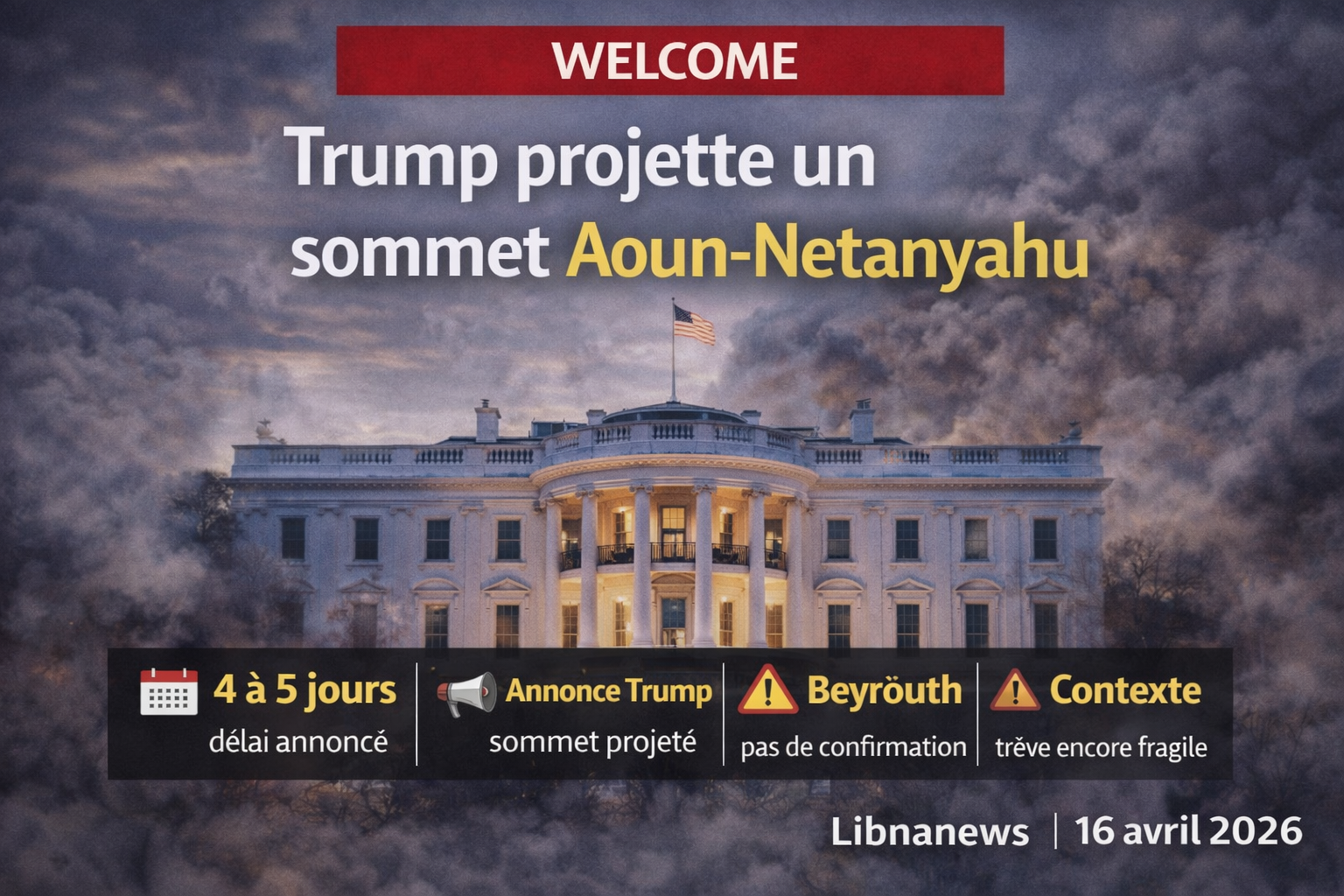
Donald Trump said on Thursday that Israeli Prime Minister Benyamin Netanyahu and Lebanese President Joseph Aoun would go to the White House « in the next four or five days » for a joint meeting under his auspices. The announcement, made in front of the press after the proclamation of a 10-day ceasefire between Lebanon and Israel, suddenly gives a much more ambitious scope to the diplomatic sequence opened in Washington. In a few hours, the White House has moved from a goal of truce to the prospect of an exceptional political scene between the leaders of two countries officially at war for decades.
Donald Trump’s formula is spectacular. She added to her earlier message on Truth Social, in which he made sure he had « excellent conversations » with Joseph Aoun and Benyamin Netanyahu, and then announced the formal beginning of a ceasefire at 5 p.m. in Washington, D.C., that is, 11 p.m. in Lebanon. This time, the American president goes further. He no longer speaks of a temporary cessation of fighting. He is already planning a meeting at the White House, in a very short time, which he has presented as a first in forty-four years.
This acceleration immediately changes the nature of the folder. So far Beirut’s priority remained the ceasefire, the cessation of strikes, the Israeli withdrawal and the return of the displaced. On the Israeli side, the focus remained on Hezbollah, security in northern Israel and the maintenance of a buffer zone in southern Lebanon. Donald Trump’s announcement adds a new dimension: that of a possible presidential staging in Washington, which would turn a still fragile truce into a diplomatic moment of historical significance.
But between the American announcement and the political reality, several steps are still missing. No official confirmation at this stage validated Joseph Aoun’s acceptance of a joint meeting with Benyamin Netanyahu. On the Lebanese side, caution still dominates. And this caution is all the more heavy as, earlier in the day, an official Lebanese source quoted by a news agency claimed that the President had refused « direct contact » with the Israeli Prime Minister. In other words, the invitation is public, but its diplomatic translation remains suspended.
Trump turns the truce into a draft summit
Donald Trump’s speech was no accessory. When he said that Netanyahu and Aoun would come to the White House in « the next four or five days, » he did not merely point to a vague intention. It imposes a timetable, puts pressure on the parties and tries to create a political horizon even before the announced truce has been tested on the ground. The method is typically Trompian: make an event exist by the announcement itself, even before all its parameters are stabilized.
The American president has also given this announcement a very marked personal coloration. In front of the press, he ironed out that he would be the first such meeting in forty-four years, adding that this was not really « good neighbourliness » for two neighbouring countries. The formula, light in its form, actually aims to dramatize the upcoming scene. Trump wants to make this meeting a symbol. It seeks to establish the idea that its administration would have succeeded, within a few days, in causing a breakthrough where decades of mediation have produced only indirect contacts or limited arrangements.
The political scope of such a move would indeed be considerable. A joint meeting at the White House between an Israeli Prime Minister and a Lebanese President would go far beyond the technical framework of the ongoing talks. It would bring the relationship between the two countries into a completely different sequence, even if it did not immediately lead to a formal agreement. It would be a strong image, an international signal, and a upheaval for two public opinions accustomed to thinking the bilateral relationship first through war, border and indirect mediation.
For Washington, interest is obvious. The Trump administration wants to demonstrate that it is not just managing a military break. She wants to appear as the architect of a political restart. After the direct discussions held on Tuesday between Lebanese and Israeli representatives, the transition to a presidential or quasi-presidential level would give the White House a diplomatic success of another magnitude. This would also allow Trump to include the Lebanese front in his broader account of regional de-escalation, as the discussions around Iran also remain very sensitive.
An invitation that is not yet valid
The American announcement does not mean, however, that a meeting is acquired. This is the first point to highlight. Between a public invitation by Donald Trump and the actual holding of a meeting, the gap can be considerable. Neither of the two capitals concerned at this time officially confirmed the date, format, agenda or even acceptance of the principle of a joint meeting at the White House. On the American side, it is a projection. On the Lebanese side, silence or prudence dominate. On the Israeli side, the messages focus mainly on the ceasefire and the security of the northern front.
This reserve is particularly important for Lebanon. Earlier in the day, even before the presidential announcement on the White House, an official Lebanese source had reported that Joseph Aoun had refused the American request to establish « direct contact » with Benyamin Netanyahu. According to the same source, the Lebanese President had informed Marco Rubio and the United States understood Lebanon’s position. Other dispatches reported that Lebanese officials claimed that there were no direct calls with the Israeli Prime Minister.
In this context, the announcement of a joint meeting in Washington creates an obvious tension. If Joseph Aoun refuses, at this stage, direct contact with Netanyahu, how would he immediately accept a common scene at the White House? The contradiction is not necessarily absolute. An improvised bilateral appeal and a highly supervised meeting under American mediation do not carry the same symbolic burden. But in Lebanon, the political border between the two is narrow. A common photo in the Oval Office or in an official room of the White House would immediately be seen as a shift from a higher level.
It is precisely for this reason that the Lebanese Presidency is making such a cautious move. Joseph Aoun can support American mediation and commend ceasefire efforts. He can even agree to talk to Donald Trump and Marco Rubio. But this does not mean that he is prepared, politically, to sit next to Benyamin Netanyahu in front of the cameras around the world in the next few days. The internal cost of such an image would be enormous in a country still in war with Israel, where Hezbollah and part of the political system are already denouncing the direct discussions opened in Washington.
Previous Tuesday in Washington
The idea of a meeting at the White House does not fall from the sky. It is part of an open sequence on Tuesday in Washington, D.C., when Lebanese and Israeli representatives met around the same table for the first time in several decades. These discussions, led by Marco Rubio, were a real diplomatic turning point. They did not reach an immediate agreement, but they have reopened an official channel that has long been new.
Tuesday’s meeting had already been presented as a historical one. It showed that Washington had succeeded in obtaining a form of direct, even limited, dialogue between two countries that did not maintain diplomatic relations and remained officially at war. But this first step was not enough to bridge the differences. Lebanon had set its traditional priorities: a ceasefire, protection of civilians, return of internally displaced persons, Israeli withdrawal and respect for sovereignty. Israel had highlighted other objectives: the weakening of Hezbollah, sustainable security in northern Israel and the maintenance of a military presence in southern Lebanon.
Donald Trump’s announcement of an Aoun-Netanyahu meeting at the White House therefore appears to be an attempt to immediately take the next step. They would no longer be diplomats or ambassadors, but the two main political leaders concerned, under American supervision. That would enable Washington to turn a technical meeting into a political summit. But it also amounts to burning several levels in a folder where symbols count as much as texts.
It should be recalled here that Lebanese-Israeli diplomacy never advances as a classical relationship. Every word, every contact, every image engages much more than just a bilateral exchange. In Lebanon, every public gesture towards Israel is immediately assessed in terms of sovereignty, normalization, Hezbollah’s place and religious balance. In Israel, any opening to Beirut is read through the prism of border security and the disarmament of Hezbollah. In this context, a summit at the White House would have a much greater burden than a simple diplomatic visit.
The ceasefire in Lebanon as a prerequisite
If Donald Trump can imagine this summit, it is because he is trying to transplant it into the ten-day ceasefire announced on Thursday. In his mind, truce is not just a stop to fighting. It serves as a launch ramp for a wider process. This is what he suggested in instructing JD Vance, Marco Rubio and Dan Caine to work with Lebanon and Israel to achieve « sustainable peace ». The invitation to the White House follows this logic: the military break would open a political moment.
But on this point again, positions diverge. Lebanon first sees the ceasefire as an emergency. For several days, Beirut had been calling for a halt to the strikes to relieve pressure on the South, respond to the humanitarian crisis and avoid further destruction. Prime Minister Nawaf Salam also welcomed the American announcement, recalling that this truce was one of Lebanon’s constant demands. The Lebanese State therefore did not present this pause as the automatic prelude to a summit, but as an immediate necessity.
Hezbollah, for its part, has set a very clear condition. He claims that he will respect the ceasefire in Lebanon if Israel terminates all its hostilities, including targeted strikes against its members. This precision weighs heavily on the entire sequence. It means that the movement does not regard the truce as acquired solely on the basis of an American announcement. He wants facts, that is, a complete cessation of Israeli operations. Until this point is verified on the ground, the very stability of the ceasefire remains uncertain.
On the Israeli side, Benyamin Netanyahu has also set limits. He explained that Israel would not accept full withdrawal to international borders or a ceasefire based on the logic of « quiet against calm ». He emphasized the maintenance of a safety belt in southern Lebanon and the need to address the issue of Hezbollah missiles. This means that, even if a truce has entered into force, Israel does not intend to return to the previous situation. Again, the gap with the idea of a quick and soothing summit at the White House is obvious.
An appointment full of contradictions
The hypothesis of a meeting in Washington thus concentrates several contradictions at the same time. The first contrasts the American rhythm with the Lebanese rhythm. Donald Trump speaks in days. Beirut still thinks in conditions. The US President wants to turn the ceasefire into a summit. The Lebanese President wants to know first whether the truce holds, whether the strikes really cease and whether the political cost of a meeting with Netanyahu can be absorbed in his country.
The second contradiction contrasts the setting logic with the field logic. While Trump announced a truce and a possible summit, strikes and fighting continued in Lebanon. On Thursday, dispatches reported the continuation of fighting around Bint Jbeil and the destruction of the last bridge over the Litani directly connecting part of the South with the rest of the country. In other words, the truce was announced when the land was not yet pacified. This reality makes any diplomatic projection more precarious.
The third contradiction is within the American sequence itself. Washington initially suggested that direct contact between Lebanese and Israeli leaders could take place on Thursday. Beirut did not confirm this version. Then Trump announced a joint invitation to the White House within four or five days. If Lebanon has not validated the principle of a direct call, it is even more difficult to imagine that it has already validated a common meeting, with such a tight timetable, with all the symbolic implications.
These contradictions do not mean that a summit is impossible. They mean that he remains politically uncertain. A part of Donald Trump’s strategy is precisely to produce a diplomatic fact through the pressure of the calendar and the publicity given to the announcement. It creates an expectation, puts everyone in front of their responsibilities and makes a pure and simple refusal politically more expensive. This method can work. It may also encounter the reality of the Lebanese red lines and the ambiguities of the ceasefire.
What everyone would look for in Washington
If the meeting took place, the three parties would not come there with the same objectives. Donald Trump would first seek to consolidate his regional success story. He would like to say that, after obtaining a cease-fire, he brought the two enemy leaders together at the White House to launch an unprecedented political process. The image would matter to him almost as much as the text. It would serve to validate its central role in the near-eastern sequence of the moment.
Benyamin Netanyahu would seek to enshrine the Israeli reading of the ceasefire. This means, according to his public comments, maintaining a security zone in southern Lebanon, refusing a complete withdrawal, and setting the agenda for the disarmament or dismantling of Hezbollah. For Jerusalem, a meeting in Washington would be of interest only if it allowed these requests to be placed in a wider dynamic, not to return to the pre-war situation.
Joseph Aoun would come from a much more defensive position. It would seek, first and foremost, the consolidation of the ceasefire, the end of the strikes, a commitment to Israeli withdrawal and an immediate improvement in the security and humanitarian situation in the South. The Lebanese President cannot afford to give the image of a Head of State who has come to discuss an abstract peace while his country is still suffering the direct consequences of the war. His whole line, so far, is to frame dialogue in a register of cessation of hostilities and sovereignty.
This divergence of objectives explains why the prospect of a summit fascinates as much as it worries. It could mark a historic break. It could also expose the absence of a solid common basis between the parties.
Between historical opportunity and risky bet
The strength of Donald Trump’s announcement is that it now forces everyone to position themselves. If Beirut refuses, the refusal will be read as a blockage or as a sign that the ceasefire does not have enough political consistency. If Beirut accepts, Joseph Aoun will expose himself to a wave of internal shock, especially against Hezbollah and forces that reject any prospect of normalization. If Netanyahu accepts, he will be able to present himself as the architect of a regional reconfiguration. If he were to step back, it would weaken the story of an Israeli breakthrough.
For Lebanese, however, the core of the problem remains simpler. The priority is not yet the possible photo in Washington. The priority is whether the cease-fire holds, whether the inhabitants can breathe, whether the bridges cease to be hit, whether the roads reopen, whether the displaced can consider a return, and whether the targeted assassinations denounced by Hezbollah actually stop. Until these elements are verified, any projection on a summit at the White House remains extremely precarious.
This may be the most important point in the sequence. Donald Trump already speaks as if the truce had become a political springboard. Lebanon, for its part, is still verifying that it exists on the ground. Between the two, four or five days may seem both very close in the American calendar and very far in Lebanese reality.




