

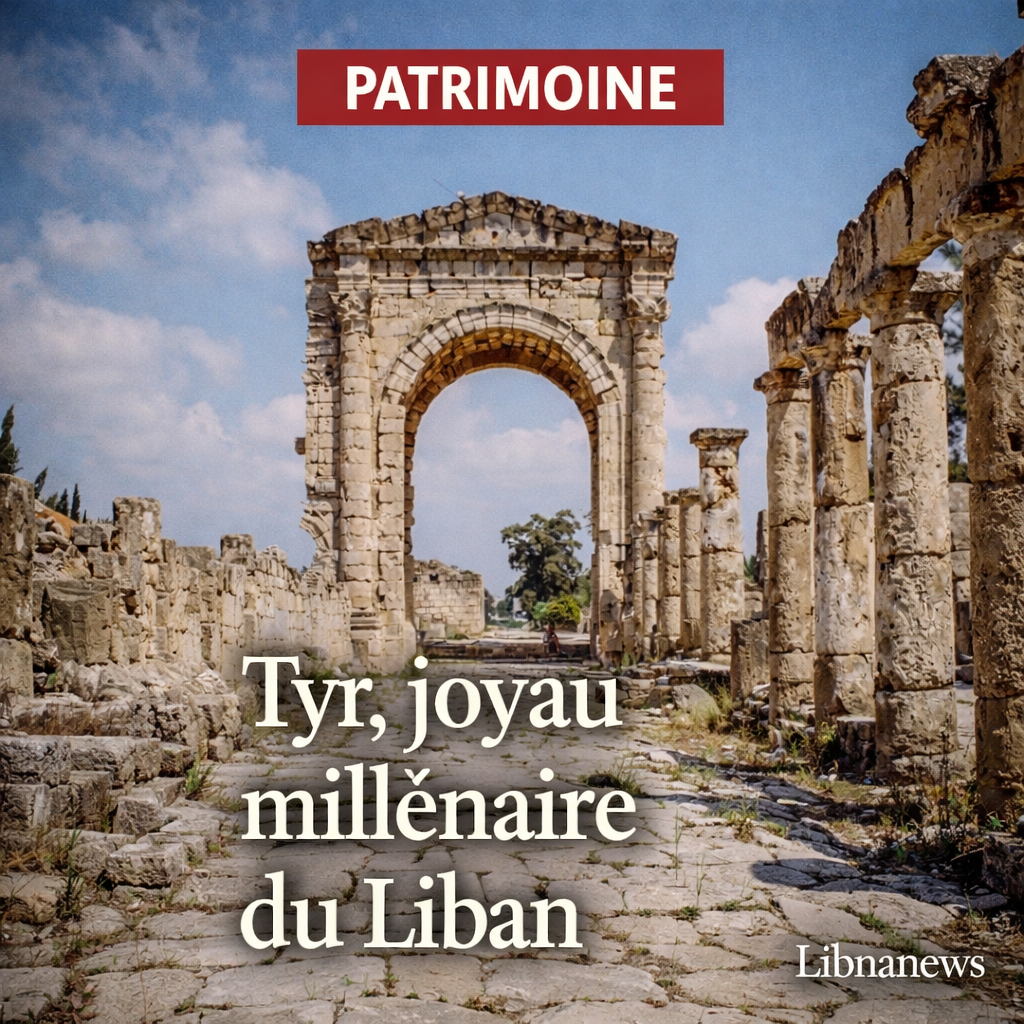
Nestled on the southern coast of Lebanon, some 83 kilometres south of Beirut, Tyre – or Sour in Arabic – is one of the oldest cities continuously inhabited by humanity. The capital of the eponymous Caza, this Phoenician city par excellence carries within it the strata of a history that goes back nearly 5,000 years. According to Herodotus, the Greek historian who visited her around 450 B.C., Tyre was founded around 2750 B.C., a dating corroborated by archaeological excavations revealing levels of occupation dating back to the beginning of the third millennium B.C. A cradle of legends and conquests, she saw the empires march from the Phoenicians to the Ottomans, passing through the Romans and the Crusaders. As part of Unesco’s world heritage since 1984 for its exceptional remains, Tyre embodies the resilience of a maritime civilization that has spread over the Mediterranean.
Phoenician origins and sea boom
The first traces of human occupation in Tyre date back to the ancient Bronze Age, around 2750 BC, when the city emerged as a prosperous maritime counter. Originally built on a rocky island – where its semitic name « Tsour », meaning « rock » – and on a continental part called « Paletyros » or « Ancienne Tyrus », it was distinguished by its strategic position, protected by natural ramparts and tumultuous waters. A vassal from Egypt to the fourteenth century BC, it gradually freed itself to become, in the tenth and ninth centuries BC, the dominant metropolis of Phoenicia, eclipsing even its neighbour Sidon.
Tyre owes its radiation to its maritime genius. The Tyrian Phoenicians, intrepid navigators, founded many colonies across the Mediterranean: Carthage in 814 B.C. (according to tradition, by Princess Elissa, or Didon in Roman mythology), Cadiz in Spain, or Lixus in Morocco. These counters provided a virtual monopoly on maritime trade, exporting cedar wood from Lebanon, glass, textiles and precious metals. The city is also credited with the invention of purple dye, extracted from the murex, a marine mollusc. This « purple of Tyre », an imperial purple reserved for elites, was worth more than its weight in gold and symbolized royal power – an industry that employed thousands of artisans and enriched the city.
The mythology surrounds Tyre with a legendary veil: it would be the birthplace of Europa (removed by Zeus, giving his name to the continent), his brothers Cadmos (presumed inventor of the alphabet) and Phoenix, as well as the point of departure of Didon towards Carthage. The temple of Melqart, a tutelary divinity equivalent to the Greek Heracles, was a major sanctuary visited by pilgrims from all over the world.
The two ports: beating hearts of the city
Like any major Phoenician community, Tyre had two natural harbours, protected by breakwaters and towers. The Sidonian port, in the north, oriented towards Sidon and the commercial routes of the Levant, coincides today with the modern fishing port. The southern Egyptian port, facing Egypt and Africa, provided shelter for ships carrying exotic goods. This infrastructure, dug in the rock and reinforced by massive wharves, allowed for large fleets – up to 100 vessels according to some ancient estimates.
However, these ports face contemporary threats. Modern port infrastructure projects, including extensions and dredging, are likely to damage submerged remains, such as ancient Phoenician piers and wrecks. Associations such as the International Association to Save Tyre campaign for their preservation, stressing the importance of these sites for underwater archaeology.
A pivotal role in biblical history
Tyre occupies a unique place in the Scriptures. In the tenth century B.C., during the reign of Hiram I (969-936 B.C.), the city made a close covenant with King Solomon of Israel. Hiram supplies cedar and cypress wood from Lebanon, architects – including the famous Hiram Abiff, master bronzer and mason – and skilled workers to build the Temple of Jerusalem dedicated to Yahweh. In return Solomon gave up territories and agricultural commodities (1 Kings 5-9). This cooperation illustrates the commercial and cultural links between Phoenicians and Hebrews, as Tyre exports not only materials but also architectural know-how influencing sacred art. The Bible also mentions Princess Jezebel, daughter of Tyrian King Ithobaal I, wife of Ahab of Israel, symbol of intrigue and religious conflicts.
Legendary seats: from Nabuchodonosor to Alexander
Tyre illustrated his fierce resistance to invaders. In the sixth century BC, it supported a thirteen-year-old siege (585-573 B.C.) by Nebuchadnezzar II of Babylon, which failed despite the destruction of the mainland. The city, protected by its insularity, did not fall, but was weakened.
The most famous episode remains the conquest of Alexander the Great in 332 BC. Refusing surrender, the Tyrians defended their stunning island. Alexander, an ingenious man, had an 800-metre-long and 200-metre-wide dam built, using the debris of the mainland city. After seven months of siege, the city was taken; 8,000 inhabitants died, 30,000 were sold in slavery. This dike, sanded over the centuries, definitely transformed the island into a peninsula, shaping the current landscape.
From successive empires to the modern era
After Alexander, Tyre joined the Seleucid Empire (200 B.C.), then Roman (64 B.C.), where she prospered as a colony. Herod the Great built a hippodrome – the largest in the ancient world, 480 metres long – of the thermal baths, an aqueduct and a colonized street paved with marble. Under the Byzantines, it became an important Christian centre; Origen was buried there around 254 AD.
Conquered by the Arabs in 638, it passed to the Crusaders in 1124, becoming a stronghold of the kingdom of Jerusalem until 1291, when the Mamluks shaved it. Under the Ottomans (1516-1918) it declined, but kept its port. In the 20th century, with Lebanon’s independence, Tyre experienced a revival, albeit marked by conflicts (Israeli invasions in 1978 and 1982, 2006 war).
Tyre Today: Living Heritage and Challenges
Today, Tyre is home to about 200,000 inhabitants, a mixture of Shiite, Sunni and Christian communities. Its archaeological sites – the necropolis of El Bass with its Roman sarcophagi, triumphal arch, hippodrome and baths – attract thousands of visitors. Unesco classifies two areas: the ancient city on the peninsula and the continental necropolis. Despite the threats of urbanization and recent conflicts, Tyre remains a living testimony of human ingenuity, where Phoenician history dialogue with the present.




