

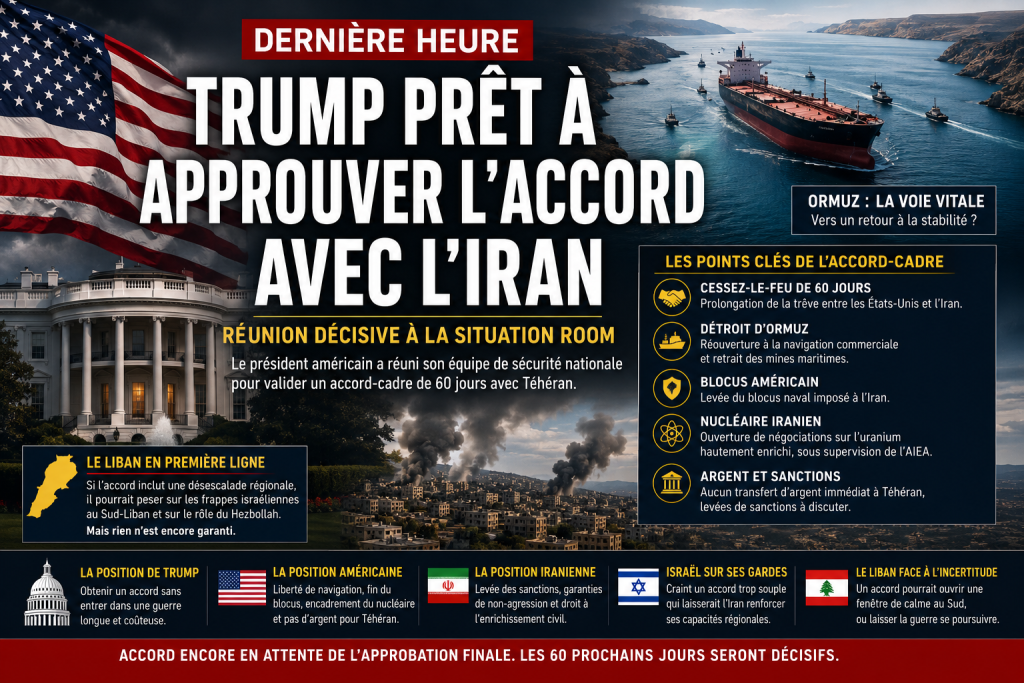
The prospect of an agreement between the United States and Iran took on a decisive dimension on Friday 29 May, after Donald Trump announced a meeting in the White House Situation Room to decide on a draft memorandum of understanding. According to several American media and news agencies, American and Iranian negotiators have agreed on a provisional framework to extend the current ceasefire by 60 days and to open a broader negotiation on the Strait of Ormuz, the United States naval blockade, the frozen Iranian assets and the Tehran nuclear programme. The US President’s final approval was not yet officially confirmed at the time of writing. But the signals sent by Washington indicate that the administration is looking for a quick exit, without giving the impression of yielding on nuclear.
The draft agreement would not immediately end the entire conflict. Rather, it would open a stabilization period, conceived as a transition to a broader arrangement. The central point would be a 60-day extension of the ceasefire between Washington and Tehran. This period should allow for the resumption of normal maritime traffic in the Strait of Ormuz, the gradual lifting of certain American measures and the opening of discussions on Iran’s stock of highly enriched uranium. The most sensitive terms remain unclear, including sanctions, guarantees of non-aggression and the role of the International Atomic Energy Agency.
Caution therefore remains necessary. Previous diplomatic announcements have often been contradicted by military incidents or partial denials from Tehran. Iran claims not to rely on American words and demands action. The United States, for its part, wants verifiable nuclear commitments and freedom of navigation. Israel is observing the process with concern, especially if the final text imposes a regional de-escalation including the Lebanese front. For Lebanon, the stakes are direct: an American-Iranian agreement could affect Israeli operations against Hezbollah, but there is still no guarantee that Tel Aviv will accept this reading.
A memorandum rather than a peace agreement
The text under discussion would take the form of a memorandum of understanding. This formula is important. It does not correspond to a comprehensive peace treaty. It serves first of all to freeze a military situation, organize a negotiating period and avoid an immediate resumption of hostilities. It voluntarily leaves several files open, as both parties do not yet appear ready to resolve the most difficult issues.
The first objective would be to extend the ceasefire for sixty days. This duration responds to an economic and military emergency. Since the beginning of the war, the Strait of Ormuz has become the centre of all concerns. This route remains essential for Gulf oil and gas exports. Any sustained blockage causes immediate tension in energy markets, increases transport costs and increases political pressure on Western governments. Donald Trump knows that the Gulf crisis can affect the US economy and mid-term elections.
The second objective concerns maritime traffic. The project would include reopening the Strait of Ormuz to commercial traffic, eliminating the most visible Iranian restrictions and removing or neutralizing maritime mines. In return, Washington would lift its naval blockade on Iran. This point is presented as one of the pillars of the provisional agreement. It would allow each party to claim a gain. Trump might claim to have obtained freedom of navigation. Tehran may claim to have forced Washington to lift a coercive measure.
The third objective concerns nuclear power. The project would not immediately resolve the file. Instead, it would open negotiations on Iran’s stock of highly enriched uranium. Washington wants to prevent any Iranian access to nuclear weapons. Trump repeated that Tehran must never possess a bomb. The United States also wants the most sensitive stock to be removed, neutralized or placed under supervision. Iran, for its part, refuses to renounce the principle of civilian enrichment, which it presents as a right under the non-proliferation treaty.
Trump is looking for a controlled exit
Donald Trump’s position is based on a complex political equation. The American president wants to appear as the one who can impose an agreement after using force. He must show that he did not retreat from Iran, while avoiding a prolonged war that would affect the economy, the US army and its electoral base. The passage through the Situation Room responds to this staging. It gives the decision a strategic and presidential character.
Trump has publicly set several requirements. He called for Iran to renounce any military nuclear ambition, for the Strait of Ormuz to be reopened without hindrance, for mines to be removed and for vessels to be allowed to leave. It also states that the United States will be responsible for lifting the blockade and destroying or neutralizing highly enriched uranium. He said that no money would be paid to Iran at this stage, which aims to neutralize Republican critics on a possible cheque in Tehran.
This last clarification reveals the inner constraint. Republican hawks already accuse any openness to Iran of replicating the weaknesses they attributed to the 2015 nuclear agreement. They want hard guarantees, strict international control and an end to enrichment. Part of the Trompist camp also fears that Iran will use a 60-day pause to rebuild its military capabilities, reorganize its regional networks and save time on nuclear power.
But Trump must also count with American public opinion. A long war against Iran is not popular if it results in higher gasoline prices, risks for US soldiers in the Middle East and lasting instability in the Gulf. The president is therefore looking for a formula to say that he forced Tehran to negotiate. The sixty-day memorandum offered him that opportunity. He can present it as a force agreement, not as a concession.
Iran demands actions before committing
Iran’s position remains distrustful. Officials in Tehran reiterated that American verbal safeguards were not sufficient. Iran wants actions: effective lifting of the blockade, sustainable reopening of trade routes, access to frozen assets, guarantees against further strikes and recognition of its right to a civilian nuclear programme. This line reflects a long memory of relations with Washington, from the US withdrawal from the 2015 nuclear agreement to strengthened sanctions.
Tehran also wants to avoid appearing as the defeated party. After several months of war, the regime must present any compromise as the result of its resistance. The reopening of Ormuz, if accompanied by the lifting of the American blockade, can be sold to the Iranian public as a balanced exchange. The issue of frozen assets is even more sensitive. Some versions of the project point to a gradual access to several billion dollars. Trump says that no money will be exchanged for now. This contradiction shows that the final text remains unstable.
Nuclear power is the main blocking point. Iran claims that it does not want nuclear weapons, but it does not want the United States to dictate a technological capitulation. The stock of highly enriched uranium is at the heart of the discussions. Washington wants it to be removed from Iranian territory, destroyed or placed under enhanced international control. Tehran could accept supervision, but it could hardly be a complete abandonment of civilian enrichment. The compromise could involve temporary freezing, partial dilution or controlled transfer to a third country, but nothing is confirmed.
Iran is also seeking to link the US file to regional fronts. Hezbollah in Lebanon, armed groups in Iraq, the Houthis in Yemen and the balances in Syria are part of the architecture of Iranian influence. Tehran can accept a drop in tension if it protects its strategic interests. But he does not want to give up his allies under US or Israeli pressure. This is one of the reasons why Lebanon appears watermarked in the discussions.
Israel fears agreement too flexible
Israel is following the case with deep mistrust. The Israeli government considers Iran to be the main strategic threat. He feared that a sixty-day memorandum would save Tehran time, preserve its nuclear stockpile and maintain its regional relays. The Israeli reservations focus on two points: the question of highly enriched uranium and the possible inclusion of the Lebanese front in the de-escalation.
If the agreement is limited to Ormuz and the U.S.-Iranian ceasefire, Israel will retain broad freedom of action in Lebanon. If the text provides for a more regional de-escalation, Tel-Aviv may find itself under US pressure to reduce its strikes against Hezbollah. It is an explosive subject at a time when the Israeli army claims to want to continue its operations in southern Lebanon, expand its military achievements and remove the threat from its northern localities.
The Israeli government can accept a break with Iran if it really weakens the nuclear programme. He will probably refuse a text perceived as a mere suspension of the fighting. So the question is how far Trump is prepared to take into account Israeli objections. The American president wants to preserve his image as Israel’s protector, but he does not necessarily want Tel Aviv to define alone the calendar of a regional war that weighs upon American interests.
This tension can weaken the agreement from birth. Should Israel intensify its strikes in Lebanon or against Iran-related targets, Tehran could consider the ceasefire to be meaningless. If Iran or its allies respond, Washington could accuse Tehran of sabotaged the truce. The memorandum should therefore address, even indirectly, the issue of the associated fronts. Otherwise, it could stabilize the Gulf while leaving the Levant in open war.
Lebanon in the centre of a domino effect
For Lebanon, the possible agreement between Washington and Tehran is not an external matter. It can directly affect the war in the South. For several weeks, Israeli strikes have intensified against Lebanese localities, infrastructure, positions attributed to Hezbollah and civilian areas. The Lebanese authorities called for a real ceasefire, Israeli withdrawal and protection of the inhabitants. But they do not control the pace of climbing alone.
A U.S.-Iranian agreement could reduce pressure if Tehran agreed to curb its allies and Washington obtained a decline in operations from Israel. But this scenario remains uncertain. Israel reiterates that the Lebanese front meets its own security imperatives. Hezbollah does not want to appear as a mere instrument of Iranian decisions. The Lebanese government is trying to put the state back in the centre, but it remains caught between Israeli strikes, Hezbollah’s arsenal and American pressure.
The current sequence is therefore risky. If Trump approves the memorandum without clearly integrating Lebanon, Israel could continue its strikes in the South while respecting a broader truce with Iran. Tehran could then be pressured by its allies to react. If Lebanon is included in a regional de-escalation, the Israeli government could challenge the text or limit its application. In both cases, Beirut must defend its priorities: stopping attacks, returning displaced persons, protecting schools and places of worship, and restoring the role of the Lebanese army.
The link between Ormuz and South Lebanon may seem indirect. He’s real, though. Iran uses the strait as a strategic lever. Israel uses military pressure in Lebanon to hit Hezbollah and, through it, the Iranian axis. The United States seeks to protect navigation and avoid an energy crisis. Each theatre weighs on the others. This makes the deal possible, but also fragile.
Frozen assets, explosive file
The financial issue remains one of the most sensitive issues. Some versions of the draft refer to Iranian access to frozen assets. Others speak only of a discussion mechanism, without immediate release. Trump took care to publicly state that no money would be exchanged at this stage. This sentence refers to his inner opinion. It seeks to avoid the image of an agreement where Washington would pay Tehran for a truce.
For Iran, access to frozen funds is a major issue. The Iranian economy suffers from sanctions, war, banking restrictions and energy instability. An agreement that would not produce any financial relief would be difficult to describe as a victory. Tehran can accept a gradual formula: humanitarian access, controlled mechanism, conditional release or framed use of certain funds. But it will require tangible results.
This can become a political trap for Trump. Too few financial concessions and Iran can refuse to commit seriously. Too many concessions and US opponents will denounce indirect financing of the regime. The US President is looking for a narrow path. It can link any access to funds to nuclear verification, freedom of navigation and respect for the ceasefire. This would make money a lever rather than an initial payment.
Sanctions pose the same problem. Broad lifting would be politically costly in Washington. Too limited a lifting would be insufficient for Tehran. The compromise could involve temporary exemptions, including certain energy, medical or humanitarian exchanges. But the exact structure of these measures is not known. It will be decisive for the survival of the memorandum.
A fragile agreement even before it is signed
The draft agreement already suffers from several frailties. The first is the absence of final confirmation. As long as Trump has not formally approved the text, it is only a waiting framework. The second is Iranian mistrust. Tehran has already minimized some American announcements and repeated that words are not enough. The third is Israel’s potential opposition. The Israeli government can accept certain elements while refusing any coercion on the Lebanese front.
The fourth fragility is nuclear. Both sides can agree on a military break and on Ormuz, but fail on highly enriched uranium. Washington wants a verifiable result. Iran wants to preserve its right to enrichment. The IAEA could play a role, but its access to sites, stocks and information should be negotiated. Without a robust mechanism, the agreement will be attacked as too weak. With a mechanism that is too intrusive, it may be rejected by Tehran.
Fifth fragility is military. A single strike, a single missile fire, an attack on an American base, a drone against an Israeli installation or a massive bombardment in Lebanon can derail the sequence. Regional ceasefires often break through margins. A local actor can act, voluntarily or not, and force capitals to react. That is why the text should include crisis channels, verification procedures and rapid de-escalation mechanisms.
The agreement, if approved, would therefore be less a peace than a test. He will test Trump’s ability to impose a compromise on his side. He will test Tehran’s ability to accept nuclear concessions without losing face. He will test Israel’s ability to limit its operations if Washington asks. Finally, it will test the possibility of separating the Gulf, Iran’s nuclear power and the Lebanese front, while these issues are now feeding on each other.
The moment of truth in Washington
The Situation Room meeting concentrates these tensions. It must allow Trump to choose between three options. The first is to approve the memorandum and announce a 60-day extension of the ceasefire. The second is to request changes, including on nuclear, sanctions or Lebanon. The third is to reject the text, at the risk of reviving the escalation in the Gulf and causing new tension in the energy markets.
The American president seems to be looking for a quick solution, but he wants to keep his hand on the story. He doesn’t just want to sign a text. He wants to be able to say that he obtained the opening of Ormuz, the end of the mines, the controlled lifting of the blockade, the supervision of Iranian uranium and the absence of immediate payment in Tehran. Its decision will therefore depend as much on the legal content as on how it can sell the agreement to its electorate.
Iran will wait for action. If the text was approved, Tehran would observe the effective lifting of United States measures, the movement of ships and the Washington tone on sanctions. Israel will observe the nuclear clauses and the consequences for the Lebanese front. Lebanon will observe the strikes in the South. The markets will observe Ormuz. The IAEA will monitor access to the nuclear file. None of these actors will agree on the White House announcement alone.
The day of May 29 can therefore mark an inflection. It does not guarantee lasting peace. It can open a 60-day period during which each camp will test the other. For Washington, the challenge is to turn a fragile truce into a process. For Tehran, it is to get a real lifting of pressure without abandoning its civilian nuclear programme. For Israel, it is to prevent an agreement deemed too permissive. For Lebanon, it is important to know whether American diplomacy can finally produce a concrete effect on the bombings in the South.




