

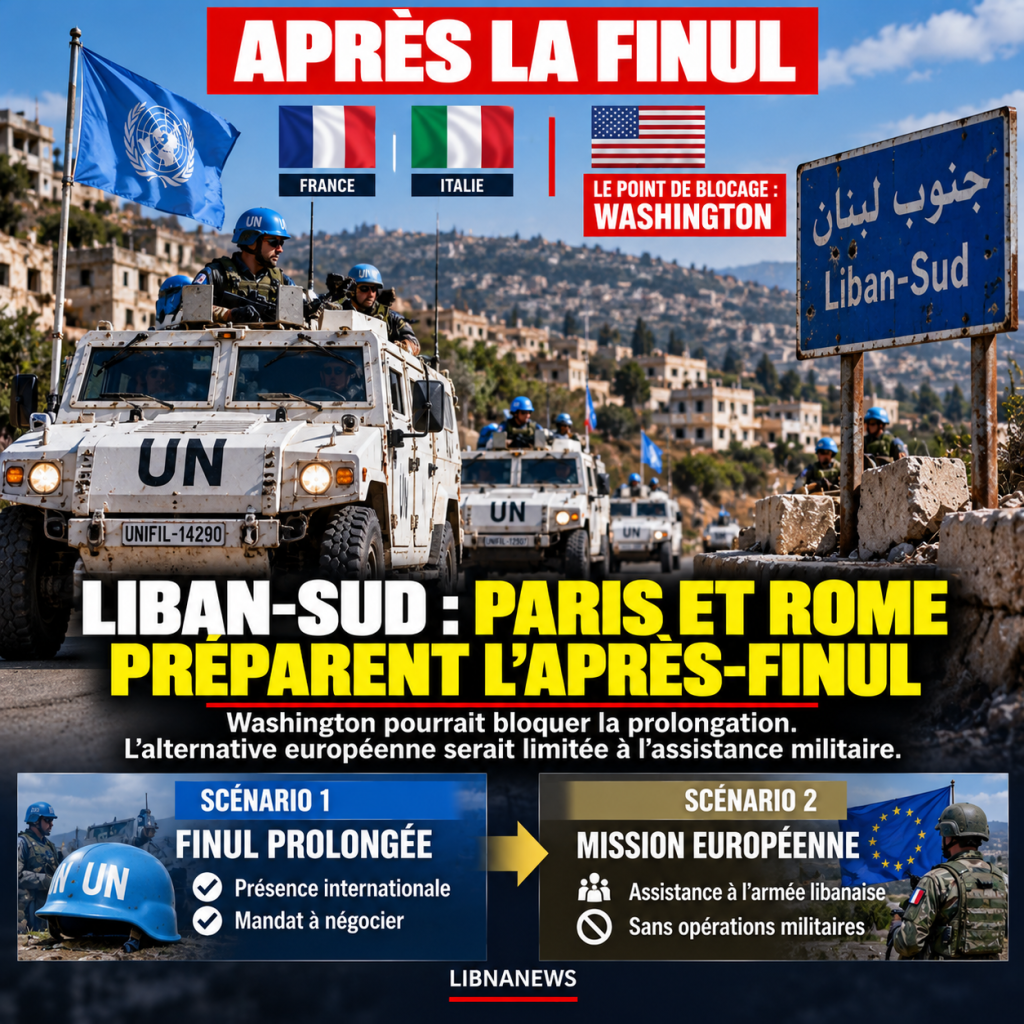
Paris wants to extend UNIFIL, but is already preparing an alternative
France and Italy are working to extend the international presence in South Lebanon. Their immediate objective is to obtain a new framework for the United Nations Interim Force in Lebanon, whose mission is nearing completion. But Paris is also preparing an alternative. An American opposition could prevent the requested extension of the Security Council. In this case, Europeans would consider a civilian and military mission to accompany the Lebanese army. However, there is a major limitation to this formula: European military personnel would not be responsible for conducting operations on the ground.
Member of Parliament Simon Abi Ramia, chairman of the Franco-Lebanese parliamentary friendship group, outlined this approach on 20 October 2026. According to him, Paris works directly with Rome to extend the international mission in a renewed framework. At the same time, the two capitals are studying a mission to assist Lebanese forces. It could intervene in a number of areas to strengthen the military and security capacities. On the other hand, it would not be intended to conduct military operations in the South. This clarification reveals the main weakness of the project: a support mission would not fully replace the functions currently performed by UNIFIL.
Discussions continue with Washington, the Lebanese authorities and several European capitals. The French military administration examines the tasks that could be assigned to this new mission. No final agreement has yet been announced on its mandate, strength or resources.
France seeks guarantees for its military
The recent visit to Beirut by French Foreign Minister Jean-Noël Barrot is part of these negotiations. Paris wants to know the conditions under which its military could continue their presence in Lebanon after the end of the current arrangements. Their safety is an important issue in the discussions. France is also seeking assurances on the missions entrusted to it and on the conditions for their deployment.
The stakes are also diplomatic. Paris wishes to retain a role in the arrangements that will determine the security of the South Lebanon. A reduction in the international presence could diminish its ability to participate directly in the monitoring of military commitments. The French authorities therefore increase consultations with their European and Arab partners. They seek to maintain an international arrangement while avoiding engaging in a mission whose responsibilities would remain poorly defined.
France is considering two options. The first is to obtain an extension of UNIFIL, possibly accompanied by a change in its missions. The second is the creation of a new European assistance structure. The latter option would depend in particular on the American position. It would also require an agreement on the respective responsibilities of the foreign military and the Lebanese army.
Rome, indispensable rather than adversary partner of Paris
Contrary to the image of an open confrontation between Paris and Rome, the information on 20 October describes above all cooperation between the two capitals. Simon Abi Ramia confirms their direct coordination on the UNIFIL file. The differences relate more to possible forms of international presence than to a formal disagreement between the two Governments.
Italy has an important experience in southern Lebanon thanks to its participation in the international force. It also maintains continued military relations with Beirut. This experience gives him a special place in the discussions on the future mechanism. France, for its part, retains a major diplomatic role and seeks to mobilise European partners around a common solution.
However, the two countries must agree on several concrete issues. A new mission will need a specific mandate. It will be necessary to determine whether its military can only train and advise Lebanese forces or whether they will benefit from additional skills. The issue of funding and staffing also remained open.
At this stage, the documents do not allow Rome to be attributed a project definitively opposed to that of Paris. To present the two capitals as engaged in a frontal rivalry would therefore be excessive.
Washington could prevent the requested extension
The most clearly identified obstacle comes from the United States. An American opposition to the Security Council could jeopardize UNIFIL’s extension. This possibility pushes Paris and Rome to prepare another formula. She explained why the European discussions already focused on a civilian and military mission separate from the current arrangements.
Washington also favours military negotiations between Lebanon and Israel. The meeting in Tampa on 20 October is intended to examine the security arrangements and the conditions for the implementation of the framework agreement. The United States would like to strengthen the communication mechanisms between the two armies. However, this approach does not address all Lebanese concerns about the international presence.
Lebanon continues to call for the cessation of Israeli attacks and the withdrawal of the occupied territories. Direct military coordination alone would not guarantee the achievement of these objectives. Nor would it automatically replace an international force on the ground.
The American position thus puts Europeans before a difficult choice: to defend the extension of a mission that could be blocked or to prepare a less ambitious scheme, but more likely to obtain a diplomatic agreement.
Beirut refuses to leave the South without an international presence
The Lebanese Government seeks to maintain an international presence after the end of UNIFIL’s mandate. Prime Minister Nawaf Salam addressed this issue with Jean Arnault, representative of the UN Secretary-General. The meeting focused on possible arrangements for the following period and the security situation in the South. Both officials also stressed the need to protect Lebanon from further regional escalation.
President Joseph Aoun defends the continuation of diplomatic efforts. He called for the implementation of commitments concerning Israeli withdrawal and cessation of attacks. At the same time, it called for the strengthening of the presence of Lebanese security forces in southern villages not occupied by Israel. This measure is intended to reassure residents and facilitate their access to administrative services.
The Secretary General of the Arab League, Nabil Fahmy, also defended the maintenance of an international force with an official framework. During his visit to Beirut, he reaffirmed the League’s support for Lebanese institutions and announced his intention to visit the South.
These positions converge on one point: Beirut does not want the departure of UNIFIL to leave the army alone in the face of all the responsibilities currently assumed within the international framework.
The major problem: a mission without intervention
The European formula currently under study has a clearly stated limit by Simon Abi Ramia. The future mission could support the Lebanese Army, strengthen its capabilities and support its deployment. However, it would not conduct military operations on the ground.
This restriction profoundly changes the scope of the device. A training mission could contribute to the functioning of Lebanese forces. It would not necessarily have the means to directly monitor incidents or intervene in areas exposed to military tensions. Its effectiveness would therefore depend largely on the capabilities of the Lebanese army and the arrangements reached with the other parties.
France is still studying the specific responsibilities that could be entrusted to its military. Discussions also focused on the continuity of international support following the departure of UNIFIL. Therefore, the proposed arrangement cannot yet be presented as an operational replacement force.
For Lebanon, the difference is considerable. The presence of European advisers and trainers would not necessarily meet the monitoring and security needs in villages close to Israeli positions. It could strengthen the army without providing it with all the capabilities currently provided by the international mission.
The case remains suspended on three decisions: the American position on an extension of UNIFIL, the European agreement on a replacement mission and the guarantees obtained by Beirut regarding its mandate.On 20 October 2026, Paris and Rome worked together, but no final formula was agreed.The main uncertainty is therefore not which of the two countries will lead the future mechanism. It concerns the missions that Europeans will really accept to undertake in southern Lebanon.





Comments