

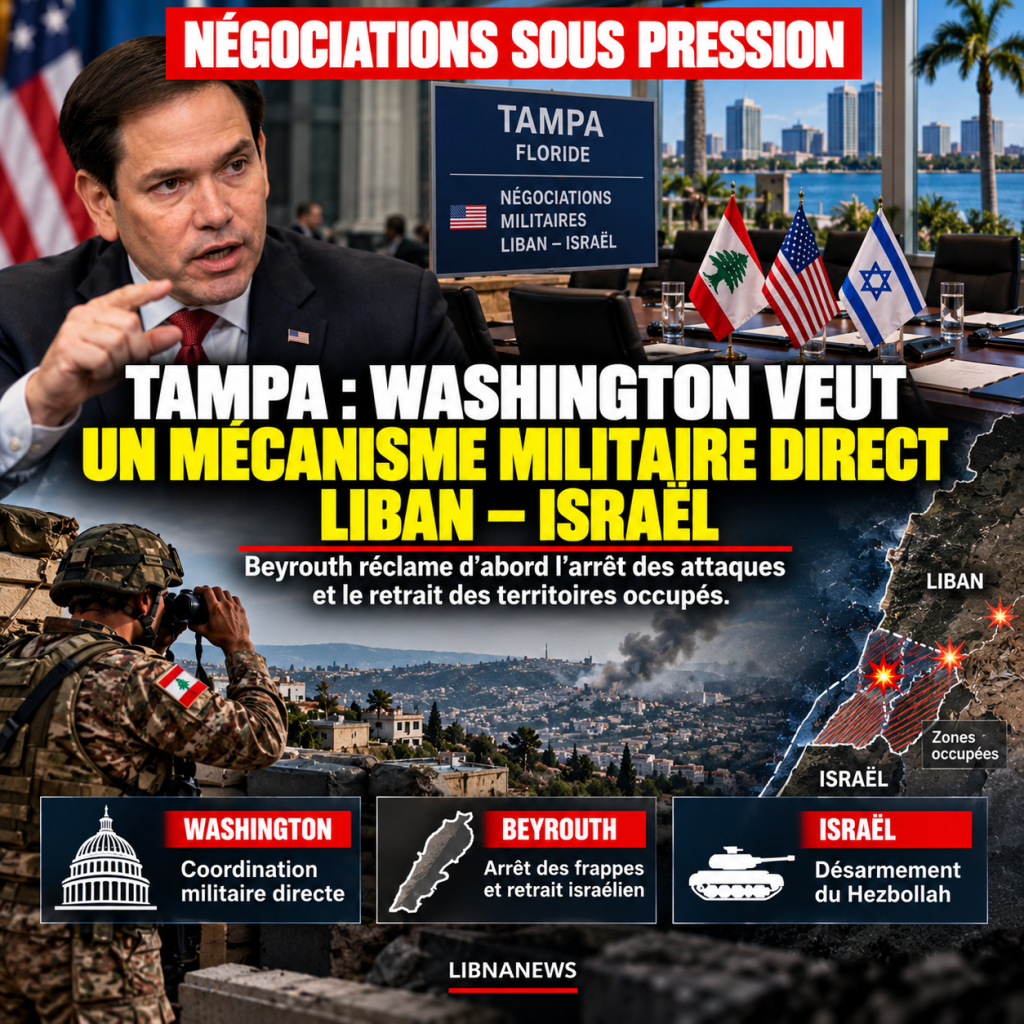
In Tampa, Florida, the military negotiations scheduled for 20 October 2026 between Lebanon and Israel could go beyond the question of the ceasefire. According to information published on the eve of the meeting, Washington would like the agreement of the Lebanese army on a mechanism for direct coordination with the Israeli army. This request was personally defended by US Secretary of State Marco Rubio to President Joseph Aoun. It would then intervene that Beirut still calls for the cessation of Israeli attacks and the withdrawal of the occupied territories. Behind a proposal presented as a means of facilitating military exchanges thus appears a disagreement on the order of commitments: should Lebanon accept new security obligations before achieving progress on the ground?
An American demand at the heart of the interview between Rubio and Aoun
The proposal for direct coordination is one of the requests given to Marco Rubio during his telephone interview with Joseph Aoun. According to information reported on 20 October 2026, the Secretary of State reportedly asked the Lebanese President to press the army command to accept a liaison mechanism with the Israeli forces. This approach was reportedly presented in the context of the military negotiations held in Tampa. Rubio also warned his interlocutor that a Lebanese absence from the meeting would have a negative impact on the negotiation process. The available information does not reproduce the full contents of the interview. However, they allow for the identification of two distinct requests: to maintain Lebanese participation in the discussions and to obtain a change in the modalities of communication between the two military institutions. The second is the most sensitive point. It concerns not only the conduct of a meeting, but could alter the operational relations between two armies belonging to States still in conflict. However, there is no available document specifying the technical arrangements for this coordination. In particular, it is not established that a written draft has been formally transmitted to the Lebanese command.
The American approach comes as negotiations continue to face difficulties. The Lebanese authorities wish to obtain results on territorial issues and on the cessation of Israeli operations. Israel places the disarmament of Hezbollah at the centre of its demands. Washington seeks to maintain a framework for discussion between the two sides despite these differences. The alleged demand for direct coordination could respond to this desire to preserve a military channel of communication. However, the information published does not determine whether this mechanism would be limited to border incidents or cover broader operational issues. This difference is decisive in assessing its scope. A liaison to prevent an incident does not necessarily meet the same objectives as a permanent security coordination mechanism. The documents do not specify the intended frequency of exchanges or the authorities responsible for supervising them. Nor can they claim that the Lebanese army has formally accepted or rejected the proposal. On the eve of the meeting, the request attributed to Washington thus appears to be a subject of negotiation rather than an agreement already reached.
Lebanon first calls for halting attacks and Israeli withdrawal
The Lebanese authorities are approaching the Tampa meeting with several demands. The first concerns the cessation of Israeli attacks on national territory. Reports of 20 October 2026 refer to strikes, destruction in southern villages and persistent military overflights. Beirut believes that these operations undermine efforts to restore stability. The second requirement concerns the Israeli withdrawal from the occupied territories. Lebanon wishes to see the implementation of the provisions of the framework agreement and to put an end to the delays it attributes to the Israeli authorities. The issue of experimental areas is also a matter of disagreement. These sectors were to make progress in implementing security arrangements. However, the Lebanese authorities consider that the commitments expected have not been fulfilled. Under these circumstances, the introduction of a new military coordination mechanism could be seen as a change in the priorities of the process. Beirut is seeking concrete results for its territory, while Washington would like to strengthen operational arrangements between the armies. Both objectives are not necessarily incompatible, but their order of implementation remains contested.
The issue of Lebanese prisoners held by Israel was also one of the issues that Beirut wished to take forward. The information available includes the request to obtain their identities and to allow the International Committee of the Red Cross to visit them. This dossier adds a humanitarian dimension to military discussions. It recalls that the negotiations are not only about the positions of the armed forces, but also about the consequences of the clashes for the persons concerned. The Lebanese authorities therefore wish to include the discussions in a set of commitments including security, territorial withdrawal and humanitarian issues. This approach explains the reservations that might arise from negotiations focusing almost exclusively on the disarmament of Hezbollah. President Joseph Aoun reaffirmed his commitment to the diplomatic solution, which he considers less expensive than a new war. This does not mean, however, that Beirut accepts all the proposals made in the talks. Maintaining dialogue is a political choice distinct from approving specific mechanisms that could be submitted to negotiators.
Israeli demands complicate the search for an agreement
The Israeli position is the other major element of the disagreement. According to information published on 20 October 2026, Israel continues to favour the disarmament of Hezbollah. The Israeli authorities regard this as an essential condition for the security of their territory. They wish to obtain Lebanese commitments concerning the military capabilities of the movement, including beyond the southern Litani. This approach runs counter to the priorities advocated by Beirut. The Lebanese authorities are calling for an end to the attacks and Israeli withdrawal before they can envisage lasting stabilization. The dispute therefore concerns the measures to be taken, but also their succession. For Israel, security guarantees must precede certain concessions. For Lebanon, the continued occupation and military operations undermine the conditions for the implementation of the commitments. The US proposal for direct coordination is precisely in the middle of this divergence. It could allow military exchanges to continue without immediately resolving the most difficult issues. However, the documents do not establish that it would constitute a response accepted by both parties.
Negotiations are also taking place in a particular Israeli political context. The general elections are scheduled for 27 October 2026, one week after the Tampa meeting. Several analyses published at that time point out that Benjamin Netanyahu has little incentive to announce important concessions before the election. Security issues are central to his campaign, while tensions with Iran remain high. Donald Trump’s public support for the Israeli Prime Minister adds an American dimension to this electoral sequence. However, the available information does not demonstrate that Netanyahu decided to block the negotiations for electoral reasons. Rather, they show that discussions take place at a time when military and diplomatic decisions can have immediate political consequences. This proximity to the election contributes to skepticism expressed by some Lebanese official sources. The latter doubt the possibility of early progress on the Israeli withdrawal. The Tampa meeting could therefore maintain the dialogue without necessarily producing a settlement on the main points of disagreement.
Direct coordination without territorial regulation?
The central question raised by the alleged US mechanism concerns its place in the architecture of negotiations. The information available does not describe a comprehensive project, but indicates that Washington would like the Lebanese command’s agreement on direct coordination with the Israeli army. Such a development could change the modalities of trade between the two parties. So far, the discussions reported are part of a US mediation framework. The establishment of a direct channel would therefore constitute a change in the way in which certain military records are handled. However, it would be excessive to automatically equate this proposal with normalization of relations between Lebanon and Israel. The documents do not mention any Lebanese decision in this regard. They also do not specify whether the envisaged exchanges would be permanent or limited to specific situations. The political scope of the mechanism would depend, inter alia, on its missions, participants and the guarantees that would accompany it. These elements are not detailed in the available information.
The proposal nevertheless raises a practical difficulty. The Lebanese authorities could be called upon to accept new modalities of military cooperation while their requests for Israeli withdrawal remain unanswered. This would create an imbalance in the perception of commitments. Lebanon may consider that it is required to change its security practices before obtaining the measures expected from Israel. Conversely, Washington could present the mechanism as a means of reducing tensions and facilitating the progressive implementation of the agreements. The information published does not determine which precise formula would be preferred by US negotiators. Nor does they demonstrate that the Lebanese army was officially required to sign a particular agreement. The dossier therefore remains open on one essential point: would direct coordination be a technical measure to accompany a settlement, or would it become an autonomous mechanism despite the persistence of territorial disputes? The documents do not provide a definitive answer, but they show why this issue is a sensitive issue in the discussions.
The Lebanese army between external negotiations and internal tensions
The army command addresses this sequence while the internal situation requires a significant mobilization. Recent incidents in Dahr al-Baidar, Semaan Gallery and some neighbourhoods in Beirut have led the authorities to strengthen security measures. President Joseph Aoun chaired a meeting on these developments at Baabda Palace. It called for strict law enforcement, confiscation of illegal weapons and better coordination between the services. These decisions concern internal security, but they are in the same political context as negotiations with Israel. The army must therefore continue its missions of maintaining stability while participating in efforts to reduce tensions on the southern border. The American demands for Hezbollah attributed to Marco Rubio add an additional dimension to this situation. However, they should not be confused with the decisions officially announced by the Head of State. The documents do not show that the measures taken in Baabda are the direct result of discussions with Washington.
Hezbollah also remains a central player in the security balance. Its officials contest the steps they consider directed against its military capabilities. They defend the role of resistance against Israel and warn against certain actions by the security forces. These positions complicate the implementation of government decisions on weapons. They also influence the context in which Lebanese negotiators must consider Israeli demands. A mechanism for direct coordination between the armed forces would not alone resolve the internal disagreement over the disarmament of Hezbollah. Nor would it address the territorial issues raised by Beirut. The information available thus shows that military negotiations are taking place on several closely linked levels. The external process seeks to organize security relations with Israel, while the Lebanese authorities must preserve internal stability. However, there is no evidence in the documents to conclude that the military would have agreed to transform its missions in response to alleged American demands.
Tampa, a negotiation whose objectives remain contested
The meeting on 20 October took place at a time when several Lebanese officials doubted whether they could achieve results quickly. One official source cited in the available information considers that the meeting could mainly maintain the negotiation process. This assessment is based on the fact that Israel’s expected commitments have not been fulfilled. Lebanon continues to call for the cessation of attacks and the withdrawal of the occupied territories. Israeli authorities maintain their demands for Hezbollah. Washington wants to preserve discussions and strengthen security mechanisms. These three directions explain the difficulties of the process. They also show why the proposal for direct coordination could become an additional subject of disagreement. Its possible acceptance would depend not only on its operational usefulness, but also on the commitments Lebanon could obtain in return.
As of October 20, 2026, the documents do not provide the results of the Tampa meeting. They do not mention any final agreement on a direct military mechanism between the two armies. On the other hand, they identify a request attributed to Washington, the territorial requirements defended by Beirut and Israeli security priorities. The most sensitive point remains the order in which these commitments could be implemented. The Lebanese authorities wish to obtain concrete measures concerning their territory and the cessation of attacks. The alleged US proposal would introduce a new phase of military coordination, the modalities of which remain unknown. It is on this difference between the stated objectives and the commitments actually achieved that the questions surrounding the Tampa negotiations are concentrated.





Comments