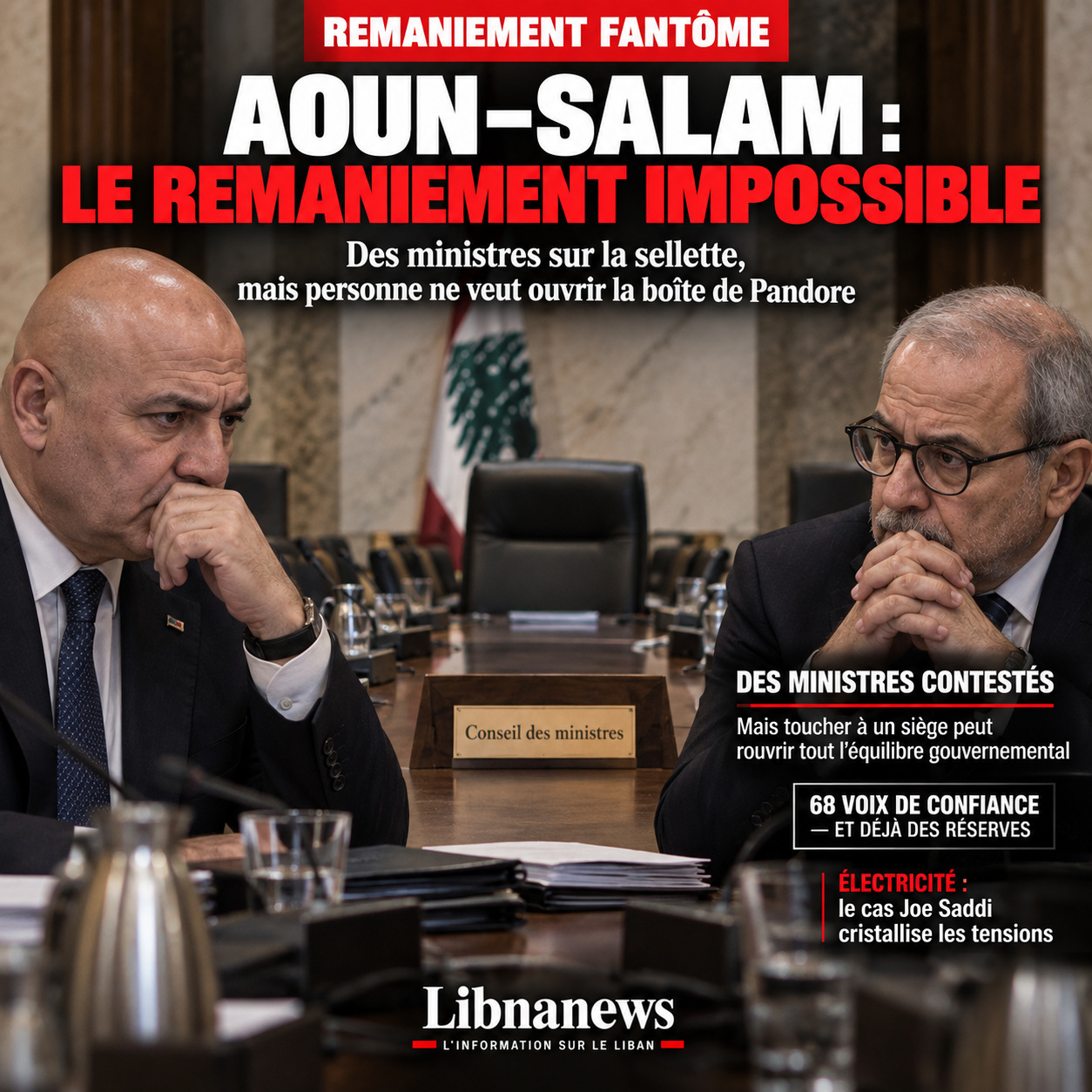
The government of Nawaf Salam had just emerged from a new parliamentary event when the first lists began to circulate. Ministers were given up. Potential replacements were mentioned. Foreign Affairs, Tourism, the Environment and Telecommunications appeared in the conversations. The name of Energy Minister Joe Saddi was directly associated with the electricity crisis. Then, almost as quickly, the redesign project lost momentum.
However, this reverse does not reflect a satisfaction found at the top of the state. The reserves exist in Baabda as in Serail. Joseph Aoun would comment on the work of ministers under his government. Nawaf Salam would also have reservations about members of the team considered close to him. More precise information also indicates presidential dissatisfaction with the management of several economic, social and environmental issues.
But no agreement was reached between Joseph Aoun and Nawaf Salam to change the government. The President of the Republic would not have even formally presented a draft reshuffle.
The paradox is there: the performance of some ministers is already contested, but the political system considers that it would be more dangerous to replace them today than to maintain them.
68 votes of confidence, then the names begin to circulate
The debate expanded after the parliamentary session on government. He obtained the confidence of 68 Members, against 12 hostile votes and two abstentions.
The result was a majority. It did not remove the criticisms made in Parliament.
In the days that followed, information began to circulate on ministers who might leave the team and on possible successors. The movement has caused discomfort within the government and among the formations to which some ministers are politically attached.
However, the available information shows that there was no definitive list.
That is an essential point. Several names were tested in political conversations. This does not mean that Joseph Aoun and Nawaf Salam had stopped a list of departures.
Reshaping existed as a political hypothesis before it existed as an institutional decision.
And it was precisely the transition from one to another that proved almost impossible.
Aoun did not ask for reshuffle, but he is not satisfied
An informed official source provides a clarification that changes the reading of the file.
Joseph Aoun did not formally propose a ministerial reshuffle or the replacement of specific ministers.
On the other hand, his dissatisfaction would be real.
It would focus on the performance of some members of the government and, more broadly, on how several economic, social and environmental issues are dealt with.
This distinction is important.
So the president wouldn’t have arrived in front of Nawaf Salam with a list of barred names. Rather, he would have noticed a performance problem.
The same source, however, brings a second and even more interesting clarification: not all ministers who seem to be inefficient would necessarily be responsible for their immobilism.
Some members of the government would give satisfaction. Others would have fallen into a form of inertia. But this inertia would sometimes be linked to the country’s general situation, regional circumstances or international constraints.
In other words, the ministers’ assessment already tackles a very concrete problem: distinguishing incompetence from blockage.
A minister may not produce results because he or she works badly. It may also not produce a result because the decision depends on non-existent funding, a political agreement not found or a regional situation that it does not control.
Changing the first can solve a problem.
Changing the second only changes the name on the department door.
Salam would also have his own reserves
Unease would not be limited to Baabda.
The information gathered indicates that Nawaf Salam would also have reservations about the performance of some ministers considered to be of his choice or political environment.
This fact prevents the case from being reduced to a classical tension between the President of the Republic and the President of the Council.
Aoun would not simply try to correct « the ministers of Salam », while Salam would protect his team.
Both presidencies would have their own criticisms.
But having common reservations about the functioning of the government does not mean agreeing on how to change it.
That is precisely what is missing.
An official source clearly states that no agreement was reached between the two presidents to reshuffle.
It also gives the reason: the current circumstances would neither change the government nor affect its balance.
The word « equilibrium » explains much more than the word « circumstances ».
Joe Saddi: Electricity turns a minister into a political test
The most visible case is Joe Saddi.
The Minister of Energy was at the centre of the discussions because of the electricity situation. His name was associated with the assumptions of change.
But his replacement immediately encountered a political red line.
Lebanese Forces circles claim that there is no question of abandoning him. Their reading is that the pressure around his ministry aims to put all parties before their responsibilities in the energy issue, not to get his departure.
Georges Okais formulated the defence in a much more offensive manner. He warned that the Lebanese Forces would not accept « burning » in the government. He also accused some actors of deliberately trying to defeat the party in the energy sector in order to break its image and put it on the same plane as those who previously managed the file.
This reaction immediately shows why a redesign presented as a technique never stays so long.
If Joe Saddi is replaced, the discussion will no longer focus solely on the number of hours of electricity.
It will deal with the Lebanese Forces’ share in the government, the historical responsibility of the sector and the identity of the successor.
A problem of administrative efficiency becomes within hours a confrontation between political formations.
Four other departments entered into conversations
Energy is not the only portfolio to have been mentioned.
Behind the scenes information also cites Foreign Affairs, Tourism, Environment and Telecommunications.
However, no definitive list was drawn up.
It would therefore be incorrect to present the incumbents of these departments as ministers officially threatened with revocation. Their presence in conversations shows rather the extent to which the operation would quickly have taken place.
If the debate involved a single portfolio, a compromise could be reached.
From the moment five departments appear in the discussions, the matter changes in nature.
Each portfolio corresponds to a component of the compromise that allowed the formation of the government. Behind each minister is a combination of political, religious and institutional considerations.
Therefore, replacing several people amounts to pulling several threads from the same fabric.
No one can know in advance who will give up the whole.
Shiite tandem does not want to reopen government sharing
This fear explains the caution of the main political forces.
The Shiite tandem, in particular, would not have shown any desire to open the file of the reshuffle widely.
This refusal does not necessarily mean that its officials consider the performance of all ministers to be perfect.
The problem is elsewhere.
Once a portfolio is discussed, the other components may ask why their own shares would not be discussed.
If one party retains the right to choose its minister’s successor, another may claim the same rule. If the Presidency wants to replace a minister on its part, the Serail may want to make its own correction. If several changes occur simultaneously, parliamentary formations may consider that the initial balance of government no longer exists.
The reorganization becomes a second formation of the government.
But this time, it takes place without prior resignation from the cabinet and while the executive must continue to run the country.
This is exactly the scenario that political actors seek to avoid.
The Constitution adds a lock: a minister is not a director general revocable by decree
The problem becomes even more complex when we leave politics for constitutional law.
The Lebanese Constitution does not contain an autonomous procedure entitled « Ministerial reform ».
The mechanism must therefore be rebuilt on the basis of several provisions.
Article 53 organises the role of the President of the Republic and the President of the Council in forming the Government.
But the real lock is in article 65.
The removal of a minister belongs to important decisions which require a two-thirds majority of the Council of Ministers.
This rule means that a minister cannot be treated as a senior official that the two presidents would simply replace after agreeing.
Even if Joseph Aoun and Nawaf Salam concluded that a minister had to leave, the question of procedure would remain.
This protection is not accidental.
The Taif system is based on the collegial nature of the executive. The Government is not legally a collection of ministers individually dependent on the President of the Republic.
The stability of the Council of Ministers is therefore itself an institutional value.
The solution of portfolio change opens another battle
However, Lebanese government history offers an intermediate path.
Instead of explicitly removing a minister, portfolio allocation can be changed.
A minister may lose a function, receive another responsibility or become a minister of state. His old wallet can be entrusted to someone else.
This technique apparently avoids the heavy revocation procedure.
But it raises a formidable legal question: when does a redistribution of portfolios become a disguised revocation?
If a minister formally retains his or her title but is removed from all the powers that warranted his or her presence in government, the problem does not necessarily disappear because the vocabulary has changed.
This issue is of particular importance in the current context.
A reshuffle designed to circumvent two thirds could open a much more serious political and constitutional dispute than the performance problem that it had to solve.
The real puzzle: how to measure the failure of a minister?
Behind these obstacles appears a more fundamental weakness.
What are the criteria used to decide that a minister has failed?
Available information indicates reservations, dissatisfaction and inertia. They do not reveal a public evaluation mechanism based on specific objectives.
There is no grid in the available evidence to say that such a minister had to carry out three reforms before September, that two were not completed and that it should therefore be replaced.
This does not mean that criticism is unfounded.
This means that the transition from criticism to punishment remains largely political.
The problem is particularly visible in energy.
If the power supply is still insufficient, what is the current minister’s share? What proportion results from the structural state of the sector? What part depends on funding? What is the share of previous choices? What part does the Council of Ministers have?
Without a specific answer, replacing Joe Saddi can be presented either as a management sanction or as a political operation.
Both interpretations would be used immediately.
The time chosen is probably the worst possible
To these difficulties is added the calendar.
Nawaf Salam is engaged in a major diplomatic sequence in the United States. Lebanon seeks to preserve an international presence in the South after the Final. It is negotiating the continuation of the mechanism with Israel. He tries to get support for the army and reconstruction.
The debate on the arms monopoly remains open.
The relationship with Damascus is in the midst of a recomposition.
The government must pursue reforms called for by its financial partners.
At the same time, the social front is beginning to move.
The transport unions decided a general strike, rallies and sit-ins throughout the country for 30 September.
Bassem Tlais criticises the government for not having implemented certain decisions taken in February concerning the sector.
Béchara Asmar believes that the situation has reached a level « that can no longer be supported ». He warns that the suffering of workers and the population can push events towards consequences difficult to control.
Opening a government crisis in this context would mean adding a new front to all others.
The main risk of reshaping is the illusion of an answer
The question then becomes deeper: what would the real purpose of reshaping be?
If it replaces a minister whose disability is established, it can improve government action.
If it clarifies responsibilities or corrects a misdistribution of skills, it may also be useful.
But if it serves to satisfy parties, redistribute wallets or give the impression that power responds to popular discontent, it becomes a cosmetic operation.
This is the risk identified in the legal analysis of the case.
A reshuffle that is supposed to improve jurisdiction can eventually replicate exactly the political and denominational mechanisms that determined the first composition of government.
The paradox would then be complete.
To correct a government that is deemed to be underperforming, officials should reopen quota negotiations which make the individual assessment of ministers so difficult.
The government therefore remains intact for an uncomfortable reason
The project gradually moved away, but none of the criticisms that had brought about it really disappeared.
Joseph Aoun remains dissatisfied with some results.
Nawaf Salam would have his own reserves.
Several ministries were cited behind the scenes.
Energy is under public pressure.
Economic, social and environmental problems remain intact.
Yet there is no agreement on change.
The formula used by an official source summarizes the situation: circumstances do not change the government or affect its balance.
This means that current stability is not necessarily the product of total confidence in the team.
It is also the product of fear of the consequences of change.
The Salam government thus finds itself in an unusual situation: sufficiently criticized for the change to have been seriously mentioned, but sufficiently difficult to recompose so that its weaknesses temporarily constitute a risk lower than that of their correction.
The issue is likely to return as soon as a departmental failure can be clearly attributed to a person rather than to circumstances, or as soon as political balances allow for change without general renegotiation.
Until then, the « phantom reshuffle » already has a very concrete effect. Each minister now knows that the question of his performance can lead his name in the Baabda and Serail discussions. But everyone also knows that in the Lebanese system, identifying a failing minister is infinitely simpler than succeeding in replacing him without reopening the entire government.