





Field information that feeds new concern
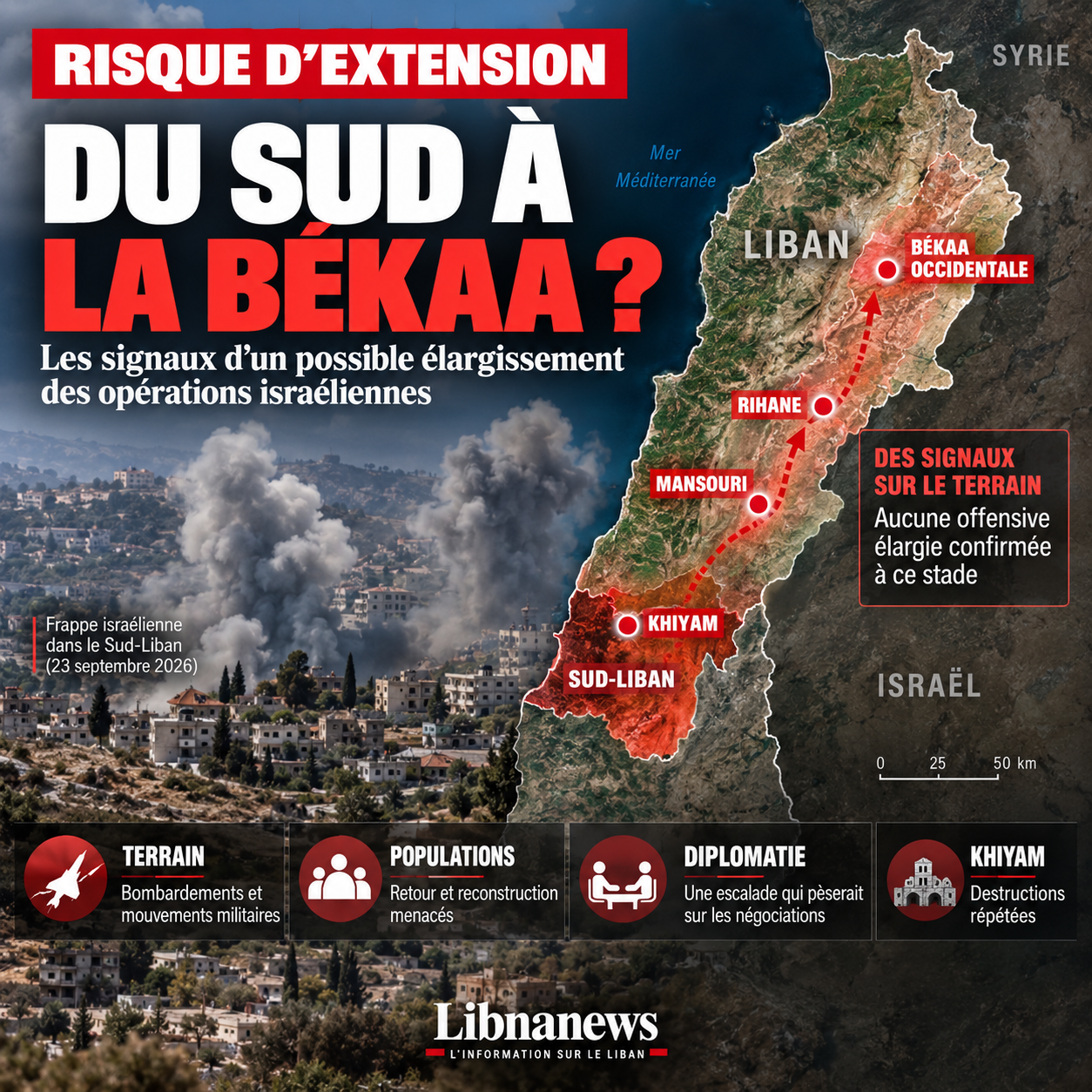
The continuation of Israeli operations in southern Lebanon raises a more worrying scenario than the repetition of the bombings and destructions observed in recent weeks. Sources of land indicate indices that could announce a geographical extension of operations to new sectors. Three areas are mentioned: Mansouri, Rihane and Western Bekaa.
At this stage, however, there is no information available to indicate that an expanded military operation has been decided. The sources themselves remain cautious. They refer to « indicators on the ground » and not to a plan whose timing or modalities they would know. A Western diplomat also believes that these signals should be followed carefully, while stressing that they do not constitute sufficient proof of the existence of an operation already scheduled.
This distinction is essential. Risk exists in the information collected, but cannot be presented as certainty.
The main reason for concern is the context in which this information appears. Israeli operations are no longer limited to one-off strikes against a single area. Artillery bombardments, airstrikes, destruction of buildings, tank movements and sweeping operations are followed in several sectors of the South. Their accumulation feeds the fear of a gradual change in the geography of operations.
On 23 September, Israeli aircraft struck the vicinity of Qantara towards Wadi al-Hujair. Artillery fire simultaneously targeted the Dawhat Kfar Rummane area. These operations are not sufficient to establish the existence of a larger offensive. However, they show that military pressure remains active while diplomatic negotiations have not yet produced lasting stabilization.
The question is no longer whether Israel will continue its operations. It now covers their perimeter.
Mansouri, Rihane and Western Bekaa at the centre of the questions
The mention of Mansouri, Rihane and Western Bekaa gives a particular dimension to the concerns expressed by the sources of land. It draws a much wider space than the border areas that usually focus attention.
However, the information available does not specify the nature of any extension or its timetable.
An extension can cover several realities. It can take the form of an increase in air strikes. It may involve more artillery fire, targeted raids or ground movements. It may also be a military pressure to change the conditions of negotiations without leading to a large-scale land operation.
None of these scenarios can currently be preferred solely on the basis of published information.
Caution is all the more necessary as such military information can evolve rapidly. Movements observed on the ground may include preparations, precautionary measures or a pressure strategy. They do not always determine the political intent that accompanies them.
The Western diplomat questioned on this subject insists precisely on this point. Indicators must be taken seriously, but they must not be turned into evidence of a decided operation. According to this reading, the real question now concerns the capacity of the diplomatic contacts currently under way to contain the escalation before the military situation creates new facts achieved.
This race between diplomacy and field becomes central.
An extension to new sectors would not only change the military situation. It would also complicate the return of the inhabitants, the deployment of the army and negotiations on the Israeli withdrawal.
From Qantara to Kfar Rummane, military pressure remains constant
The operations observed allow us to understand why these concerns are echoed.
The Qantara environment was targeted by Israeli aircraft towards Wadi al-Hujair. At the same time, artillery fire hit Dawhat Kfar Rummane. Other sectors also experienced operations during the same period.
The vicinity of Baraachit in Bint Jbeil District were bombed. The Ain al-Samahiyah area, between Zawtar al-Sharqiyah and Mayfadoun, sustained artillery fire. The area around the Scout City in Zawtar al-Sharqiyah was also affected.
Seven Merkava tanks were also reported in the Zawtar al-Sharqiyah neighbourhoods.
Wadi Zibqin was targeted by artillery. Automatic weapon-scanning operations were conducted towards Haddatha, Beit Yahoun and Aita al-Jabal.
Taken separately, these events do not demonstrate strategic change. Their concentration, however, shows that the South remains subject to sustained military activity.
The consequences go beyond the security dimension. Every bombardment delays the rehabilitation of infrastructure. Each military movement maintains uncertainty among the inhabitants who plan to return. Every new destruction also increases the cost of reconstruction.
It is this accumulation that makes the scenario of an extension particularly sensitive.
Khiyam, laboratory for a prolonged destruction policy
Khiyam occupies a particular place in this sequence. The city has experienced several destruction operations in the last few days. Cabins have been energized. A large explosion blast was heard in several villages in the Marjayoun region. Other similar destructions had already been reported.
Buildings west of Khiyam were also reportedly burned.
One explosion damaged power lines in the Nabaa al-Hamam area. Food was interrupted in several areas, including Hasbaya, Shebaa and Arkub.
This is an important element of the current situation. An operation in a locality can affect a much larger territory through electricity, water or transport networks.
Physical destruction therefore produces a second circle of consequences. Populations not directly in the area may lose access to essential services.
Khiyam also shows why the distinction between military operation and sustainable land transformation is becoming increasingly difficult. When the destruction affects homes and infrastructure repeatedly, its effect continues long after the bombing has ended.
For the Lebanese authorities, this situation poses a question directly related to the negotiations: how to stabilize a region when further damage continues to be recorded at the same time as it is being prepared to return to normal life?
The return of the inhabitants could be the first victim of an extension
A possible extension of operations would have an immediate effect on the return of populations.
The government is currently seeking funding to move from emergency aid to return and then reconstruction. Nawaf Salam defended in New York an approach in which these different stages must be conducted simultaneously. According to this logic, one must not wait for a final hypothetical end to the crisis to restore schools, water, electricity and livelihoods.
However, this strategy requires minimum security predictability.
It is difficult to rehabilitate a road when it risks being cut off again. It is equally difficult to restore a house or power grid when military operations continue in the vicinity.
An extension to new areas would increase this problem.
It could also cause further displacement. Residents who have already experienced several phases of departure and return would face new uncertainty. Municipalities should take on new needs while their capacity remains limited.
The problem would then become national. The economic and social consequences of a new wave of displacement would not remain confined to the South.
This dimension explains why the authorities constantly associate military stabilization with reconstruction.
The Lebanese Armed Forces facing the risk of a wider geographical front
The army is the other actor directly exposed to the consequences of an extension.
Its deployment to the South is central to the official strategy. The government wants to strengthen its presence and give it a growing role in the exercise of state authority. Its foreign partners are also calling for concrete results on the ground.
But the wider the area of instability, the more resources needed.
An extension to Mansouri, Rihane or Western Bekaa would require the military institution to simultaneously manage more sectors. It should ensure the safety of the inhabitants, monitor movements on the ground and accompany return operations in an expanded area.
This prospect comes at a time when the military command already insists on the importance of the cohesion of the units and their preparation.
General Rodolphe Haykal recently reminded the military that the protection of all Lebanese and the maintenance of stability remained at the heart of their mission. He also denounced attempts to weaken the morale of the institution through rumours and accusations.
These statements take on particular importance in the face of the possibility of a further extension of the theatre of operations.
The army would not only face a military problem. It should also manage the civilian consequences of an escalation: displacement, closed roads, damaged infrastructure and the return of residents.
The battle around the state presence
Tensions on the ground are not just about bombing. They also concern the authority which must organize daily life in sensitive areas.
An episode in Deir Mimas illustrates this dimension. A dispute concerned the access of Lebanese residents to their lands for olive harvest. The inhabitants had turned to the Lebanese army to accompany their movement.
The episode took on a range that far exceeds the agricultural harvest.
For Beirut, the army must be the contact point for citizens on Lebanese territory. This presence is one of the most concrete manifestations of state sovereignty.
Each restriction on this function becomes politically sensitive.
The Battle of the South is also played around apparently ordinary questions: who allows a farmer to join his field? Who secures a road? Who accompanies the inhabitants to their village? Who decides that an area is accessible?
These issues are of particular importance in areas affected by operations.
A geographical extension would necessarily multiply this type of friction.
The destruction of agricultural land adds another dimension to the crisis
Damage is not limited to buildings.
A judicial procedure initiated in France by a French businessman of Lebanese origin highlights the violations of agricultural land. The complainant claims that 600 olive trees belonging to his family were torn from Zawtar al-Sharqiyah. Some would have centuries.
He accuses the Israeli army of being responsible for these destructions. These are at this stage allegations made in a judicial proceeding, not a liability established by a final judgment.
The dossier nevertheless shows another consequence of the operations: the destruction of an agricultural heritage whose reconstruction may take several generations.
A building can be rebuilt. An electric line can be replaced. A centuries-old olive tree cannot be under the same conditions.
This agricultural dimension is particularly important in the South, where many families depend directly or indirectly on their land.
If the operations were to expand to new rural areas, the question of economic damage would therefore become more important.
Climbing the negotiations
The risk of extension appears at a time when diplomatic discussions remain fragile.
A new meeting between Lebanon and Israel is envisaged, but its timetable is not finally agreed. Washington is trying to maintain the channel of discussion. Beirut calls for concrete results on the withdrawal, security and situation of the people.
A military extension could alter this dynamic.
It would add new files to an already busy negotiation. Affected areas, destruction, displacement and military positions would become new subjects to be addressed.
It could, above all, weaken the argument that the negotiation gradually produces stabilization.
Conversely, diplomacy can still help prevent this scenario. That is precisely the meaning of the current consultations. Foreign interlocutors are asked whether the observed signals actually announce a new phase or whether they can still be contained.
The time factor is decisive.
The longer operations continue, the more new realities emerge on the ground. These realities then become additional elements of negotiation.
The scenario of an expanded operation remains a hypothesis, not an acquired fact
The available information finally requires two simultaneous readings.
The first command to take the reported signals seriously. Field sources explicitly refer to Mansouri, Rihane and Western Bekaa. At the same time, shelling and destruction continue in several sectors of the South. Tank movements and raking operations show that the situation remains active.
The second reading requires that we do not go beyond what is available.
No date is known. No operational plan is described. There is no evidence that a final decision on enlargement has been taken. Even sources reporting the risk do not present their information as evidence of an imminent offensive.
The real issue is therefore within this range.
Signals are serious enough to warrant increased vigilance. They are not precise enough to announce a new offensive.
For Lebanon, this uncertainty is already having far-reaching consequences. It hinders the return of the inhabitants, complicates reconstruction, increases the responsibilities of the army and makes it more urgent to find an international mechanism for the South.
Mansouri, Rihane and the Western Bekaa thus become less the site of an announced offensive than the names of a question now posed to diplomacy: will Israeli operations remain contained in their current geography, or is the ground preparing for a new phase of the conflict?