

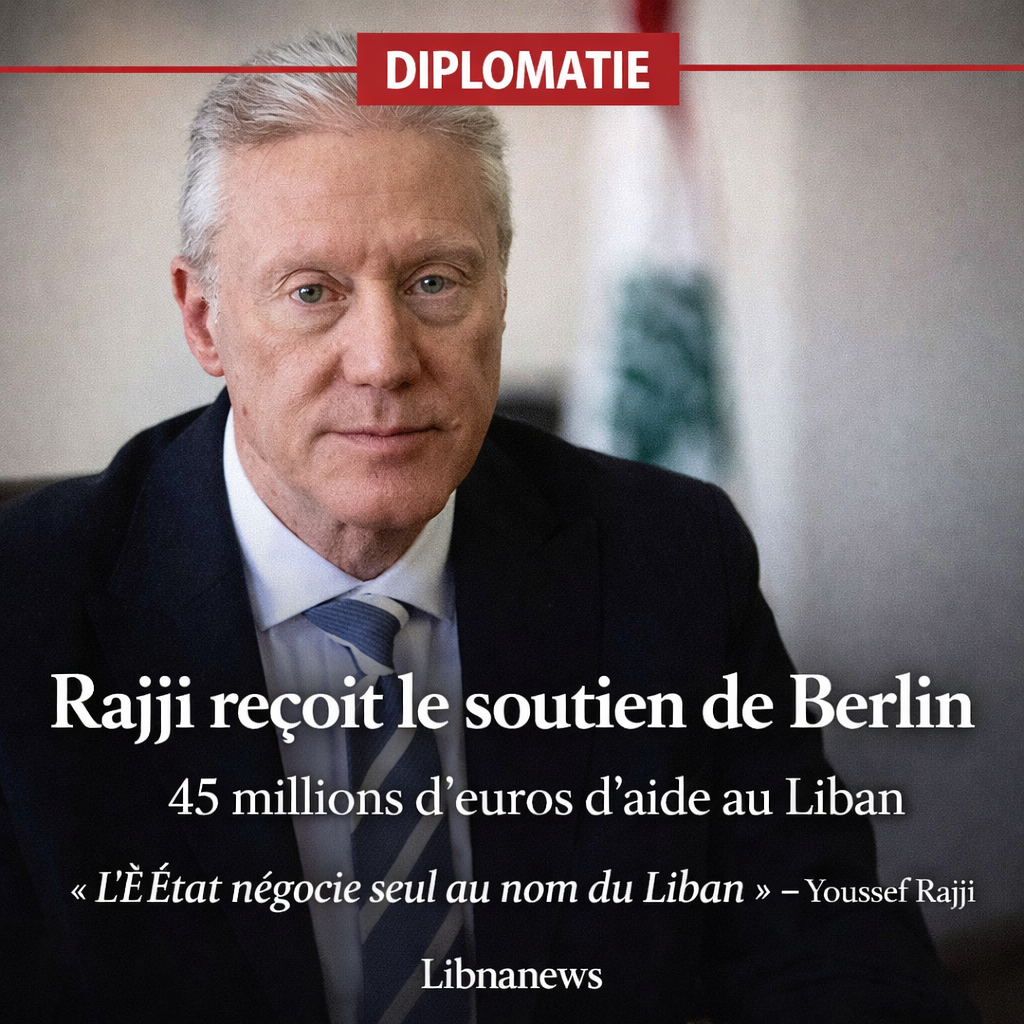
It is not the amount announced that gives its political significance to the interview between Youssef Rajji and Johann Wadephul. The €45 million promised by Berlin is a humanitarian emergency, but the sentence left behind by the Lebanese Foreign Minister is still weighing more on the diplomatic sequence of the moment. By saying that the use of direct negotiations with Israel « has effectively dedicated the separation between the Lebanese file and the Iranian file », Rajji set out the true centre of gravity of the exchange: to bring Lebanon out of the logic of regional aggregation which for a long time locked it in an indirect face-to-face between Tehran, Washington and Tel Aviv. The call from Berlin, relayed by the National Information Agency, is therefore not a mere aid announcement. It acts, in the vocabulary of Lebanese diplomacy, a more ambitious repositioning: treating the Lebanese front as a sovereign issue, with its own emergencies, its own temporality and a negotiating mandate claimed by the Lebanese State itself. According to the official report, the Head of German Diplomacy reiterated his support for the Lebanese government’s efforts to extend its sovereignty and stabilize the country, while indicating that Germany was working on a ceasefire and was releasing €45 million in humanitarian aid.
The choice of words is nothing ornamental. Since the resumption of the Israeli offensive in Lebanon after Hezbollah fired on 2 March, the regional debate has been constantly hesitant between two readings. The first makes Lebanon a mere extension of the Iranian front, thus a theatre dependent on the arm of war between Tehran and its opponents. On the contrary, the second seeks to detach the Lebanese file from this matrix, to place war, the ceasefire and negotiations within a specific Lebanese-Israeli framework. This is the second reading Rajji chose to publicly assume. Reuters reported on Monday that the minister had taken this idea almost word for word, explaining that opening up a direct negotiation route was tantamount to endorsing the separation between the Lebanese « file » and the Iranian trajectory. The signal targets the outside, but also the inside. Outside Beirut wants to convince mediators that there is a separate political space to discuss the ceasefire and security guarantees. Inside, the power tries to recall that diplomacy, such as the decision to war, can no longer come under competing channels or parallel decision-making centres.
Washington, next test
This telephone exchange with Berlin takes place on the eve of the meeting scheduled for Tuesday 14 April in Washington between the ambassadors of Lebanon and Israel in the United States, Nada Hamadeh Moawad and Yechiel Leiter, under the auspices of the American Ambassador to Lebanon, Michel Issa. Again, the novelty is not only due to the unique character of face-to-face. It is due to the confrontation between two agendas. On the Lebanese side, the mandate set out in recent days is narrow: to obtain a ceasefire, then only to consider the continuation. Reuters reported that Beirut was first looking for a temporary truce to allow wider discussions, in a format separate from the Iranian-American channel but inspired by the same logic of de-escalation. On the Israeli side, the discourse is radically different. Benjamin Netanyahu said he wanted to start « peace negotiations » with Lebanon as soon as possible, including the disarmament of Hezbollah and the establishment of peaceful relations. This discrepancy is not procedural in detail. She says that Lebanon comes to the table to stop the strikes, while Israel wants to use the table to redefine Lebanon’s strategic architecture without first suspending the war.
It is precisely for this reason that the German call has a particular dimension. Berlin was not content with a humanitarian message. According to the Lebanese official report, Johann Wadephul reaffirmed Germany’s support for the Government’s efforts to impose its sovereignty over the entire territory and to restore stability. This formulation, because it embraces one of the most sensitive aspects of Beirut’s current discourse: that of a state seeking to take over the issue of arms, war and negotiation. In the exchange reported by Beirut, no details are given on the sectoral breakdown of this €45 million envelope. But his position on the regional context is better known. On 8 April, at the press conference of the federal government, Berlin called on all actors to use the window opened by the Iranian-American truce to contribute to the de-escalation, while recognizing that interpretations diverged on the exact perimeter of this truce. The German Ministry of Foreign Affairs also indicated that Wadephul had pleaded with its Israeli counterpart that Israel should limit itself to what it considers its defence necessary, and not go beyond it.
Berlin, sovereignty and aid
This German shade illuminates the scope of the gesture announced in Beirut. Humanitarian aid does not address Western ambiguities or the margins left to Israel on Lebanese ground. But it points out that, from Berlin’s point of view, Lebanon is no longer merely a peripheral front observed through the relationship with Iran. It becomes a full file, combining humanitarian urgency, sovereignty and the search for a diplomatic outcome. In the present context, this shift is not insignificant. Since the announcement of the Washington-Theran truce on 8 April, contradictory statements have accumulated as to whether or not Lebanon should be included in regional de-escalation. Germany recognized the existence of divergent versions and called for a general de-escalation. The Lebanese power goes further: it claims that the opening of a direct channel with Israel effectively devotes a separation of tracks. In other words, Beirut no longer wants to depend on a hypothetical extension to Lebanon of an arrangement designed elsewhere. He wants to place his own negotiations within an autonomous framework, even if this framework remains under strong American supervision.
The problem is that this claimed autonomy is built under constraint. On the ground, Israeli operations are continuing. Reuters reported on Monday that Israel was pressing its offensive against Bint Jbeil on the eve of the Washington talks, while recalling that no ceasefire was on the Israeli side. The same article points out that in Beirut, however, the objective of direct trade remains to achieve a truce. The gap is considerable. It means that Lebanon is trying to build a negotiating channel separate from the Iranian case, but is doing so in an environment where the other party still refuses the very principle of suspension of hostilities as a prerequisite. This asymmetry reduces the flexibility of Lebanese diplomacy, while strengthening the political value of Rajji’s formula. To say that the Lebanese « route » is now distinct from the Iranian route does not mean announcing a diplomatic victory. This is, first of all, to assert a right to independent political existence, even as military reality continues to be imposed from outside.
A clean channel, but under duress
The sequence opened by the call with Berlin therefore has two intertwined dimensions. The first is immediate: €45 million in humanitarian aid represents concrete support for a population affected by strikes, displacement and the collapse of services. Reuters estimated that on Monday more than one million people had been displaced since 2 March, while the Lebanese authorities reported more than 2,000 deaths. In a country already exsangued, where the state struggles to absorb the shock and where the reconstruction of the residential sector is forecast to be dizzying, this aid is not marginal. It gives oxygen in the very short term. But the second dimension is more strategic. By explicitly linking aid, sovereignty and ceasefire, Berlin offers European political support to Beirut that goes beyond the register of assistance. In essence, Germany says that helping Lebanon is not just funding the emergency. It also recognizes the legitimacy of a government that wants to speak on behalf of the whole country, on a matter that other actors, regional or internal, often claimed to fit in with it.
This is where Rajji’s insistence on the state monopoly makes sense. In the minutes of the meeting, the Minister stressed that the Lebanese State alone had the decision to negotiate on behalf of Lebanon. Formally, the formula seems self-evident. Politically, it aims at an open wound to the Lebanese system: the existence of a politico-military force, Hezbollah, capable of bringing the country into a cycle of regional confrontation without the control of all institutions. By reaffirming that only the state negotiates, Rajji does not just send a message to Israel, Washington or Berlin. He also talks inside. It redrafts the dividing line between official diplomacy and regional front logics. At this moment, this line is essential. If Beirut wants to convince that a « Lebanese file » really exists, it must demonstrate that it is carried by a recognized, identifiable authority with a clear mandate. Otherwise, separation from the Iranian cadre would remain a slogan. With this sentence, the Lebanese government tries to make it a doctrine.
State, Hezbollah and Political Risk
However, this doctrine is not without risk. Detach Lebanon from the Iranian path can increase the readability of the case for Europeans and for some of the mediators. But it also exposes Beirut to a face-to-face with Israel and the US negotiating framework. This framework is far from neutral. Reuters reported that the Israeli embassy in Washington already presented the upcoming discussions as the beginning of formal « peace negotiations », while Lebanese Minister of Culture Ghassan Salamé explained on Sunday that the Lebanese representative was allowed to deal substantially with the ceasefire. The risk is clear: if Beirut wants to set up an autonomous Lebanese channel, it could be called upon to enter a much wider sequence, where the issue of halting strikes would be relegated to the issue of Hezbollah disarmament, border security or longer-term normalization. The autonomy of the Lebanese file can therefore be a lever. It can also become a trap if it is used to decouple Lebanon from Iran without guaranteeing it a better balance of power.
The role of Berlin is then read from a different angle. Germany is not the main mediator of this sequence. It does not hold the room, the calendar or the security guarantee sought by Beirut from the United States. But it can help consolidate a diplomatic environment where Lebanon does not appear only as a military appendix to the Iranian front. Its support for the sovereignty of the government, its call for de-escalation, its reminder to Israel of the proportion and limits of self-defence, and the announcement of substantial humanitarian aid converge in the same direction: to recognize a Lebanese State interlocutor and to give him a minimum of political space. This is not nothing at a time when the Lebanese internal divisions remain deep. Reuters again reported on Monday that Hezbollah and its ally Nabih Berri rejected the idea of negotiations with Israel before a ceasefire was reached, which shows that the channel opened by the government does not benefit from a national consensus. Again, the German call solves nothing. But it strengthens the camp of those who want to resettle diplomatic decisions in official institutions.
Humanitarian emergency and political emergency
Basically, the €45 million announcement and the sentence on the separation of tracks belong to the same scene. One responds to the material emergency, the other to the political emergency. Lebanon needs help to hold. He also needs a language that allows him to regain possession of his own file. This is what Rajji is trying to do when he says that direct negotiations with Israel have dedicated the separation of the Lebanese route from the Iranian route. The formula does not address the Israeli firepower, the American centrality, or the internal fractures of the country. But it says something very clear on the line that Beirut is now trying to impose: to negotiate to silence arms in Lebanon, on behalf of Lebanon, and not as a by-product of a regional equation defined elsewhere. The interview with Wadephul gives this line a partial European validation and a concrete translation in the form of help. The test will come to Washington on Tuesday: whether this distinct channel will remain a principle stated by Beirut or whether it will finally become a framework recognized by its interlocutors.




