

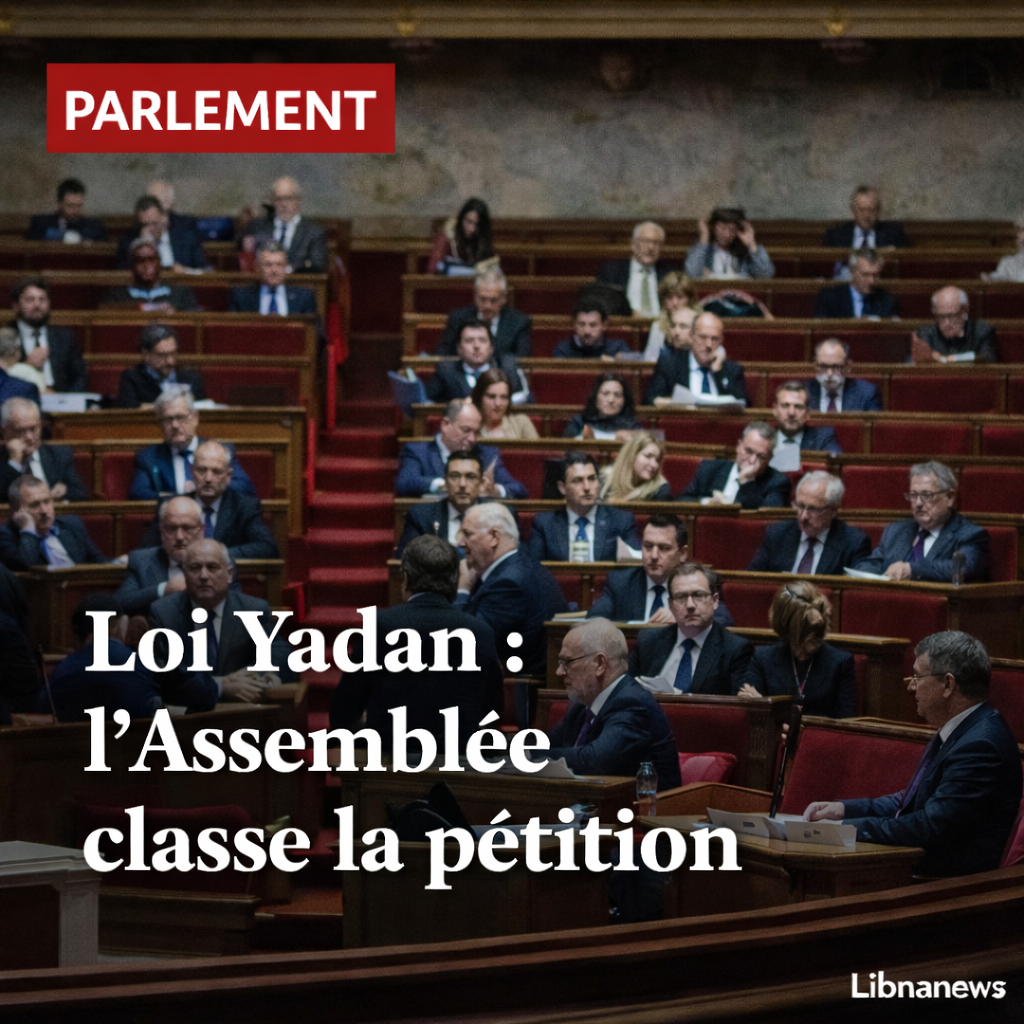
With 707,957 signatures recorded on the official platform of the National Assembly, the petition « No to the Yadan Law » had largely crossed the threshold that could pave the way for a debate in open session. However, on Wednesday, April 15, the Law Commission chose to classify it. By 30 votes to 21, MPs closed the door to a specific discussion on this citizen’s text, on the grounds that Caroline Yadan’s bill is due to be discussed on Thursday in the Chamber. The decision does not end the controversy. She’s moving it. For beyond the specific case of the Yadan law, the episode reveals a wider uneasiness about the place given to mass petitions in the parliamentary procedure, on the border between freedom of expression and the fight against anti-Semitism, and on the Assembly’s ability to absorb a civic challenge when it far exceeds militant circles.
A massive petition, a closed door
The first highlight is volume. The petition filed on 18 February on the National Assembly site reached 707,957 signatures before its closure, with a deadline of 15 April. The official platform now presents it as « classified by the commission » at the end of the meeting of the Law Commission on 15 April at 12:30 p.m. This level of mobilisation far exceeds the threshold of 500,000 signatures from which the Conference of Presidents may decide to hold a debate in open session, provided that the signatories are distributed in at least 30 departments or overseas communities. In strict law, this threshold does not therefore open an automatic right to debate. It creates a possibility. It is precisely this procedural nuance that served as the basis for the ranking decided on Wednesday.
The Law Commission ruled on only two options: to review or close the petition. She retained the second, by 30 votes to 21. The argument put forward by Members in favour of ranking is simple: the bill itself arrives in the Chamber on Thursday, after having been placed on the agenda of Thursday and Friday, with a solemn vote scheduled for 5 May. In this reading, a debate on the petition would duplicate the discussion of the text. Supporters of the ranking believe that a debate on a petition offers neither the same levers nor the same effects as a traditional legislative review, since it does not allow the text to be amended or voted on. The majority of committees therefore chose procedural coherence rather than political valorisation of citizen mobilization.
But the case is not limited to a formal dispute. Within weeks, the petition became a symptom. Its scope reflects first of all the very strong polarization triggered by the bill to combat the renewed forms of anti-Semitism. Secondly, it raised a delicate question before the Assembly: how to deal with a very large-scale digital mobilisation when the text is still under discussion and not already adopted. On this point, the comparison with the petition against the Duplomb law is illuminating. The February debate on the latter concerned a text already voted. Here, MEPs felt that opening a second space for discussion, in parallel with the examination of the text itself, would blur the procedure. The message is clear: the petition is recognized, recorded, made visible, but not necessarily translated into autonomous parliamentary time.
Why Yadan Law Concentrates So Much Tension
Caroline Yadan’s bill was introduced on 19 November 2024. The government initiated the accelerated procedure on this text on 23 January 2026. As a result of the commission, the mechanism envisages, inter alia, a strengthening of the repression of the offences of provocation and public decency of terrorism. It also includes an article creating an offence of public appeal for the destruction of a State recognized by the French Republic, inserted under the Act of 29 July 1881 on freedom of the press. In other words, the text deals with highly flammable matters: terrorism, public speech, anti-Zionism, freedom of expression, and the very definition of what constitutes a reinvented or renewed anti-Semitism.
It is this joint that nourishes the most vivid oppositions. Supporters of the text argue that the right must be adapted to more diffuse, sometimes coded, hate speech, sometimes formulated under the guise of anti-Zionism, and better protect victims in a context of rising anti-Semitic acts. The detractors fear a slippage: in their view, the bill risks maintaining a mix between Israel’s critics, anti-Zionism and anti-Semitism, with a deterrent effect on expressions of support for the Palestinian cause. The citizen’s petition against the law is also frontal, presenting the text as a threat to freedom of expression. The heart of the political conflict is there. It focuses less on the stated objective of combating anti-Semitism, which is widely shared, than on the legal instruments adopted and their concrete effects in the public debate.
This tension explains why the parliamentary battle far exceeds the single majority-opposition divide. Left-wing groups are calling for the text to be withdrawn from the agenda and denouncing a liberticide text. The Socialist Group, which had abstained during the examination in committee in January, announced its intention to vote against it at the sitting. More embarrassing for the government camp, MoDem indicated that it would not vote in favour of the proposal either. This misalignment weakens the trajectory of the text even before its arrival in the Chamber. It reveals a deeper political difficulty: on such a sensitive subject, the executive and the central bloc fail to maintain a united basis. Hence, the petition no longer appears merely as an external protest. It becomes the mirror of a fragility internal to the camp supposed to pass the law.
The right to petition affects parliamentary logic
The episode highlights the still little known functioning of the right of petition to the National Assembly. On the official platform, the rules are clear. A petition can be assigned to one of the eight standing committees. Over 100,000 signatures, it is gaining visibility. In addition to 500,000 signatures from at least 30 overseas departments or authorities, the Conference of Presidents may decide on a debate in open session. The verb is important: it « can ». It is neither a referendum of shared initiative nor a binding referral. The mechanism opens up a political space, but it does not remove control of its own agenda from the Assembly. This is the institutional interest of the mechanism. It is also its most visible democratic limit when the volume of signatures becomes massive.
In the case of the Yadan Law, this architecture produced a sharp gap between the wait for the crossing of the 500,000 signature threshold and the actual outcome of the proceedings. For many of the signatories, the course reached last week could be understood as the promise of a debate. Legally, this was only a necessary condition, not sufficient. Politically, ambiguity is formidable. The Assembly encourages participation, displays the meters, makes public the progress of the petition, and recalls, at the decisive moment, that the decision remains entirely parliamentary. From an institutional point of view, reasoning is defensible. From a civic point of view, he can nurture a sense of dispossession. This is all the more true as the petition against the Yadan law becomes one of the most signed in the recent history of the platform.
The closest precedent helps to understand the current frustration. In February 2026, the petition for the Duplomb Act had given rise to a debate in open session without a vote at its conclusion. This precedent was rooted in the public space that a very large petition could really force the assembly to take up a citizens’ challenge. The Yadan case shows that the precedent is not worth automating. The two files differ on a central point: the Duplomb petition took place after the passage of the contested text, while the petition against the Yadan law was telecopied with the parliamentary examination of the proposal itself. This overlap provided the main argument to the Law Commission to close the parenthesis opened by the dynamics of signatures.
A vote that reveals the fracture lines
The committee vote clarified the camps. Deputies from the central bloc and the National Rally voted for the ranking of the petition. Left-wing groups, joined by elected Liot according to several parliamentary reports, defended its consideration in the name of respect for the signatories and their substantive opposition to the bill. This geography of the vote says several things. Firstly, it shows that support for classification does not prejudge unanimous support for the text. It may be considered that a debate on the petition would be redundant, while being reserved or even hostile, on the bill itself. Then it reveals that the procedural battle does not wipe out the political battle. By classifying the petition, the committee did not pacify the case. She hardened it, giving her opponents a new motive for mobilization on the eve of the examination in session.
The malaise is particularly visible in the centre. The MoDem, the usual ally of the government, publicly stood out by announcing that it would not vote the text. This takes account of the fact that it takes place before the opening of debates in the Chamber. She pointed out that the argument of combating the renewed forms of anti-Semitism alone was not enough to win the support of all the partners of the majority. Several centrist elected officials consider the text to be poorly calibrated, legally risky or politically counterproductive. This float adds uncertainty to an already explosive sequence. It also opens the possibility of a scenario in which the bill would not be openly adopted or clearly buried, but gradually trapped by motions, amendments and saturation of the agenda. This last reading is still an analysis, but it is based on the political fractures already visible before the opening of the session.
On the left, the episode feeds an opposite story: that of an assembly that would refuse to hear an exceptional citizen mobilization because it is politically disturbing. Opponents of the text stressed the contrast between the number of signatures, the speed of mobilization and the short institutional treatment of the petition. Their argument is simple: when a text gathers more than 700,000 signatures against it on the official platform of the Assembly, the institution should seize this opportunity to open a real moment of public discussion, even if the legislative debate begins in the wake. This reading does not remove the Committee’s procedural arguments, but it gives the case a broader democratic dimension. The subject is no longer just the Yadan law. It becomes the way the Assembly prioritizes citizen expression in the face of its own routines.
The text comes down before the Chamber
On paper, the bill remains on the agenda of Thursday and Friday sessions, with a solemn vote announced on 5 May. In fact, its trajectory seems much more uncertain. Several parliamentary observers point to the risk of obstruction, the density of the agenda and the fragility of the political base supposed to carry the text. It’s not a detail. In the life of a bill, the solidity of the path counts as much as the content. Yet the Yadan law arrives in session in an unfavourable configuration: strong external contestation, public divisions within the center, declared opposition of the left, and permanent semantic battle on the real scope of the text. To this is now added a procedural episode that put the case at the forefront of the media at the worst moment for its defenders. The frailties mentioned here are partly a matter of analysis, but they are based on an official timetable and already public positions.
The sequence is all the more sensitive as the Assembly does not debate here a technical subject with low resonance. She debated a text that touched on anti-Semitism, anti-Zionism, political speech and the limits of militant expression. So every word is politically overloaded. Each provision is read through a wider conflict over Gaza, the polarization of public debate and the French difficulty in articulating the fight against hate speech and the protection of freedoms. In such a climate, the ranking of the petition cannot be received as a mere agenda operation. It is interpreted, according to the camps, either as a parliamentary measure or as a lockdown. And this divergence of interpretation already weighs on future debates.
A procedural victory, a political risk
For the defenders of the ranking, the decision of 15 April protects the coherence of parliamentary work. In their view, it avoids organising a parallel debate, while the real debate, which allows for amendments, confrontation of the groups and the final vote, begins the following day. This argument is not negligible. It recalls that a Parliament cannot function only by accumulating symbolic sequences. It must also maintain a hierarchy of procedures. But institutional rationality is not always enough to contain the political effects of a choice. In this case, the Law Commission may have gained in coherence what it may lose in perceived legitimacy among some of the opinion mobilized.
The difficulty is further accentuated by the very nature of the text. A law intended to better combat anti-Semitism should, in the minds of its promoters, appear as a consensual bulwark against hatred. However, the public debate was structured in the opposite way: around the risks to freedom of expression, the effects of potential censorship and the suspicion of amalgamation between anti-Zionism and anti-Semitism. By refusing to grant an autonomous space to a petition of more than 700,000 signatures, the Assembly does not silence this controversy. She adds an institutional layer. The opponents of the text now have an additional argument: not only would the law be misconceived, but the institution would refuse to hear massively those who contest it.
Finally, there remains a more underground but decisive data: trust in the participatory promise. Petition platforms create a translation expectation. They give the feeling that a digital mobilisation, when it reaches a critical mass, must produce a visible effect in representative deliberation. When this effect does not occur, or when it is neutralised by agenda considerations, there is a risk of fuelling the idea that participation is tolerated as long as it does not disturb parliamentary order. The Yadan case does not close this debate. It opens up more widely, at a time when the Assembly is seeking to improve its right to petition. On Wednesday, the Law Committee closed a text. Perhaps, at the same time, it has revived a more embarrassing question: what is a threshold of 500,000 signatures politically worth when a majority can still decide that it does not deserve clean space?




