

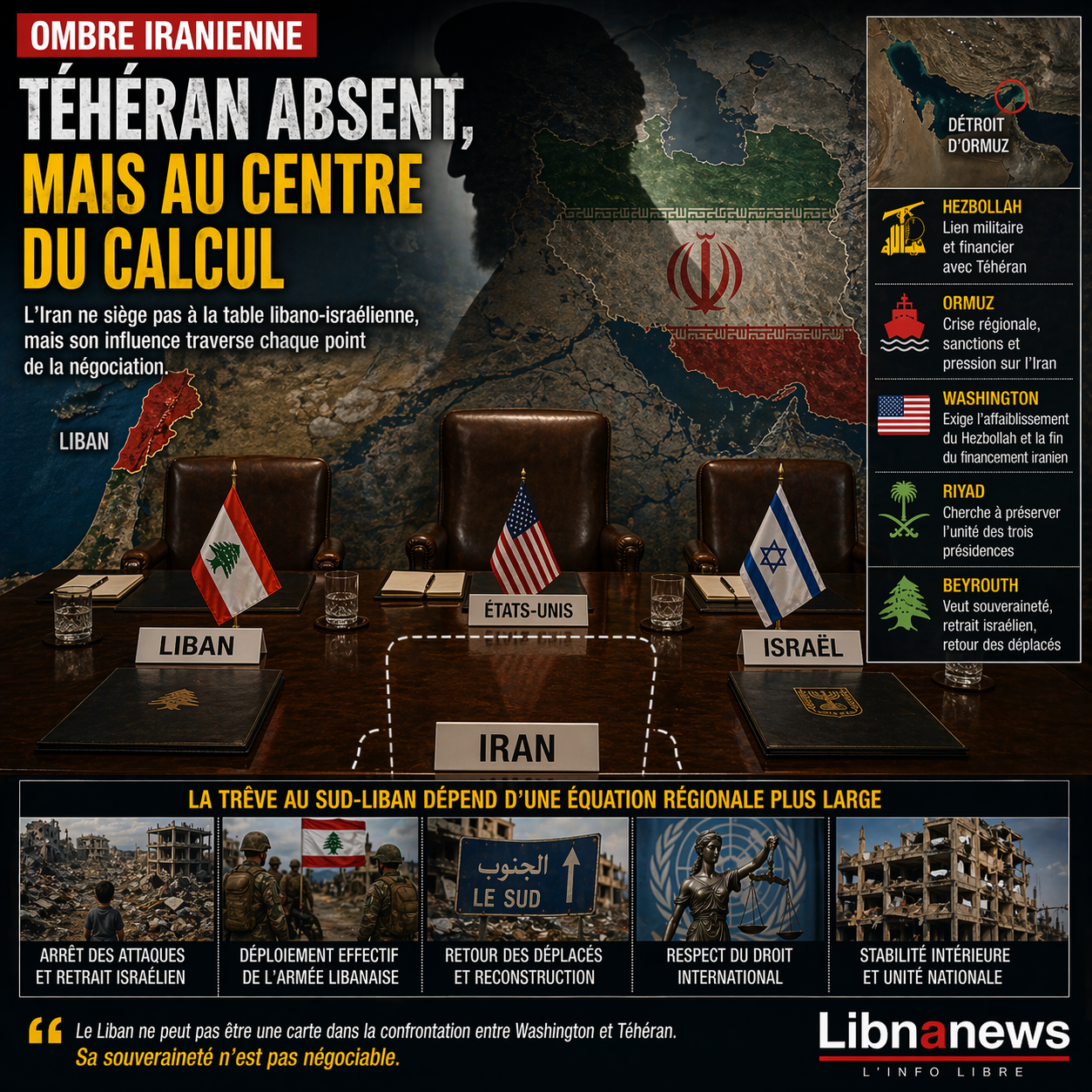
Iran is not represented at the Lebanese-Israeli table opened under American sponsorship. Yet its weight crosses every point of the negotiation. It appears in Washington’s words on Hezbollah, in pressure on Beirut, in Israeli calculus, in Saudi action, in the crisis in the Strait of Ormuz and in fear of regional burning. The Lebanese issue is officially discussed between Lebanon, Israel and the United States. But it remains framed by a broader equation: the confrontation between Washington and Tehran.
One absent from discussion center
The Washington meeting is officially about the ceasefire between Lebanon and Israel. Lebanon calls for the cessation of attacks, Israeli withdrawal, return of displaced persons, protection of civilians and respect for its sovereignty. Israel is seeking security assurances. The United States wants to turn the truce into a rapid political process. In this architecture, Iran has no seat.
Yet Washington brought the case back to Hezbollah from the very first statements. The US administration links the future of the truce to the ability of the Lebanese state to protect itself from the Shiite party. She also asked Tehran to cut its funding. This formulation moves the centre of gravity. The subject is no longer just the southern border. It becomes the relationship between the Lebanese state, Hezbollah and Iran.
This slip is essential. It shows that the United States does not see truce as a simple Lebanese-Israeli question. They see it as a piece of regional pressure against Tehran. Lebanon thus becomes a space where two agendas cross. The first is national: protect the territory, stabilize the South and allow the return of the inhabitants. The second is regional: reducing Iranian influence and limiting Hezbollah’s margin.
Hezbollah as a junction point
Hezbollah is the main reason Iran weighs on the table. The party, now led by Naim Kassem, remains at the heart of Israeli and American calculations. For Israel, any truce must reduce the military threat to the north. For Washington, any stabilization must strengthen the Lebanese state at the expense of the Tehran-supported axis. For Beirut, the subject is more complex. It affects the army, sovereignty, internal balances and the risk of political civil war.
The government of Nawaf Salam is trying to put the issue within a state framework. The Prime Minister claims that the removal of weapons from public authority is of Lebanese interest. It links this direction to the strengthening of the Lebanese army. This formulation avoids frontal shock. She says the goal is the state, not the internal confrontation. It also tries to meet external expectations without opening an immediate national crisis.
But this caution does not remove the problem. Any discussion on Hezbollah refers to Iran. Any pressure on weapons refers to regional balances. Any U.S. request to cut off funding goes back to Tehran. Lebanon therefore finds itself having to deal with an internal subject that also depends on external power relations.
Washington uses Lebanon in its pressure on Tehran
The American strategy is not limited to truce. It is part of a series of confrontations with Iran. The maritime blockade, tensions around the Strait of Ormuz, financial measures and sanctions against Hezbollah-related networks form the same environment. Washington seeks to reduce the resources of Tehran and its allies. Lebanon is entering into this logic.
The United States sanctions have for several years been aimed at financial channels attributed to Hezbollah, including networks linked to the transfer of funds, informal exchange, gold, commercial products and Iranian oil. This approach shows that party funding is not only treated as a Lebanese case. It is seen as an extension of Iranian regional policy.
In this context, the ceasefire becomes a lever. Washington can say in Beirut: stability depends on your ability to contain Hezbollah. He can tell Tehran that Lebanon will be part of the cost of your regional influence. He can tell Israel: American mediation does not neglect your request for security. This triple address places Lebanon in a difficult position. The country needs American mediation, but it does not want to become a tool in a confrontation that goes beyond it.
Israel seeks to link withdrawal and guarantees against the Iranian axis
Israel should present the Lebanese front as an extension of the Iranian file. This reading allows him to say that the main problem is not only territorial, but strategic. The withdrawal of the occupied areas, the cessation of the strikes and the end of the destruction then become conditioned by guarantees on Hezbollah. The debate is moving. Lebanon speaks of sovereignty. Israel speaks of security against the Iranian axis.
This move is dangerous for Beirut. He can delay the Israeli withdrawal. It can also turn every Lebanese demand into an arms debate. The risk is that destroyed villages, internally displaced persons, killed civilians, targeted journalists and damaged agricultural land will become a secondary issue. Israeli security then became the key to the process, while Lebanese security had yet to be demonstrated.
Lebanon must therefore reject this reversal. The question of state and weapons exists. She can’t be denied. But it cannot be used to justify occupation, attacks or a de facto buffer zone. Israeli withdrawal and the protection of civilians must remain immediate demands. The debate on the security architecture must come in a context where the Lebanese State is strengthened, not humiliated.
Riyadh tries to contain the Iranian effect
Saudi Arabia intervenes in this sequence to prevent Lebanon from being drawn solely by American and Israeli logic. Yazid bin Farhan’s visit to Beirut and Faisal bin Farhan’s contacts with Nabih Berri aim to bring the three presidencies closer together. Riyadh seeks to preserve the Lebanese institutional unity as Washington accelerates.
The Iranian dimension is not absent from this approach. Riyadh knows the weight of Tehran in the Lebanese case. The kingdom seeks to avoid an internal rupture that would further pave the way for external influences. It also wants to prevent the American process from being seen as an attempt to impose a solution without Arab coverage on Lebanon.
The reminder of the Taif agreement plays a specific role here. Taif serves as a framework for Lebanese stability and for Lebanon’s Arab relationship. It allows us to say that any evolution must go through the institutions. It also offers a common language between the three Presidencies. In the face of the Iranian shadow, Riyadh tries to strengthen the state rather than open a direct confrontation.
Tehran acts through the regional context
Iran also weighs in the regional climate. The Ormuz crisis, the maritime blockade, American threats and Pakistani mediation between Washington and Tehran form the background of the Lebanese truce. If tensions rise in the Gulf, South Lebanon becomes more vulnerable. If a de-escalation occurs, the truce can gain a margin.
This link makes the Lebanese file unstable. The Washington table can move forward one day and block the next due to a maritime incident, a strike, a sanction or Iranian refusal to resume discussions. Beirut does not control this variable. He suffered part of the power ratio between the United States and Iran.
This dependence is one of the great dangers of the sequence. Lebanon is negotiating for its territory, but the pace of the crisis can be set elsewhere. The Strait of Ormuz, Iranian oil revenues, United States sanctions and Tehran calculations can influence the fate of Lebanese villages hundreds of kilometres away.
The risk of regional bargaining
The great Lebanese fear is to be integrated into regional bargaining. If Washington and Tehran are looking for an exit from the crisis, Lebanon could become a map among others. Relax on Ormuz could reduce pressure in the South. Conversely, an escalation could push each camp to harden its position. The country would then be exposed without having decided on the main issue.
This risk requires Beirut to clarify its mandate. Lebanon should not negotiate as an annex to the Iranian crisis. He must speak from his own interests: sovereignty, withdrawal, return of inhabitants, protection of civilians, role of the army and reconstruction. These points must remain non-negotiable, regardless of the climate between Washington and Tehran.
This does not mean that Lebanon can ignore Iran. Rather, it must incorporate this reality into its calculation. But integration does not mean submission. Lebanese diplomacy must use regional contradictions to obtain guarantees, without accepting that its territory serves as an adjustment variable.
The Lebanese Army at the heart of the response
Strengthening the Lebanese army is the only institutional response that can reduce the space left to outside actors. The more the army is present, equipped and supported, the more the state can claim its sovereignty. The weaker the state, the more the debate on Hezbollah and Iran dominate the table.
The deployment of the army in the South, however, cannot be a slogan. It involves Israeli withdrawal, verifiable truce, logistical support, coordination with international forces and internal political coverage. The army cannot be sent to an area where the attacks continue without real guarantees.
Resolution 1701 remains the best known framework for this architecture. It links the stabilization of the South to the role of the Lebanese Army and the United Nations Interim Force in Lebanon. But implementation remains fragile. First, it depends on the will of the parties and the ability of the Lebanese State to exercise its authority.
Joseph Aoun facing a regional equation
Joseph Aoun must defend the Lebanese position in a scene where interlocutors often talk about something else. Washington talks about Iran and Hezbollah. Israel is talking about security. Riyadh talks about institutional stability. Tehran weighs by its ties and by the regional context. The Lebanese President must bring the discussion back to the national mandate.
That mandate must be clear. It must include stopping attacks, Israeli withdrawal, the return of displaced persons, the protection of journalists and rescue workers, the deployment of the army and respect for the blue line. It must also refuse any required buffer zone. These elements allow Lebanese sovereignty to be placed at the centre.
The difficulty is not to ignore Hezbollah without allowing the file to be reduced to Hezbollah. Lebanon must talk about the state. He must be talking about the army. He needs to talk about civilians. He has to talk about reconstruction. Thus it can prevent Iran from being the only prism through which others read the crisis.
Nawaf Salam and the language of law
Nawaf Salam has another tool: international law. The approaches to international forums, the discussions on war crimes and possible recourses give Lebanon a different scene than that of the balance of power. This legal ground can help to rebalance the discussion.
The law makes it possible to talk about civilians, journalists, rescue workers, destroyed villages and weapons used. He has to document. It imposes criteria. It gives Lebanon a language that is neither that of the Iranian axis, nor that of Israeli security, nor that of American pressure. He’s the one with protection.
This is not a substitute for negotiation. She completes it. It can also prevent the Lebanese file from being absorbed by the Hezbollah question alone. By bringing the violations before competent bodies, Beirut recalls that the conflict first affects people and territory.
Why Iran doesn’t need to be present
Iran does not need to sit at the table to weigh. It weighs by Hezbollah. It weighs with American sanctions. He weighs by Ormuz. It weighs by Israel’s calculations. It weighs on Saudi concerns. It weighs by the possibility of de-escalation or regional escalation. This indirect presence is more difficult to deal with than an official presence.
If Iran were at the table, its positions could be formulated, challenged and negotiated. In his absence, his influence passes through actors, signals and power relations. This makes the discussion more opaque. The United States is talking about Tehran without Tehran. Israel acts according to the Iranian axis. Lebanon suffers the consequences without controlling the main variable.
That is why Lebanese diplomacy must avoid two mistakes. The first would be to deny the Iranian role. The second would be to accept that this role erases Lebanese demands. The country must recognize regional reality, while defending an independent national position.
A Lebanese table under Iranian shadow
The three-week truce will not be judged only in Washington. She will also be tried in Tehran, Riyadh, Tel Aviv, the Gulf and southern villages. This multiplicity explains the fragility of the process. Lebanon is entering a phase where each actor pursues a different goal.
Washington wants a quick success. Israel wants security assurances. Riyadh wants to avoid institutional collapse. Tehran wants to preserve its regional levers. Beirut wants to regain its sovereignty and protect its inhabitants. These objectives may intersect. They can also contradict each other.
The only way for Lebanon not to be absorbed by the American-Iranian confrontation is to strengthen its national mandate. The Washington table can be useful if it produces concrete guarantees. It will become dangerous if it transforms Lebanon into a secondary field of a larger iron arm. Iran is not sitting at the table. But all the negotiations are already under his shadow.




