

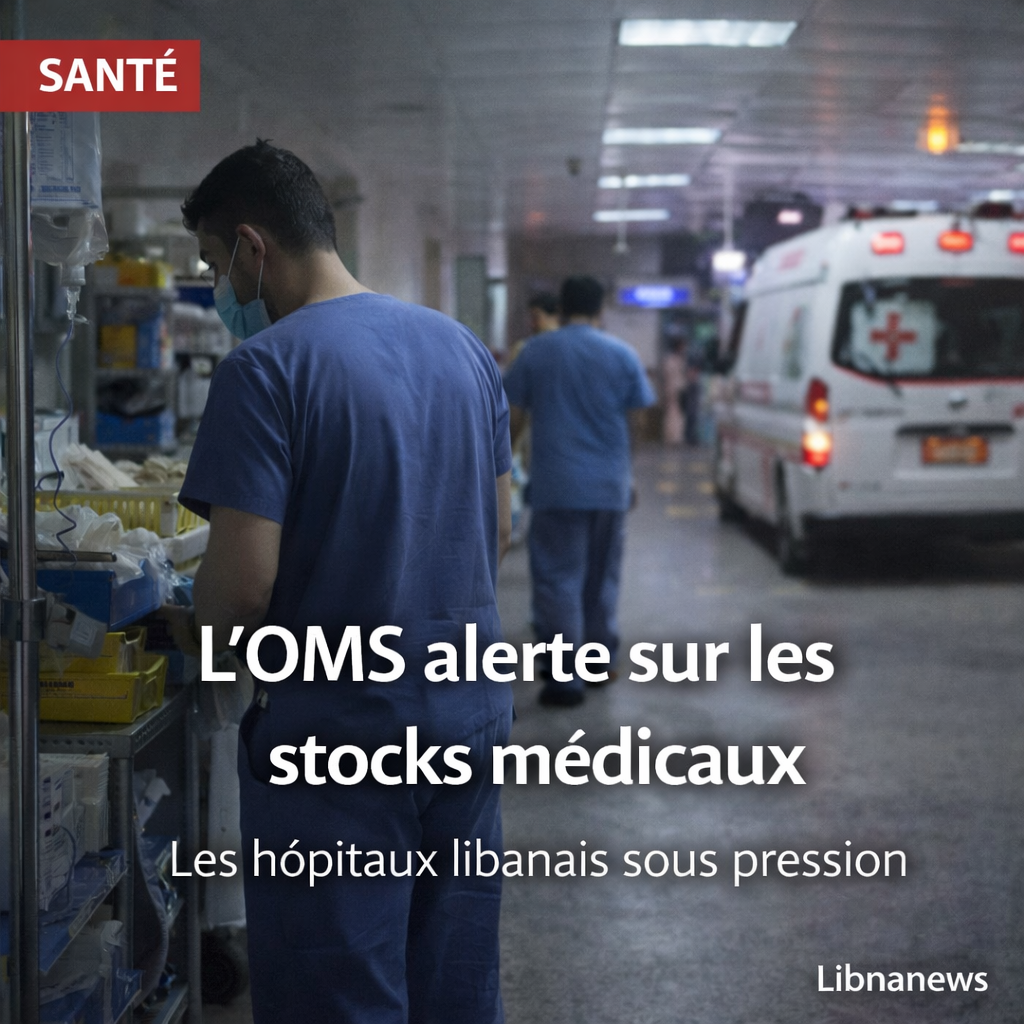
The World Health Organization warns against a new phase of tension in Lebanese hospitals. On its official channels, the institution explains that the health system continues to operate despite the war, but that it is under increasing pressure from strikes, displacements and attacks on health structures. At the WHO site, I did not find the phrase quoted on a risk of rupture « in the next few days ». On the other hand, I have found several official documents of the institution that clearly state that critical stocks must be replenished urgently to avoid shortages and interruptions of care in Lebanon.
The most explicit document is theUpdate 17published by the WHO Lebanon Office of the7 April 2026. In this note, the organisation explains that hospitals are under high pressure, that some public structures have seen their occupancy rate rise up to95%, and that « urgent secure and responsive critical stocks to prevent shortages and disorders in treatmentThis means securing and urgently rebuilding critical stocks to avoid shortages and interruptions in treatment. The same report states that six hospitals have closed, twelve have suffered partial damage, and 51 primary care centres are closed, further increasing the pressure on the remaining facilities.
On the main WHO site, another publication dated3 April 2026Go in the same direction. The institution writes that the Lebanese health system still works, but that access to essential services is « increasedly at riskWithout urgent action or sustainable international support. It also recalls that a convoy offour truckssupplies arrived on1 Apriltraumatic surgery equipment and specialized medicines, according to WHO, sufficient to support50,000 patientsof which:40,000 surgical procedures. The same text points out that since2 March 2026,92 attacks on health carewere reported in Lebanon, causing53 deathsand137 injured.
The other important element found at the WHO site concerns essential drugs other than traumatology. In the situation note of 7 April, the organisation states that75 %the essential list of primary care drugs remained available with morethree monthsstock cover3 April. But she immediately added that demand had to increase further because of more than one million displaced persons and the continuing impact of war and the economic crisis on vulnerable patients, especially those suffering from chronic diseases. This means that, even if not all drugs are on the verge of immediate rupture, WHO considers that the care chain is under pressure and that some critical reserves must be restored quickly.
In the state, therefore, the wording closest to the one you quote does not appear as it is in the official WHO pages that I was able to find. The institutional message is clear: Lebanese hospitals are overloaded, attacks on health structures are increasing, capacity is shrinking, and the organization is calling for an urgent resupply of critical stocks to avoid disruptions. It is this alert, already well present in the official documents of the WHO, which was then repeated and hardened in other media accounts.




