

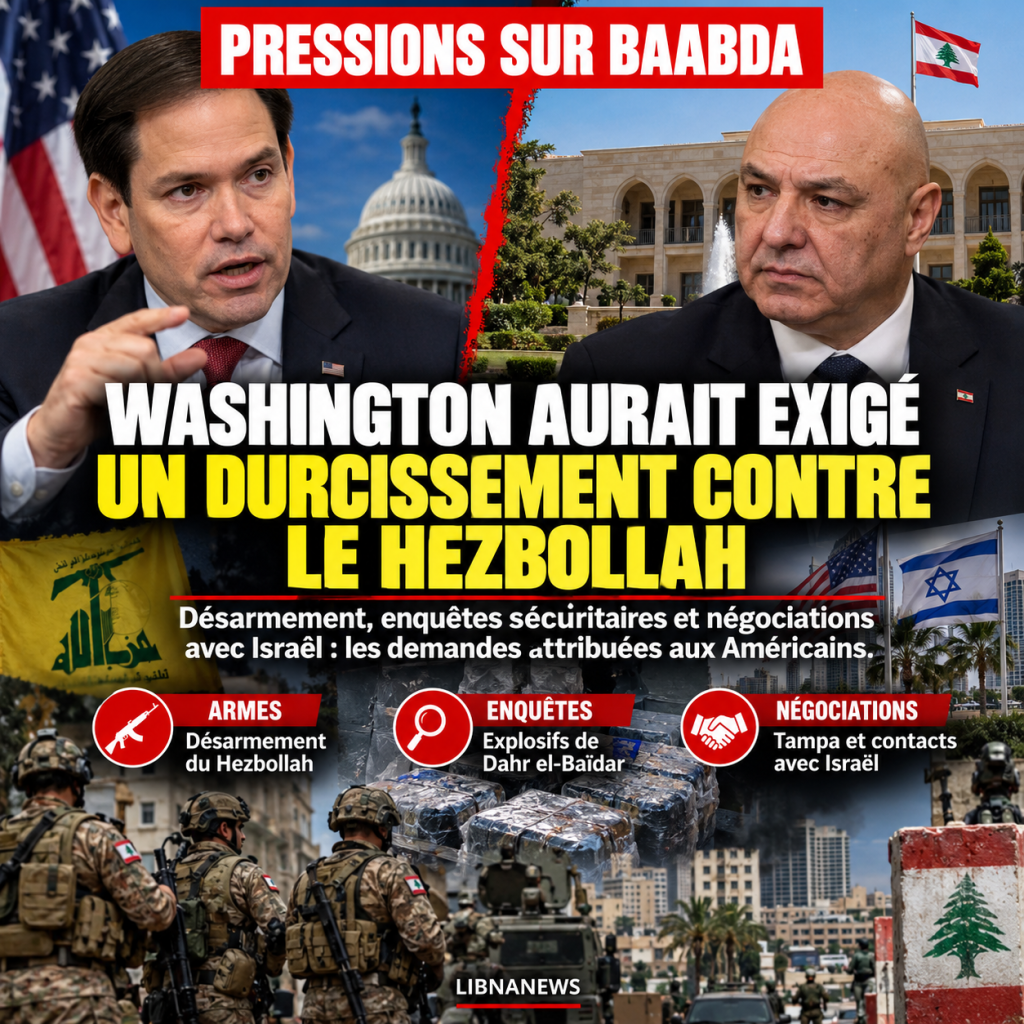
The US pressure on the Lebanese authorities is said to have reached a new stage on the eve of the Tampa military negotiations scheduled for 20 October 2026. A telephone interview between US Secretary of State Marco Rubio and President Joseph Aoun reportedly focused on several security requirements. These would include investigations into Hezbollah, continued operations against its military networks and the establishment of new coordination mechanisms with Israel. At the same time, the arrival in Beirut of a United States intelligence officer reportedly led to representations to several Lebanese officials. This information, reported by journalistic sources, draws a context of strong tensions. However, they do not allow for independent confirmation of all applications awarded in Washington.
An interview between Marco Rubio and Joseph Aoun at the heart of the tensions
U.S. Secretary of State Marco Rubio reportedly personally asked President Joseph Aoun to speed up measures against Hezbollah. According to the information reported on 20 October 2026, this telephone interview covered several sensitive security issues. In particular, Washington would like to obtain concrete results in investigations into the movement’s military activities. The case of explosives intercepted in Dahr al-Baydar was said to have occupied an important place in this conversation. The United States authorities would seek information on the persons involved and possible responsibilities of Hezbollah executives. These demands would be part of a broader strategy to strengthen the authority of the Lebanese State on military and security matters.
According to the available account, Rubio also expressed his astonishment at the lack of precise information on certain financial flows attributed to Hezbollah. The US official reportedly mentioned significant sums that would have joined the movement’s circuits. However, these amounts are based on estimates whose calculation methods are not detailed. It is therefore impossible to determine precisely their origin or destination. Nevertheless, the Secretary of State reportedly requested the Lebanese authorities to strengthen their investigations. This approach would involve financial networks, but also military activities that could be counterproductive to government decisions. The American pressure would thus focus on several dimensions of the functioning of Hezbollah, beyond the question of its weapons alone.
Lebanese participation in the Tampa negotiations would have been another central point of the interview. Rubio reportedly warned Joseph Aoun of the consequences of the possible absence of the Lebanese delegation. The United States wishes to maintain the process with Israel, despite the continuing differences between the two sides. According to the reports, Washington would see these negotiations as an indispensable tool for imposing new security provisions. The Secretary of State would therefore have insisted on the need to continue discussions. However, the exact content of its warnings is not fully documented. The information available makes it possible to identify an alleged diplomatic pressure, but not to fully reconstitute the conversation between the two officials.
Dahr al-Baydar’s case becomes a diplomatic issue
Interception of a shipment of explosives in Dahr al-Baydar has led to a series of political and security tensions. The information published on 20 October presents this case as one of the main elements of the disagreement between the authorities and Hezbollah. The investigations initiated after the discovery reportedly led Lebanese officials to examine the circumstances of the transport and the persons likely to have participated in it. The case would also have attracted the attention of the US authorities. Washington would like investigations to identify responsibilities beyond those directly involved in transport. This presumed requirement raises an important question: how far can the judicial and security authorities continue their investigations without causing confrontation with the movement concerned?
The information available indicates that the Lebanese authorities have requested the competent authorities to expand the investigations. Judicial measures were reportedly envisaged, inter alia, to find persons involved in the transport of explosives. However, the documents do not establish the criminal liability of particular officials. The existence of an investigation is not evidence of guilt. Similarly, political statements surrounding the case must be distinguished from judicial findings. This distinction is essential in a case where partisan tensions can influence the presentation of facts. The charges concerning Hezbollah cannot replace the results of judicial proceedings. The competent authorities shall remain responsible for determining possible responsibilities.
However, the case went beyond ordinary criminal investigations. It intervenes as the government of Nawaf Salam seeks to strengthen state control over weapons and military activities. Hezbollah challenges several decisions regarding its weapons. Its officials consider that resistance retains an essential role in defending the territory against Israel. On the other hand, government authorities affirm their willingness to enforce laws and preserve institutional authority. This divergence places the security forces in a difficult situation. They must execute legal decisions while avoiding incidents that could cause confrontation. The investigation of explosives thus appears to be a particularly sensitive issue in the relations between power and movement.
US intelligence officer reportedly increased contacts in Beirut
One of the most sensitive aspects of published information is the approach attributed to US intelligence services. A new head of the local US Central Intelligence Agency station reportedly arrived in Beirut after performing duties in Israel. According to the reports, this official, known as Austin, met several Lebanese interlocutors. These exchanges reportedly covered security operations and the measures expected against Hezbollah. However, the information available does not allow for independent confirmation of the exact identity of the person in charge, the full schedule of his meetings or the content of each of his interventions. Claims concerning its role should therefore be considered as information attributed to journalistic sources.
According to the same information, the United States official accused the Lebanese authorities of being cautious about Hezbollah. In particular, he asked his interlocutors why they were reluctant to engage in operations that could lead to internal confrontation. His comments suggest a more coercive approach than that formally advocated by the Lebanese authorities. However, no transcript of these exchanges is available in the documents. It would therefore be excessive to infer the existence of an American decision to provoke a civil war. The information can only be used to establish that a publication assigns this person particularly firm requests. The difference between these two levels of certainty remains critical to understanding the scope of the file.
The alleged requests included the search for Hezbollah officials involved in the transport of weapons. They were also reported to have involved the identification of depots and facilities that could house military equipment. The United States authorities would like the Lebanese forces to strengthen their operations in several regions. The southern suburbs of Beirut, Bekaa and the South are among the areas mentioned in the available information. However, the documents do not indicate that a detailed operational programme has been adopted. Nor do they demonstrate that specific transactions would have been directly ordered by the US services. Institutional responsibilities remain distinct: decisions concerning the army and the security forces are the responsibility of the Lebanese authorities.
Joseph Aoun orders a strengthening of internal security
The security meeting chaired by Joseph Aoun at Baabda Palace, on the other hand, is an officially documented event. The Head of State brought together key military and security officials to discuss the internal situation. The army commander, General Rodolphe Haykal, was among the participants. Officials from the Internal Security Forces, General Security, State Security and Intelligence were also present. This meeting takes place in a climate marked by several incidents and growing concern about the stability of the country. In particular, the authorities have examined the necessary measures to prevent disturbances and to strengthen coordination between institutions.
Joseph Aoun called for stricter enforcement. He stressed the need to prevent armed demonstrations and confiscate illegal weapons and ammunition. It also called for an acceleration of investigations and the transmission of cases to the competent courts. The President stressed the importance of preventive measures and continuous exchange of information between services. It wishes to avoid overlapping skills and to increase the effectiveness of interventions. These guidelines cover all Lebanese territory. These include areas where recent incidents have caused tensions. The decisions announced are formally part of a policy of maintaining law and order and protecting citizens.
The Head of State also called for a stronger security presence in the southern villages not occupied by Israel. This measure should help to reassure residents and facilitate their access to administrative services. It reflects a desire to strengthen the role of institutions in areas affected by military operations. However, there is no formal evidence in the documents that Baabda’s decisions constitute a direct response to Marco Rubio’s requests. Their chronological proximity may raise questions. It is not sufficient to demonstrate a causal link. The distinction between officially announced Lebanese decisions and reported US pressures therefore remains essential.
Hezbollah warns authorities of the risks of confrontation
Hezbollah’s reactions reflect the seriousness of internal tensions. Several leaders of the movement have denounced the measures they consider directed against resistance. In particular, the president of the parliamentary bloc of Resistance Loyalty, Mohammad Raad, defended Hezbollah’s military role. He claimed that resistance was, in his view, a necessary choice for national defence. He also criticized the statements questioning his legitimacy. These positions are taking place as the government continues its efforts to strengthen the state’s arms monopoly. The disagreement therefore concerns both the security decisions and the definition of the military role of Hezbollah in the Lebanese institutional system.
According to reports, the movement also issued warnings to military and security officials. He reportedly indicated that certain actions against his facilities could be considered hostile acts. Such warnings would include operations that could involve forced entry into buildings or the arrest of movement officials. The available information does not confirm the full content of these messages. However, they show that the risk of incidents between the security forces and Hezbollah members is a major concern. The authorities must therefore reconcile the application of judicial decisions with the prevention of confrontation.
The situation is all the more sensitive as Hezbollah remains represented in political institutions. His ministers participated in the government of Nawaf Salam, despite disagreements over several security decisions. This institutional presence complicates any reading simply between the state and the movement. Hezbollah challenges certain government policies while retaining participation in the executive branch. For their part, the authorities must enforce the laws without turning every intervention into a political confrontation. This situation explains repeated calls for restraint and coordination. It also highlights the difficulties faced by the army when a security operation concerns an organisation with a significant political and social representation.
Army seeks to prevent a deterioration of the situation
The information gathered from military sources presents an approach focused on preserving internal stability. The army has reportedly stepped up its intervention in several areas following recent incidents. The discovery of explosives in Dahr al-Baidar, tensions in Semaan Gallery and the gatherings of motorcyclists have led to increased security measures. Military forces have increased their visibility in certain areas of Beirut and its southern suburbs. These interventions are designed to prevent disorder and reassure the population. They do not necessarily constitute operations directed exclusively against Hezbollah.
Military sources indicate that several operations in the southern suburbs were conducted without major opposition. They include arrests related to illegal shooting and drug cases. This information contrasts with the widespread confrontation scenarios mentioned in some political narratives. They suggest that security forces still have room for action in areas considered sensitive. However, this situation does not guarantee the absence of tension in future interventions. The nature of the operations and the people involved can change the reactions on the ground. Military officials thus stress the need to maintain a cautious approach and to focus on measures to avoid incidents.
The military institution must also continue its missions in the South. Israeli attacks, destruction and territorial issues continue to mobilize its capabilities. The prospect of a transformation of the international presence adds an additional difficulty. The army must therefore allocate its resources between internal security, the protection of the population and its responsibilities in border regions. This accumulation of missions explains the importance attached to coordination between the various departments. It also helps to understand the potential for a strategy based on large-scale coercive operations.
Tampa negotiations add regional dimension to pressures
Tampa’s military discussions are taking place in a context where Israeli and Lebanese demands remain distant. Israel wishes to place the disarmament of Hezbollah at the centre of the process. The Lebanese authorities, for their part, called for the cessation of attacks, the withdrawal of the occupied territories and the implementation of existing commitments. The issue of Lebanese prisoners is also one of Beirut’s demands. This divergence complicates the prospects for agreement. Nevertheless, the United States is seeking to maintain discussions and develop mechanisms to prevent incidents between the two armies.
According to available information, Washington would like to establish more regular direct military contacts. This could allow operational exchanges on border incidents. However, such a development raises reservations in Lebanon. Military officials are concerned that a permanent coordination mechanism will be established prior to the resolution of territorial issues. The risk would then be to focus on Israeli security requirements without obtaining sufficient compensation. The Lebanese authorities continue to defend the implementation of resolution 1701 and respect for their sovereignty. Tampa’s discussions thus appear to be an extension of the tensions that are also going through domestic politics.
The proximity of the Israeli elections on 27 October reinforces the uncertainties. Benjamin Netanyahu continues a campaign marked by security issues and relations with the United States. Donald Trump publicly supported him. This situation feeds into questions about the possibilities of Israeli concessions before the election. However, the information published does not suggest that a new military operation would be decided for electoral reasons. Above all, they show that negotiations are taking place in a period of strong political and regional tensions.
A US pressure whose effects remain difficult to measure
The applications assigned to Washington relate to several distinct areas. They would cover Hezbollah’s military operations, financial channels, judicial investigations and Lebanon’s participation in negotiations with Israel. Their accumulation suggests an American will to reinforce the constraints on the movement. However, the documents do not accurately measure the influence of these approaches on Lebanese decisions. The Beirut authorities have their own institutional objectives. Strengthening security, law enforcement and protecting the population are among the responsibilities they formally claim.
The central question remains the means employed. The Lebanese authorities are seeking to strengthen their capacity to act in a context of political tensions and external threats. Hezbollah, for its part, considers that measures aimed at its weaponization may weaken its ability to resist Israel. The United States wants to see faster changes. These guidelines overlap only partially. Their coexistence explains the difficulties encountered by Lebanese officials in making sensitive security decisions.
The available information does not establish the existence of an officially adopted American plan to provoke a confrontation between the army and Hezbollah. They nevertheless document particularly strong alleged demands, Lebanese security decisions and warnings from the movement. Their consequences will depend in particular on judicial investigations, actual operations and the evolution of military negotiations. As of 20 October 2026, there is no evidence in the documents that an internal confrontation would be inevitable. The situation remains marked by a significant tension between security demands, political balances and the need to preserve Lebanon ‘ s stability.





Comments