

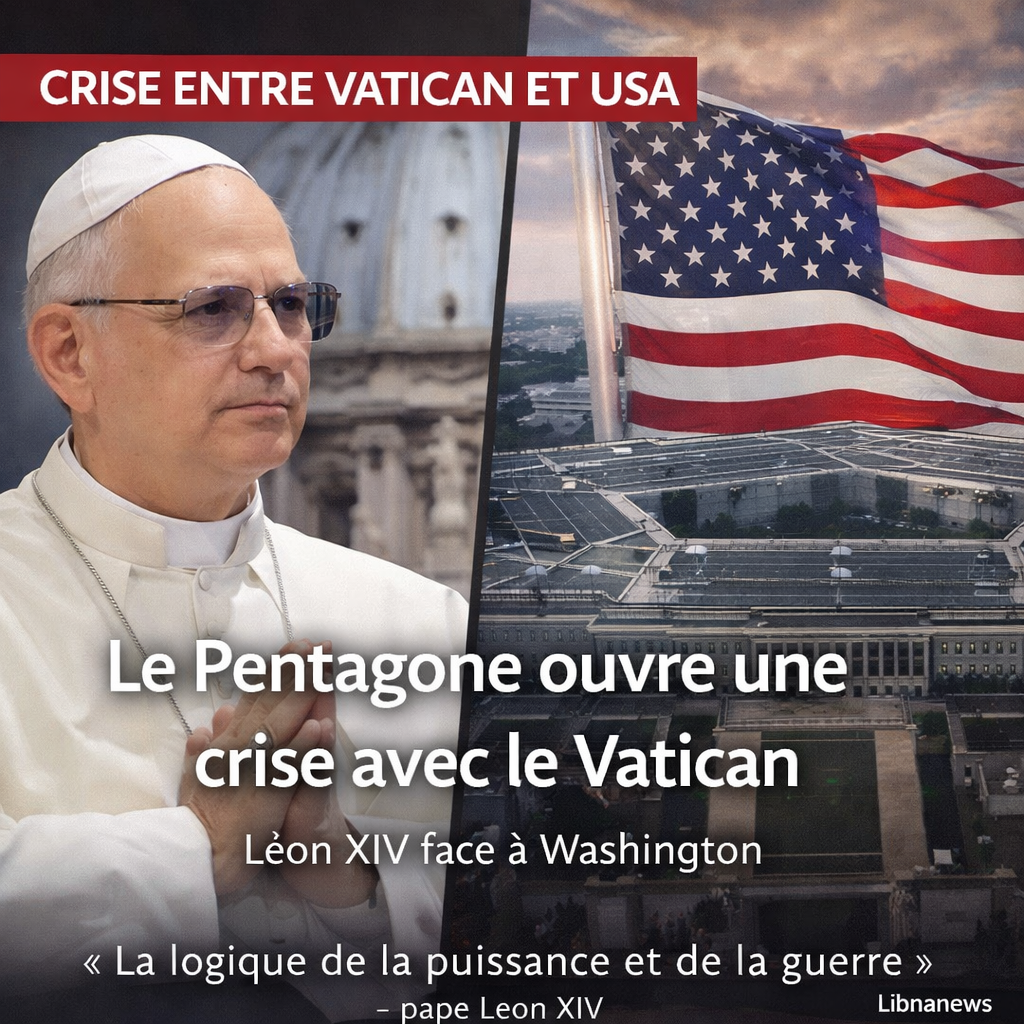
A new tension between the Vatican and the Trump administration. According to a story first published byThe Free PressCardinal Christophe Pierre, the representative of the Holy See in the United States, was reportedly summoned to the Pentagon after a speech by Pope Leo XIV denouncing the logic of war and the diplomacy of force. At this meeting, the Undersecretary for Pentagon Policy, Elbridge Colby, reportedly urged the Church to align with Washington’s strategic priorities, going so far as to refer to Avignon’s papacy. The Pentagon rejects all intimidation and speaks of a « respectable and reasonable » exchange. JD Vance said he wanted to check the facts before deciding. At this stage, several elements of the narrative circulate widely, but the entire scene described has not been independently and fully confirmed by official public sources.
The controversy is all the more sensitive as it affects a fracture line already installed between Leo XIV and the American power. Since the beginning of his pontificate, the pope has multiplied calls for diplomacy, the protection of international law and military restraint. In his speech of 9 January 2026 before the diplomatic corps accredited to the Holy See, he warned that diplomacy based on dialogue and the search for consensus was replaced by « the logic of power and war ». Vatican News presented this speech as a warning against a « zealous war » that is gaining ground in the international system.
It is this speech, according to the stories circulating today, that would have provoked the anger of a part of the American security apparatus. Several media reports that Pentagon officials have read this speech as an implicit but direct criticism of Washington’s military course. The strongest accusations come from secondary accounts based on themselvesThe Free Pressand unnamed sources. They cannot therefore be presented as facts to the same degree as an official declaration. On the other hand, what is verified is the existence of a wider public conflict between the pope and the Trump administration over war, the place of force in international relations and American rhetoric vis-à-vis Iran.
What the story about the Pentagon says
The heart of the case rests on a version of the facts first attributed toThe Free Press, then taken over by other titles. According to this account, Cardinal Christophe Pierre was summoned to the Pentagon for an in camera interview with Elbridge Colby, Undersecretary of Politics. During that meeting, it would have been very harshly explained to him that the United States had the military power to impose its line and that the Catholic Church had to take it into account. Several media coverages of this version also mention a reference to the papacy of Avignon, a historical episode often associated with a Church placed under strong political influence.
We need to be specific here. At present, this passage has not been confirmed by an official transcript, either by a communiqué from the Holy See, or by a detailed American public record. They are therefore allegations relayed by the media from indirect and anonymous sources. Several articles present them as credible or serious, but this does not replace independent confirmation. This is an essential point for rigorous journalistic treatment. The fact that a narrative circulates widely is not enough to turn it into an established truth.
On the other hand, the American denial is well documented. A Pentagon spokesman described the meeting as « respectful and meaningful discussion, » a « respectable and reasonable » discussion, rejecting the idea that there was a threat or intimidation. The Department of Defence also stated that it maintained « the highest respect » for the Holy See and wished for further dialogue. This line has been included in several reviews of the controversy.
JD Vance took a more cautious position. When asked about this case, the Vice-President said he wanted to talk to Cardinal Christophe Pierre and the American officials concerned to understand « what really happened ». He added that it was not appropriate to comment on « unconfirmed and unsubstantiated » stories. Again, the formula is important: it does not validate the accusations, but it does not sweep them away either. It shows above all that the case has reached a sufficient level of visibility to require the Vice-President to react publicly.
The speech of 9 January, starting point of the rupture
In order to understand why this case has grown so large, we must go back to the speech of 9 January. On that day, in front of the diplomats accredited to the Holy See, Leo XIV delivered one of his most clear positions on the international situation. Vatican News sums up its remarks around a central observation: rights, freedoms and international balance are threatened when diplomacy of dialogue gives way to the logic of force. The Pope denounces a world order increasingly dominated by military power and a form of habituation in war.
This text did not refer only to the United States. It was a general address to the diplomatic corps. But his vocabulary, his date and his context fed the idea in Washington that he also aimed at American posture. Several commentators then linked this speech to the growing tensions between Leo XIV and the Trump administration, notably on Iran, immigration and how to conceive Western power. The three American cardinals Blase Cupich, Robert McElroy and Joseph Tobin published a rare statement on 19 January on American foreign policy, covering several themes of papal speech and calling for a stricter respect for human dignity and law.
Since then, the pope has made public his criticisms of certain specific episodes. The Associated Press reported that it had described Donald Trump’s threat as « truly unacceptable » to « destroy Iranian civilization », judging this rhetoric contrary to international law and morally unacceptable. So this is not just a difference of style. It is a fundamental opposition on the language of war, the legitimacy of force and the moral framework of international action.
Christophe Pierre, a diplomatic figure in the centre of the case
The choice of Cardinal Christophe Pierre, if it is confirmed that he was indeed received at the Pentagon in this context, would be heavy of meaning. As a Vatican representative in the United States, he is not just a prelate. It is one of the most important diplomatic channels between Washington and the Holy See. That such an interlocutor be summoned after a critical papal speech would, in itself, be a strong political signal, even if the exact content of the interview remained contested.
In the stories that circulate, the meeting is presented as an attempt to pressure Vatican diplomacy. The American officials dispute this reading. It is precisely this gap that makes the case so explosive: on the one hand, an accusation of ideological pacing the Church; on the other, an American version that speaks of a simple frank but normal exchange between institutional interlocutors. At this stage, without public minutes or detailed confirmation of the Vatican, serious journalism must reveal this contradiction instead of artificially deciding.
This does not prevent us from seeing the symbolic gravity of the accusation. The supposed reference to the papacy of Avignon is not a neutral image. It refers to one of the most sensitive periods in the history of the Church, often interpreted as the excessive dependence of spiritual power on temporal power. To use such a comparison in an exchange with a Vatican representative, if it did well, would be to mobilise a historical symbol of political subordination. This explains precisely the reaction force that has been generated by history.
The White House, the Vatican refusal and the symbol of Lampedusa
The other part of the crisis concerns the pope’s agenda. It is well established that an invitation to visit the United States was transmitted to him in May 2025 during a meeting between JD Vance and Leo XIV. The vice-president had then reported to the pope an invitation from Donald Trump and the First Lady to visit the United States.
What is much less well documented, however, is the direct link between this invitation, the alleged meeting of the Pentagon and a possible refusal. Media reported that the Vatican had declined an invitation from the White House for the 250th anniversary of the United States. However, in accessible sources, this is mainly based on secondary reports and unappointed officials. In parallel, theWashington PostAs early as February, according to Vatican spokesman Matteo Bruni, Leo XIV did not go to the United States in 2026 and sought to position himself as a global pope, not centered on his country of origin. This more institutional explanation therefore also exists.
On the other hand, the trip to Lampedusa on 4 July 2026 was official. Vatican News announced in February that the pope would visit the island on July 4 as part of his pastoral trips to Italy. The Vatican calendar also confirms this visit. The symbol is strong: instead of an American celebration, Leo XIV will be on an island-world associated with migration, the dramas of the Mediterranean and the memory of Francis’ pontificate. But we must be careful about the absolute political interpretation of this choice. Travel is official; The idea that it was conceived as a direct response to Washington remains, it, more interpretive.
A crisis that goes beyond mere protocol dispute
Even by setting aside the unconfirmed elements, the tension is real. It is not just about a disputed meeting. It is due to an increasingly visible incompatibility between two world views. On the one hand, an American administration that assumes a hard strategic reading, centred on power, power relations and the demonstration of superiority. On the other hand, a pope who repeats that war does not solve crises, that force cannot replace law and that civilians always pay the price of military adventures.
The friction is all the deeper since Leo XIV was the first pope born in the United States. Washington could hope for a privileged bond. The beginning of his pontificate tells the opposite: caution on an American visit, criticism of Iran, insistence on diplomacy, and apparent refusal to enrol in a patriotic or geopolitical American liturgy. The contrast is political, moral and even symbolic. He explains why a meeting at the Pentagon, if it really took the tone described by some media, could be seen in the Vatican as a turning point. The latter sentence is an analysis of publicly established facts and contradictory accounts of the meeting.
It should also be noted that the US authorities have not chosen the frontal counterattack. The Pentagon denied, but in a relatively measured language. JD Vance’s timed. This suggests awareness of the flammable nature of the subject. Touching the Vatican, or giving the impression of having wanted to intimidate pontifical diplomacy, is politically risky in a country where Catholicism remains a major religious and cultural force.




