

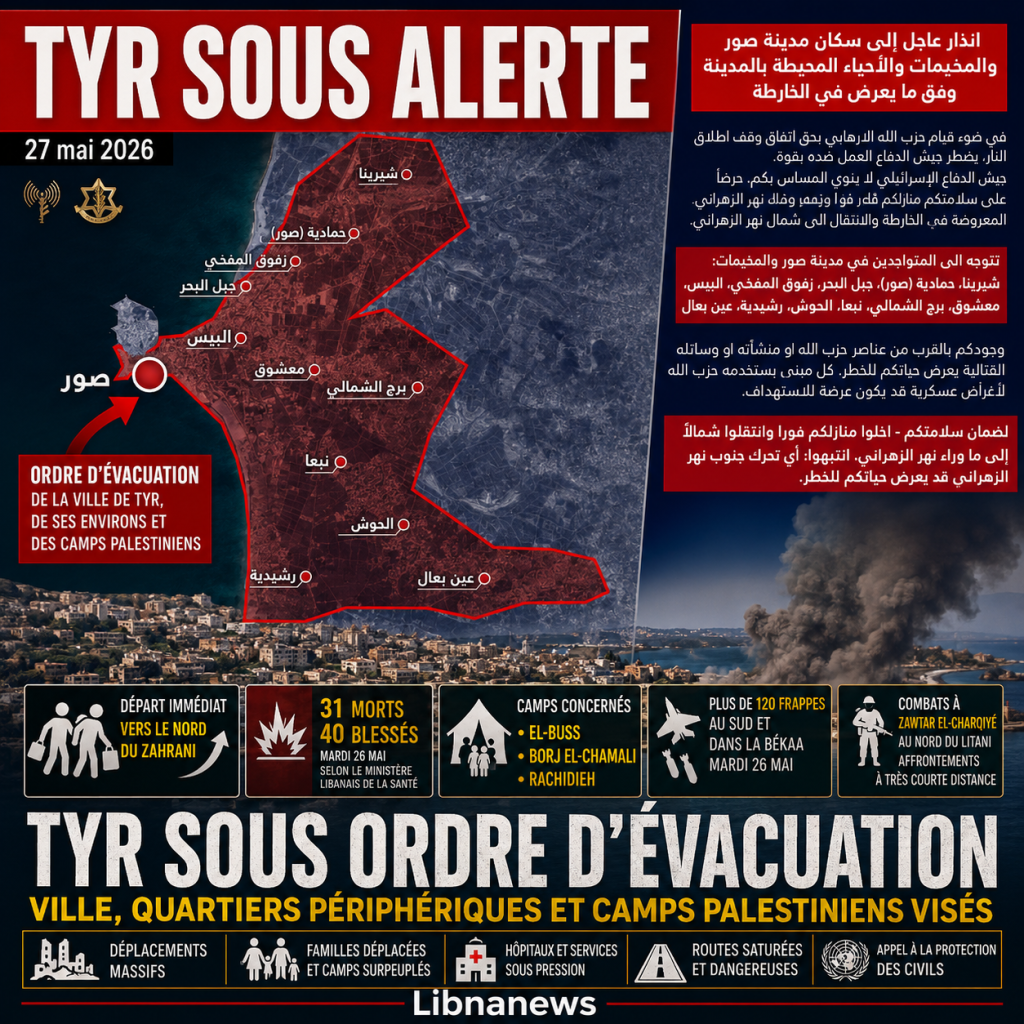
The Israeli army ordered on Wednesday the evacuation of Tyre, its suburbs and neighbouring Palestinian camps, in a further tightening of the war in South Lebanon. The message broadcast in Arabic by the Israeli military spokesman asks the inhabitants to leave the areas indicated on a map and to head north of the Zahrani River. The coastal city, already weakened by months of bombing and the arrival of displaced persons from border villages, is in the centre of a sequence marked by intense raids, ground fighting near the Litani and a sharp increase in human performance.
Tyre, its camps and suburbs under alert
The map published with the warning covers a large part of Tyre and its circumference. It includes urban areas, seafront areas, adjoining localities and Palestinian camps in El Bus, Burj al-Shamali and Rashiyah. The opinion also cites several sectors of the Tyre Caza, including Maashuk, Hoshe, Ain Baal and Burj al-Shamali. In the message, the Israeli army claims to want to strike Hezbollah positions in the area. For the inhabitants, the reservation means above all an immediate departure, without guarantee of shelter, transport or sufficient time.
The city of Tyre is not only a southern agglomeration. It remains an administrative, commercial and hospital centre for much of the coastline. It welcomes displaced families from villages close to the border and areas already emptied by the strikes. The evacuation order therefore weighs on a population that has often already left a first home. Several families find themselves facing the same choice: going to Saida, Beirut or villages further north, or staying with elderly relatives, shops, housing and property that they do not want to abandon.
The scope of the warning is also measured by the presence of Palestinian camps. El-Buss, Bourj el-Chamali and Rachidieh are home to populations already facing precariousness, urban density and limited services. Evacuation is more difficult than in better served neighbourhoods. Close alleyways, lack of vehicles, poverty and the presence of older people make departures difficult. Families must also check the papers, collect medicines and find a place to stay. Local organizations and relief services have reduced margins.
The Israeli order mentions a displacement north of the Zahrani. This instruction moves the supposed safety zone far beyond Tyre. It creates immediate pressure on the roads linking the southern coast to Saida and then Beirut. Available cars, taxis and buses become essential. Service stations, pharmacies and hospitals are also being sought out. In several villages, residents consult maps, telephones and voice messages to determine whether their neighbourhood is affected. The information circulates quickly, but it often arrives without local confirmation.
Lebanon’s growing record
The Lebanese Ministry of Health announced that at least 31 people had been killed and 40 injured on Tuesday in Israeli strikes in the south and east of the country. This includes civilian victims, including women and children, according to information provided by the media and agencies. Bourj al-Shamali, on the outskirts of Tyre, is one of the most heavily affected sectors. According to the National Information Agency, at least 10 people were killed in a strike, while 14 victims were reported in the same area.
Tuesday’s strikes also hit Kouthariyet al-Riz, Habbush, Maaraké, Selaa, Machghara and areas close to the Qaraoun Dam. The raids were numerous and close. Foreign media reported over 120 Israeli strikes in one day. The Israeli army claimed to have targeted Hezbollah sites, depots, command posts and observation points. The Lebanese authorities, on the other hand, highlight the human situation, the houses destroyed, the roads cut off and the damage inflicted on areas inhabited or close to civilian infrastructure.
Since the resumption of the offensive on 2 March, the cumulative balance reported by the Lebanese authorities has exceeded 3,200 deaths and 9,700 injuries. The numbers are changing as hospitals transmit their data and rescues remove bodies from rubble. The number of internally displaced persons exceeds one million according to estimates from the international press. These trips are concentrated in schools, family housing, emergency rented apartments and public buildings. Pressure is increasing on municipalities hosting families without regular resources.
In Tyre, health facilities remain at the heart of concern. The city had already seen buildings near a hospital damaged in previous strikes. Caregivers must now prepare for the possible arrival of new injuries while taking into account the departure of part of the population. Ambulances must travel on roads where residents seek to flee. Lebanese relief workers, the Red Cross, civil defence and local teams must deal with the risk of secondary strikes, roadblocks and the difficulty of entering certain areas after a bombardment.
The Finul remains a central player in the security system in the South, although its ability to act remains limited by the intensity of the fighting. The UN force monitors the Blue Line, transmits information and regularly calls on the parties to comply with the commitments made. In the field, its patrols cannot substitute for relief or prevent shelling alone. For the inhabitants, however, the international presence retains a witness value. It allows for documenting incidents, alerting diplomatic channels and maintaining a minimum of communication in areas where the state sometimes struggles to access quickly.
Southern municipalities are working urgently. They identify displaced families, assess damage, coordinate ambulances and seek accommodation. Many lack fuel, generators, medical equipment and funds. Mayors must respond to residents who ask whether a road is safe or whether a strike has hit a specific neighbourhood. In empty villages, local services often work with small teams. The management of bodies, wounded and missing persons becomes more difficult when the raids follow one another.
The Lebanese Ministry of Health is centralizing the assessments, but it depends on hospitals, civil defence and relief teams to consolidate the figures. The first numbers broadcast after a strike can therefore evolve. Injured persons succumb to injuries, bodies are found under the rubble and some areas remain inaccessible for several hours. This method explains the differences between the provisional balance sheets and the subsequently published data. Health authorities also stress the pressure placed on hospitals in the South, where stocks of blood, medicine and fuel must be renewed rapidly.
Reported fighting near Litani
Hezbollah announced on Wednesday that its fighters had confronted Israeli forces in Zawtar al-Sharqiyah, a town north of the Litani, in the Nabatiyah district. The movement claimed that the hang-up took place at a very short distance, following an advance by Israeli soldiers in the area. This claim comes one day after Israel announced an extension of its land operations in the South. The Israeli army did not confirm the story of Hezbollah in the same terms, but said it was continuing targeted operations against threats to northern Israel.
Zawtar al-Sharqiyah is located in a sensitive area, not far from the Litani and the heights that dominate several southern axes. The reference to a battle in the north of the river has attracted attention in Lebanon, as the Litani has been a geographical reference in security talks for years. The inhabitants of Nabatiyah District are already aware of the bombings, evacuation notices and destruction. Close villages, such as Arnoun, Yohmor al-Shaqif, Kafr Tebnit and Nabatiyah al-Faukah, have been affected or largely emptied by military operations.
The Israeli army talks about an advanced defence line and a security zone to keep Hezbollah away from the border. In Lebanon, this presence is described as an occupation of southern areas, beyond the Blue Line, with villages rendered inaccessible and houses demolished. The so-called yellow line, drawn by Israel to define the area where its troops operate, does not correspond to a border recognized by the Lebanese authorities or the United Nations. Displaced families mainly see no return villages and property destroyed.
Qaraoun, roads and exposed infrastructure
Bombardments also affect the infrastructure on which daily life depends. The vicinity of the Qaraoun dam was hit this week, which led the Litani National Office to request diplomatic action to protect the building and its facilities. The dam represents the country’s main water reservoir and contributes to irrigation, hydraulic management and hydropower production. The Litani alert does not indicate a break in the structure, but it highlights the danger that direct or indirect targeting would pose to downstream localities.
The death of a Lebanese soldier near Qaraoun added a sensitive element to the file. The Lebanese Army announced that one of its soldiers had been killed in an Israeli strike in the east of the country. Field information also mentioned difficulties for relief in the same sector. The Lebanese military institution finds itself in an exposed position. It must maintain its posts, assist civilians, coordinate access and maintain internal order, while its own soldiers may be affected by the bombings.
The Lebanese government is calling for an end to the attacks and Israeli withdrawal from the occupied areas in the South. State officials are seeking to mobilize open diplomatic channels with the United States, the United Nations and the countries involved in mediation. The discussions announced in Washington should focus on the ceasefire, Israeli withdrawal, border security and the future of Hezbollah weapons. Beirut addresses these discussions with degraded military terrain, affected infrastructure and an displaced population awaiting concrete guarantees.
The truce taken in climbing
The truce announced in mid-April seems increasingly fragile. Israeli strikes continue almost every day, while Hezbollah claims attacks against Israeli forces and positions north of Israel. Israel accuses the party of violating the agreement by firing and drones. Hezbollah accuses Israel of maintaining troops in Lebanon and striking civilian areas. Between these two speeches, the Lebanese State tries to assert the protection of civilians, the sovereignty of the territory and respect for the ceasefire mechanisms.
The regional context further complicates the Lebanese scene. Discussions between Washington and Tehran are continuing on a wider Middle East arrangement. Iran wants the Lebanese front to be included in any regional de-escalation. Israel, on the other hand, claims to want to retain its freedom of action against Hezbollah. This superposition places Lebanon in a narrow position. Decisions that determine the pace of strikes often go beyond its institutions, while the consequences are measured in its cities, camps, villages and hospitals.
In Tyre, people mainly follow practical information. Families want to know which neighbourhoods are affected, which roads remain open, where to find fuel, which hospitals are functioning and where to spend the night. Schools and public buildings further north can become reception points. Families with relatives in Saida, Shuf, Beirut or Kesrouan are trying to organize themselves. Those who do not have a family network are more dependent on municipalities, associations and the few places still available in accommodation centres.
The traders in Tyre close their curtains in uncertainty. Fishermen hesitate to go out. Taxi drivers answer serial calls. The pharmacies prepare bags of medicines for clients who are in a hurry to leave. In the camps, families gather some clothes, identity papers, telephones and chargers. Departures often take place without a return schedule. The evacuation order does not say when the inhabitants can return. It also does not specify which buildings will be targeted or how long the threat will last.
South Lebanon now lives at the pace of evacuation maps and health records. Tyre concentrates the day’s attention, but the bombings of Nabatiyah, Western Bekaa and around Qaraoun show that the pressure is not limited to the coast. The reported fighting in Zawtar al-Sharqiyah indicates that the land front remains active near the Litani River. The next few hours will depend on announced strikes, troop movements, Hezbollah responses and the ability of relief agencies to reach the affected areas. The next review of the Lebanese Ministry of Health is expected in this context.




