

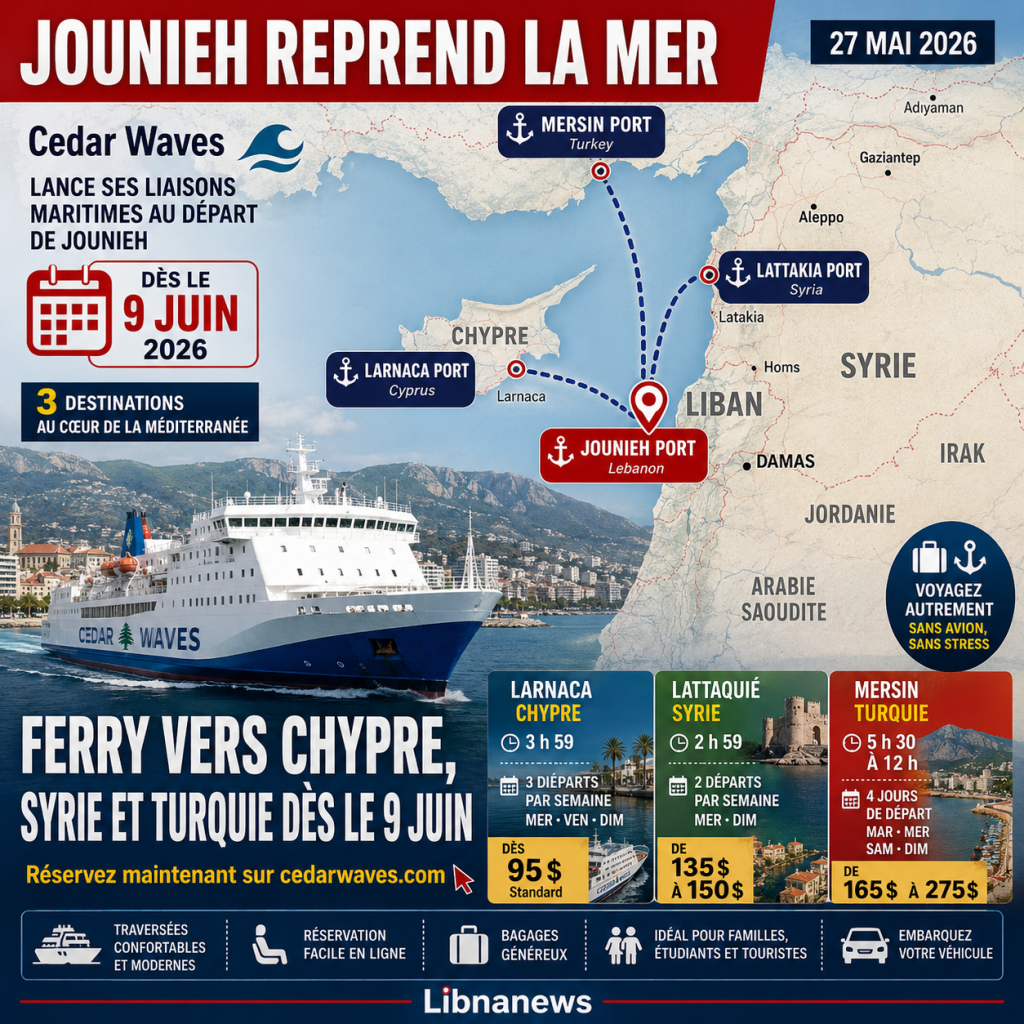
Promised last year, expected all summer, then delayed, the ferry from Jounieh returns this time with schedules, rates and a date. Cedar Waves announced the launch of its maritime links from the port of Jounieh from 9 June 2026. The flagship destination remains Larnaca, in Cyprus, with three announced weekly crossings. But the offer no longer stops at the neighbouring island. The network published by the operator adds Latakia, in Syria, and Mersin, in Turkey, with durations ranging from 2:59 a.m. to almost 12 hours depending on journeys and stops. For Jounieh, this is more than just a new summer service. It is the return of a maritime role long put in brackets.
The ferry Jounieh-Larnaca finally leaves the dock
The news has a sweet revenge scent. For years, Lebanon has been talking about reviving a real passenger link to Cyprus. Many saw it as a nice idea, but always pushed back the next day. This time, the reservation is open and the first prices circulate. The standard ticket to Larnaca is announced at $95 per person. The Plus and Lounge categories are $155 and $175 respectively. For a voyage announced in 3:59 a.m., the vessel will not fly the aircraft on the chronometer. He plays another card: less stress, a direct arrival at the port, a view of the Mediterranean and this small, very Lebanese pleasure of turning a trip into an exit.
The calendar is simple for Cyprus. Departures from Jounieh to Larnaca are scheduled for Wednesday and Sunday at 9 a.m. and Friday at 10 a.m. Arrivals are announced at 12:59 p.m. on Wednesday and Sunday, and at 1:59 p.m. on Friday. Schedules are given in Beirut time. This gives three weekly crossings in the direction Lebanon-Cyprus. For families, students, tourists and Lebanese who want to blow a few days in Larnaca, Ayia Napa, Limassol or Paphos, the format almost looks like a ready-to-use weekend. Departure Friday morning, return to organize according to available places, and the sea between the two.
Three destinations from Jounieh
Cedar Waves also has two other axes. The Jounieh-Lattaquié route is announced in 2h59. Prices published for Syria range from $135 to $150 depending on the dates. Crossings to Latakia are indicated on Wednesday and Sunday. The connection to Mersin in Turkey is longer. The shortest time announced is 5:30 a.m., while some trips may approach 12 hours when they include a stopover in Latakia. Rates to Mersin range from $165 to $275. The days indicated for this destination are Tuesday, Wednesday, Saturday and Sunday. The set draws a small maritime map of the eastern Mediterranean, with Jounieh as the starting point.
In total, the published offer shows nine weekly slots per destination combined: three for Larnaca, two for Lattaquié and four for Mersin. This figure must be read as a commercial launch grid, likely to evolve according to season, demand, weather and port formalities. Nevertheless, it remains significant. Jounieh is not content with a symbolic boat a week. The port is offered a regular activity, with several days of departure and a range of prices large enough to reach different profiles. The passenger in a hurry will keep the plane. The flexible traveller can look at the sea.
A long sleepy port
The return of Jounieh to the maritime landscape is not insignificant. The port had officially reopened after many years of operational sleep. It had been presented as ready to accommodate passenger ships, after work and efforts to return it to the circuit. For a long time, it was no longer really functional for regular international activity. It existed, of course. The locals knew him. Boaters too. But he no longer played the role of a front door or exit door, which the city had experienced in more difficult periods of Lebanese history.
Because Jounieh has a very special maritime memory. During the civil war, when land roads became impossible and Beirut airport was sometimes inaccessible, the port served as a vital alternative. Ferries connected the Lebanese coastline to Cyprus. Families, travellers, expatriates, students and injured people have taken to sea from this area when the country closed by road and air. The affair with Larnaca was therefore nothing of a fantasy invented for the holidays. It reactivates a concrete memory, that of a Lebanon that was always looking for a way out, even when heaven and earth were complicated.
This time, the trip wants to be light
The difference this time is the tone of the project. The boat does not present itself as an emergency solution, but as a transport and tourism offer. The commercial message speaks of getaway, comfort, Mediterranean and travel without airport. The shade counts. In the Lebanese imagination, Cyprus has often been the destination of hasty departure, waiting for visas, transit to other places. Cedar Waves tries to make it a more accessible destination of pleasure. The bet is not just maritime. He’s also psychological. It is about convincing that a departure from Jounieh can rhyme with weekend, not just with crisis.
The rates are in this direction. At $95 in standard category for Larnaca, the call price is below some last minute air offers, especially in high season. The comparison should be cautious. The aircraft connects Beirut to Larnaca in less than an hour’s flight, but additional access to the airport, check-in, check-in, boarding and baggage waiting is required. The ferry takes almost four hours from port to port. It offers a longer time, but sometimes easier to live. Travellers will make their calculations according to their budget, patience, luggage and desire to start the holidays before arrival.
The tariff schedule for Cyprus is based on three levels. The Standard opens access to the trip. The Most targets those who want superior comfort. The Lounge targets passengers who are willing to pay more for a quieter or more enjoyable experience on board. The precise details of the services included must be checked at the time of booking, as offers may evolve. For other destinations, prices are presented in the form of ranges. Latakia is between $135 and $150. Mersin is much higher, between 165 and 275 dollars, due to the distance and possible routes.
Durations to be provided by destination
The table of durations also gives a practical reading. Jounieh-Lattaquié is the shortest route, with less than three hours. Jounieh-Larnaca occupies the middle, at 3:59. Jounieh-Mersin demands more organization. Live, the fastest crossing is announced at 5:30 a.m. With a stopover, the trip becomes almost a small day at sea. It’s no longer just a move. It is a journey to be planned with books, headphones, patience, telephone charger and, for the most sensitive, the usual precautions against sea sickness.
The formalities remain a central point. For Cyprus, Lebanese travellers must check their entry conditions before booking. A ferry ticket does not replace a visa when required. Passengers must also check the validity of their passports, insurance requirements, conditions for minors and any rules specific to the country of destination. The same applies to Syria and Turkey. Prices are eye-catching, but the success of the trip will depend a lot on the documents. The return of the ferry does not remove paperwork. It simply moves it from the air window to the sea window.
A breath for Jounieh
For Jounieh, the tourist issue is obvious. The city already has a well-known bay, a lively seafront, restaurants, hotels, close to Harissa and quick access from Beirut and Kesrouan. A regular connection may add a new clientele, including Cypriot, Syrian or Turkish. It can also encourage short stays in Lebanon, if formalities and security follow. The ferry will not transform the local economy alone. It can, however, give the port a visible function and create a movement around taxis, travel agencies, restaurants, cafes and accommodation.
The project also comes at a time when Lebanese are looking for alternatives. Flight tickets increase rapidly during holidays, school holidays and extended weekends. Beirut airport concentrates most of the country’s international traffic. Any maritime novelty therefore offers a breath. She won’t replace the flights. It will not solve the difficulties of the tourism sector. But she adds an option. In a country where options are often reduced over crises, this simple addition is enough to create curiosity.
The symbolic effect is not secondary. Seeing a boat regularly from Jounieh to Larnaca, Lattaquié or Mersin gives a different picture of the country. Lebanon no longer presents itself only as a destination served by a saturated airport and an economy under pressure. It regains a fleeting maritime presence, even modest. The Mediterranean is once again becoming an ordinary area of traffic. Older generations may see this as a reminder of more difficult travel. The younger ones will mainly see an alternative to the plane, a summer plan, or an opportunity to post a departure video with the bay in the background.
The real test will come after launch
The question of regularity remains. A maritime service must gain the confidence of travellers. It will have to meet its schedules, manage delays, inform clearly in case of adverse weather, respond to requests for reimbursement and stabilize its booking platform. The launch attracts attention. The continuation will depend on execution. Lebanese people are used to ads that ignite and then turn off. To install the line sustainably, Cedar Waves will have to turn the novelty effect into a habit. The real test won’t be the first start. It will come after several weeks of crossings, when passengers will compare promises and real experience.
Tourism professionals will also monitor the benefits. A regular marine connection can allow for combined formulas, with ticket, hotel, insurance and transfer. Several agencies already offer this type of product for Cyprus or Turkey. The difference, with a departure from Jounieh, lies in the experience. You can imagine three-night packages, one-way trips for students, family weekends, or offers for diasporas who want to travel between Lebanon and Cyprus without going through the airport. Success will depend on the final price once taxes, baggage, transfers and insurance are added.
Caution therefore remains useful. The prices announced are starting prices or ranges. They may vary according to the date, the chosen category, the request and the booking conditions. Schedules may also change. Travellers will need to check directly on the company’s site before purchasing. But the essential thing is there: the line announced last year is no longer a vague promise. It enters into the 2026 calendar with a date, destinations, durations and amounts. In Lebanon, often delayed announcements, this is already a successful little crossing.
The launch also has a small urban reach. For years, Jounieh Bay has lived mostly around the promenade, restaurants, private marinas and cable car to Harissa. The return of a regular passenger line changes the scene. The port becomes a place of departure again, with timetables and travelers coming for something other than a coastal ride. This maritime normality, if it stands, could be worth almost as much as commercial novelty.
The launch scheduled for June 9 will mainly put Jounieh to the test. The port will have to absorb checks, boarding, taxis, families arriving too early, late arrivals, too heavy suitcases and selfies on the dock. This agitation may be the best sign. After years when the port seemed to look at the sea without really borrowing, the return of the passengers will give the bay a more concrete movement. The next landmark will be the first Wednesday of departure to Larnaca, with an expected arrival at 12:59 pm and, if the sea remains docile, four hours to rediscover that Cyprus is not so far away.
Practical references
| Destination from Jounieh | Frequency announced | Estimated duration | Price announced |
|---|---|---|---|
| Larnaca, Cyprus | 3 departures per week | 3:59 a.m | $95, $155 or $175 |
| Latakia, Syria | 2 departures per week | 2:59 a.m | $135 to $150 |
| Mersin, Turkey | 4 days of departure indicated | 5:30 a.m. to close to 12 p.m | $165 to $275 |




