

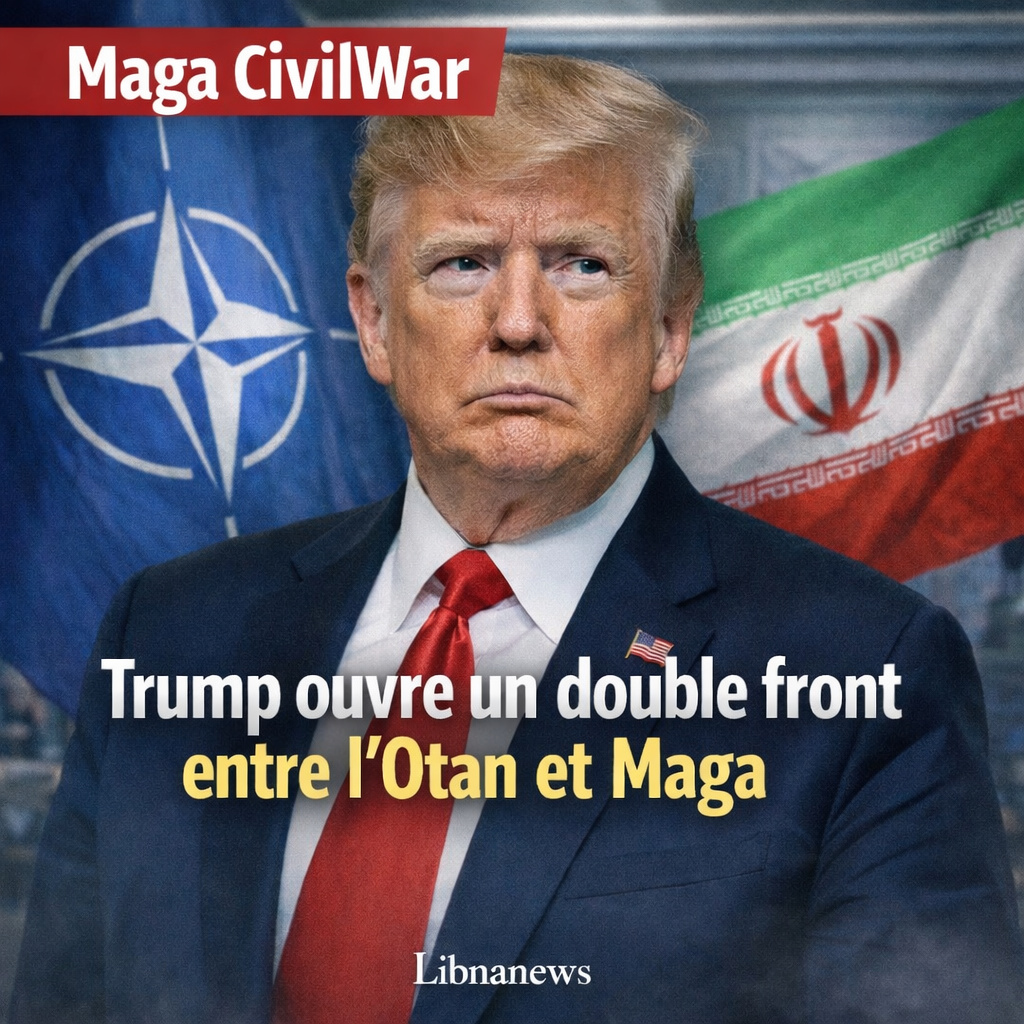
Donald Trump opened a new political front in the aftermath of the Iranian sequence: against NATO, which he considers disappointing, and against a part of the Maga galaxy, which accuses him of flirting with a wider war against Iran before retreating into a confused truce. In a few hours, the American president is caught up with his European allies, accused of not following Washington, then several media figures of the right-wing trumpist, now breaking on the Iranian line. This double offensive says one simple thing: after wanting to appear as the warlord and then as the creator of the ceasefire, Trump is now trying to regain control of a story that escapes him both outside and in his own camp.
The sequence is politically revealing. Internationally, Trump blames NATO for its lack of alignment in the Iranian crisis and again threatens the Atlantic alliance. Internally, he takes on voices that were among the most useful for digital and audiovisual trompism, such as Tucker Carlson, Megyn Kelly, Candace Owens or Alex Jones, all of whom became critical of his management of the Iranian case. The cleavage is deep: for some, Trump was too belligerent; for others, it has retreated too quickly; For him, everyone has betrayed the spirit of « Maga » which he now redefines around a word: win.
This crisis comes as the cease-fire with Iran remains fragile, ambiguous and contested in its real effects, notably because of the continued Israeli strikes in Lebanon and the tensions around the Strait of Ormuz. Reuters sums up the malaise: the White House proclaims a war almost over, but American objectives remain unclear, opinion is sceptical, and the story of a clear victory does not impose either on the international or on the trumpist base. It is precisely in this space of uncertainty that Trump settles his accounts.
NATO, immediate target of trumpian anger
The first target is NATO. The Associated Press reports that Trump hardened the tone against the alliance, which he described as a paper roder, a paper tiger, by accusing the allies of failing to meet his expectations in the war against Iran. According to AP, he even revived his threat of withdrawing the United States from NATO, in a new demonstration of pressure against Europeans. The organization, for its part, did not wish to become directly involved in this conflict, faithful to its nature of defensive alliance. This restraint fueled presidential frustration.
The core of the dispute is the Gulf and the sharing of the military burden. Several press reports indicate that Trump requires concrete commitments to secure the Strait of Ormuz, one of the most sensitive energy corridors in the world. This request, particularly addressed to Secretary-General Mark Rutte, amounts to extending the Atlantic logic towards a crisis which several Europeans regard as first of all an American-Israeli choice. There is the fracture: Washington speaks of strategic solidarity, while several allies speak of prudence, strict defence and refusal to be drawn into a war chosen by others.
This tension is not theoretical. Reuters showed that Spain closed its airspace to conflict-related aircraft and adopted a very critical line towards the war, while other capitals, notably Paris and London, resisted the idea of a direct offensive engagement against Iran. This feeds Trump’s anger, who sees this European prudence both as a lack of loyalty and an embarrassing reminder of his dependence on alliances when he chooses to climb. In other words, the American president wants a useful NATO when he opens a front, but he continues to weaken the alliance as soon as it does not obey.
Mark Rutte appears, in this context, as a bumper more than an arbitrator. AP points out that the Secretary-General is trying to preserve the transatlantic link by keeping Trump alive, even if he takes more and more violent exits. But this calming diplomacy has its limits. The more Trump attacks NATO for its lack of support on Iran, the more it weakens the very credibility of the alliance it claims to want to mobilize. The contradiction is frontal: it requires NATO to serve American power, while publicly degrading the trust on which this power rests.
Iran’s War Breaks Right Maga
The second front is internal, and it may be even more dangerous for Trump. TheWall Street Journalreports that he directly attacked on Truth Social several conservative figures who contested his line on Iran, calling them « losers » and « stupid people ». The names cited are heavy: Tucker Carlson, Megyn Kelly, Candace Owens and Alex Jones. Not all of them play the same role in the Maga universe, but all have a common point: they speak to a populist, nationalist or isolationist right who has long considered that outer adventures betray the promise of America First.
This conflict did not arise from the ceasefire itself, but from the entire Iranian sequence. Trump threatened Iran in extreme terms, going so far as to evoke the destruction of an entire civilization, before falling back on a fragile agreement that its most hawk supporters consider insufficient and that its most anti-war supporters consider dangerous. Wired even talks about a breaking point in the Maga media, with accelerated fragmentation of the pro-Trump ecosystem. Some denounce interventionist drift, others humiliating retreat, others both at once.
The ideological divide is deep. Part of the Maga base accepts an aggressive posture as long as it remains rhetorical, spectacular and focused on intimidation. But as soon as the threat of a long, costly and unreadable war appears, the old mistrust of the war-endless reappears. This is where Trump encounters a real difficulty: he built his ascent by promising to break with the neoconservatives and the disasters of the Middle East, then he found himself talking and acting as if he could reopen one of these fronts without political cost. The influencers’ reaction reveals this strategic contradiction.
The Laura Loomer case illustrates yet another fracture line. TheDaily Beastreports that she denounced the deal with Iran as « awful for America, » while continuing to support Trump personally. This type of position reflects a typically trumpist phenomenon: loyalty to the leader can survive the rejection of his decision. But this does not solve the problem for the White House. When the most loyal figures begin to say that the line followed is bad, the disorder is already installed in the base.
Trump tries to redefine Maga in his own way
In the face of this dissent, Trump is not trying to get the pieces back together. He’s trying to redefine Maga. According toWall Street JournalHe affirmed that the heart of the movement is not the doctrinal rejection of external wars, but the ability to This is a decisive reformulation. It shifts the centre of gravity of the trumpism: less anti-interventionism than brutal efficiency, less strategic prudence than claimed victory.
This slide is not trivial. It allows Trump to attack his criticism on two fronts at the same time. NATO Europeans would be weak allies refusing to share the fight. The anti-war Maga influencers would be naive moralists or opportunists unable to understand the logic of power. In both cases, Trump puts himself at the centre as the only legitimate interpreter of firmness. But this posture has a cost: it brings his speech closer to the one he once claimed to fight, that of an American executive who threatens, strikes, demands alignment, and then treats any reservation as a betrayal. This last sentence is an analysis of its simultaneous attacks against NATO and its critics Maga.
The problem for Trump is that his base is more homogeneous. The media trempism of the years 2024-2025 was based on a coalition of nationalists, anti-establishment populists, isolationists, conservative Christians and cultural hawks. The war against Iran is testing the limits of this coalition. Some people always want more force. Others want a strategic fence on the external fronts. Others finally want to see the threat without the reality of war. Trump is trying to talk to the three groups at once, and that is precisely what makes his position unstable.
A truce that did not close the crisis
The ceasefire with Iran could have offered him an exit. But Reuters points out that it remains surrounded by ambiguity, both on its real conditions and on its sustainability. The persistent tensions in Lebanon, the uncertainties over Ormuz and the absence of clearly achieved US goals prevent Trump from turning this sequence into a simple victory. Internationally, his allies doubt. In his camp, critics persist. In the opinion, rising energy prices and a sense of confusion weigh.
That’s why Trump settles his accounts now. It does not only respond to disagreements. He tries to discipline a story escaping him. By attacking NATO, he seeks to bring to the allies a share of the political cost of the Iranian sequence. By attacking Maga influencers, he tries to prevent ideological dissent from turning into a lasting fracture. But this strategy poses an obvious risk: the more he designates enemies in his own camp and among his allies, the more he shows that he no longer fully controls his political coalition or his strategic environment. This conclusion is based on an analysis based on its public attacks and the context described by Reuters, AP and WSJ.
A double political bill
Basically, the sequence says two things. The first is that Trump continues to regard alliances as transactional instruments, useful as long as they obey, dispensable as soon as they resist. The second is that the Maga sphere is no longer a perfectly disciplined resonance body. It becomes a real challenge to foreign policy, especially when a crisis reactivates the trauma of endless wars.
Trump wanted to appear as the one who knocks hard, folds Iran, forces NATO to follow and imposes silence in his camp. For the time being, he finds himself with a fragile Atlantic alliance, a divided base, influencers in rebellion and a truce that has not erased doubts. It is all irony of the moment: by wanting to show that it remains the only centre of gravity of the American right and the Western camp, it reveals above all the extent of the cracks that now surround its power.




